Bridal party transport and guest transport are two different jobs, and they fail in different ways. The bridal party job is a small vehicle that stays with a handful of people, moves on the photographer’s clock, and needs somewhere legal to stand. The guest job is a capacity problem with fixed departure times and no flexibility at the ceremony end. One vehicle can sometimes cover both. It can only do so when the photo schedule is short and nothing about the guest movements depends on it.
The two jobs, side by side
| Bridal party transport | Guest transport | |
|---|---|---|
| What it is really booking | Time and availability | Seats against a deadline |
| Typical numbers | 4 to 14 people | 30 to 150 people |
| Vehicle end of the fleet | People mover, 13-seat van, small minibus | Midi-coach or full-size coach |
| Who sets the timing | The photographer, in real time | The ceremony seating time, fixed weeks earlier |
| Movements | Continuous, with stops | Two to four scheduled departures |
| Main failure mode | Nowhere legal to stand while waiting | Guests missing a fixed departure |
| Changes on the day | Constantly | Should not change at all |
| Minimum hire that applies | Three hours on minibuses and people movers | Four hours on midi-coaches and full-size coaches |
Read the second-last row again, because it is the whole article. The bridal party vehicle is booked on the assumption that the plan will move. The guest vehicle is booked on the assumption that it will not.
The bridal party job: a vehicle on standby
What the bridal party actually needs is a vehicle that is theirs for a block of hours, with a driver who is happy to sit while a photographer works.
That has three practical consequences.
It is priced on hours, not distance. A bridal party run might cover fifteen kilometres across a whole afternoon. The cost sits in the hours, and the minimum hire is three hours on the people movers and minibuses that suit this job.
Size down, not up. A 7-seat Mercedes V-Class at $125 an hour or a 13-seat Toyota Commuter at $110 an hour will do things a 53-seat coach cannot, starting with fitting into a normal kerb space near a photo location. The published rates run from $110 an hour for a 13-seat Commuter through to $195 an hour for a 53-seat executive coach, and the vehicles and seat counts we run are listed with their minimum hire periods.
Dresses and suits change the seat count. A vehicle rated for seven adults does not comfortably carry seven adults plus a gown, a photographer’s cases and a bag of shoes. Count the people, then count the things, then ask the operator whether that combination fits.
The guest job: capacity against a clock
Guest transport is arithmetic with a deadline attached.
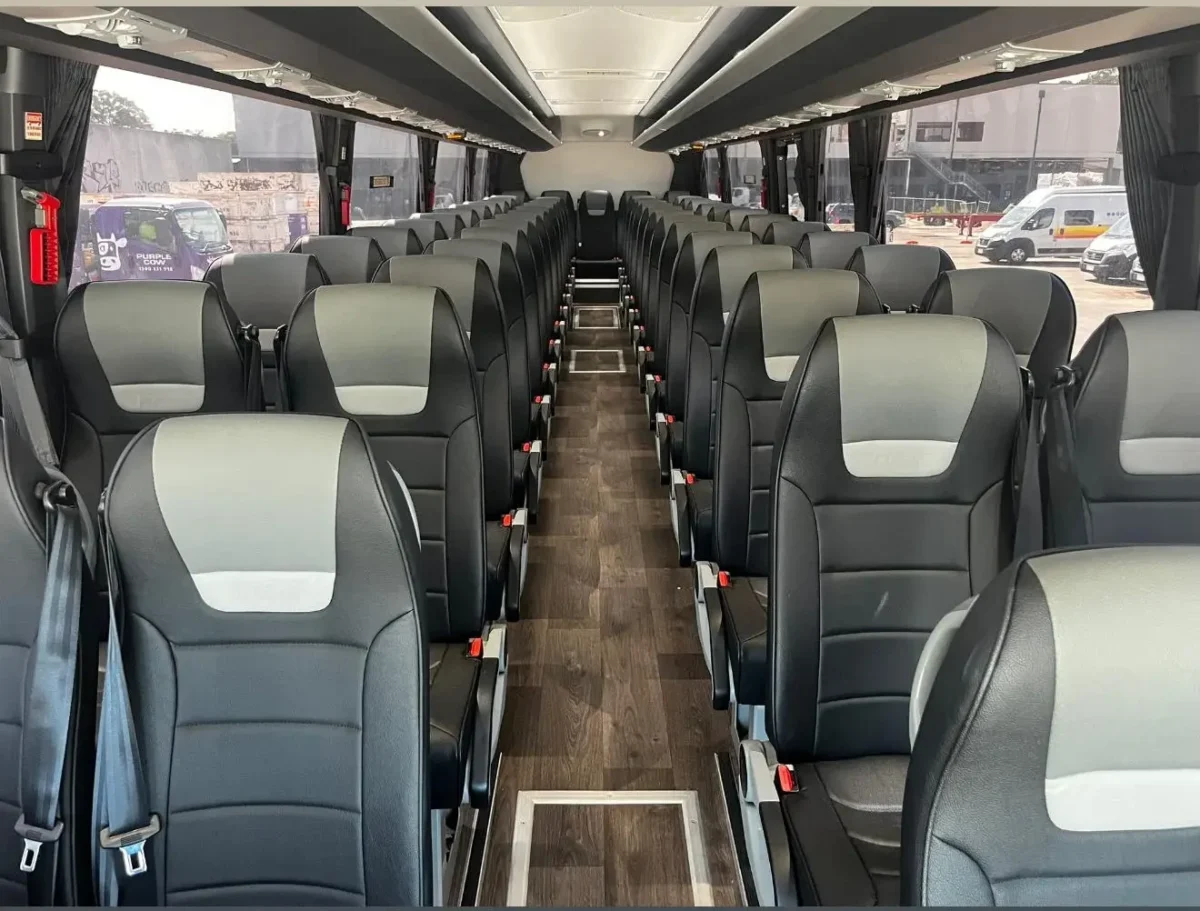
You need enough seats for the people who will actually use the shuttle, arriving before the seating time, with a published departure that guests will treat as an arrival time. Seat counts on the published rate card exclude the driver, which matters when you are within one or two seats of a decision.
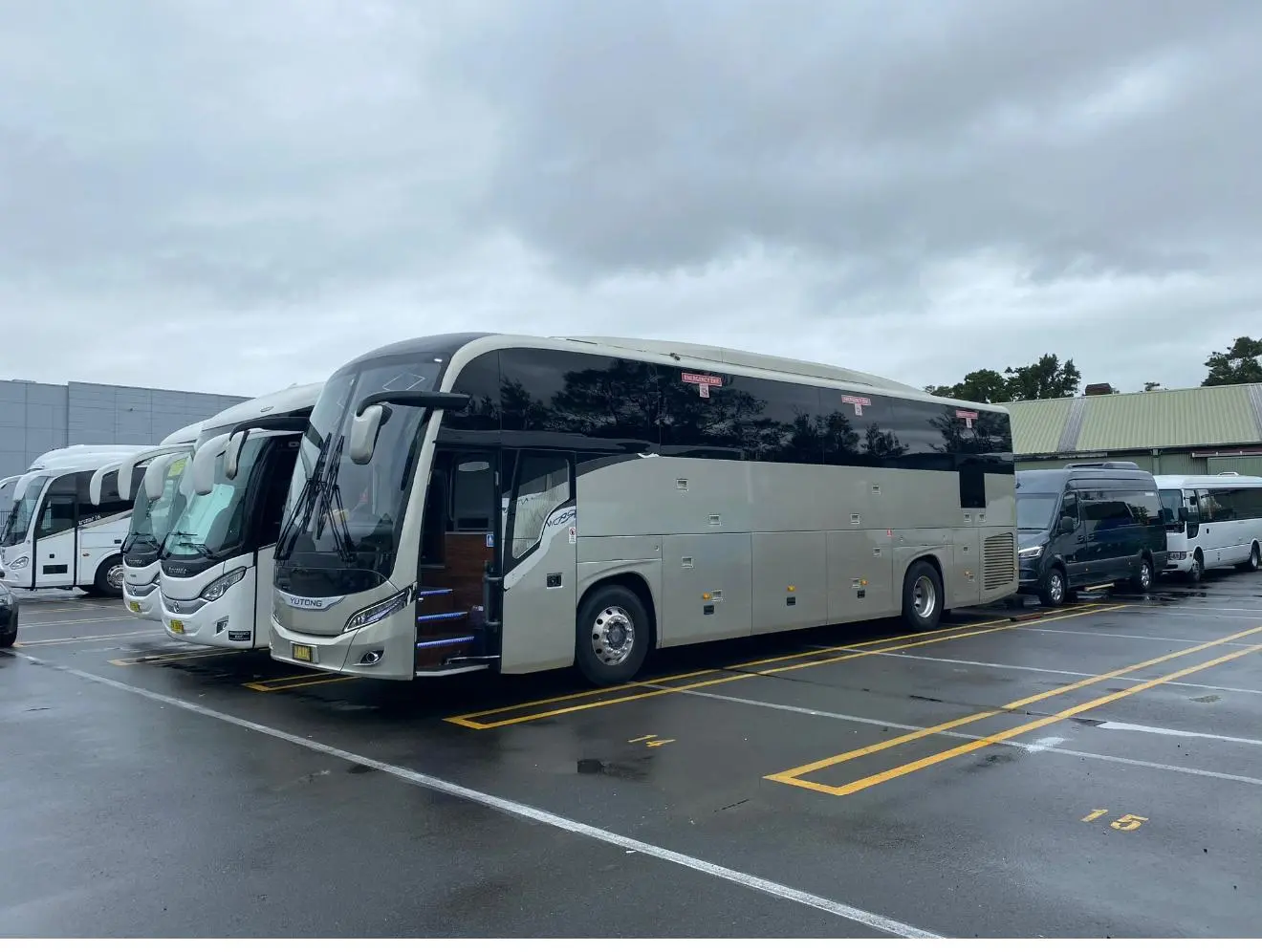
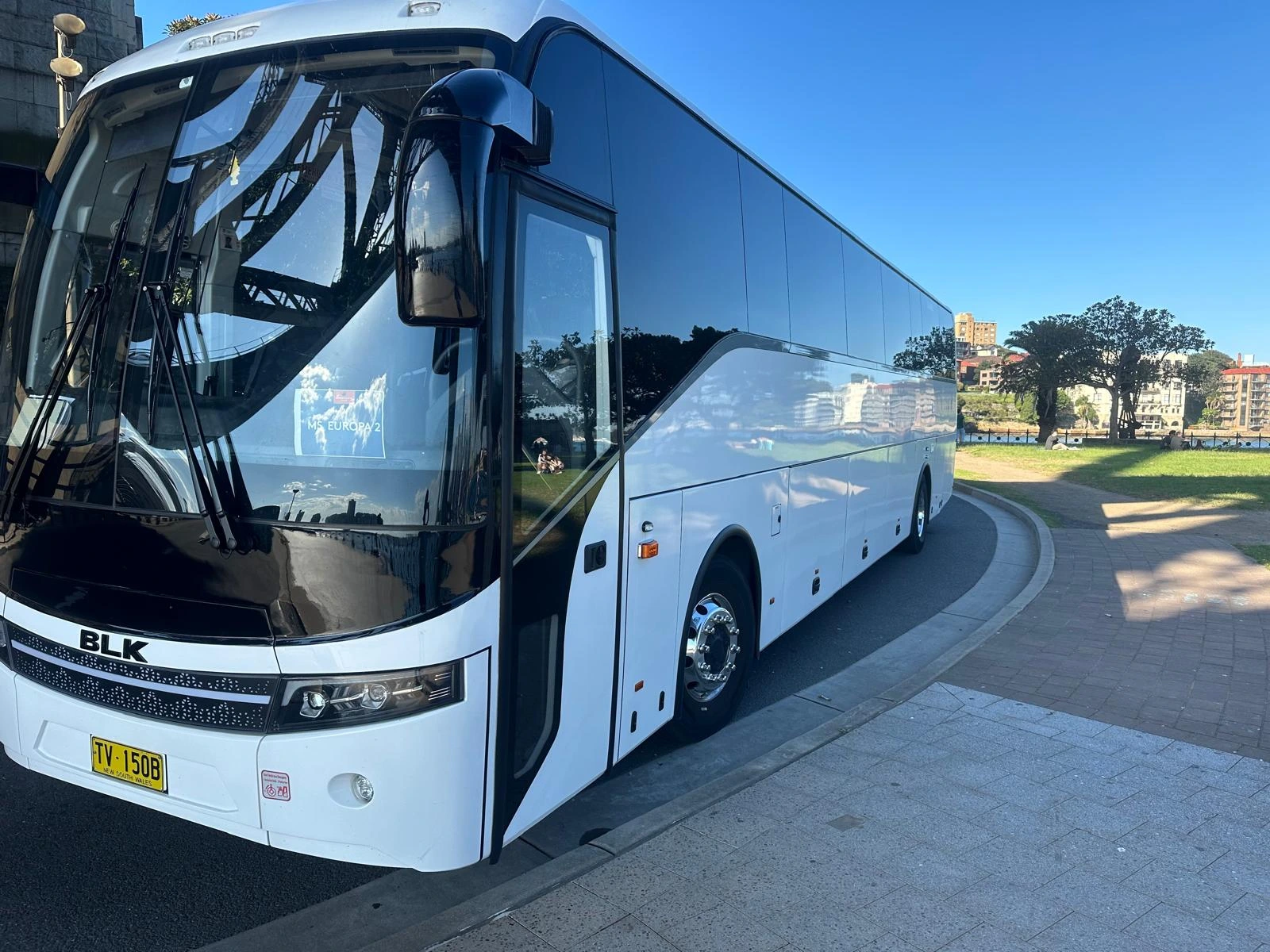
The fleet ladder runs from 7 to 57 seats, and a group of 58 or more is quoted as a coordinated convoy per event rather than off the hourly table. That threshold is worth knowing before you start splitting a guest list, because two vehicles are not simply twice the price of one: two vehicles each carry their own minimum hire.
The other thing that separates the guest job is that it is nearly always more than one movement. Guests to the ceremony, ceremony to reception, an early bus, and a last bus. Each of those is a departure time somebody has to publish, and each of them is a moment where a missing guest becomes a decision.
If you want the two jobs quoted against each other rather than guessed at, wedding bus and coach hire in Sydney is where the vehicle types and rates sit.
Can one vehicle do both jobs? Four tests
Run all four. One failed test is enough to make it two vehicles.
- Is the gap between the ceremony and the reception under about an hour? A single vehicle can absorb a short gap. It cannot absorb a two hour photo session and still make a guest departure.
- Do the guests have a movement that depends on the vehicle returning? If the ceremony-to-reception transfer needs the same bus that is currently at a lookout with the bridal party, the answer is no.
- Can the vehicle stand legally where the photographs happen? See the next section. This is the test that most often fails in Sydney.
- Are the bridal party numbers small enough that the coach is mostly empty, and large enough that a car will not do? If the answer is that the coach runs with six people aboard for three hours, you are paying coach rates for a people mover job.
If all four pass, one vehicle is genuinely the better booking. It is fewer moving parts, one driver to brief, and one set of hours. Do not force it, though. The saving on the second vehicle is small compared with the cost of a delayed ceremony.
Photographs between venues, and the Sydney kerb problem
Sydney couples build photo runs around the same handful of places: Observatory Hill, Barangaroo, Centennial Park and the harbour foreshore among them. We do not publish access or standing arrangements for individual photo locations, and neither, in most cases, do the sites themselves. What is published is the rule that governs the vehicle.
Under the NSW Road Rules, a driver must not stop in a bus zone unless driving a public bus that is dropping off or picking up passengers. The NSW Dictionary defines a public bus to include a coach, which means a charter coach may lawfully set down and pick up in a bus zone. It may not wait there. Set-down and pick-up only, with no layover, and the sign on the zone can exclude a bus in any case.
Add to that the City of Sydney’s position in its Central Sydney On-Street Parking Policy, which states that the City will not accommodate long-stay coach lay-over on-street in central Sydney.
Put those two together and the practical Sydney answer is simple. A photo run that involves waiting is a small vehicle job. A 7 or 13-seat vehicle can use ordinary kerbside parking that a 12.5 metre coach cannot, which is why splitting the bridal party onto its own vehicle solves a legal problem as well as a scheduling one.
Before the day, ask each photo location one question in writing: where can a vehicle of this size legally stand while we are here. The answer determines the vehicle, not the other way around.
A worked comparison
Same wedding, two ways to book it. Sixty guests, a bridal party of eight, a two hour photo gap between ceremony and reception, and a six hour total window.
| Option | Vehicles | Published basis | Hours |
|---|---|---|---|
| One vehicle for everything | One 53-seat executive coach | $195 per hour, 4 hour minimum | 6 |
| Two vehicles, jobs separated | One 53-seat executive coach for guests, one 13-seat Commuter for the bridal party | $195 per hour with a 4 hour minimum, plus $110 per hour with a 3 hour minimum | 6 and 5 |
Option one costs $1,170 for the six hours. Option two costs $1,170 plus $550 for a five hour bridal party booking, which is $1,720. The second option is roughly $550 more, and it buys back the entire two hour photo gap as a scheduling problem you no longer have.
Both figures are worked from the published rate card rather than from any actual booking, and all published rates are GST inclusive. Tolls and parking, public holiday and after-hours loading, and waiting time beyond the booked window are confirmed in advance and priced separately. Driver, fuel, vehicle insurance and GST are already inside the hourly rate.
Whether that $550 is worth spending is a judgement about your photo schedule, not about your budget. If the photographer has asked for two hours, it usually is.
Frequently asked questions
Do we need separate vehicles for the bridal party and the guests?
Not always, but you need to test it rather than assume. The four tests above are the ones that matter, and the one that most often fails in Sydney is whether a full-size coach can stand legally at the photo stops.
What does the bridal party need that guests do not?
Availability. The bridal party vehicle is on standby for the photographer, so it is booked as a block of hours rather than as a set of departures. Guests need seats, a published departure time and a driver who leaves on it.
Can a wedding car and a guest bus be booked together?
The bridal party vehicle and the guest coach can sit on the same enquiry, which is worth doing because the two schedules interlock. Send both jobs at once rather than booking the coach and adding the small vehicle later.
What size vehicle suits a bridal party of ten?
A 13-seat Toyota Commuter at $110 an hour with a three hour minimum, or an 11 to 14 seat Mercedes Sprinter at $145 an hour, depending on how much room the dresses need. Seat counts on the rate card exclude the driver.
Does the coach have to wait during photographs?
Only if you have booked it to. If the guest coach is holding through the photo gap, that time is inside the booked window and priced accordingly. If it is released and returns, that is a different quote shape and a different risk profile.
What happens if photographs run over?
With two vehicles, two people arrive late to the reception. With one vehicle, sixty guests do. That asymmetry is the strongest argument for separating the jobs on any day with a serious photo schedule.
Next step
Send both jobs on the same enquiry: the guest movements with their times, and the bridal party block with the photographer’s schedule attached. You will get a written quote back with each vehicle named and each set of hours priced, normally within two business hours during office hours. Put both jobs on one enquiry or call 02 9469 6600, and if the bridal party is the only piece still undecided, a minibus or people mover for the bridal party is the part of the fleet to look at first.
Sources
- NSW Government, Road Rules 2014 (NSW), rule 183 and Dictionary, https://legislation.nsw.gov.au/view/html/inforce/current/sl-2014-0758. Accessed 7 September 2026.
- City of Sydney, Central Sydney On-Street Parking Policy, https://www.cityofsydney.nsw.gov.au/-/media/corporate/files/publications/policies/central-sydney-street-parking-policy/central-sydney-on-street-parking-policy_0525.pdf. Accessed 7 September 2026.