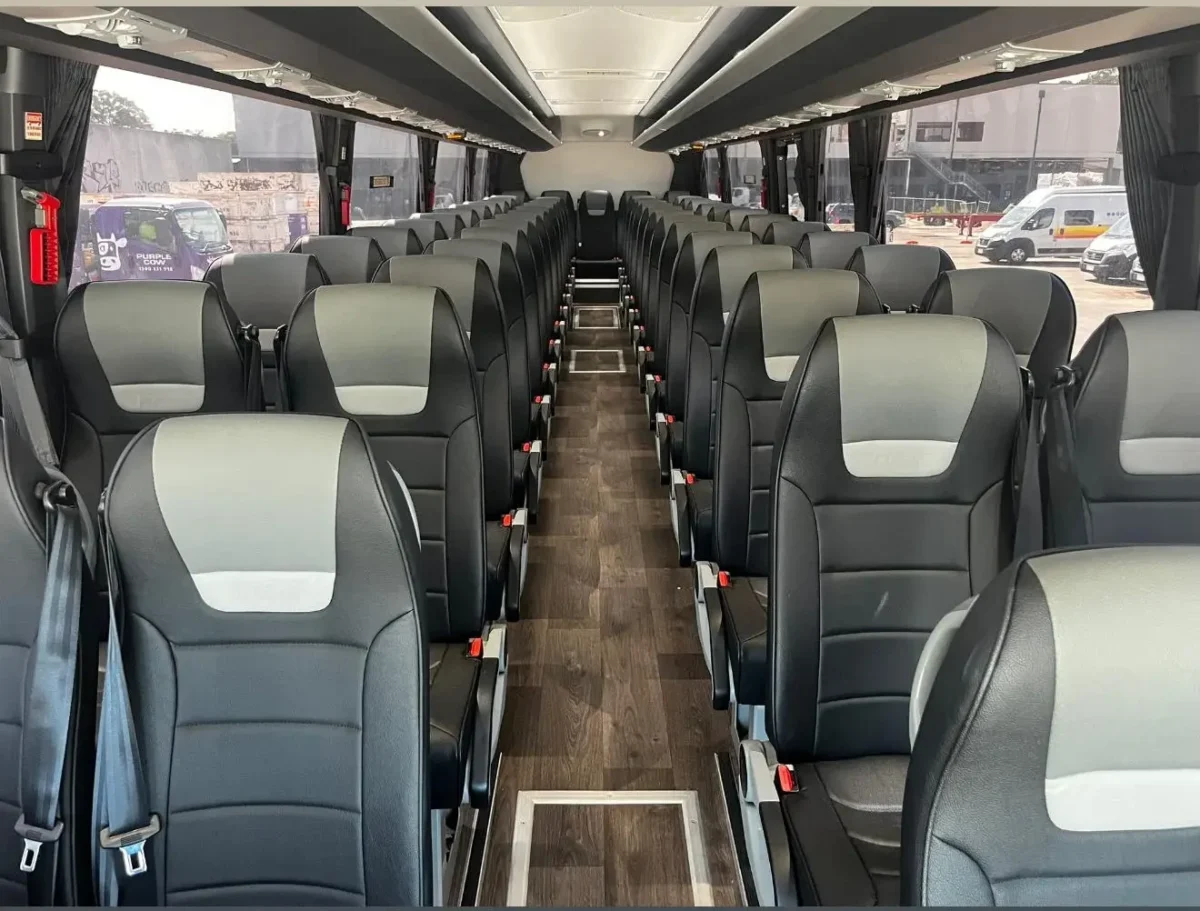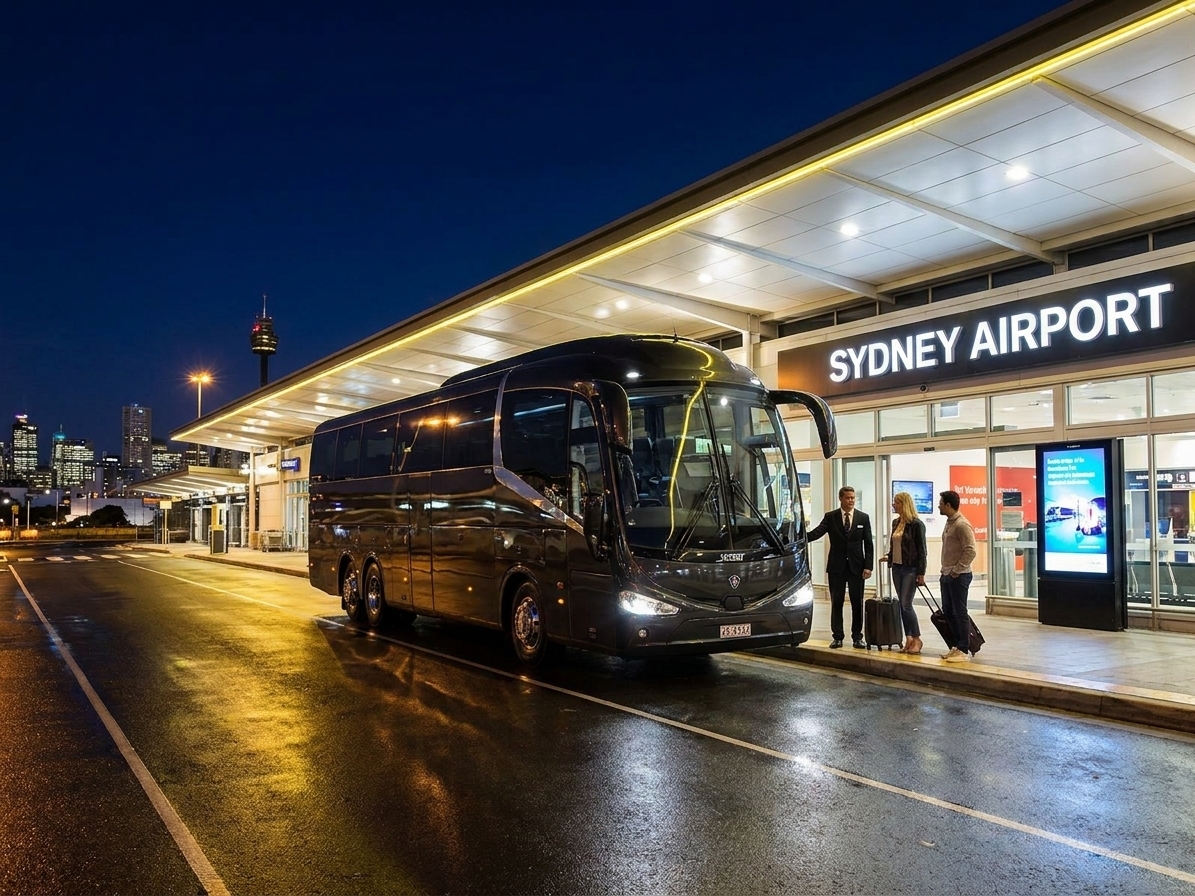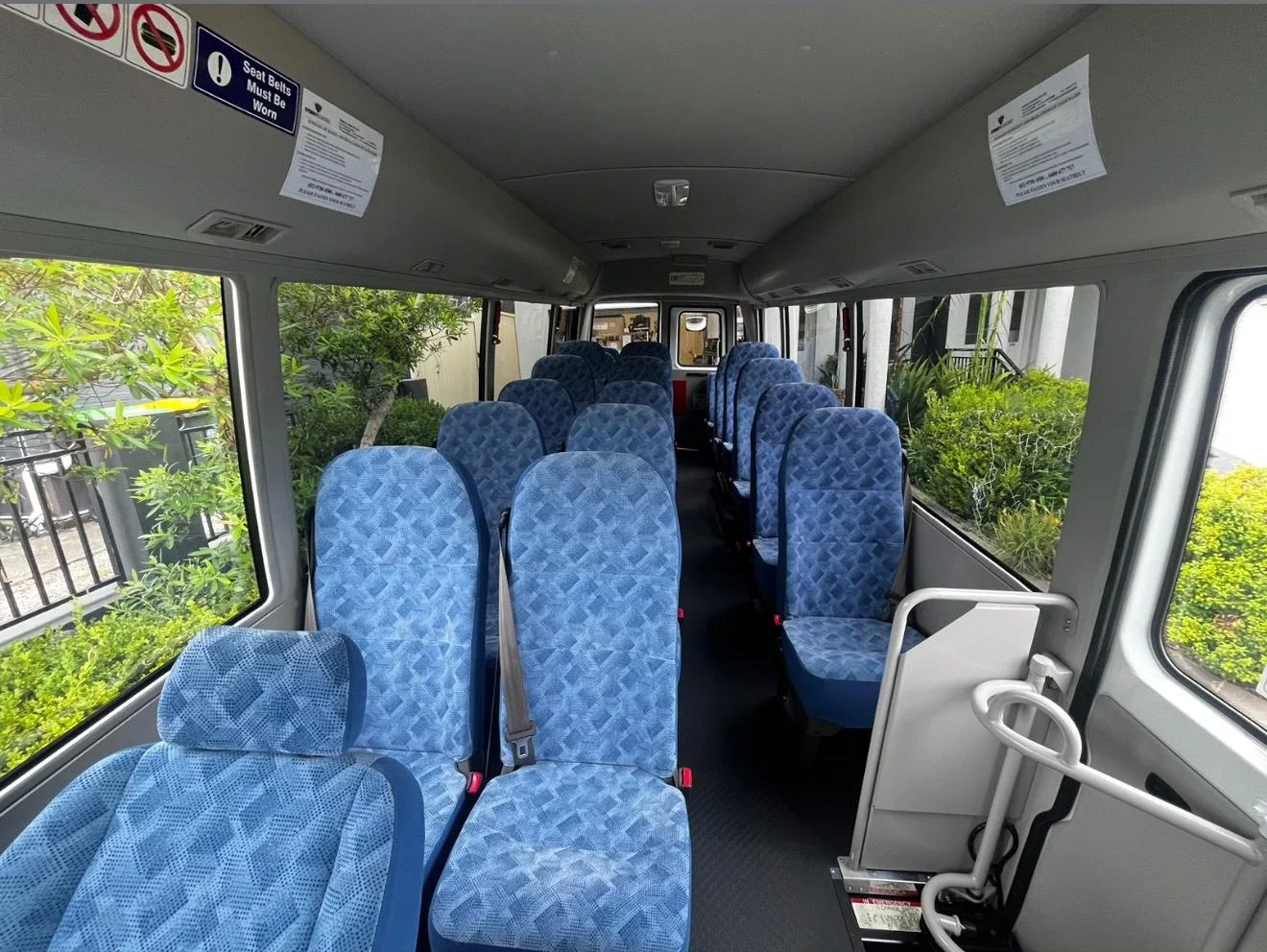
A 53-seat coach is stopped by three things far more often than street width: parked cars narrowing the usable lane, overhanging branches and awnings, and the absence of anywhere to turn around. Height is the number that sorts Sydney vehicles, and a full-size coach exceeds 2.8 metres. When an address will not take one, the answer is a smaller vehicle from the same fleet, or two vehicles, not a cancelled booking.
Width is rarely the real problem
Most people picture the problem as a coach that is too wide for the road. That happens, but it is not the usual failure.
The usual failure is that the street is wide enough on paper and not wide enough in practice. Two rows of parked cars turn a comfortable residential street into a single usable lane. A wheelie bin day narrows it further. A works van parked opposite a driveway removes the one point where a large vehicle could have passed. None of that shows up on a map, and all of it changes week to week.
The second failure is exit. A vehicle can often get in and then have nowhere to go. Cul-de-sacs, dead ends, streets that narrow partway along, and driveways that look generous until you consider reversing a long vehicle out into traffic. A driver will not commit a full-size coach to a street they cannot leave, and that judgement is made on the day, not on the map.
The third is height, and height is the one that has actual published numbers attached to it. It is also the reason an address anywhere across the Sydney suburbs and regions we pick up from is worth raising at enquiry stage rather than on the morning.
Height is the number that sorts vehicles in Sydney
Sydney’s infrastructure is full of height thresholds, and they are the clearest evidence that a full-size coach is a different class of vehicle to a minibus.
- 2.8 metres. Sydney toll roads classify by length and height. Class A is 12.5 m or less in length and 2.8 m or less in height, and a full-size coach exceeds 2.8 m, so it is Class B on every class-based Sydney toll road regardless of length. Dimensions include anything towed or roof-mounted.
- 2.9 metres. The Sydney Airport T2/T3 Priority Pick-up zone has a 2.9 m height restriction, which excludes full-size coaches from it entirely.
- 3.1 metres. Royal Randwick sets down coaches over 3.1 m high on the eastern side of Darley Road, outside TAFE NSW Randwick. Mini buses under 3.1 m use the infield car park.
- 3.4 metres. Rosehill Gardens uses a different threshold: coaches over 3.4 m set down along the western side of Arthur Street, while mini buses under 3.4 m use the Grand Ave P1 bus stop park. The two Australian Turf Club racecourses genuinely do not use the same number.
- 2 metres. The Scenic World car park at Katoomba has a 2 m clearance, which makes it unusable by coaches and by most minibuses.
Add the residential version of the same problem: awnings, carport overhangs, low-hanging branches on an established street, and the entrance to an apartment building’s basement or a shopping centre car park. Domestic and commercial car parks are where a coach most reliably gets caught, because the clearance bar is at the entry and there is no way to reverse the decision once you are in the ramp.
The Sydney addresses that cause the most trouble
Certain address types come up again and again across the six Greater Sydney regions.
Older inner-suburban terrace streets. Narrow carriageways with continuous kerbside parking on both sides and no off-street setback. The road is fine. The remaining lane, on a weekday evening, often is not.
Cul-de-sacs and battleaxe blocks. Common in newer estates and on the northern beaches. Entry is easy, turning is not, and reversing a long vehicle back out is the thing a driver will decline.
Steep or unsealed driveways. Common at private properties in the Blue Mountains and on bushland blocks. A long vehicle grounds where a car does not, and gradient plus a tight entry angle is a firm no.
Apartment and hotel forecourts. Designed for cars and small vans, often with a height bar at the entry and a turning circle that suits neither.
Club grounds, ovals and school gates. Usually fine for a coach, occasionally not, and the difference is often a single gate width or a bollard. Nominate the gate by name when you book.
Anywhere with a school zone on the approach. Not an access problem, a timing one. Most NSW school zones run 40 km/h from 8:00 to 9:30am and 2:30 to 4:00pm on notified school days, and the sign always governs.
What gets sent instead
This is the part that matters, because an address that will not take a 53-seat coach almost never means the trip cannot happen. It means a different vehicle, or a different loading point.
| Vehicle | Seats | Typical use when a coach cannot reach the address |
|---|---|---|
| Mercedes V-Class | 7 | Very tight residential access, or a small group with an awkward driveway |
| Toyota Commuter | 13 | Standard substitute for suburban streets a coach cannot commit to |
| Mercedes Sprinter | 11 to 14 | Similar footprint to a large van, comfortable in most residential streets |
| Executive minibus | 21 to 24 | The workhorse substitution: most of a midi-coach group, in a vehicle that fits ordinary streets |
| Executive midi-coach | 27 | Fits many streets a full-size coach cannot, while keeping the group in one vehicle |
| Luxury coach | 48 | Needs a proper road and a lawful set-down |
| Executive coach | 53 | Needs a proper road and a lawful set-down |
| Luxury touring coach | 50 to 57 | Needs a proper road and a lawful set-down |
| Coordinated convoy | 58+ | Quoted per event |
Seat counts exclude the driver. You can see the whole ladder on the published fleet from 7 to 57 seats, and the most common substitution by far is minibus hire in Sydney, either as a single smaller vehicle or as two vehicles running together.
Three substitution patterns cover almost every difficult address.
- Downsize the vehicle. A 27-seat midi-coach reaches a lot of streets a 53-seat coach will not.
- Split across two smaller vehicles. Often better for the group anyway, because loading two vehicles at once is faster than loading one large one.
- Move the loading point one block. Keep the coach and change the kerb. A nominated corner on a through road, a hundred metres from the house, solves most residential problems and costs nothing.
Option three is the one organisers resist and then prefer. Ninety seconds of walking removes the entire problem.
How to check your address before you enquire
Do this before you send the enquiry and you will get a better quote and a more accurate vehicle.
- Stand outside at the time of day the pick-up will happen. Parking on a Saturday morning is not parking on a Tuesday at 6pm.
- Look up. Branches, awnings, power lines, carport edges. A full-size coach exceeds 2.8 m in height, so anything close to that is a problem.
- Work out the exit. Can a long vehicle continue through, or would it have to reverse? If the answer is reverse, plan for a smaller vehicle or a different kerb.
- Check for a driveway or a corner it must swing across. Tight turns are the constraint people underestimate most.
- Check any car park you were relying on. If there is a height bar at the entry, note the number on it.
- Pick a plan B kerb. The nearest through road with a lawful set-down and no immediate obstruction.
- Tell the operator all of it. Send the address, what you observed and your plan B. This is the single most useful thing a customer can do at enquiry stage.
If the address is anywhere across the Sydney suburbs and regions we pick up from, raise it at quote stage rather than on the day. Vehicle changes made three weeks out are routine. Vehicle changes made at 7am are not.
A note on the vehicle rules behind all this
Two things are commonly misunderstood, and they explain why operators are careful here.
Australian licence classes are set by gross vehicle mass and axle count, not by seat count above 12 adults. There is no seat-based rule that tells you which licence a 27-seat or 53-seat vehicle needs, so the honest check is the compliance plate and the number of axles, paired with the driver’s Bus Driver Authority.
And in NSW, the maximum speed for any vehicle over 4.5 tonnes GVM is 100 km/h regardless of a higher posted limit. A coach is not a large car. It is a heavy vehicle with its own rules, and the street question is only the most visible one.
Frequently asked questions
Can a coach fit down my street?
Often, but the deciding factors are usually parked cars, overhanging branches and whether the vehicle can get out again, rather than the mapped width of the road. Send the address at enquiry stage and describe the street at the time of day the pick-up will happen.
What happens if the coach cannot get to my address?
The trip goes ahead with a different arrangement. Usually a smaller vehicle from the same fleet, two vehicles instead of one, or the same coach loading from a nominated corner on a nearby through road.
How tall is a full-size coach?
More than 2.8 metres, which is why a full-size coach is Class B on every class-based Sydney toll road and why the Sydney Airport T2/T3 Priority Pick-up zone at 2.9 m excludes it. Treat any clearance close to 2.8 m as a genuine obstacle and measure the vehicle including roof-mounted equipment.
Will a coach fit in my building’s car park?
Almost certainly not. Car parks have height bars at the entry, and even generous commercial car parks are frequently below coach height. The Scenic World car park at Katoomba, for example, has a 2 m clearance. Plan a street-level set-down instead.
Does using a smaller vehicle cost more?
It depends on the vehicle and the trip rather than on the substitution itself. Minimum hire is 3 hours for minibuses and people movers and 4 hours for midi-coaches and full-size coaches, and two smaller vehicles are not automatically dearer than one large one. Ask for both options priced.
Next step
Send the pick-up address, the group size and the date, and you will get a fixed written quote back within two business hours with the vehicle named. If the street is tight, say so in the enquiry: the vehicle recommendation changes, the price often does not change much, and the day goes smoothly instead of starting badly.
Call 02 9469 6600, Monday to Friday 7am to 6pm or Saturday 8am to 2pm. Coverage runs across six Greater Sydney regions with no travel surcharge inside Greater Sydney.
Sources
- Linkt, Vehicle classes in Sydney, https://www.linkt.com.au/help/travelling-toll-roads/vehicle-class/sydney. Accessed 7 September 2026.
- Sydney Airport, Resources for registered limousines, buses and coaches, https://www.sydneyairport.com.au/corporate/partner-with-us/commercial-vehicles/resources-for-registered-limousines-buses-and-coaches. Accessed 7 September 2026.
- Australian Turf Club, Travel and parking at Royal Randwick, https://www.australianturfclub.com.au/travel-parking-at-royal-randwick/. Accessed 7 September 2026.
- Australian Turf Club, Travel and parking at Rosehill Gardens, https://www.australianturfclub.com.au/travel-parking-at-rosehill-gardens/. Accessed 7 September 2026.
- NSW Government, Licence classes and conditions, https://www.nsw.gov.au/driving-boating-and-transport/driver-and-rider-licences/licence-classes-and-conditions/classes. Accessed 7 September 2026.
- Transport for NSW, School zones, https://www.transport.nsw.gov.au/roadsafety/community/schools/school-zones. Accessed 7 September 2026.