A staff shuttle is designed through four decisions, taken in order: the shape of the route, the cycle time, the headway, and the vehicle size. Fix the two ends of the route first. Measure the full round trip in real Sydney traffic, not on a map. Divide that cycle time by the number of vehicles to get the headway staff will actually experience. Then size the vehicle against the busiest single departure rather than the daily total, and review it on a fixed cadence.
Why Sydney employment precincts generate shuttle demand
Sydney’s large employment precincts are not laid out like the CBD. Macquarie Park, Norwest, Sydney Olympic Park and Port Botany each spread a working population across a wide footprint, and the distance between where public transport puts someone down and the door they need is often too far to walk comfortably and too short to justify driving and parking.
That last leg is the whole product. A shuttle is worth running when three conditions hold together: a concentrated origin, a concentrated destination, and arrival times that repeat. Take any one away and a shuttle becomes an expensive taxi service.
Shift patterns matter as much as geography. A precinct where people start and finish across a four hour spread needs a different design from one where 200 people need to be at their desks by 9am. Port Botany style shift work, where a whole crew changes over at once, produces the sharpest peaks of all and the easiest sizing decision.
Decision one: the shape of the route
There are three shapes, and choosing between them is the decision that everything downstream inherits.
The closed loop. The vehicle runs a fixed circuit continuously, calling at the same points in the same order, and staff turn up rather than book. Suits short circuits with a high, steady flow and no single dominant departure time.
The point-to-point spur. The vehicle runs A to B and back on a published timetable, with no intermediate stops. Suits a single transport interchange feeding a single site, which is the most common Sydney corporate shuttle by a wide margin.
The multi-stop collector. The vehicle picks up at several residential or park-and-ride points on the way in, then runs direct to site. Suits dispersed staff and an employer prepared to accept a longer ride in exchange for a shorter walk at the home end.
Pick the shape before you pick the vehicle. A collector route with six stops and a 48-seat coach is a different operation from a two-point spur with a 21-seat minibus, and they fail in different ways.
Decision two: cycle time, measured properly
Cycle time is the total time for one vehicle to complete one circuit and be ready to start the next. It has four parts, and the last two are the ones planners leave out.
- Running time out. Measured at the hour the shuttle will actually run, not at 11am on a Tuesday.
- Running time back. Rarely the same number. A route that crosses a motorway or a bridge is usually asymmetric.
- Dwell time at each stop. Boarding a full load through one door takes real minutes. Count them.
- Recovery time at the terminus. The buffer that stops one late run from making every later run late. Without recovery, a shuttle degrades over the peak instead of recovering.
Three Sydney conditions distort cycle time predictably, and all three are worth building in rather than discovering.
School zones sit across a surprising number of Sydney shuttle routes. Most NSW school zones operate 8:00 to 9:30am and 2:30 to 4:00pm at 40 km/h, on notified school days, and the sign at each zone always governs because non-standard times exist. Both windows land squarely on the morning and afternoon shuttle peaks.
Motorway routing carries a cost that is easy to miss. Sydney toll roads classify by length and height, not weight, and any vehicle over 2.8 m high is Class B on every class-based road. A full-size coach is therefore always Class B, and the Class B multiplier is not uniform across the network. On a shuttle, a toll is not a one-off: it is paid on every run, every working day. Tolls and parking are confirmed in advance and priced separately from the hourly rate, so a route that avoids a tolled crossing can be materially cheaper to run than one that does not, even when it is slower.
Vehicle speed is capped independently of the posted limit. Any vehicle over 4.5 tonnes GVM is limited to 100 km/h in NSW regardless of a higher signed limit, which flattens the advantage of a longer motorway route against a shorter arterial one.
Decision three: headway is arithmetic, not a preference
Headway is the gap between departures. It is not something you choose directly. You choose vehicles, and headway falls out of the division:
> Headway = cycle time / number of vehicles
Turn it around when you have a service target instead:
> Vehicles needed = cycle time / target headway, rounded up
Worked through on an example cycle time of 48 minutes:
| Vehicles on the route | Resulting headway | What staff experience |
|---|---|---|
| 1 | 48 minutes | A timetable. People plan around it or miss it. |
| 2 | 24 minutes | Still a timetable, but a forgiving one. |
| 3 | 16 minutes | The threshold where most people stop checking times. |
| 4 | 12 minutes | Turn-up-and-go. Expensive to hold all day. |
Two things follow that are worth stating plainly. Halving the headway costs a whole extra vehicle and driver, not a percentage. And every minute you cut from cycle time is bought back across the entire day, which is why recovery time and stop design deserve more attention than the vehicle badge.
Most Sydney corporate shuttles do not need turn-up-and-go all day. They need it for roughly ninety minutes in the morning and again in the evening, and a timetable in between. Designing two frequency bands into one route is usually cheaper than running four vehicles for eight hours.
Decision four: size against the busiest departure
Size the vehicle against the largest single expected boarding, not the daily headcount and not the average.
If 180 people use the shuttle across a morning but 60 of them want the 8:15 departure, the 8:15 departure is the design case. Anything smaller leaves people standing on a kerb, and a shuttle that leaves people behind twice loses its riders permanently.
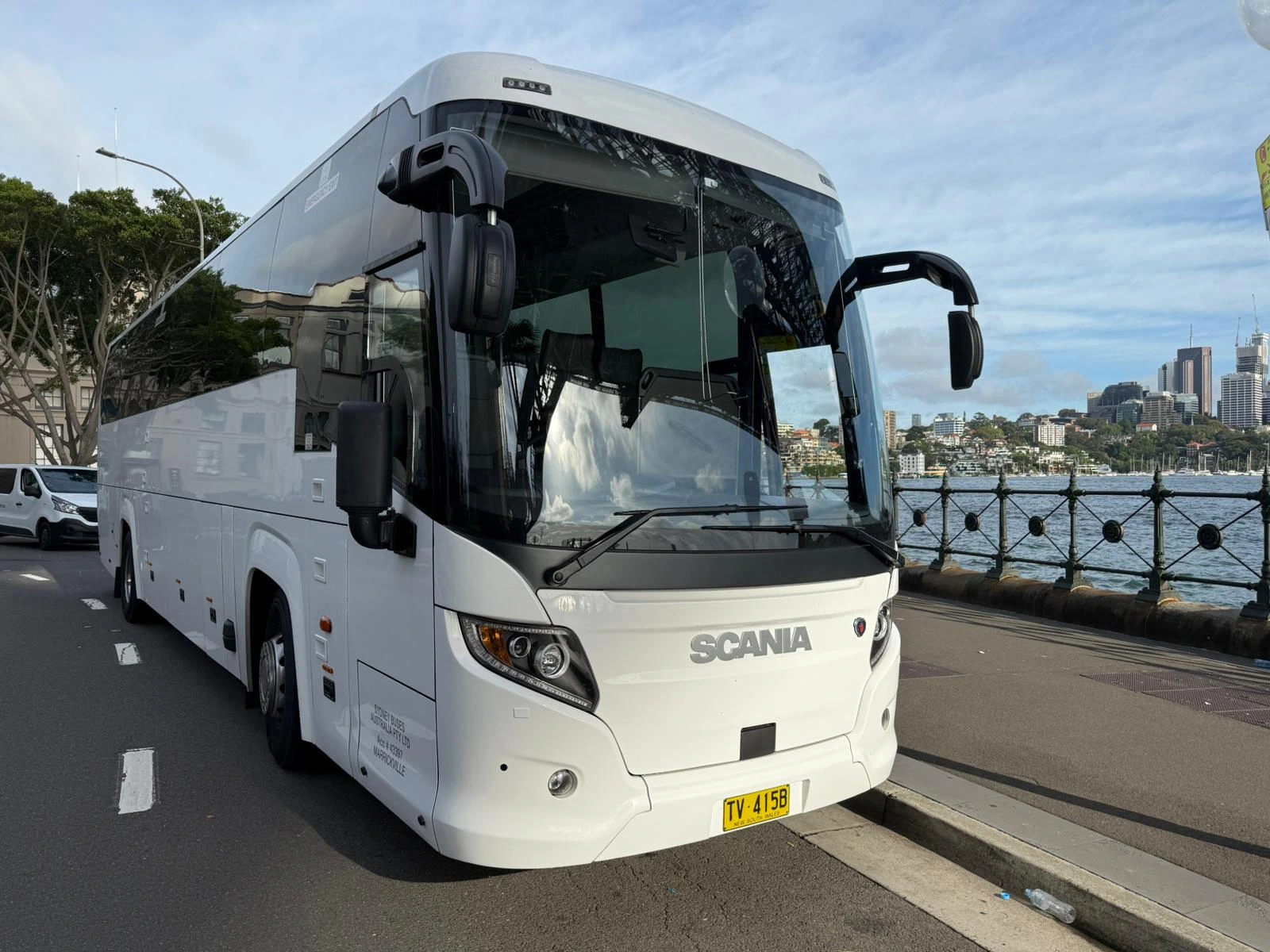
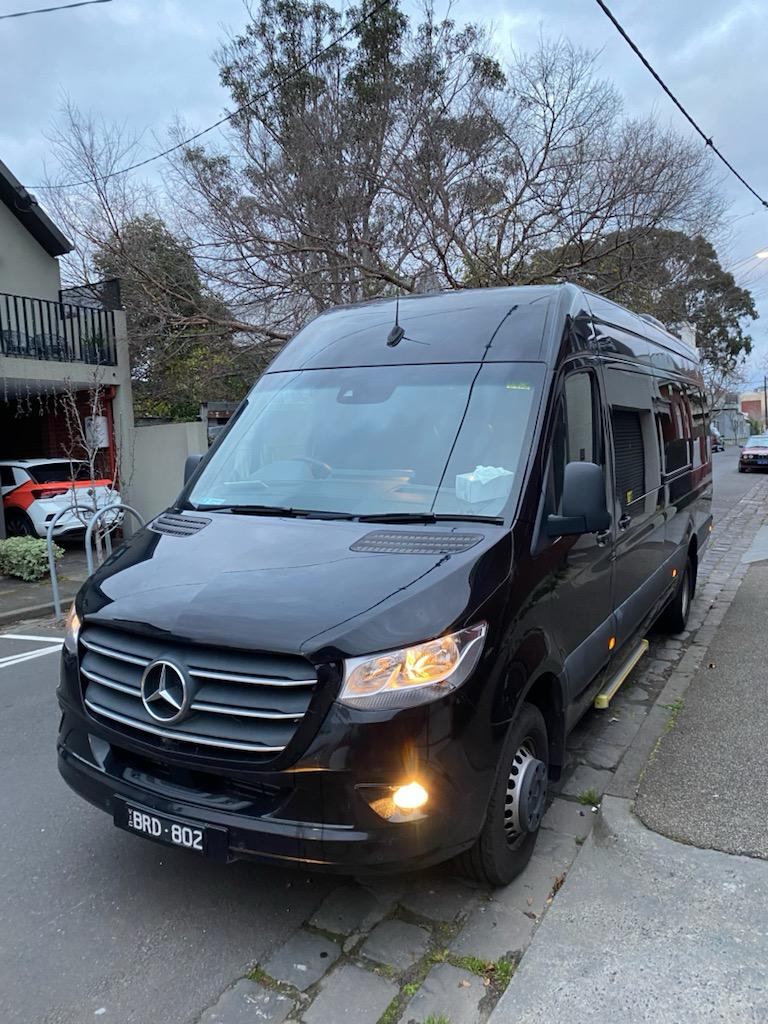
Our seat counts exclude the driver, and the ladder runs from a 7-seat Mercedes V-Class up to a 53-seat executive coach and a 50 to 57 seat luxury touring coach, with coordinated convoys quoted per event above 58.
| Expected peak boarding | Sensible vehicle | Notes for a shuttle |
|---|---|---|
| Up to 11 | Mercedes V-Class or Sprinter | Kerbside footprint of a large van. Easiest access into tight business park frontages. |
| 12 to 13 | Toyota Commuter | Sits just below the commercial accreditation boundary. Check the door and step arrangement against your boarding rate. |
| 14 to 24 | Executive minibus | The workhorse size for a two-point corporate spur. |
| 25 to 27 | Executive midi-coach | Longer dwell time. Underfloor bay matters if staff carry anything. |
| 28 to 48 | Luxury coach | Over 2.8 m high, therefore Class B on tolls, and height clearance becomes a real routing input. |
| 49 to 57 | Executive or luxury touring coach | Boarding one door at a time. Build extra dwell into the cycle. |
| 58 and above | Coordinated convoy | Two or more vehicles departing together, quoted per event. |
The relevant trap is buying capacity you only need twice a day. Two 24-seat minibuses running a 20 minute headway will often serve a peak better than one 48-seat coach running a 40 minute headway, because a shuttle is judged on waiting time, not on seats.
Stops: where a shuttle can legally stand in Sydney
Stop design is where otherwise sound shuttle plans come apart, and the rules are specific.
A charter coach counts as a public bus under Road Rules 2014 r183, so it may lawfully stop in a bus zone to set down or pick up passengers. The limit is absolute: set-down and pick-up only. A coach may not wait or lay over in a bus zone, and the rule also carves out any public bus that the sign itself excludes.
That single distinction shapes the terminus. A shuttle needs somewhere to sit between runs that is not the stop it just used. For a CBD end of a route, Transport for NSW operates the King Street Wharf Bus and Coach Layover, accessed via Lime Street, open 24 hours for accredited operators running vehicles seating more than 12 adults, with entry by number plate recognition and prior registration required. For a business park end, the layover is usually private land, which means it is a conversation with the building or precinct manager before the timetable is written, not after.
At Sydney Olympic Park, coach access runs to Coach Pod C off Edwin Flack Avenue, reached from Uhrig Road via Carter Street, and the precinct is a restricted parking area where vehicles must sit wholly within marked bays. A shuttle terminating there is working inside a managed precinct rather than on open street.
Accessibility belongs in the design, not the exceptions
If the shuttle becomes the practical way to reach a workplace, it is part of how people get to work, and access needs to be settled at design stage.
Coaches with a fixed seat for every passenger are not required to provide an allocated wheelchair space under section 9.8 of the Transport Standards, but the other duties in the Standards continue to apply, including access paths, boarding devices, information and direct assistance. In practice the design question is simpler than the legal one: decide early whether every person expected to use the shuttle can board the vehicle you have chosen. Wheelchair-equipped vehicles with hoists are available, and specifying one at design stage is far cheaper than retrofitting an answer later.
What a shuttle costs to run, and what sits outside the hourly rate
Every quote includes the professional driver, fuel, vehicle insurance and GST. Confirmed in advance and priced separately: tolls and parking, public holiday and after-hours loading, waiting time beyond the booked window, and driver accommodation on multi-day work.
Minimum hire on our published rates is three hours for minibuses and people movers and four hours for midi-coaches and full-size coaches. On a shuttle that matters more than it does on a one-off charter, because a shuttle is usually two short blocks rather than one long one. A 90 minute morning peak and a 90 minute evening peak are three hours of work and a long gap in the middle, and how that gap is treated is a commercial question worth settling in writing before the first week.
There is also a hard limit that is not commercial. Charter operations sit inside the Heavy Vehicle National Law fatigue regime, and work and rest hours are capped inside any 24 hour period. A shuttle spanning from an early morning first run to a late evening last run is often two driver shifts rather than one long one, and that is a legal constraint rather than a preference.
The review cadence
A shuttle is not finished when it starts. Set the review rhythm at launch, because the first design is a hypothesis.
| When | What you look at | What you are allowed to change |
|---|---|---|
| End of week one | Departure punctuality, whether anyone was left behind, driver notes on the worst leg | Dwell allowances, stop positions, recovery time |
| End of month one | Boardings by departure, the busiest and emptiest runs | Timetable within the existing vehicle count |
| Quarterly | Boardings by departure and by stop, cycle time drift, complaints | Vehicle size, headway, adding or cutting a stop |
| Annually | Whole route shape against where staff now live and work | The route itself, and whether the shuttle should exist |
Two rules keep reviews honest. Judge the service on the busiest departure and the emptiest one, never on the average, because the average hides both failures. And do not cut a stop on one quarter of data if that stop serves a shift that only runs part of the year.
Ready to have a route looked at properly? Corporate bus hire in Sydney covers the service, the vehicle ladder from 7 to 57 seats sets out the sizing options, and published hourly rates and minimum hire show what headway costs.
What to send us to get a shuttle plan priced
A shuttle quoted from a vague description gets a vague price. Send this instead:
> Route ends: origin address or interchange, destination address, and which one is fixed. > Days and span: operating days, first departure, last departure. > Expected load: total riders per day, and your best estimate of the single busiest departure. > Service target: the headway you want at peak, and the headway you will accept off peak. > Stops: any intermediate points, and who controls the kerb at each end. > Access needs: whether any expected rider needs a hoist or ramp, or step-free boarding. > Layover: whether there is off-street space at either end, and who to speak to about it. > Start date and term: including whether the pattern changes across the year.
Send those eight lines and the conversation starts at cycle time rather than at guesswork. Our published lead times are two to four weeks for most work and four to eight weeks for peak periods including December, race days, school excursion season and long weekends, and a recurring shuttle wants more runway than a one-off charter because it needs a trial run before it needs a timetable.
Frequently asked questions
How do you work out how many vehicles a shuttle needs?
Divide the measured cycle time by the headway you want, then round up. One vehicle on a 48 minute cycle produces a 48 minute headway, two produce 24 minutes, three produce 16. Frequency is bought in whole vehicles, so the decision is always a step, never a slider.
What frequency is right for a staff shuttle?
It depends on the alternative. If staff have a fallback (their own car, a walk they will tolerate), you need a headway short enough that waiting beats the fallback, and around 15 minutes is where most people stop consulting a timetable. If the shuttle is the only realistic option, a reliable published timetable at a longer headway works, provided it is genuinely reliable.
Should the shuttle run all day or only at peak?
Most Sydney corporate shuttles need high frequency for roughly ninety minutes at each end of the day and much less in between. Running two frequency bands on one route is usually cheaper than holding peak vehicle numbers across the whole day, and it is easier to defend at budget time.
Can the shuttle stop in a bus zone?
To set down or pick up, yes: a charter coach is a public bus for the purposes of Road Rules 2014 r183, unless the sign on that particular zone says otherwise. It cannot wait or lay over there. That is why a shuttle terminus needs a separate standing arrangement.
How long before launch should a shuttle be arranged?
Longer than a one-off charter. Published lead times run two to four weeks for most jobs and four to eight weeks in peak periods, and on top of that a new shuttle benefits from a dry run of the route at the actual operating hour before the timetable is published to staff.
How do you know whether it is working?
Boardings by departure, punctuality, and whether anyone got left behind. Track those three from week one and the quarterly review writes itself, including the case for keeping the service in the budget.
Next step
Send the eight lines above and we will build a shuttle plan against them: measured cycle time on your actual route at your actual hour, the vehicle count that delivers your headway, and a written quote naming the vehicle, usually within two business hours.
If you would rather talk the route through before committing anything to paper, call our operations team on 02 9469 6600 and we will book a shuttle plan review.
Sources
- Transport for NSW, “School zones”, https://www.transport.nsw.gov.au/roadsafety/community/schools/school-zones. Accessed 7 September 2026.
- NSW Legislation, “Road Rules 2014”, https://legislation.nsw.gov.au/view/html/inforce/current/sl-2014-0758. Accessed 7 September 2026.
- Transport for NSW, “King Street Wharf Bus and Coach Layover”, https://www.transport.nsw.gov.au/operations/roads-and-waterways/business-and-industry/buses/operators/king-street-wharf-bus-and. Accessed 7 September 2026.
- Linkt, “Vehicle classes, Sydney”, https://www.linkt.com.au/help/travelling-toll-roads/vehicle-class/sydney. Accessed 7 September 2026.
- National Heavy Vehicle Regulator, “Heavy vehicle fatigue management, bus industry”, https://www.nhvr.gov.au/safety-accreditation-compliance/fatigue-management/heavy-vehicle-fatigue-management-bus-industry. Accessed 7 September 2026.
- Sydney Olympic Park Authority, “Bus and coach parking”, https://www.sydneyolympicpark.com.au/parking/bus-and-coach-parking. Accessed 7 September 2026.