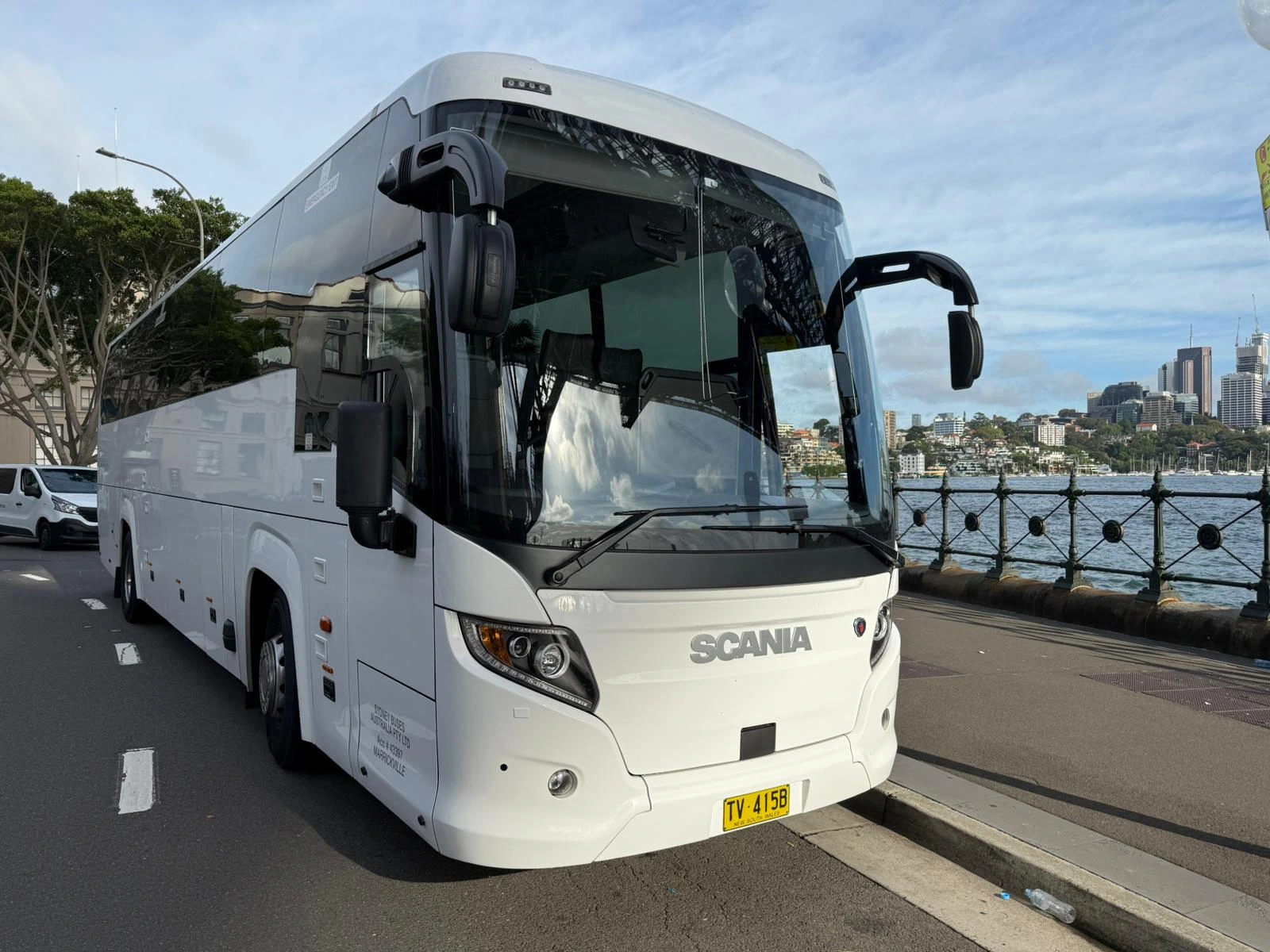
If a booked charter bus does not arrive, two things are running at once. Legally, services in Australia carry consumer guarantees, including that they be supplied with due care and skill and within a reasonable time, and a failure gives rise to a remedy. Practically, the next thirty minutes matter more than the law does. Call the driver, call the operator’s office, get the replacement plan in writing, and start a timeline you can rely on later.
Non-arrival is the most serious failure in group transport, and it is the most frequent severe complaint in published reviews of Australian charter operators. It deserves a straight answer rather than reassurance, including from an operator like us that publishes how we operate as an owner of vehicles rather than a broker.
First, work out what has actually gone wrong
Most reported non-arrivals are not an empty depot. They are one of four situations, and telling them apart changes what you should do next.
| What it looks like | What it usually is | What changes |
|---|---|---|
| No bus, no contact | A location mismatch. The vehicle is at a different corner, a different entrance, or the other side of a large venue | Solvable in minutes if you have the driver’s mobile number |
| Bus is late but coming | Traffic, a delayed previous job, or a driver-hours constraint | The trip proceeds. The question becomes the return timing, not the pick-up |
| Vehicle has failed | Mechanical failure on the way to you or on a previous run | The operator should be arranging a replacement and telling you the plan |
| No booking exists | A booking that was never confirmed, or a job passed to a third party that did not accept it | This is the most serious of the four and the one where documentation matters most |
The first row is far more common than people expect, particularly at large venues, stadium precincts and airport terminals where the coach set-down point is often not where a group would naturally wait. That is exactly why driver name, mobile number and vehicle registration should already be in your hand before the day.
The first thirty minutes
Work through this in order. Do not skip step four, even if the problem is resolved quickly.
- Call the driver’s mobile. You should have it. Sydney Buses & Coaches sends driver name, mobile number and vehicle registration twenty-four hours before travel, and any operator can be asked to do the same. This resolves the location mismatch that causes most reported non-arrivals.
- Call the operator’s office, not the booking email. Email is the wrong channel in a live failure. Office hours are Monday to Friday 7am to 6pm and Saturday 8am to 2pm.
- Ask one specific question: is a replacement vehicle coming, and what is its estimated arrival time? Not “what happened”. You need the plan, not the diagnosis. If the answer is not a time, ask when you will be given one.
- Start a written record. Time of the booked pick-up, time you called, who you spoke to, what you were told, and each subsequent update. A short note written at the time is worth far more later than a reconstruction.
- Decide your fallback at a stated cut-off, and say the cut-off out loud. “If there is no vehicle here by 8:15 we will book rideshares.” A named cut-off changes the conversation and it gives you a defensible basis for the costs you then incur.
- Keep receipts for anything you spend. Alternative transport, missed prepaid entry, a rescheduled booking. Whether you recover them is a separate question, but you cannot claim what you cannot evidence.
- Confirm in writing the same day. One short email to the operator setting out what happened and what you are asking for. This is the message everything else will be built on.
For a school group, add one step ahead of all of the above: account for the students and move them to a safe, supervised waiting area before you start making calls. The transport problem can wait five minutes. Supervision cannot.
What a reasonable operator should do
The behaviour is more informative than the apology. On a non-arrival, an operator that is running its own vehicles should be able to tell you three things quickly: what has happened, what the replacement plan is, and when you will next hear from them.
Sydney Buses & Coaches publishes its position: if a vehicle fails, a replacement is arranged and the customer is kept informed. Being kept informed is the part that matters most in the first hour, because a group standing on a kerb with no information will make its own decisions within about fifteen minutes.
What you should expect to see:
- Contact initiated by the operator rather than by you, wherever they know first.
- A named replacement vehicle and a realistic arrival time, revised if it changes.
- An honest statement when a replacement cannot reach you in a useful timeframe, rather than a rolling series of twenty-minute estimates.
- A commercial position offered promptly afterwards, in writing.
An operator that will not put the plan in writing during the event is unlikely to put a remedy in writing after it.
Where a non-arrival sits under Australian Consumer Law
This section is general background, not legal advice. Get your own advice for anything that matters commercially.
Services supplied to consumers in Australia carry statutory consumer guarantees. The ones that bear on a charter booking are that the service is supplied with due care and skill, that it is fit for the purpose you made known, and that it is supplied within a reasonable time where no time is agreed. A charter with a booked pick-up time has an agreed time, which makes the position simpler rather than harder.
Where a service fails, the law distinguishes between failures that can be fixed and failures that are major. A failure that cannot be fixed within a reasonable time, or that means you would not have entered the booking had you known, is treated more seriously and carries stronger remedies. A group left without transport for an event that has already started is not a failure that can be remedied by supplying the service later.
Two practical points that people get wrong:
A contract term does not remove a consumer guarantee. Terms and conditions sit alongside the guarantees rather than replacing them. That said, read the cancellation and service terms in your written quote, because they govern the commercial process even where the guarantees govern the entitlement.
Consequential loss is a separate question from a refund. A refund of the fare is the straightforward part. Recovering what the failure cost you beyond the fare is a different and harder conversation, and the quality of your contemporaneous record is usually what decides it.
The current guidance on consumer guarantees is published by the ACCC, and complaints in New South Wales are handled by NSW Fair Trading. Check their current published process rather than relying on any summary, including this one.
How to escalate, in order
- In writing to the operator, the same day. State the booking reference, the booked pick-up time and place, what happened, what it cost you and what you are asking for. Ask for a written response by a stated date.
- To the business owner or manager if the first response is inadequate. With a small operator this is often a short step.
- To the consumer protection body. For a NSW consumer, that is NSW Fair Trading. The ACCC publishes the national guidance on consumer guarantees.
- Safety concerns go somewhere else entirely. If the issue involves vehicle roadworthiness, driver fatigue or accreditation, that is a regulatory matter for Transport for NSW rather than a consumer complaint, and it is worth raising separately.
One point on verification, because it comes up during escalation. NSW bus operator accreditation is administered by Transport for NSW under the Passenger Transport Act 1990, and it covers good repute, financial viability, passenger and public safety, and depot and maintenance capacity. There is no public register you can search. The only way to verify an operator is to ask for its Certificate of Accreditation. Ours is available on request, and the NSW accreditation number is 43397.
Why the operator’s structure changes the outcome
This is the part that is rarely said plainly, and it is the most useful thing in the article.
A broker sells you a job and then buys a vehicle from somebody else. When that vehicle fails at 6am, the broker cannot dispatch anything, because it owns nothing and employs no drivers. It can only ring around. That is why non-arrival complaints so often describe long silences: the party you are speaking to is not the party who can solve it.
An operator that owns its vehicles, employs its drivers and schedules its work in-house has a different set of options. It can see what else is in the yard, what is finishing a run nearby, and which driver has hours available. It still cannot conjure a coach out of nothing at 6am on a Saturday, and any operator that promises an instant replacement anywhere in Sydney is overselling. But the decision is made by the people holding the keys, which is why ownership of the fleet is a fair question to ask any operator before you book.
Ask directly: do you own the vehicle you are quoting, and do you employ the driver? The answer tells you what happens on the bad morning.
The questions that reduce the risk before you book
Ask these at quote stage. They take five minutes and they change your exposure more than price comparison does.
- Do you own this vehicle and employ this driver? If the job is being passed on, ask who to.
- What is your accreditation number, and can I have the Certificate of Accreditation? There is no public register, so the certificate is the verification.
- What is your written policy if a vehicle fails on the day? Get the words, not a reassurance.
- When will I receive the driver’s name, mobile number and vehicle registration? Twenty-four hours before travel is a reasonable answer, and it is what we do.
- Who do I call outside office hours on the day of travel? Ask for the number now, not on the morning.
- What does the written quote name? A fixed quote that names the specific vehicle is a different document from a price estimate.
Put those answers in the file with the booking confirmation. For a school or a committee purchase, they are also most of what a procurement checklist needs.
Frequently asked questions
What are my rights if a charter bus does not turn up in Australia?
Services carry consumer guarantees, including that they be supplied with due care and skill and within the agreed or a reasonable time, and a failure gives rise to a remedy. Where the failure is major, the remedies are stronger. This is general background rather than advice, so check the ACCC’s current guidance and get your own advice for anything significant.
Should I wait or arrange something else?
Set a cut-off, tell the operator the cut-off, then act on it. Fifteen to twenty minutes past the booked time with no confirmed replacement plan is a reasonable point to start arranging alternatives, and having stated the cut-off puts you in a much stronger position on the costs.
Can I claim the cost of taxis or rideshares?
You can ask, and a reasonable operator will engage with it. Whether you recover it depends on the circumstances, the terms of your booking and the size of the loss. Keep every receipt and the contemporaneous record of what you were told and when.
What if the bus is just late rather than missing?
Different problem, different response. Confirm with the driver that the vehicle is coming and get an arrival time, then look at the other end of the day. A late start on an hourly booking usually means the return time needs renegotiating, and it is better done at 8am than at 5pm.
How do I check the operator is accredited?
Ask for the Certificate of Accreditation. There is no public register of NSW bus operator accreditation, so a certificate on request is the only practical verification. Sydney Buses & Coaches supplies it on request and its NSW accreditation number is 43397.
Does this happen often?
Non-arrival is rare in absolute terms and severe when it happens, which is why it dominates negative reviews across the industry. The risk is concentrated in bookings that were never properly confirmed and in jobs passed to a third party, which is why the confirmation questions above matter more than any promise about reliability.
Next step
If you are assessing operators, ask for the accreditation certificate, the written failure policy and confirmation of when driver details are sent. We send driver name, mobile number and vehicle registration twenty-four hours before travel, and a fixed written quote naming the vehicle comes back within two business hours during office hours. Our published booking and service terms set out the rest.
If you are in the middle of a problem right now, call 02 9469 6600 during office hours rather than emailing.
Sources
- Transport for NSW, “Applying for bus operator accreditation”, https://www.nsw.gov.au/departments-and-agencies/transport-for-nsw/bus-operators-nsw/applying-for-bus-operator-accreditation. Accessed 7 September 2026.
- NSW Government legislation, “Passenger Transport Act 1990”, https://legislation.nsw.gov.au/view/whole/html/inforce/current/act-1990-039. Accessed 7 September 2026.