Booking direct means your contract is with the company that owns the vehicle and employs the driver. Booking through a broker means your contract is with an intermediary that places the work with an operator you may never deal with. Both are legitimate models. What changes is where the margin sits, who is accountable when something goes wrong, and how quickly a problem can be solved on the day. For a single Sydney job, direct is usually simpler. For a multi-city or multi-operator programme, a broker can genuinely earn its fee.
The two models, plainly
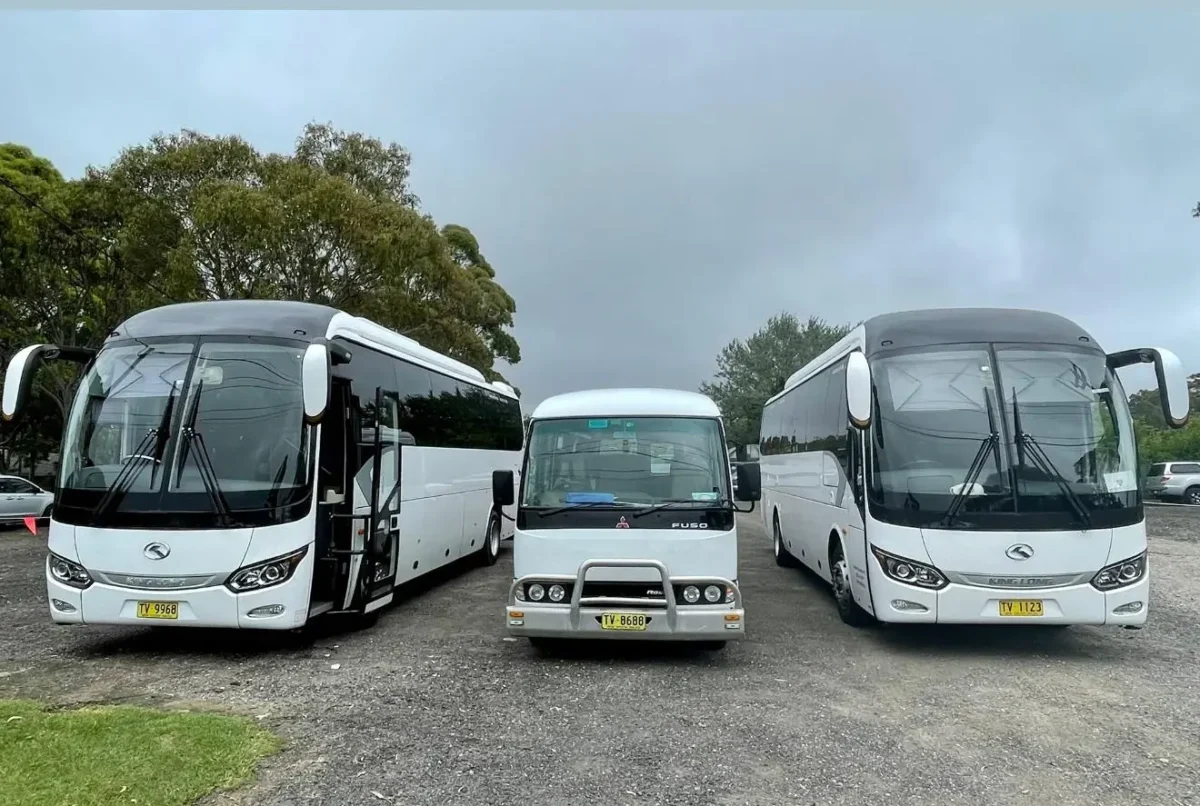
A charter operator owns buses, employs drivers, holds NSW operator accreditation, maintains a depot and runs a scheduling diary. Its constraint is its own fleet.
A broker, agent or marketplace holds none of that. It holds demand, a network of operators and a booking system. Its constraint is the availability of other people’s vehicles, which in practice means it is rarely constrained at all. That is genuinely its strength.
Neither description is a criticism. They are different businesses solving different problems, and the mistake buyers make is not choosing the wrong one. It is not knowing which one they chose.
Side by side
| Booking direct with the operator | Booking through a broker | |
|---|---|---|
| Who you contract with | The company that owns the vehicle | An intermediary that places the work |
| Who is accountable on the day | One party | Two, and they can reasonably point at each other |
| Escalation path | Straight to the office that controls the vehicle | Through the broker, then to an operator you have no contract with |
| Vehicle certainty | The specific vehicle can be named on the quote | Often a class rather than a vehicle, confirmed later |
| Price structure | Operator’s own rate | Operator’s rate plus a margin, usually not itemised |
| Capacity ceiling | The operator’s own fleet | Effectively unlimited, drawn from many operators |
| Geographic reach | One region done well | Multi-city and interstate in one transaction |
| Best suited to | A single job in one city | A programme spanning multiple cities or many simultaneous vehicles |
Where a broker genuinely helps
This is worth saying without qualification, because a comparison that concedes nothing is not a comparison.
Multi-city programmes. A conference with delegates moving in Sydney on Monday, Melbourne on Wednesday and Brisbane on Friday is three procurement exercises, three sets of terms and three invoices if you do it yourself. A broker turns it into one. That is real work removed from your desk.
Very large multi-operator events. When a job needs twenty coaches on the same morning, no single Sydney operator’s fleet covers it, and somebody has to coordinate across several operators. A broker does that professionally. So do some operators, but a broker does it as its core business.
Unfamiliar territory. If you are organising transport in a city you do not know, with operators you cannot assess, an intermediary that has already done the vetting is buying you something valuable.
Volume with no time. A procurement team running fifty movements a year across multiple regions may reasonably prefer one supplier relationship to fifteen.
If your job looks like any of those, a broker is a defensible choice and you should not be talked out of it.
Where direct is clearly stronger
For a single Sydney job, the direct case is not close.
The vehicle can be named. An operator quoting from its own fleet can put a specific vehicle type and seat count on the quote, because it knows what it has. A quote naming a class rather than a vehicle is a quote that has not yet been allocated.
One phone call solves the problem. At 6:15am at a kerb in Marrickville, the useful number is the one that reaches the people who control the vehicle. An escalation that has to travel through an intermediary before it reaches anyone with a bus is an escalation with a delay built into it.
The margin is not doubled up. A broker’s fee is real work and deserves paying, but on a single-city, single-vehicle job it is paying for coordination you did not need.
Accountability is undivided. When the operator that took your money is also the operator that owns the bus, there is no version of the conversation where two companies each explain that the other one is responsible.
Ours is the direct model: we own the vehicles, employ the drivers and schedule the work in-house from the depot at 74 Edinburgh Rd, Marrickville, which is set out on who owns the vehicles and employs the drivers.
Three questions that settle it
You cannot look this up. There is no public register of accredited NSW bus operators for a customer to search, which means the model you are buying is established by asking, not by checking.
- Do you own the vehicle that will carry us, and do you employ the driver? A direct operator answers immediately and usually volunteers the depot. An intermediary that answers honestly will say it places work with accredited operators, which is a perfectly good answer.
- What is the NSW operator accreditation number for the vehicle that will carry us? Not the number of the company selling to you. The number of the operator whose bus turns up. Ours is 43397 and the Certificate of Accreditation goes out on request.
- If something goes wrong at 6am, whose number do I ring, and do they control a bus? The answer tells you the real length of the accountability chain.
None of the three is confrontational and all three take a minute. What matters is not which answer you get. It is that you get one before you pay a deposit rather than during a dispute.
What changes when something goes wrong
This is the practical core of the comparison, and it is where the two models genuinely diverge.
Under a direct booking, a vehicle failure is one company’s problem. Our position is that a replacement is arranged and you are kept informed, and the office arranging that replacement is the office that owns the fleet.
Under a brokered booking, the same failure involves your contract with the broker and the broker’s contract with the operator. Both may behave impeccably and the problem may still take longer to solve, because information has to travel one more step in each direction. If a dispute follows, you have a claim against the broker and no contractual relationship with the operator whose bus it was.
That is the structural point, and it holds regardless of whether either party is any good. It is worth weighing before you book rather than discovering while you are standing on a footpath with forty people.
Comparing the price properly
Brokered quotes and direct quotes are hard to line up, because the broker’s margin is rarely itemised. Comparing on a per-head basis makes them commensurable.
Worked from the published rate card rather than any actual booking: a 53-seat executive coach at $195 per hour, across the four-hour minimum, is $780 GST inclusive. Carrying 50 passengers, that is $15.60 per head for the whole booking. Carrying 30 passengers on the same coach it is $26 per head, which is the arithmetic that makes vehicle sizing matter so much.
Do the same division on every quote in front of you, brokered or direct, and hold the results against the published rate the per-head figure is built from. Then check that both quotes name a vehicle, state the hours, state the GST treatment and state the toll treatment, because a per-head figure built on a different set of assumptions is not a comparison either.
Frequently asked questions
Is booking through a broker a bad idea?
No. It is the right answer for multi-city programmes, very large multi-operator events and unfamiliar territory. It is usually the wrong answer for a single vehicle on a single day in one city.
How do I tell whether a company is an operator or a broker?
Ask whether they own the vehicle and employ the driver, and ask for the NSW accreditation number of the operator whose bus will carry you. There is no register to search, so the question is the only route.
Does a broker cost more?
Not always, because a broker with a wide network can sometimes find spare capacity at a keen rate. What is consistent is that the margin is not itemised, so compare on a per-head basis and check that both quotes describe the same job.
Who is responsible if the bus does not turn up?
Under a direct booking, the operator you contracted with. Under a brokered booking, your contract is with the broker, and the broker’s contract is with the operator. That extra link is the thing to understand before you book.
Can a broker name the specific vehicle?
Sometimes, once the work has been placed. An operator quoting from its own fleet can name it at quote stage, because it knows what it holds.
Does it matter for a school or council booking?
More than for most, because procurement usually needs the accreditation and insurance details of the entity actually performing the service. Establish early which entity that is, so the supplier record matches reality.
Next step
If you are holding a brokered quote and want something to measure it against, get a per-head figure from an operator quoting its own fleet. Send the pick-up suburb, the date and the group size and ask for a per-head figure, or call 02 9469 6600. The quote comes back within two business hours with the vehicle named, the hours stated and our accreditation number on it, which is enough to compare properly.
Sources
- Transport for NSW, Applying for bus operator accreditation, https://www.nsw.gov.au/departments-and-agencies/transport-for-nsw/bus-operators-nsw/applying-for-bus-operator-accreditation. Accessed 7 September 2026.