You cannot size a wedding shuttle from the guest list. You size it from a counted number of riders, collected on the RSVP, with every non-responder counted as a rider and a planning buffer added on top. Round that figure up to the next vehicle in the fleet, then decide whether one vehicle running twice or two vehicles running once fits your schedule. Distance and the gap between ceremony and reception decide that second question, not budget.
Why guest count is the wrong starting number
A hundred invited guests might produce eighty riders or twenty-five. The variable is not the size of the wedding. It is whether your guests have a realistic alternative.
At a venue 120 km from the city with limited parking, no rideshare coverage after dark and a bar running until late, almost everyone rides. At an inner-Sydney venue with parking, trains nearby and plenty of rideshare, a large share of guests will make their own way and the shuttle carries a minority. Same guest count, completely different vehicle.
This is why published uptake percentages are useless to you. Someone else’s 60 per cent was measured at someone else’s venue. What you need is your own number, and you can collect it for free at the RSVP stage.
The RSVP question that gives you a number you can size against
Ask a question that returns a count of seats, not an opinion about transport. Three rules make the answer usable.
Ask per person, not per invitation. A couple where one drives and one rides is common and an invitation-level question hides it. Ask separately for the outbound and return legs, because they behave differently: guests who drive to the ceremony frequently want a seat home. And make the question binary with a seat count attached, so you are adding integers rather than interpreting intentions.
Wording that works on a wedding website RSVP form:
> Coach transport. We are running a coach between [pick-up point] and the venue. > Will you use the coach to the venue? Yes / No. How many seats? ___ > Will you use the coach from the venue at the end of the night? Yes / No. How many seats? ___
Two details matter more than the wording. Publish the pick-up point and the departure time before you ask, because a guest cannot answer honestly without them. And publish the last return time in the same block, since the answer to “will you use the coach home” changes entirely once someone knows the alternative is finding their own way at 11pm.
The buffer, and why it is not a percentage of your guest list
Once the RSVPs are in, build the number in this order.
- Count the yes answers. Outbound and return separately. You will usually find the return number is the larger of the two. Size to the larger one.
- Count every non-responder as a rider. People who never answer the transport question are not people who have made a plan. They are people who have not thought about it, and they turn up expecting a seat.
- Add a planning buffer on top. Ten per cent of the counted total is the usual margin, and it exists to cover the drift that happens on the day rather than errors in your count.
- Round up to the next vehicle in the fleet. There is no such thing as 0.4 of a coach.
The drift in step three is real and it runs one way. Guests who intended to drive have a drink and leave the car. A hotel room falls through and two people who were staying in town now need the run home. Someone brings a plus one you were not counting. Almost nobody who booked a seat decides at 11pm to walk instead.
The floor to check your answer against: at the end of the night, every guest still on site who cannot legally or safely drive needs a seat on a vehicle that is still running. If your last return run cannot take that group in one movement, you either need a bigger vehicle, a second vehicle, or an earlier staggered run that thins the crowd before the last one.
One trip or two: the decision that sets your vehicle count
A single vehicle can carry more people than its seat count, but only if it has time to go back. Whether it does is a distance question.
Work out the cycle time before you decide:
Cycle time = running time out + running time back + loading time + unloading time + a traffic buffer.
Loading time is the part organisers leave out. A group that is standing together, briefed and ready boards a coach quickly. A group spread across a hotel lobby, a bar and a car park does not, and thirty people boarding one at a time takes far longer than the drive.
Sydney examples using the operating figures for these runs:
| Run | One-way distance | One-way running time | Realistic cycle for a second trip |
|---|---|---|---|
| Inner Sydney hotel to inner Sydney venue | Short | Minutes, subject to traffic | A second trip is usually easy |
| Sydney to Southern Highlands | 120 km | About 1.5 hours | About 3 hours of driving alone, plus loading |
| Sydney to Hunter Valley (Pokolbin) | 165 km | 2 to 2.5 hours | 4 to 5 hours of driving alone. Two trips is not a plan |
| Local shuttle between a nearby hotel cluster and a venue | Around 16 km | 20 to 60 minutes | Two or three trips are realistic if the schedule allows |
The rule that falls out of the table: two trips work when the full cycle fits inside a gap in your schedule with room to spare. Over a long distance it does not, and the answer is a bigger vehicle or a second one.
There is a legal dimension too, and it is worth knowing before you plan a late finish. A coach driver’s working day is bounded by heavy vehicle fatigue law, which applies to charter work carried out for a fare. The driver cannot simply agree on the night to run one more trip. Build the run sheet so the last movement sits comfortably inside the booked window rather than at its edge.
Mapping your number onto real vehicles
Seat counts below exclude the driver. Minimum hire hours apply because the vehicle and driver are committed for a block, not a trip.
| Vehicle | Seats | Minimum hire |
|---|---|---|
| Mercedes V-Class | 7 | 3 hours |
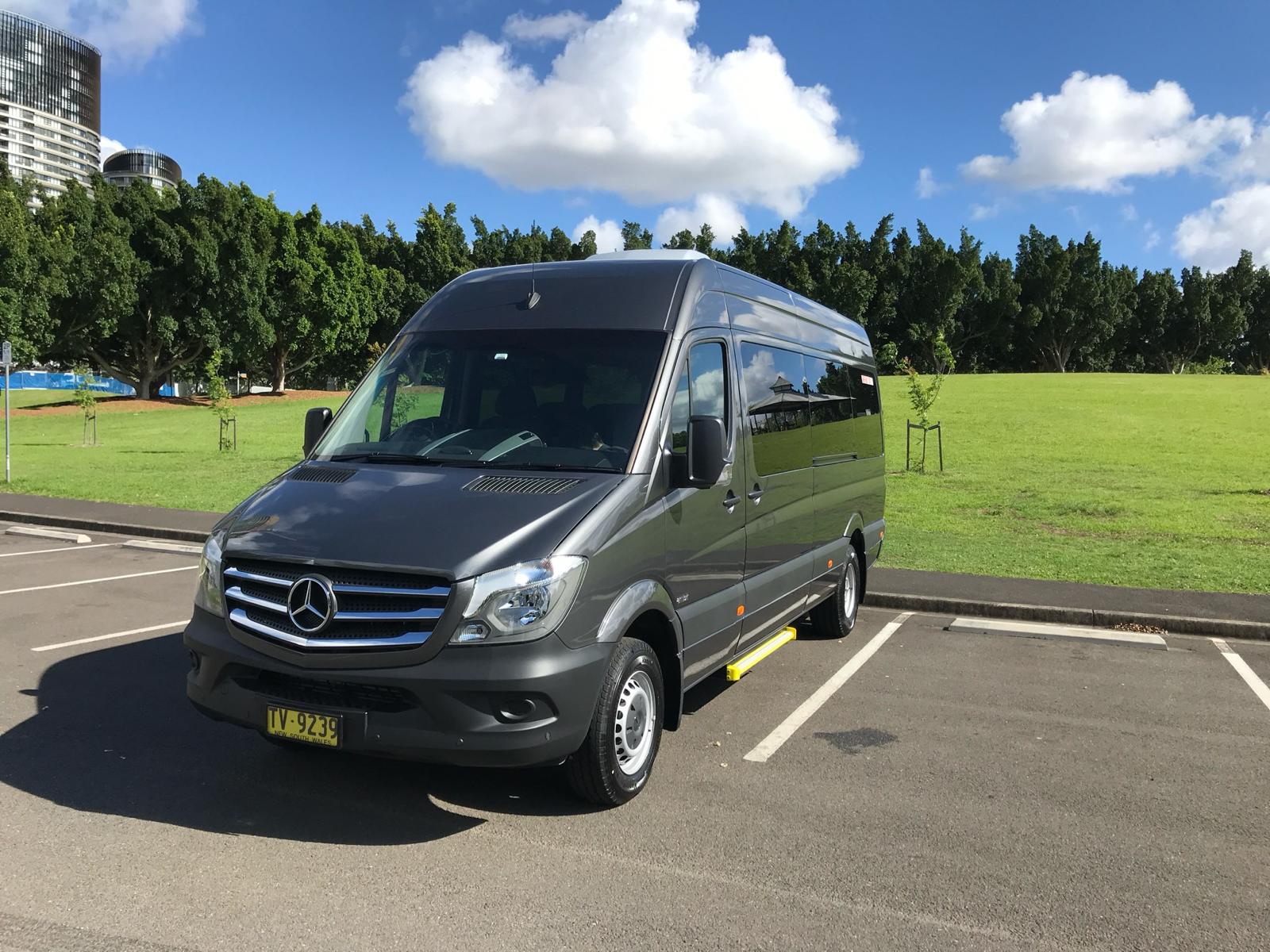
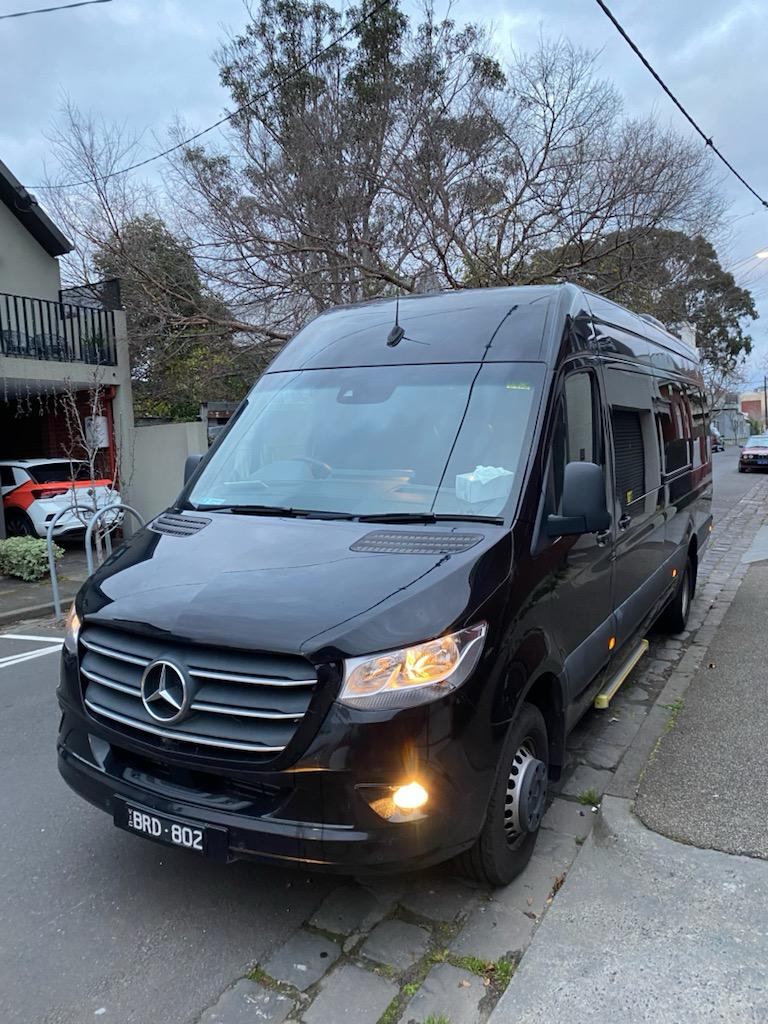
| Mercedes Sprinter | 11 to 14 | 3 hours |
| Toyota Commuter | 13 | 3 hours |
| Executive minibus | 21 to 24 | 3 hours |
| Executive midi-coach | 27 | 4 hours |
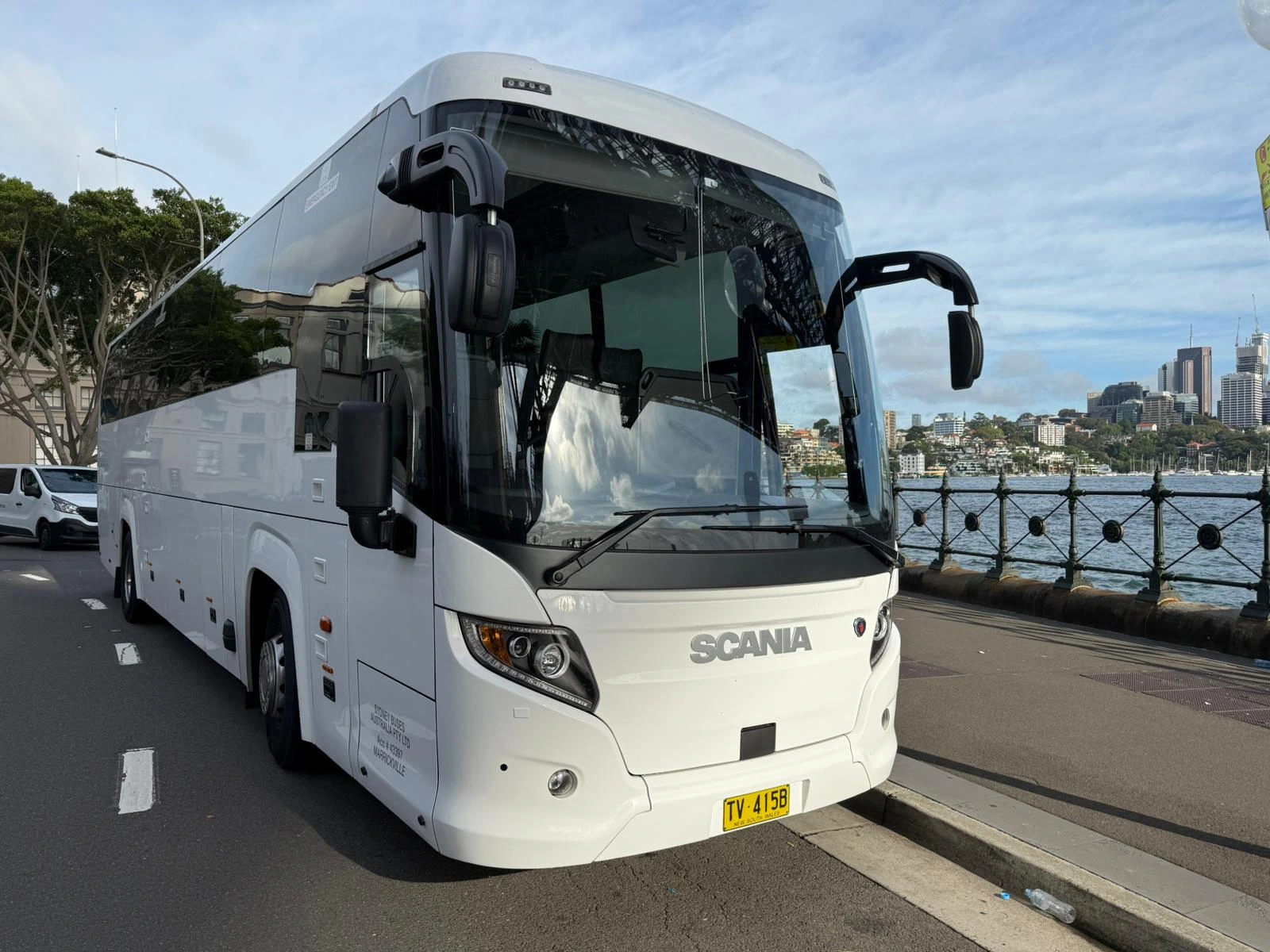
| Luxury coach | 48 | 4 hours |
| Executive coach | 53 | 4 hours |
| Luxury touring coach | 50 to 57 | 4 hours |
| Coordinated convoy | 58 and above | Quoted per event |
Three thresholds are worth knowing because they change the shape of the answer.
Around 27 riders you are choosing between a midi-coach in one movement and a minibus running twice. Around 55 riders, one full-size coach in a single movement usually beats two minibuses, because two vehicles means two drivers, two arrival times and two head counts. Above about 57 riders on one movement, you are into a convoy, and at that point the question changes from vehicle size to run sheet: which vehicle leaves first, where each one stops, and who is counting.
You can check the exact configuration against the seat counts across the fleet before you commit to a plan, and settle the hourly or fixed-fare basis against our published hourly rates and minimum hire hours.
A worked example
This is an illustrative calculation, not a real booking.
A wedding at a Southern Highlands venue, 120 km from the city. 110 guests invited, 92 accept. The couple publish a 2pm departure from a city hotel and a last return at 11.30pm, then ask the two RSVP questions.
Answers come back: 61 riders outbound, 74 riders on the return, 9 guests never answer the transport question.
- Size to the return, the larger leg: 74.
- Add the 9 non-responders: 83.
- Add the ten per cent planning buffer: 91.4, so 92.
- Round up to the fleet: 92 riders exceeds any single vehicle, so this is two vehicles.
At 120 km each way, a second trip is roughly three hours of driving before anyone gets on or off, so running one coach twice is not viable for the return. Two full-size coaches, or a coach plus a midi-coach, carry the group in one movement each way. The 27-seat midi-coach also gives the couple a natural earlier return run for guests with children, which thins the last movement.
Notice what did the work: the counted return number and the distance. The guest list of 110 never entered the calculation.
What to settle before you ask for a quote
- The number of riders on the return, not the outbound, because it is the bigger and later number.
- The pick-up point or points, as street addresses.
- The published departure time and the published last return time.
- Whether the vehicle waits between movements or is released and comes back, since that changes the hours you are charged for.
- Who the day-of contact is, and it should not be the couple.
- Whether alcohol will be consumed on board, which is permitted on private function bookings by prior arrangement only and needs to be agreed in advance rather than assumed.
Send those six things with your enquiry and the quote comes back with a vehicle named rather than a range.
Frequently asked questions
What percentage of wedding guests actually use the shuttle?
There is no reliable general figure, and any percentage you find online was measured at a different venue. Uptake is driven by whether guests have an alternative: at a regional venue with no parking and no rideshare after dark it approaches everyone, and at an inner-Sydney venue with trains and parking it can be a minority. Measure your own with a yes or no question on the RSVP.
Should I size the bus to the outbound trip or the return?
The return. It is almost always the larger number, because guests who drove to the ceremony have often decided by the end of the night not to drive home. Size to the return and the outbound takes care of itself.
Can one bus do two trips?
Over a short distance, yes, and it is often the cheapest answer. Over a long one it is not. Add the running time out, the running time back, loading, unloading and a traffic buffer, then check whether that total fits inside a real gap in your schedule. For a Southern Highlands venue at about 1.5 hours each way, a second trip is around three hours of driving before anyone boards.
What if more guests turn up for the bus than booked a seat?
That is what the buffer is for, and it is why non-responders are counted as riders. If the number is still over capacity on the night, the vehicle cannot carry standing passengers, so someone is left behind. Deciding in advance who has priority, and publishing a staggered earlier run, is a better answer than hoping.
How far in advance should a wedding shuttle be booked?
Most jobs need two to four weeks of lead time. Peak periods run to four to eight weeks, which covers December, race days, school excursion season and long weekends. Wedding dates cluster in those periods, so book earlier than you think you need to.
Next step
Send the return rider number, the venue address, the pick-up point and the date, and you will get a fixed written quote back within two business hours with the vehicle named and the run sheet built in rather than left to the day.
Start with wedding bus hire in Sydney or call 02 9469 6600, Monday to Friday 7am to 6pm or Saturday 8am to 2pm. Driver name, mobile number and vehicle registration are sent 24 hours before travel, which is the detail you will want to forward to your day-of contact.
Sources
- National Heavy Vehicle Regulator, Heavy vehicle fatigue management: bus industry, https://www.nhvr.gov.au/safety-accreditation-compliance/fatigue-management/heavy-vehicle-fatigue-management-bus-industry. Accessed 7 September 2026.