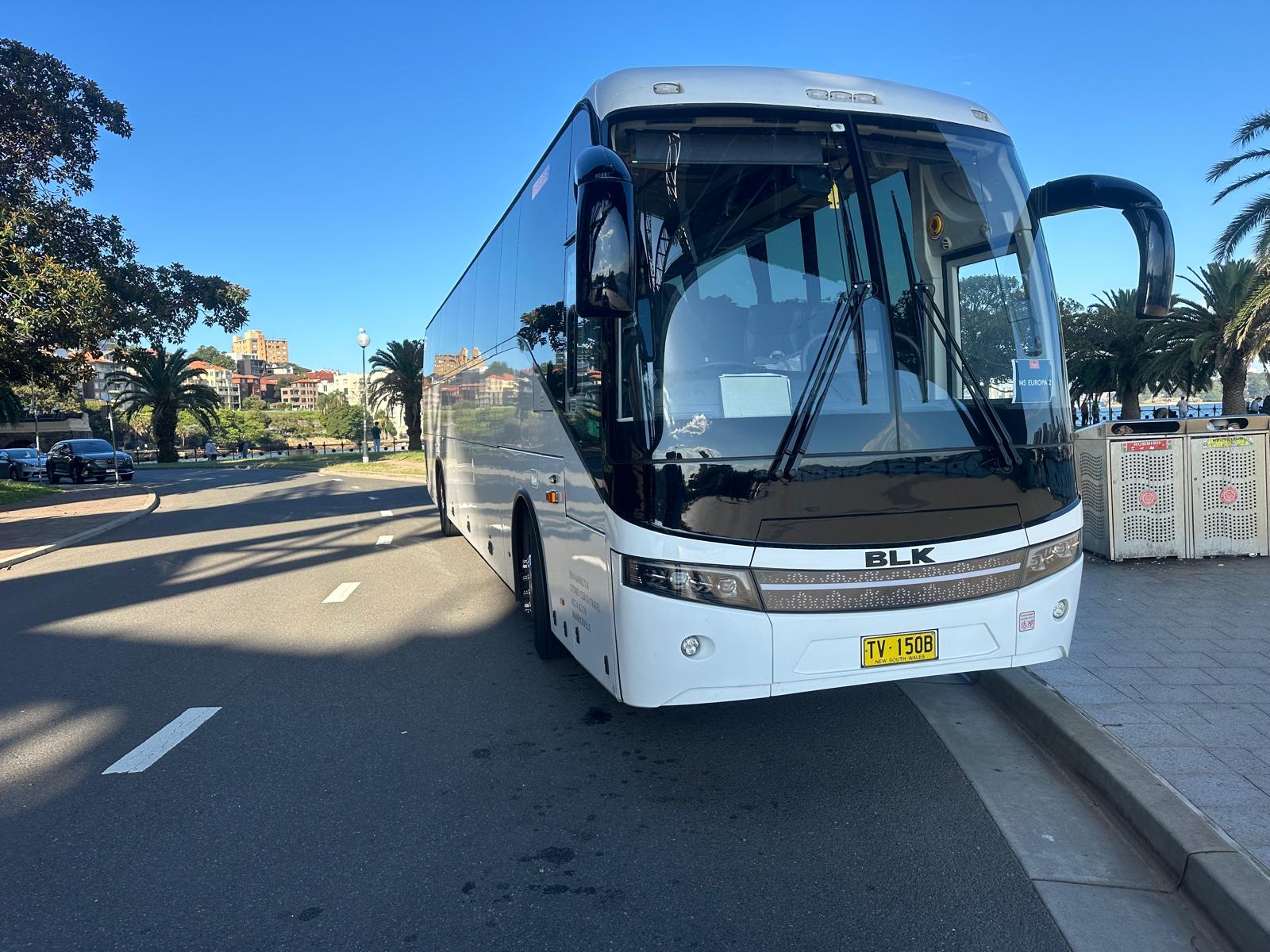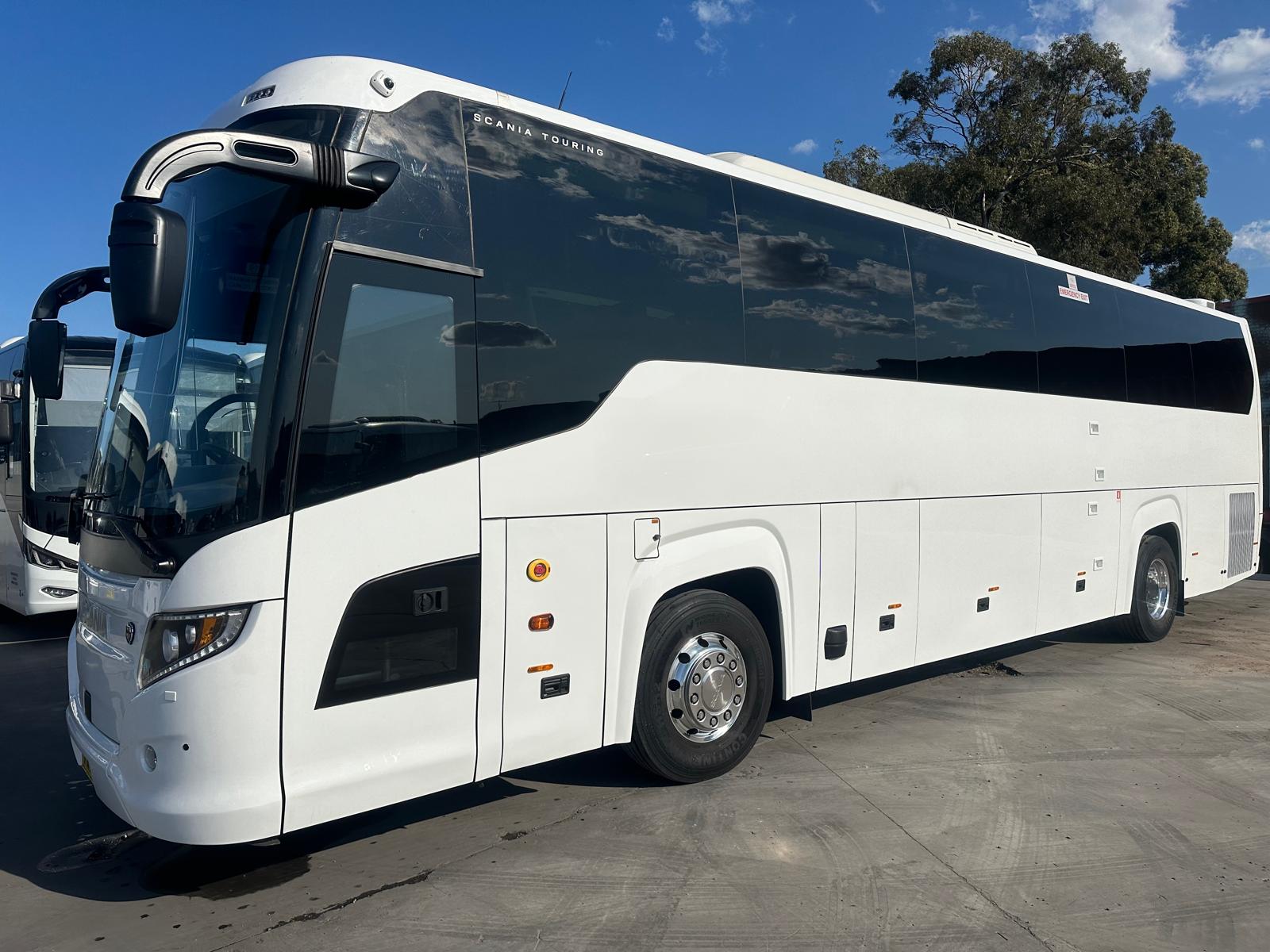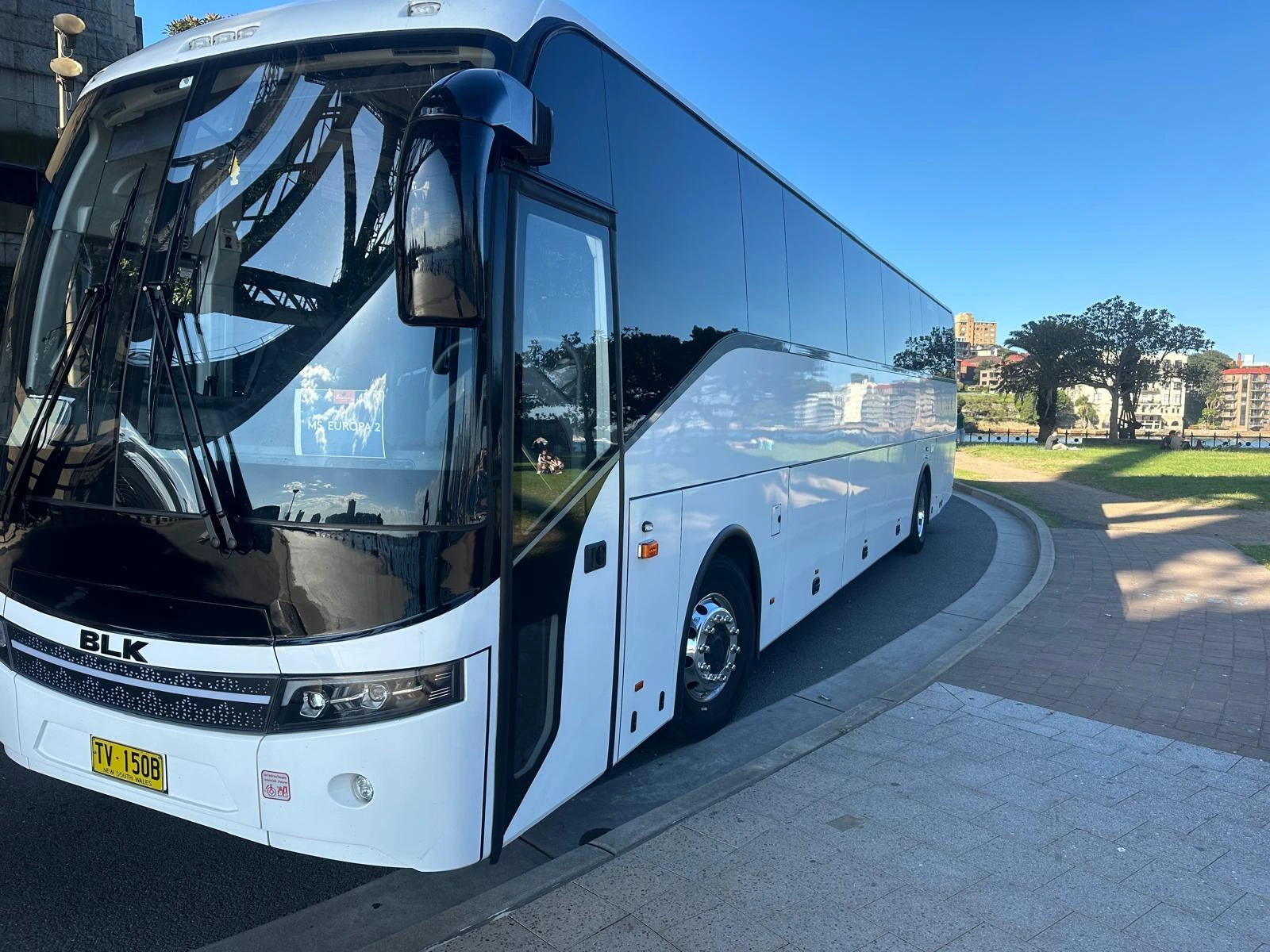
At Sydney Airport, coach drop-off is kerbside at Departures level, but collection happens inside dedicated Ground Transport Zones rather than at the arrivals kerb. A touring group with a kit bag or a board bag each therefore walks its gear to the vehicle. Declare every oversized item at quoting stage, ask for the bay capacity of the vehicle assigned to your dates, and build the walk and the load into your timings rather than the flight arrival time.
Declare the gear before the flight is booked
Luggage and equipment capacity belongs to the individual vehicle, not to its seat count, and it varies across a fleet. Two coaches with the same number of seats can take different loads underneath. That means the honest answer to “will our gear fit” is always specific to the vehicle assigned to your dates, and it has to be confirmed rather than assumed.
Send the itemised list with the enquiry, not after the deposit:
- Passengers, split into those with a checked case only and those with additional gear.
- Every rigid item, with its longest dimension in centimetres. Bike boxes, board bags, hard instrument cases, kit trunks and medical cases all belong here.
- Anything with a pressurised cylinder, a fuel component or a battery beyond a normal device battery, named explicitly.
- Anything that must stay with a passenger in the saloon.
- Whether the return leg carries more than the outbound, which is common for touring sides and school ensembles.
Then ask three questions and require the answers in writing: which specific vehicle is assigned, whether that vehicle’s bay takes the declared load, and whether a trailer is available on that vehicle if it does not. Sydney airport transfers for groups are quoted on both passenger and gear counts for exactly this reason.
Where the group and the vehicle actually meet
This is the part that catches first-time organisers, and it is worth understanding before you promise anyone a meeting spot.
Commercial buses and coaches at Sydney Airport must be registered through the Bus and Limousine Registration System, and access is limited to accredited operators. Collection happens in dedicated zones. T1 International and T2 Domestic each have a Bus and Coach Pickup area, and T3 is different again: it splits Bus Pickup from Coach Pickup, so the vehicle type determines where the group goes.
Two further points shape a gear-heavy job.
The Priority Pick-up zone at T2 and T3 has a 2.9 metre height restriction, which excludes full-size coaches. If your group needs a coach rather than a minibus, that zone is not an option, and the walk is longer.
Waiting happens away from the terminal. A Bus Holding Area operates on Ross Smith Avenue and is free for the first 60 minutes. Drivers of buses and coaches may leave the vehicle to meet passengers inside the terminal, which is genuinely useful when you are shepherding thirty people and a pallet of gear, but the vehicle itself is not sitting outside arrivals waiting.
Sydney Airport publishes meeting points at two terminals: T1 International on the Arrivals level between exits A and B, and T2 Domestic on the Arrivals level opposite baggage carousel 6. There is no published T3 meeting point. Those points are signposted and can move, so treat them as current guidance and confirm the meeting arrangement with your operator the day before rather than relying on an article.
Going the other way, kerbside drop-off at Departures is set-down only and the driver must remain with the vehicle. A group unloading twenty board bags at a Departures kerb is not a plan; that unload needs to be organised, briefed and quick.
A timing framework for a gear-heavy collection
Work backwards from the vehicle, not forwards from the flight. The sequence below is the one that goes wrong, and each step has a dependency worth naming to your group before travel.
| Stage | What actually governs it | What the organiser controls |
|---|---|---|
| Landing to immigration and customs | Nothing you control, and it varies widely on international arrivals | Nothing. Do not build a plan that depends on this being fast |
| Baggage reclaim | Oversized items often come out at a separate oversize belt, after the standard carousel | Brief one person to own the oversize belt so the group is not split |
| Regrouping | Group size, and whether anyone has cleared before the rest | Nominate a single meeting point inside the terminal and brief it before departure |
| Walk to the pickup zone | Distance from the terminal to the zone, and the number of trolleys | Trolley count. Assign trolleys before you leave home |
| Loading | Number of rigid items, and whether they need to be stacked in a specific order | The declared gear list, which the driver can pre-plan around |
| Departure | Traffic and route | Booking a realistic window rather than an optimistic one |
Two scheduling notes worth taking seriously. An airport or point-to-point run can be quoted as a single fixed transfer fare rather than an hourly booking, and a fare quoted that way is not charged at a minimum hire. That is usually the right structure for a straightforward collection. If your group is being collected and then held for a second movement, hourly is the honest structure, and our minimum hire is three hours on minibuses and people movers and four hours on midi-coaches and full-size coaches.
Two Sydney arrivals that behave differently
A touring sports side landing at T1 with kit. International arrival, so the clearance time is unpredictable and the oversize belt matters. Coaches cannot use the Priority Pick-up zone, so the group walks. The single most useful thing the manager can do is nominate one person to own the oversize belt and one to own the trolleys, then meet at the T1 Arrivals meeting point between exits A and B as a full group before moving.
A school band landing domestically before a Canberra run. Instruments and stands make this a bay-capacity question first and a schedule question second. If the ensemble continues straight out of Sydney, remember that Canberra is 285 km and 3 to 3.5 hours each way on our operating figures, which makes the loading delay at the airport a real cost to the day rather than an inconvenience.
Groups continuing to a ship are on a tighter clock again. Sydney’s cruise terminals are around 12 km from the airport and 25 to 45 minutes’ drive, and both terminals cap drop-off under current published guidance at two minutes with the driver remaining at the vehicle. Airport to cruise terminal transfers is the same-day movement worth planning as one job rather than two.
What to confirm in writing
- The specific vehicle assigned, named rather than given as a seat range.
- Whether the declared gear fits that vehicle, and where oversized items travel.
- Whether a trailer is available on that vehicle and on your date.
- The terminal, and which pickup zone applies to the vehicle type.
- Whether the job is a fixed transfer fare or an hourly booking.
- How a delayed arrival is handled, agreed before you travel rather than by phone from the baggage hall.
Frequently asked questions
Can a coach pick us up at the arrivals kerb at Sydney Airport?
No. Collection at Sydney Airport happens inside dedicated Ground Transport Zones for registered commercial vehicles, not at the arrivals kerb. Drop-off is kerbside at Departures level and is set-down only. Plan for your group to walk to the vehicle with its luggage.
Where do bike boxes and board bags go?
Into a luggage bay if they fit the bay opening on the assigned vehicle, and into a trailer if they do not. Because bay openings differ between vehicles with the same seat count, give the longest dimension of each item at enquiry stage and ask for confirmation against the specific vehicle.
How early should the group be collected?
Work backwards from the vehicle rather than forwards from the flight. Allow for clearance, an oversize baggage belt that runs behind the standard carousel, regrouping, the walk to the pickup zone and the load. Agree the plan with the operator instead of setting a fixed time based on the scheduled landing.
Is an airport transfer charged hourly?
Not necessarily. A point-to-point airport run can be quoted as one fixed transfer fare, and a fare quoted that way is not charged at a minimum hire. If the vehicle is held for a second movement, an hourly booking is the honest structure, with a three or four hour minimum depending on the vehicle.
Which terminal has a coach pickup area?
T1 and T2 each have a Bus and Coach Pickup area, and T3 splits Bus Pickup from Coach Pickup. The Priority Pick-up zone at T2 and T3 has a 2.9 metre height restriction that excludes full-size coaches. Confirm the arrangement with your operator, since zone layouts change.
Next step
Send your flight number, your passenger count and an itemised gear list with the longest dimension of anything rigid, and we will name the vehicle, confirm where the oversized items travel and quote the transfer. Written quotes come back within two business hours, or call 02 9469 6600.
Sources
- Sydney Airport, “Resources for registered limousines, buses and coaches”, https://www.sydneyairport.com.au/corporate/partner-with-us/commercial-vehicles/resources-for-registered-limousines-buses-and-coaches. Accessed 7 September 2026.
- Sydney Airport, “Pick-up”, https://www.sydneyairport.com.au/pickup. Accessed 7 September 2026.
- Sydney Airport, “Drop-off”, https://www.sydneyairport.com.au/dropoff. Accessed 7 September 2026.