Luggage capacity belongs to the individual vehicle, not to its seat count, so no operator can honestly convert your headcount into a bag number. The reliable method is to inventory what your group is actually carrying, convert that inventory into a written question, and have the operator confirm the figure for the vehicle assigned to your dates. Ask for measured bay capacity on that vehicle, whether a trailer is available, and how oversized items are handled.
Why a seat count cannot tell you a bag count
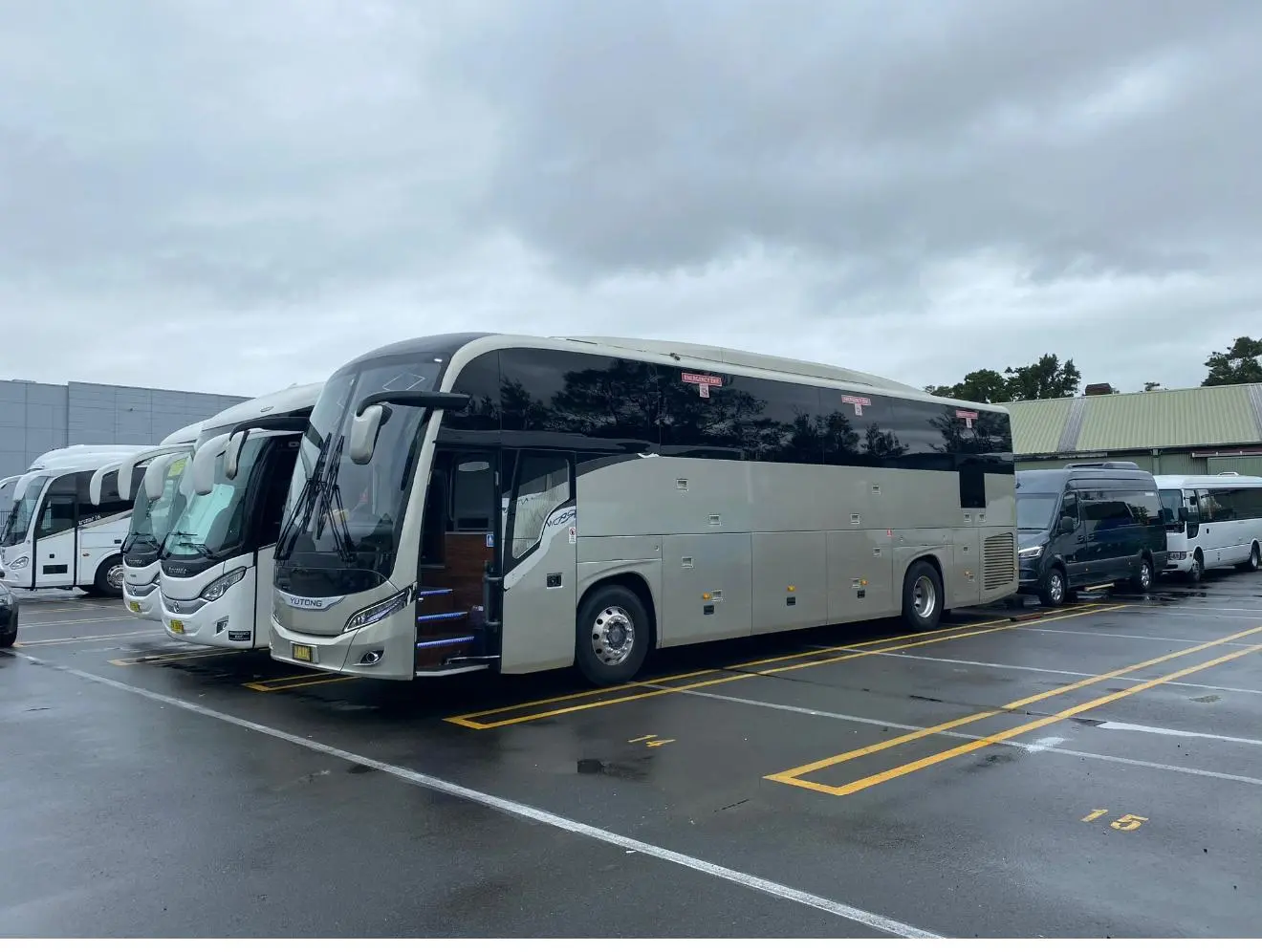
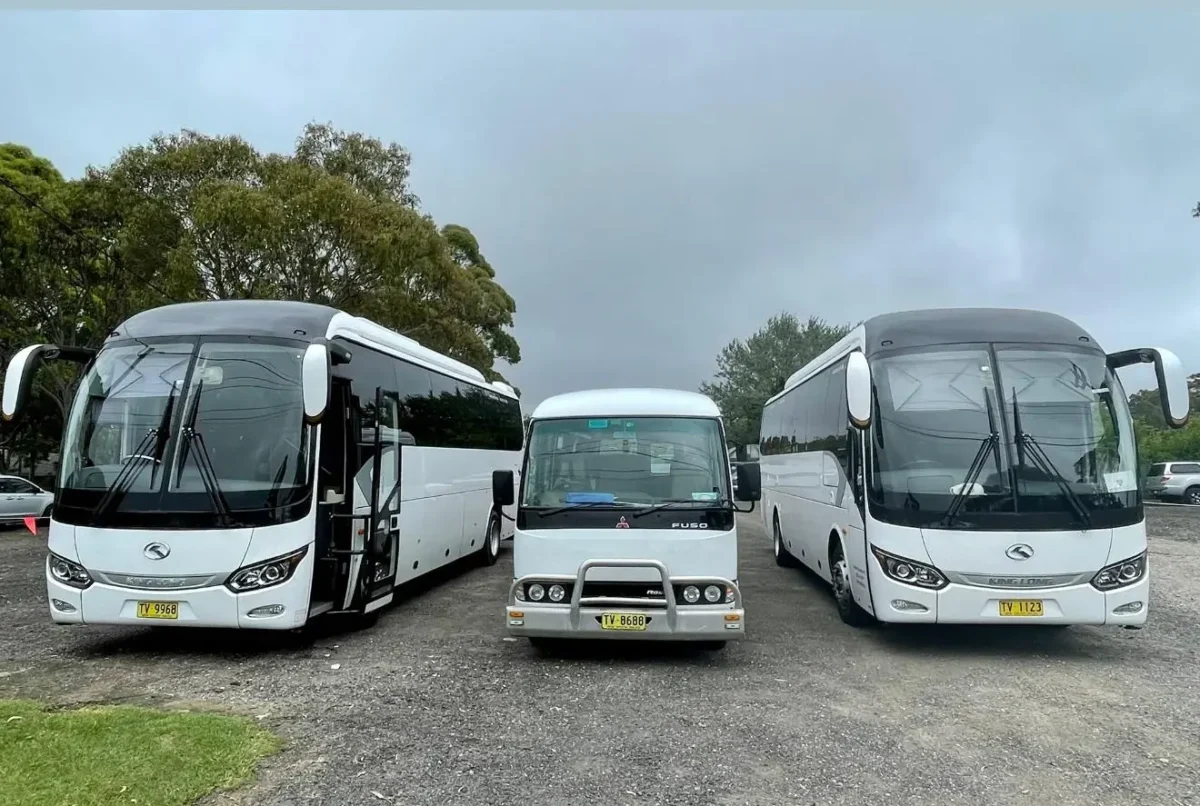
Two 27-seat midi-coaches from different builders can have very different underfloor volume. Bay depth, the position of the axles, the fuel and AdBlue tanks, whether a vehicle was specified for day work or touring work: all of it changes what goes underneath, and none of it is visible in the seat number on a fleet list.
This is why capacity questions get vague answers. An operator who has not yet allocated a vehicle to your date genuinely does not know which of several vehicles you will get. A confident bag number quoted before allocation is a guess wearing a uniform.
The number that matters is the one for the vehicle assigned to your dates, given in writing, after you have told the operator what you are carrying. Everything below is about getting to that point efficiently. The vehicles in our fleet and their seat counts run from a 7-seat Mercedes V-Class to a 53-seat executive coach, and the luggage answer differs across that range in ways the seat numbers do not signal.
Inventory what the group is actually carrying
Most organisers arrive with a headcount and a rough sense that there will be “bags”. That is not enough to size a vehicle. Ten minutes with the list below produces something an operator can act on.
Count each category separately. Do not average them.
| Category | What to count | Why it changes the answer |
|---|---|---|
| Checked cases | One line per case, noting how many are large (roughly 75 to 80 cm tall) versus mid-size | Large cases stack badly and waste bay volume around them |
| Cabin bags and backpacks | Total number | Often travel in the saloon on overhead shelves or at feet, so they may not compete for bay space |
| Soft bags and duffels | Total number | Compress and fill gaps, so they are the most bay-efficient item a group can carry |
| Hard cases and boxes | Number, plus longest dimension of each | A rigid item sets the minimum bay opening required |
| Oversized or awkward items | Itemise individually: bikes, boards, instrument cases, sporting kit, marquee poles, display stands | These are the items that decide whether a trailer is needed |
| Items that must stay with a passenger | Medical equipment, valuables, laptop bags, cabin pets in approved carriers | These reduce saloon space rather than bay space |
| Mobility equipment | Wheelchairs, walkers, folding scooters, plus whether each folds | Changes the vehicle specification, not just the volume |
Two things worth noting while you count. First, day bags and checked cases are not interchangeable: a group of 25 with day bags is a completely different job from the same 25 with a checked case each, even though the headcount and the vehicle would be identical. Second, count the return leg as well. Interstate sporting sides, school music tours and conference groups routinely go home with more than they arrived with.
Turn the inventory into a question an operator can answer
An organiser who sends a headcount receives an estimate. An organiser who sends an inventory receives a commitment. Adapt this and send it with your enquiry.
> Group of 24 passengers, Marrickville pick-up, one-way to Sydney Airport T1 on a Tuesday morning. > > Luggage: 24 large checked cases, 24 cabin bags carried on the person, plus 2 hard cases 1.2 m long. > > Please confirm in the written quote: > 1. Which specific vehicle is assigned to this date. > 2. Whether that vehicle’s luggage bay takes 24 large checked cases, or whether a second vehicle or a trailer is needed. > 3. Where the two 1.2 m hard cases travel. > 4. What happens if the group turns up with more than the stated count.
Every one of those questions has a factual answer. None of them can be answered honestly by a seat count alone, and an operator who answers all four in writing has told you something meaningful about how they run their business.
Our quotes name the vehicle rather than a model family, and come back within two business hours. That naming matters here more than anywhere else, because a listing like “11 to 14 seats” describes a range of vehicles with a range of bays.
When luggage becomes the binding constraint
Seats and luggage run out at different rates, and once luggage runs out first, the whole shape of the booking changes.
A group of 25 with day bags sits comfortably in a 27-seat executive midi-coach at $165 per hour on a four hour minimum. Give the same 25 people a checked case each and the seat count is still fine while the bay may not be. At that point the options are a larger vehicle, a second vehicle, or a trailer, and only the operator can tell you which is available on your date.
Three practical consequences follow.
Cost moves in steps, not smoothly. Moving up to a 48-seat luxury coach at $185 per hour for 25 passengers is buying bay space, not seats. A second vehicle is two drivers and two separate minimum hire blocks. Neither is a small increment, which is exactly why the question is worth asking three weeks out rather than three days out. Our published hourly rates and minimum hire let you price the alternatives before you commit.
Loading time is real time. A group with a case each takes longer to load and unload than a group with day bags, at both ends. On an hourly booking that time sits inside your window.
A trailer changes the vehicle’s dimensions. Sydney toll roads classify vehicles by length and height rather than by weight or axles, and the measurement includes anything towed. Class A is 12.5 metres or less in length and 2.8 metres or less in height; anything exceeding either limit is Class B. A vehicle that would have travelled as Class A can move into Class B once a trailer is on the back. Tolls are confirmed and priced separately from the hourly rate, so ask for that to be spelled out.
Where Sydney groups hit the limit first
Airport and cruise work is where the case-per-person reality bites, and Sydney adds a wrinkle that inland cities do not have.
At Sydney Airport, coach drop-off is kerbside at Departures level, but collection happens inside dedicated Ground Transport Zones rather than at the arrivals kerb. Your group walks to the vehicle with its luggage rather than the vehicle pulling up beside the group. That distance is trivial for a business group with cabin bags and considerable for a touring party with a trolley each, so build it into your timings.
Cruise terminal work is tighter again. At both the Overseas Passenger Terminal and White Bay, drop-off is capped under current published guidance at two minutes and the driver may not leave the vehicle. A group that has not pre-sorted its luggage will not load in that window.
For long runs out of Sydney, the practical question shifts from volume to access. A day trip to Katoomba, 105 km and around two hours each way on our operating figures, is a day-bag job for most groups. A multi-day Hunter Valley or Port Stephens booking is a case-per-person job, and it is worth confirming bay capacity at the same time you confirm the itinerary.
What to get in writing before you confirm
Five lines in the quote, and the luggage question is closed.
- The specific vehicle assigned, named rather than described as a range.
- The luggage capacity of that vehicle, stated as a figure the operator will stand behind.
- Where oversized items travel, itemised individually.
- Whether a trailer is available on your date and on that vehicle, and what it adds.
- What happens if the group arrives with more luggage than declared.
If an operator will not put those in writing, that is useful information about the booking, not just about the bags.
Frequently asked questions
How many suitcases fit under a coach?
It depends on the specific vehicle, and honest operators will say so. Bay volume varies between vehicles with identical seat counts, so the only figure worth relying on is the one confirmed for the vehicle assigned to your dates. Send your bag inventory and ask for that number in the written quote.
Do cabin bags count against luggage capacity?
Usually not in the same way. Cabin bags and backpacks that travel with passengers in the saloon compete for legroom and overhead space rather than for bay volume. Count them separately from checked cases so the operator can size both.
When do I need a trailer?
Trailers come up when a group carries oversized items that will not fit a bay opening, or when the volume exceeds what the vehicle carries underneath. Availability is vehicle-specific, so ask whether a trailer can be towed on the vehicle assigned to your booking rather than whether the business owns one.
Does a trailer change what I pay in tolls?
It can. Sydney toll classes are set by length and height, and the measurement includes anything towed, so a trailer can push a vehicle over the 12.5 metre Class A length limit. Tolls are confirmed and priced separately from the hourly rate, so ask for the toll treatment to be stated in the quote.
What if we turn up with more luggage than we declared?
That is the scenario worth pre-agreeing. Ask the operator what happens on the day: whether surplus items can be accommodated, whether anything travels in the saloon, and what gets left behind. Sorting this in the quote is far easier than sorting it in a Departures kerbside window.
Next step
Send your passenger count and your luggage count together, itemising anything oversized, and we will name the vehicle that fits both and put the luggage answer in the written quote. Quotes come back within two business hours, or call 02 9469 6600 and we will work through the inventory with you.
Sources
- Sydney Airport, “Resources for registered limousines, buses and coaches”, https://www.sydneyairport.com.au/corporate/partner-with-us/commercial-vehicles/resources-for-registered-limousines-buses-and-coaches. Accessed 7 September 2026.
- Linkt, “Vehicle class, Sydney”, https://www.linkt.com.au/help/travelling-toll-roads/vehicle-class/sydney. Accessed 7 September 2026.
- Port Authority NSW, “Overseas Passenger Terminal frequently asked questions”, https://www.portauthoritynsw.com.au/cruise/sydney-harbour/overseas-passenger-terminal-frequently-asked-questions. Accessed 7 September 2026.