For one to four people, the train to the Blue Mountains is usually the better answer. For twenty or more, the comparison stops being about the fare. A chartered coach costs more in total and less per head above a certain group size, and it removes the part of the day the train cannot help with: moving a whole group between Wentworth Falls, Leura and Katoomba on a schedule you control. Here is the arithmetic, and the point where it flips.
What the two options are actually being compared on
Almost every Blue Mountains guide online assumes a train, because almost every Blue Mountains guide online is written for a couple or a family. That assumption is fine at that size and quietly wrong at group size, because it compares the wrong two things.
The train is a fare. A coach is a day. The fare comparison is only half the decision, and it is the half that flatters the train.
The other half is what happens between stops. A group that arrives in the mountains by train has solved getting to the mountains and has not yet solved getting around them. A group that arrives by coach has solved both, and has also solved luggage, mixed mobility, the late runner, and the finish time.
The coach side of the arithmetic
Coach cost is knowable before you book, because the hourly rates are published and the quote comes back fixed and in writing with the vehicle named.
A Blue Mountains day is a full day. Katoomba is 105 km from Sydney on the operator’s published figures, about two hours each way, and about two and a half hours from the eastern suburbs or the northern beaches. With a driver sign-on before the pick-up and a depot return after the set-down, the vehicle is committed for roughly eleven hours.
The table below multiplies the published GST-inclusive hourly rate by an eleven hour day, then divides by a realistic load rather than a full one. It is an illustration of how the number behaves, not a quote. Tolls and parking, including the paid council bus and coach parking at Echo Point, are confirmed in advance and priced separately.
| Vehicle | Seats | Hourly rate | Eleven hour day | Realistic load | Indicative per head |
|---|---|---|---|---|---|
| Toyota Commuter | 12 | $110 | $1,210 | 12 | about $101 |
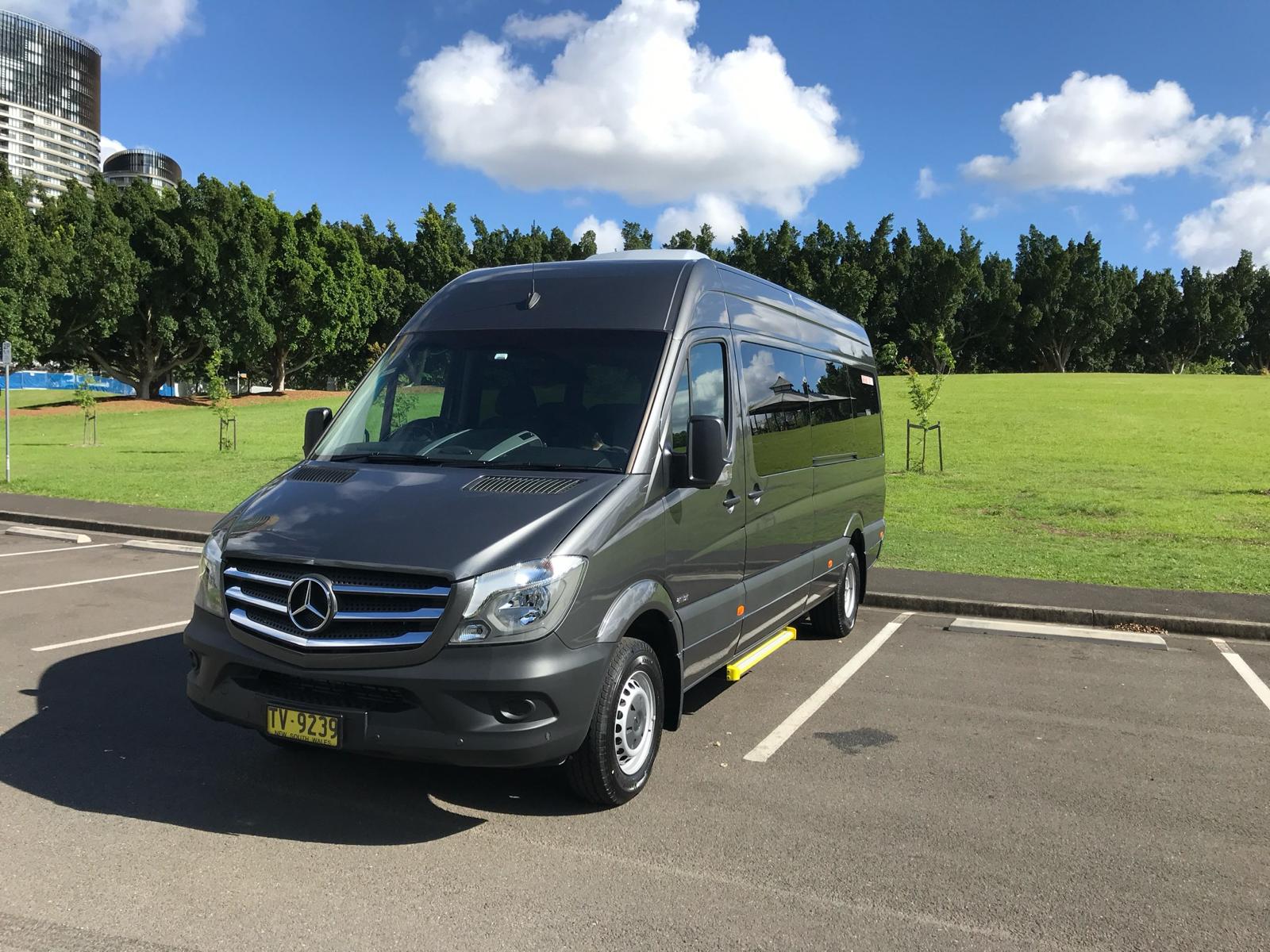
| Executive minibus | 21 to 24 | $145 | $1,595 | 22 | about $73 |
| Executive midi-coach | 27 | $165 | $1,815 | 25 | about $73 |
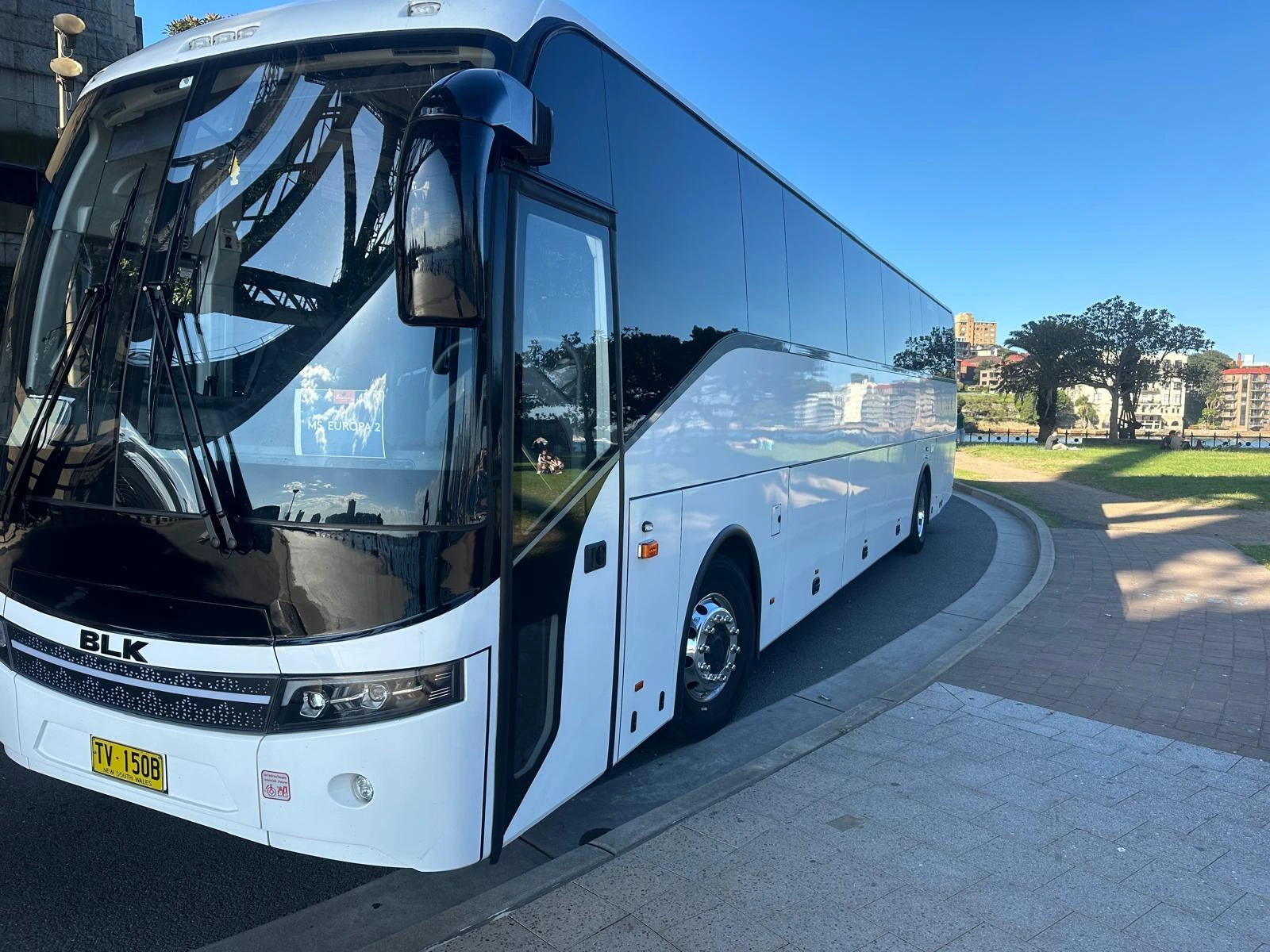
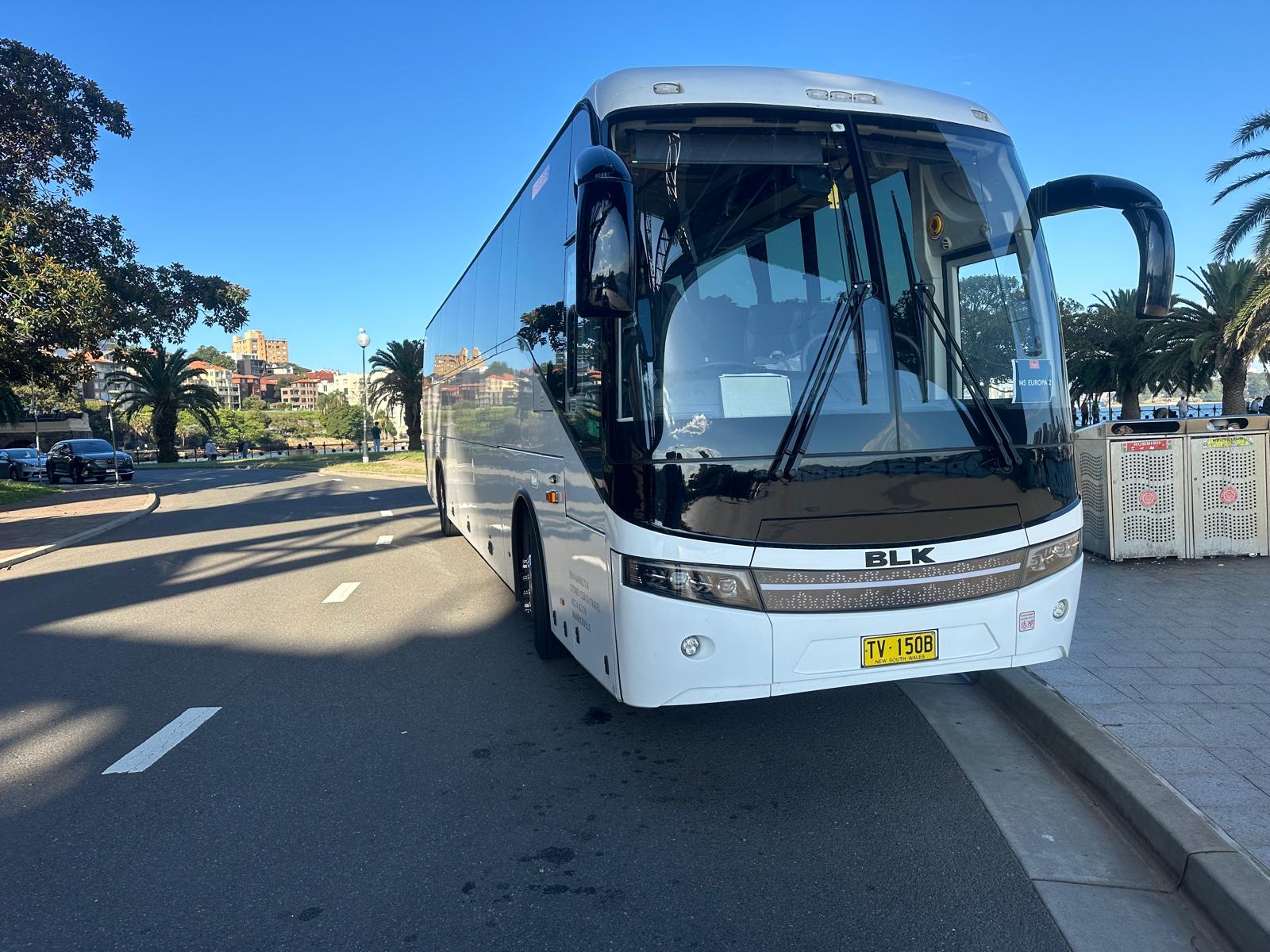
| Luxury coach | 48 | $185 | $2,035 | 45 | about $45 |
| Executive coach | 53 | $195 | $2,145 | 50 | about $43 |
Three things that table is telling you.
First, the per-head number falls steeply and then flattens. The expensive part of a charter is committing a vehicle and a driver for a day. Adding passengers to a vehicle you have already committed is close to free.
Second, the sharpest drop is between the minibus band and the coach band. A group of 22 pays roughly $73 a head. A group of 45 pays roughly $45. The group that should think hardest about this is the one sitting at 24 or 26 people, because it is paying midi-coach money for a load that has not yet earned the coach discount.
Third, a group of twelve in a Commuter is paying around $101 a head, and that is the size where the fare comparison genuinely matters.
The train side, and why this article will not put a number on it
Opal fares change, and they are capped and discounted in ways that depend on the day, the time and the traveller. Publishing a fare here would be publishing something that goes stale. Look up the current fare for your travel day and multiply by your head count. That is the whole calculation, and it will be flat: twenty people pay twenty times one fare.
Two timing facts are worth knowing before you do it. Opal fare peak times are Monday to Thursday excluding public holidays, 6:30 to 10:00am and 3:00 to 7:00pm. A weekday Blue Mountains day that leaves Sydney around 7:30am and comes home in the late afternoon sits inside both peak windows. The same trip on a Friday, a weekend or a public holiday does not, which is a real and often overlooked reason a group might move its date rather than its transport.
Where the train genuinely wins
Say this plainly, because a comparison that never concedes anything is not a comparison.
- One to four people. The per-head coach number at that size is not competitive and there is nothing clever to be done about it.
- A Katoomba-centred day. If the plan is one town, on foot, with no fixed return time, the train does the job.
- A group that cannot agree on a schedule. People who want to leave at different times should not be on the same vehicle.
- Budget as the dominant constraint, with a small group. Under about twelve people, fare beats flexibility for most social groups.
- A group of confident independent travellers going to one place. The coach earns its money on complexity, and a simple day has no complexity to buy back.
Where it stops working above twenty
The failure is not the journey out. It is the day itself.
Dispersal. A Blue Mountains day worth doing touches more than one place. Wentworth Falls, Leura and Katoomba are three separate destinations, and a group of thirty moving between them without its own vehicle is running three separate mini-logistics exercises, each with a straggler.
Arriving together. Twenty people making their own way to a station will not all be on the same service. A pick-up at a nominated address at a nominated time either happens or does not, and it is visible.
Access at the far end. A coach is not merely transport in the mountains, it is a parking strategy. Council operates paid bus and coach parking along Echo Point Road and Panorama Drive, banded by seat count. NPWS publishes that bus parking is available at Wentworth Falls, and that at Govetts Leap large buses should drop off and park near the Blue Mountains Heritage Centre. Those positions exist because coaches are expected there. Nothing equivalent exists for a group of thirty on foot with a lunch booking two suburbs away.
Gear and mixed mobility. Eskies, wet weather kit, a wheelchair user, someone who cannot manage a long walk, a school group’s supplies. Every one of those is a non-event on a chartered vehicle and a planning problem on a train.
The finish time. This is the one organisers underrate. On a charter, the finish time is a thing you negotiate at quote stage. On the train, the finish time is a timetable, and if half the group is still at lunch it becomes an hour of standing on a platform.
How to run this comparison for your own group
Four steps, in this order.
- Count the actual heads, not the invitation list. Per-head coach cost is entirely driven by this number, so a guess of “about forty” that turns into twenty-eight changes the answer.
- Look up the current Opal fare for your travel day and multiply. Note whether your day falls inside the Monday to Thursday peak windows.
- Get the fixed written charter quote. Ask for it against a named vehicle, with tolls and parking shown as separate confirmed lines rather than folded into an estimate.
- Price the gap, not just the difference. If the coach is dearer per head, ask what the gap is buying: how many between-stop movements it removes, whether it makes a second town possible, and what a controlled finish time is worth on the day.
If the answer to step four is “nothing much”, take the train. That happens, and an operator who cannot say so is not being useful.
What a coach changes about the day
The honest summary is that a coach does not make the Blue Mountains cheaper. It makes a more ambitious day possible for the same amount of daylight.
A train day is realistically one town well. A coach day is a lookout, an attraction, a village and a seated lunch, in an order that works, with the vehicle waiting where you left it. That is the trade, and the group size is what decides whether it is worth paying for.
For the published distance, driving time and route detail, see a chartered coach from Sydney to the Blue Mountains. To sanity-check the per-head arithmetic against the current rate card, how Sydney bus and coach hire is costed and seat counts across the fleet have the inputs.
Frequently asked questions
Is it cheaper to take a group to the Blue Mountains by train or by coach?
By total spend, the train, almost always. By spend per head, a coach closes the gap fast as the group grows, because the cost of committing a vehicle and driver is fixed and the passengers are close to free. Run both numbers for your actual head count rather than assuming.
At what group size does a coach start to make sense?
There is no single number, but the shape of the curve is clear. Under about twelve people the fare comparison usually decides it. Between about twenty and thirty the decision turns on how many stops your day has. Above about forty the per-head coach cost is low enough that the day’s complexity usually decides it instead.
Do Opal caps change the comparison?
They can, and they are exactly the kind of figure that goes stale, so this article does not state them. Check the current fares and caps for your travel day on the Transport for NSW site, and note that Opal fare peak times run Monday to Thursday excluding public holidays, 6:30 to 10:00am and 3:00 to 7:00pm.
Can a coach actually park at the Blue Mountains lookouts?
At the main ones, yes, with conditions. Blue Mountains City Council operates paid bus and coach parking on Echo Point Road and Panorama Drive, banded by seat count. NPWS publishes that bus parking is available at Wentworth Falls, and that large buses at Govetts Leap should drop off and park near the Blue Mountains Heritage Centre. Confirm the current Echo Point arrangements before you travel, because Council has a booking and payment system scheduled for that site.
Does a coach have to be booked for a minimum number of hours?
Minimum hire is four hours for midi-coaches and full-size coaches and three hours for minibuses and people movers. A Blue Mountains day runs far longer than either, so the minimum is not the constraint on this trip.
Next step
Give us your real head count, your pick-up suburb and the date, and we will send a fixed written quote against a named vehicle so you can put a proper per-head number next to the Opal fare. If the arithmetic says take the train, we will tell you that too. Call 02 9469 6600 or send the trip details and the quote comes back within two business hours.
Sources
- Transport for NSW, “Opal peak and off-peak fares”, https://transportnsw.info/tickets-fares/fares/opal-peak-off-peak-fares. Accessed 7 September 2026.
- Blue Mountains City Council, “Visitor Bus Management Plan”, https://www.bmcc.nsw.gov.au/documents/visitor-bus-management-plan. Accessed 7 September 2026.