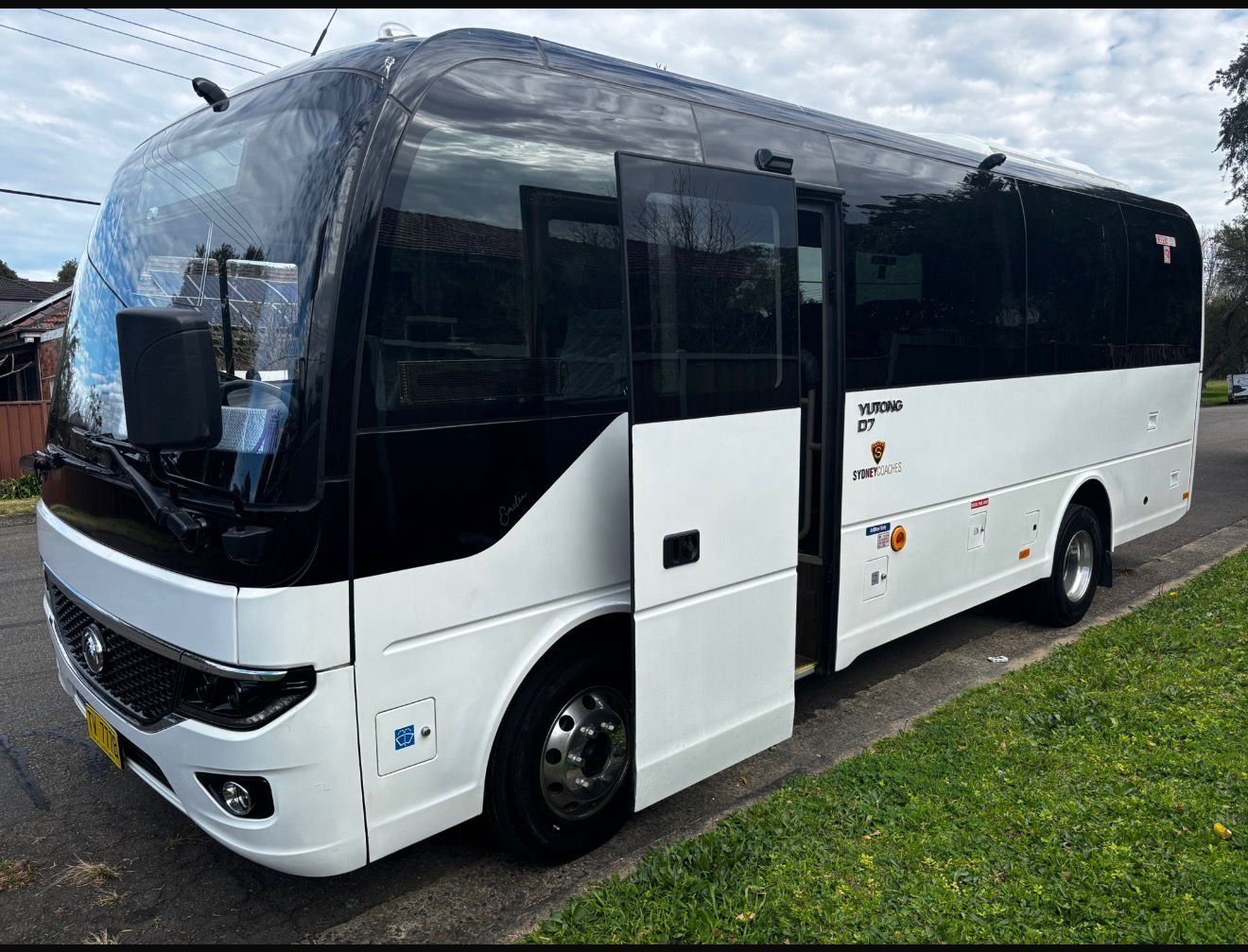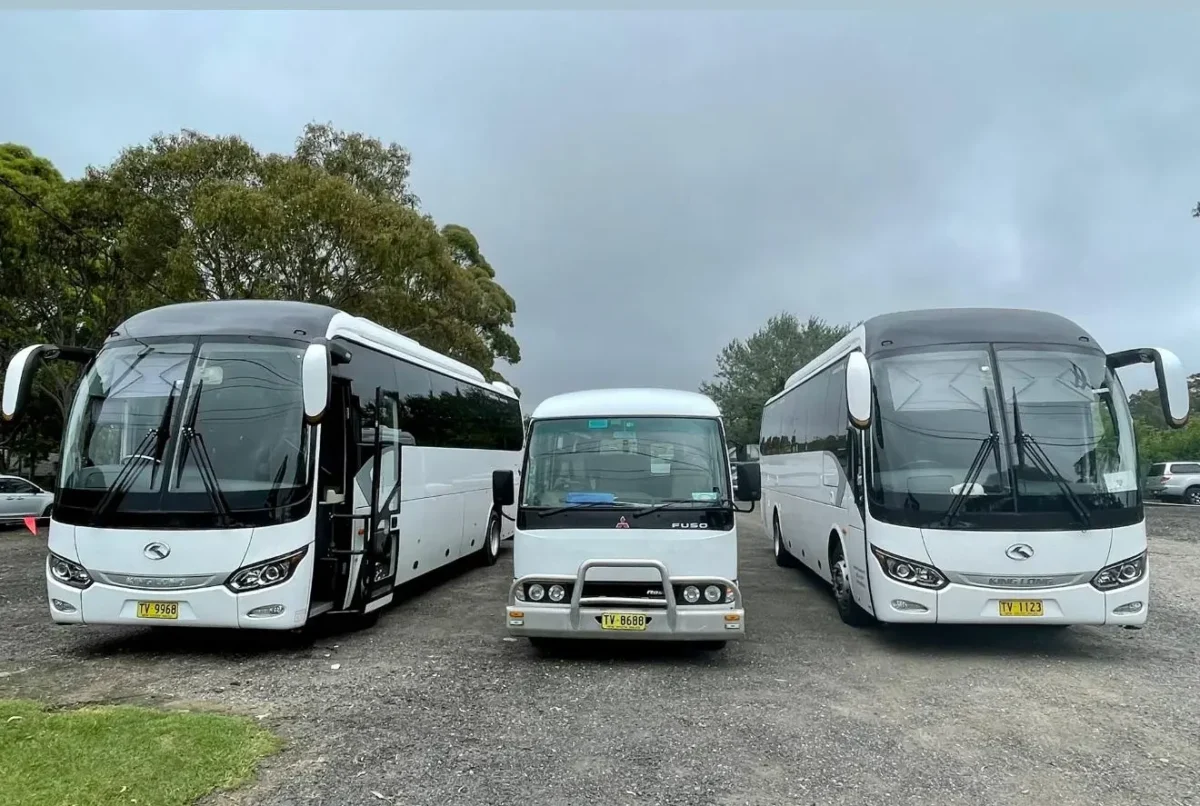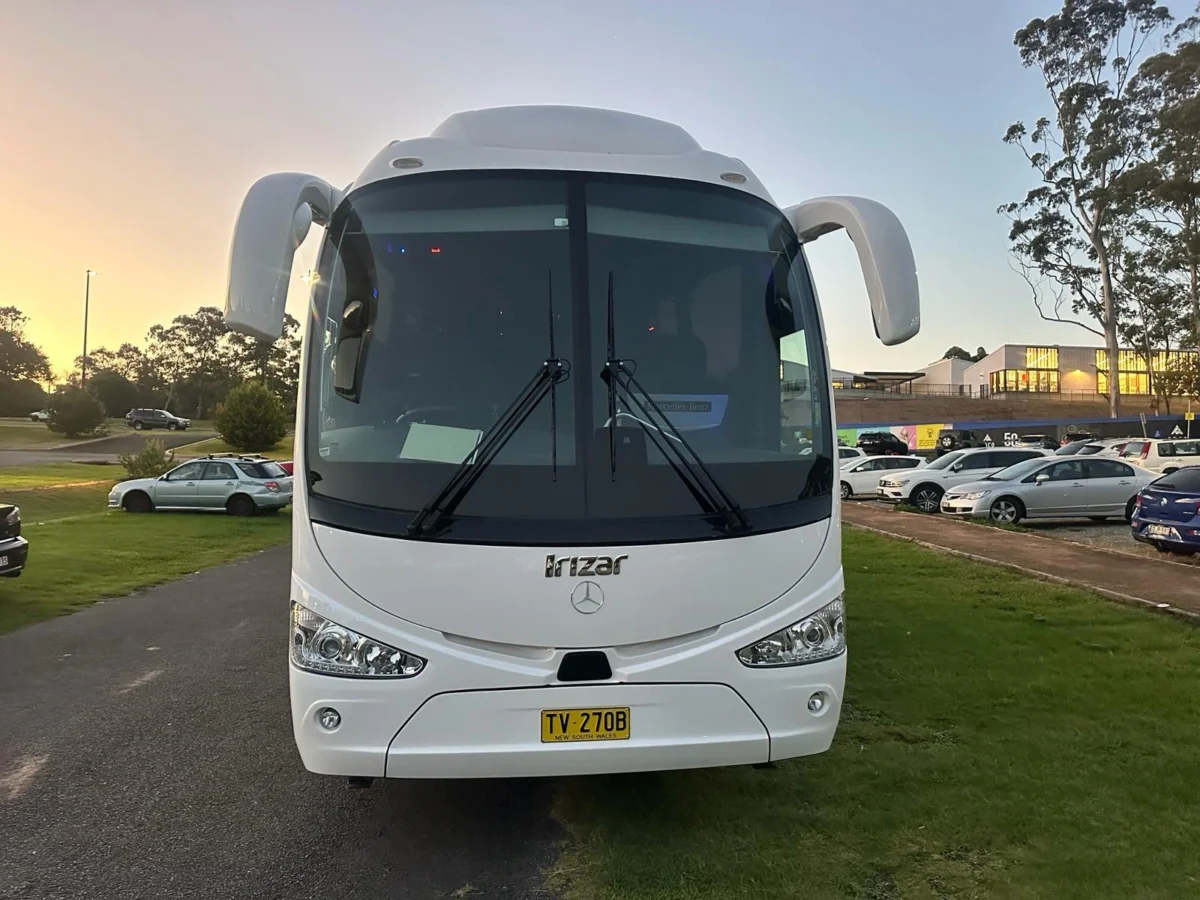
A multi-venue night runs on arithmetic, not enthusiasm. Every stop costs roughly 20 minutes of overhead at each end on top of the time inside, so a four-hour booking with four venues leaves under 40 minutes at each. Three stops is the honest ceiling for a group of 20 or more. And in Sydney the route has to be built around where a coach can lawfully set down, because a coach may stop in a bus zone to drop off and pick up but never to wait.
The arithmetic nobody does before booking
Start with the booked hours, then subtract before you add.
A stop is not the time in the venue. It is the approach through traffic, the set-down, the walk in, the walk back out, the round-up of people who are mid-conversation, the boarding, and the departure. On a group of 20 or more that overhead is rarely under 20 minutes at each end even when nothing goes wrong.
Run the numbers against your booked window before you promise anyone a route.
| Booked hours | Venues | Overhead at 20 min each end | Time actually inside each venue |
|---|---|---|---|
| 4 | 2 | 80 min | Around 80 min each |
| 4 | 3 | 120 min | Around 40 min each |
| 4 | 4 | 160 min | Around 20 min each |
| 5 | 3 | 120 min | Around 60 min each |
| 5 | 4 | 160 min | Around 35 min each |
Twenty minutes inside a venue is not a stop, it is a queue for the bar. That is the row where most multi-venue nights break, and the fix is either fewer venues or more hours, not optimism.
Note also that the pick-up loop at the start eats the same budget. If the group is collected from three suburban points, the first hour of a four-hour booking is gone before the first venue.
Three stops is the honest ceiling
For a group of 20 or more, plan three venues and be pleased if you manage a fourth. For a group under 12, four is achievable because boarding is genuinely faster.
Two adjustments make three stops feel like more.
Cluster the middle. Put two of the three venues within short walking distance of each other so the coach makes one set-down and one pick-up for both. The vehicle movement between them is where the time goes, not the walk.
Front-load the travel. If one venue is further out, make it the first or the last, not the middle. A long leg in the middle of the night is the one that people notice and that eats the schedule.
Set each stop as a departure time rather than a duration. “We leave at 9.40pm” is a plan. “About an hour here” is a suggestion, and it will be treated as one.
Where the coach waits between venues
This is the constraint that reshapes Sydney routes, and it is the one organisers almost never plan for.
Under NSW Road Rules 2014 rule 183, a coach may stop in a bus zone to set down or pick up passengers, because the NSW Dictionary defines a public bus as including a coach. It is set-down and pick-up only. Waiting and layover are not permitted, and the sign at the zone still governs.
On top of that, the City of Sydney’s Central Sydney On-Street Parking Policy states that the City will not accommodate long-stay coach lay-over on-street in central Sydney. So there is no on-street answer to “where does the bus sit for the 90 minutes we are inside”.
That leaves two models, and you should choose one deliberately.
The coach stays with the group. It is booked continuously, the driver moves it to somewhere it can lawfully sit, and it is back at each published departure time. You pay for the full span, including the waiting, and you keep the ability to move early.
The coach is released and returns. It drops the group, leaves, and comes back at a fixed published time. Cheaper on the clock, but the time is fixed and there is no early departure.
For an operator, Transport for NSW runs the King Street Wharf Bus and Coach Layover, accessed via Lime Street, open 24 hours a day with a maximum stay of 24 hours, restricted to accredited bus and coach operators with prior registration. That is an operator arrangement rather than something a group organiser books, but it is a reasonable thing to ask about when you want to know where the vehicle will actually be.
Planning around Sydney’s precincts
Sydney’s drinking precincts are not equally friendly to a full-size vehicle, and the differences are about street width, turning room and how far the lawful set-down point is from the door.
Two things are worth knowing before you sketch a route.
George Street through the CBD is not a route. It is a pedestrian boulevard, a car-free path running from Haymarket to Circular Quay, with extension works staged along it. A route that assumes a coach can run the spine of the city centre does not work, and the practical consequence is that CBD and Rocks venues are reached from cross streets rather than from George Street itself.
Narrow inner-city strips are set-down problems, not access problems. The vehicle can usually get near a precinct. What it often cannot do is stop directly outside a particular door on a busy single-carriageway strip at 10pm. That is normal and it is manageable, provided you plan the set-down point rather than assume it.
The method for every precinct is the same, and it is three questions asked of each venue in writing before the night.
- Where can a full-size vehicle legally set down and pick up near you, given as a street address?
- Does that change late at night or on a Saturday?
- How far is the walk from that point to your door, in metres?
Then publish the answer to your group as an address plus a landmark. A 100 metre walk to a set-down point that clearly works beats a coach circling a block while 25 people stand on a footpath.
The rules on board
Sydney Buses & Coaches publishes a clear position. Food and non-alcoholic drinks are fine on all vehicles. Alcohol is permitted on private function bookings by prior arrangement only, and never on school or youth charters. A multi-venue night for adults is a private function booking, so the arrangement is available, but it is agreed as part of the booking rather than assumed.
Where seatbelts are fitted, wearing them is mandatory in NSW for every passenger aged 16 or over, and it is enforceable against the passenger. The driver retains the final say on the vehicle at all times, which is worth telling your group before the night rather than explaining at the third stop.
Handling people who drop out
On a multi-venue night, some of the group will leave early, and a few will simply not be at the kerb. Plan for it rather than discovering it.
- Publish the departure time at every stop, out loud and in a group message, at the moment you arrive.
- Nominate two head-counters who are not hosting anything, and give them the list.
- Agree the rule in advance: the coach leaves at the published time, and anyone not there makes their own way to the next venue.
- Nominate one person who will stay behind if someone genuinely needs help, so the answer is never “the whole bus waits”.
- Publish the final drop-off order at the start of the night, not at the end.
- Take the headcount before boarding, not after, so a missing person is found on the footpath rather than three suburbs later.
The published time is the only tool that works. A group that knows the vehicle leaves at 10.15pm behaves differently from a group that believes it leaves when everyone is ready.
Before you request a quote
Write down the date, the pick-up points as street addresses with a passenger count for each, the venues in order with an arrival and a published departure time for each, whether the vehicle stays or is released, the final drop-off order, whether alcohol will be carried, and one named contact who is not the guest of honour.
That is what an operator needs to price the night. For the vehicle, party and function bus hire in Sydney is the place to start, how charter hours are counted explains the stay-or-release difference, and if the night begins out west of the city, charter pick-ups across the Inner West covers that area.
Frequently asked questions
How many venues can you fit into one night?
Three is a realistic ceiling for a group of 20 or more. Each stop costs around 20 minutes of overhead at each end on top of the time inside, so four venues inside a four-hour booking leaves roughly 20 minutes at each, which is not a stop.
How long should you spend at each venue?
Set a departure time rather than a duration, and aim for 40 to 60 minutes inside as the working minimum for a group that has to be rounded up. Anything shorter is a queue at the bar and a walk back to the kerb.
Does the bus wait outside while we are inside?
Only if you book it that way. A coach may stop in a bus zone to set down or pick up but not to wait, and the City of Sydney will not accommodate long-stay coach lay-over on-street in central Sydney. So the vehicle is either booked continuously and moved to somewhere lawful between stops, or released and brought back at a published time.
Can we drink on board between venues?
Alcohol is permitted on private function bookings by prior arrangement only, and never on school or youth charters. Food and non-alcoholic drinks are fine on all vehicles. Agree it when you request the quote rather than at the kerb.
What happens if someone is not at the bus?
Decide the rule before the night. The workable version is that the coach leaves at the published time, one nominated person stays behind if there is a genuine problem, and everyone else makes their own way to the next venue. Holding a full vehicle for one person destroys the rest of the schedule.
Can a coach get to Sydney CBD venues on George Street?
Not along George Street itself, which is a pedestrian boulevard running from Haymarket to Circular Quay with works staged along it. CBD and Rocks venues are reached from cross streets, so ask each venue where a full-size vehicle can legally set down nearby and publish that address to your group.
Next step
Send the date, the pick-up suburb, the group size and the venues you have in mind. You will get a fixed written quote back within two business hours with the vehicle named and the hours set out against a route that fits the time.
Start with party and function bus hire in Sydney or call 02 9469 6600, Monday to Friday 7am to 6pm or Saturday 8am to 2pm.
Sources
- NSW Government, Road Rules 2014 (NSW), rule 183 and Dictionary, https://legislation.nsw.gov.au/view/html/inforce/current/sl-2014-0758. Accessed 7 September 2026.
- City of Sydney, Central Sydney On-Street Parking Policy, https://www.cityofsydney.nsw.gov.au/-/media/corporate/files/publications/policies/central-sydney-street-parking-policy/central-sydney-on-street-parking-policy_0525.pdf. Accessed 7 September 2026.
- Transport for NSW, King Street Wharf Bus and Coach Layover, https://www.transport.nsw.gov.au/operations/roads-and-waterways/business-and-industry/buses/operators/king-street-wharf-bus-and. Accessed 7 September 2026.