Gosford is about an hour from central Sydney by car and Terrigal about 90 minutes. The 45-minute figure that circulates is measured from Sydney’s northern boundary, not the CBD, so it is not a number any group should plan around. For a coach the day turns almost entirely on the M1 and on the NorthConnex mandate, which routes a full-size coach through the tunnel whether the driver wants to or not.
How far it really is
Visit NSW publishes about an hour to Gosford and about 90 minutes to Terrigal. Those are the working figures.
The 45-minute claim you will find in marketing material is not wrong so much as measured from somewhere your group is not. It starts at Sydney’s northern boundary. If the group is assembling in Parramatta, Bondi or Cronulla, add the Sydney leg before anything else.
Then add the coach adjustments. Any vehicle over 4.5 tonnes GVM is capped at 100 km/h in NSW regardless of a higher posted limit, so a coach does not travel the M1 at car speed. A group run needs a comfort stop. And the day starts at your pick-up address, not at the CBD marker the tourism figure is measured from.
None of that makes the Central Coast a bad day trip. It is one of the closest destinations Sydney has. It just means the honest planning figure for a coach is longer than the brochure figure, and the difference is worth about an hour across the round trip.
The NorthConnex rule that decides your route
This is the fact that separates a coach trip north from a car trip north, and almost no destination guide mentions it.
Under the Pennant Hills Road regulation, buses over 12.5 metres long or over 2.8 metres high travelling between the M1 and the M2 must use the NorthConnex tunnel, unless they have a genuine destination that can only be reached via Pennant Hills Road. There is no exemption list and no application process. Two camera gantries enforce it.
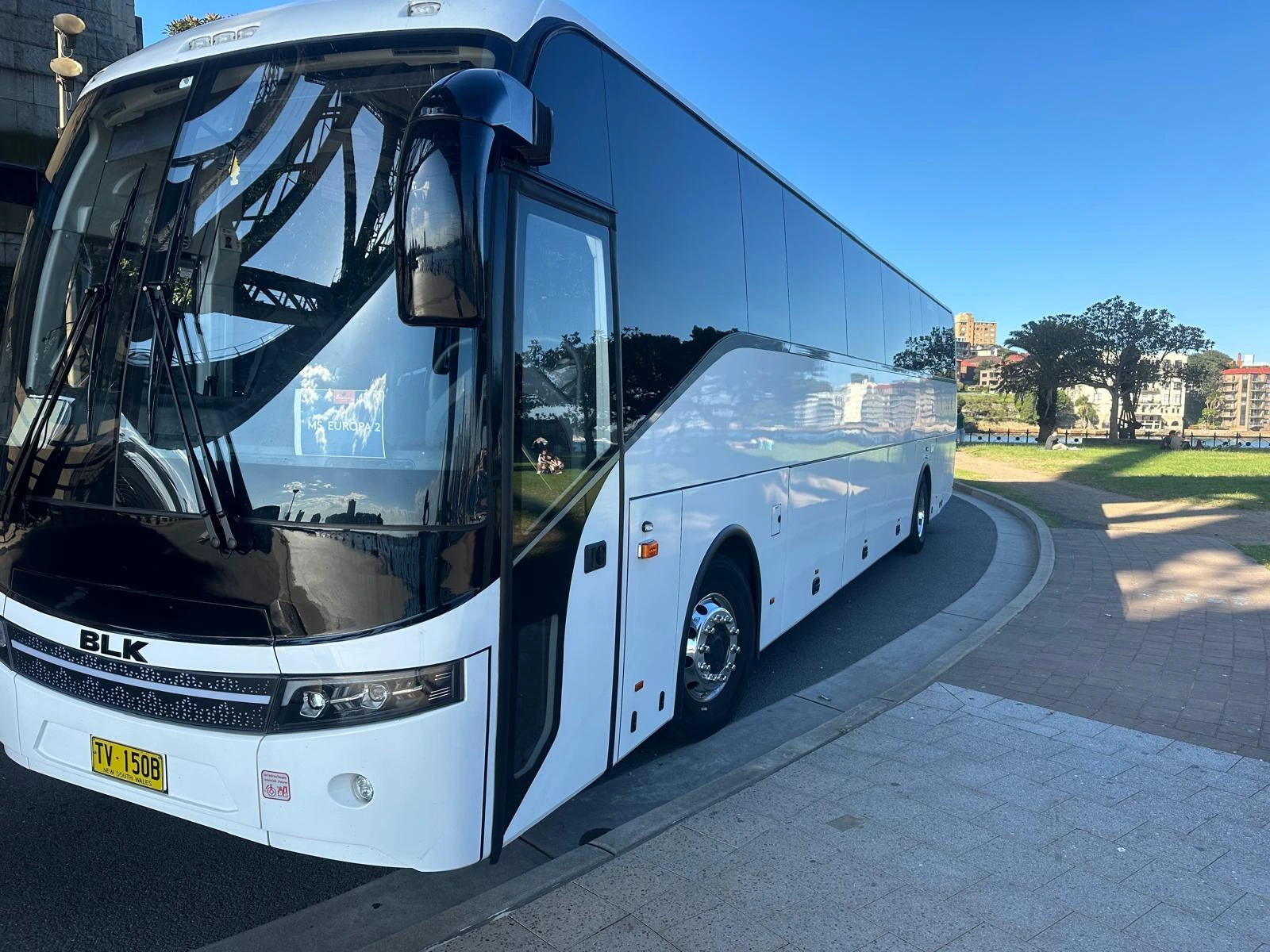
A full-size coach is over 2.8 metres high. So for practical purposes, the route is chosen for you.
Three things follow.
The tunnel has its own speed regime. NorthConnex is limited to 80 km/h, with average-speed cameras for heavy vehicles. That is not a place where time gets made up.
The toll is a Class B toll. Sydney toll roads classify by dimension, and any vehicle exceeding 12.5 metres in length or 2.8 metres in height is Class B. On NorthConnex and the Hills M2 the Class B rate is three times Class A, so a northbound coach run carries a meaningfully different toll profile from the same trip in a car. Tolls are confirmed in advance and quoted separately, so ask for them itemised.
Clearance is not an issue for a standard coach. NorthConnex is 5.1 metres and the Hills M2 is 5.0 metres. It only becomes a question if the vehicle carries roof-mounted equipment, in which case measure the vehicle including it.
If your group is close to the size boundary, this is a genuine reason to look at the vehicle sizes we run before booking. A shorter, lower vehicle has route options a full-size coach does not.
When to leave, and why it matters more here than anywhere else
The Central Coast day trip has a short travel leg and a long exposure to Sydney traffic. That is an unusual combination, and it means departure timing has more leverage on this trip than on almost any other.
Be careful with claims about peak hour. Transport for NSW’s traffic volume reporting defines the weekday AM peak as 6:00 to 10:00am and the PM peak as 3:00 to 7:00pm for data purposes. That is a measurement convention, not official advice on when to travel, and there is no official Transport for NSW definition of Sydney peak hour for road users. Use it as a rough shape, not a promise.
Also worth knowing for the Sydney end of the run: most school zones operate at 40 km/h between 8:00 and 9:30am and again between 2:30 and 4:00pm on notified school days, and the sign always governs. A suburban pick-up run through those windows is slower than the map suggests.
| Departure from Sydney | What the group gets | Trade-off |
|---|---|---|
| Before 7:00am | The cleanest run north and a full day at the coast | Early call time, and after-hours loading may be quoted separately |
| 7:00 to 9:30am | The most common choice | Sits inside the morning traffic build and the school zone window |
| After 9:30am | Easier on the group, and clear of school zones | Arrival close to midday, which shortens the day at the coast |
| Return before 2:30pm | Beats the afternoon build entirely | Feels early to a group that is enjoying itself |
| Return 3:00 to 7:00pm | What most groups actually want | The slowest window in both directions |
The pattern is the one every Sydney organiser eventually learns. An hour saved on the return leg is worth more to the group than an hour gained at the destination, because the return hour is spent sitting still.
Where a coach can actually stop
Here the honest answer is short. No coach parking or coach set-down arrangement for Gosford, Terrigal, The Entrance or the Central Coast beachfronts appears in our verified sources. Central Coast Council does not publish one that we have been able to confirm.
That is not a reason to avoid the destination. It is a reason to fix your stops before you book, not on the day.
- Choose one anchor location for the group rather than three loose ones.
- Ask the venue, club or beachfront facility directly whether a coach can set down at the front and where the vehicle then goes.
- Decide whether the coach stays or is released, and have both priced.
- Give the operator a street address for the set-down, with a cross street.
- Keep the walk from the set-down to the group’s actual destination short, especially for a seniors or school group.
Beachfront kerb space in summer is the constraint nobody plans for. If the trip is in January, assume the obvious stop will be busy and pick a second one in advance.
Day trip or overnight
The Central Coast is comfortably a day trip, which is precisely why the overnight question gets skipped.
Run it as a day trip when the group has one anchor activity, a booked lunch and a defined return time. Roughly two to three hours of round-trip travel against a full afternoon at the coast is a good exchange.
Consider an overnight when the group has two activities that both want the middle of the day, when the trip includes an evening function, or when the return would otherwise land in the late-afternoon window. On a multi-day booking, driver accommodation is confirmed in advance and priced separately, so ask for the overnight version quoted alongside the day version and compare the two properly.
For a group weighing a few destinations at once, the same maths applied to Wollongong at 80 km and 80 minutes is worth a look before you commit.
Frequently asked questions
How long does it take to get from Sydney to the Central Coast?
Visit NSW publishes about an hour to Gosford and about 90 minutes to Terrigal, measured from central Sydney by car. A coach is capped at 100 km/h, needs a comfort stop on a group run, and starts at your pick-up address, so allow longer than the published figure.
Is the Central Coast really 45 minutes from Sydney?
Not from the CBD. The 45-minute figure is measured from Sydney’s northern boundary. From central Sydney the published figures are about an hour to Gosford and about 90 minutes to Terrigal.
Does a coach have to use the NorthConnex tunnel?
Between the M1 and the M2, yes, for buses over 12.5 metres long or over 2.8 metres high, unless the destination can only be reached via Pennant Hills Road. There is no exemption list and no application process, and two camera gantries enforce it. A full-size coach is over 2.8 metres high.
Where can a coach park at Terrigal or Gosford?
No coach parking arrangement for either is published in our verified sources. Confirm the set-down point with your venue and with Central Coast Council before the day, and agree with the operator whether the vehicle stays or is released.
Is the Central Coast better as a day trip or an overnight?
A day trip works well with one anchor activity and a fixed return time. Go overnight if the group wants two full activities, an evening function, or to avoid a late-afternoon return. Ask for both versions quoted so the difference is visible.
Next step
Send the pick-up suburb, the date, the group size and where on the coast you are heading, and you will get a fixed written quote back within two business hours with the vehicle named, the tolls itemised and the departure time set for the traffic rather than for the brochure.
Call 02 9469 6600, Monday to Friday 7am to 6pm or Saturday 8am to 2pm, or start from the NSW charter routes we run. Summer weekends book out early, so allow four to eight weeks over December and long weekends. It is also worth reading how tolls and parking are quoted before comparing two quotes on this route, because the northbound toll profile is not trivial.
Sources
- Transport for NSW, Pennant Hills Road heavy vehicle road access, https://www.transport.nsw.gov.au/operations/roads-and-waterways/business-and-industry/heavy-vehicles/road-access/pennant-hills-road. Accessed 7 September 2026.
- Transport for NSW, Using Sydney’s tunnels, https://www.transport.nsw.gov.au/operations/nsw-roads-network/using-sydneys-tunnels. Accessed 7 September 2026.
- Transport for NSW, School zones, https://www.transport.nsw.gov.au/roadsafety/community/schools/school-zones. Accessed 7 September 2026.
- Linkt, Vehicle classes on Sydney toll roads, https://www.linkt.com.au/help/travelling-toll-roads/vehicle-class/sydney. Accessed 7 September 2026.