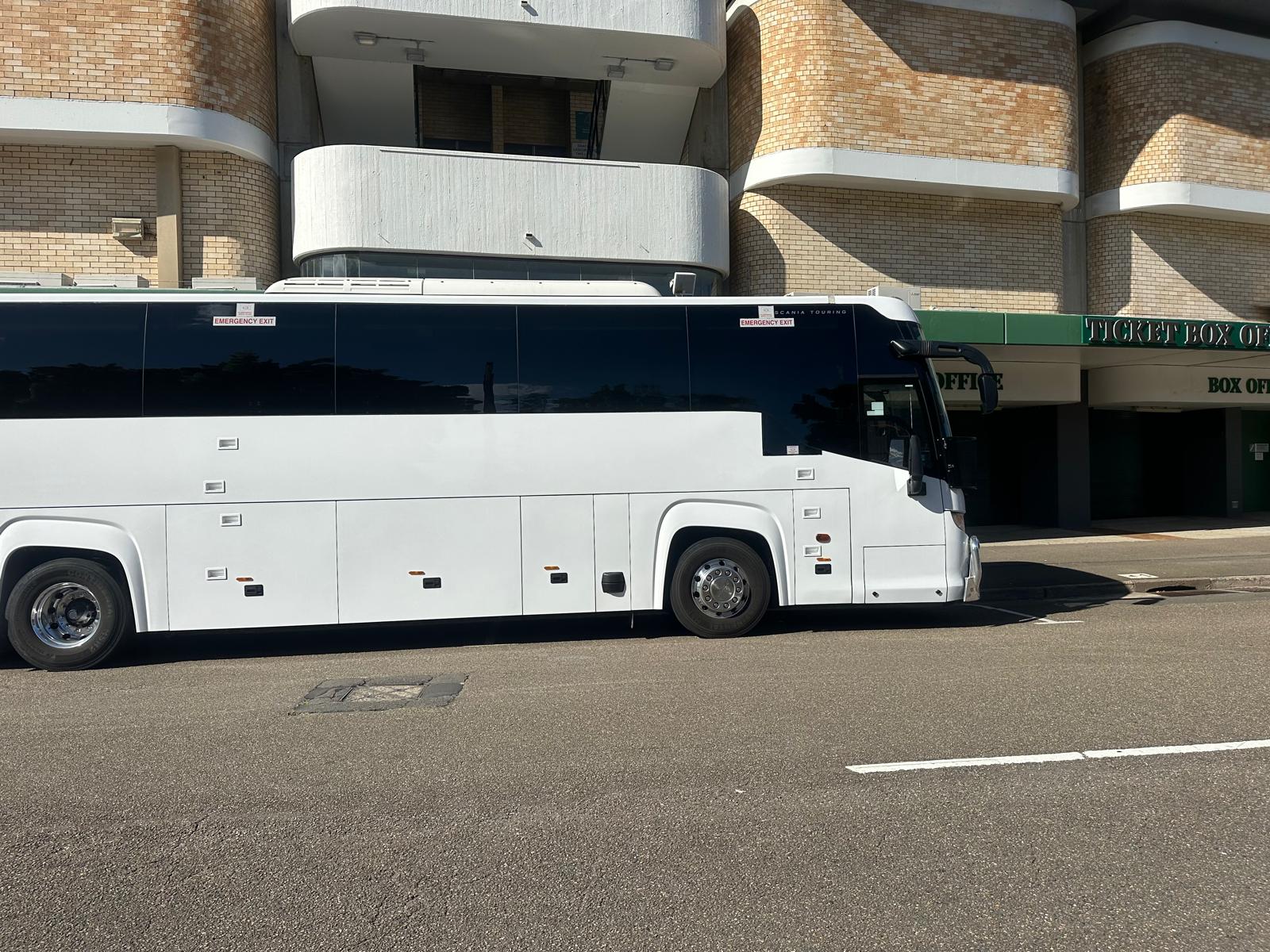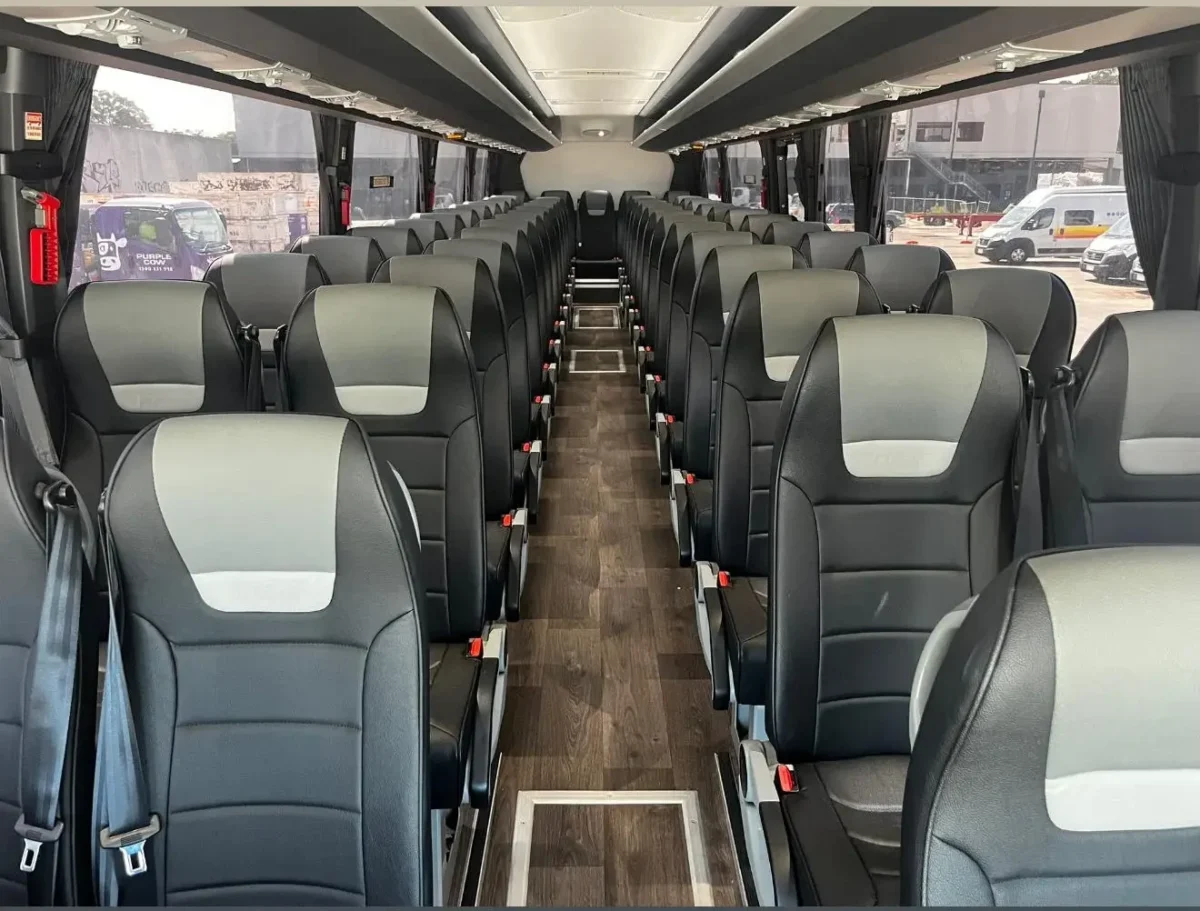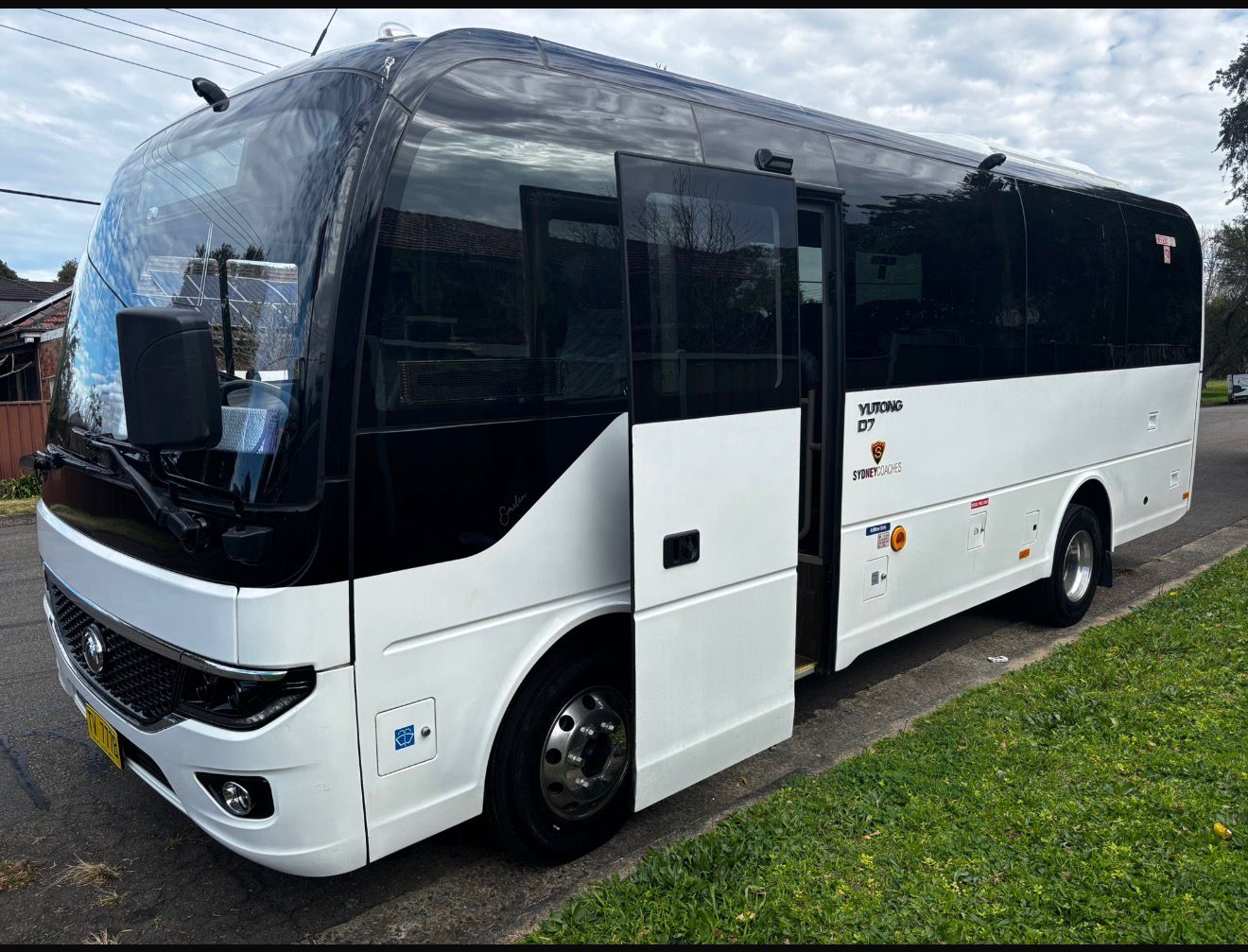
Group transport to a concert or festival is planned backwards. The trip in is easy: arrivals spread themselves across two or three hours and nothing is under pressure. The trip out is the entire job, because everyone leaves at once, phone reception in a dense crowd is unreliable, and a group that has not been given a meeting point and a published departure time will not assemble. Fix the return first, then work back to the pick-up.
Why the outbound leg is not the problem
An arrival has slack built into it. If the group leaves 15 minutes late, most of that is absorbed by the fact that nobody has to be in a seat at a precise moment. Doors open before the event starts, and people trickle in.
A departure has no slack at all. The event ends, and every person in the venue moves in the same direction at the same moment. Your group is inside that, trying to find each other, in the dark, with tired legs and a phone battery that has been streaming all night.
That asymmetry is why the return has to be designed rather than assumed. In practice it means writing the return plan first, publishing it before the event, and letting the outbound schedule fall out of it.
You cannot know the egress time, so plan a window
Here is the honest position: no Sydney venue publishes a figure for how long it takes a crowd to clear, and anyone who quotes you one is guessing. Egress depends on the event, the crowd size, the weather, whether an encore runs long, and how the precinct’s traffic management is set up that night.
So do not plan a departure time. Plan a departure window, and give it a floor.
The business’s own published figure for a stadium shuttle run is around 16 km taking somewhere between 20 and 60 minutes depending on conditions. Post-event traffic sits at the slow end of that range, not the fast end. Build every return leg on the slow number.
Three practical consequences follow.
Publish a departure time that is later than the event’s advertised finish, not equal to it. A group standing at a kerb for 25 minutes is a much better outcome than a coach idling in a bus zone it is not allowed to wait in.
Publish two departures for a group over about 30. An early one for the people who want to beat the crowd, and a later one for the people who will stay to the end. This single change removes most of the pressure from the return leg.
Book the vehicle for a window, not a time. Waiting time beyond the booked window is confirmed in advance and priced separately, so an honest window in the quote is cheaper than an optimistic time plus an overrun.
What the venues actually publish
Several of Sydney’s major event venues publish coach arrangements, and those arrangements constrain the return leg more than they constrain the arrival.
Sydney Olympic Park, serving Accor Stadium and Afterpay Arena, directs coaches to Coach Pod C off Edwin Flack Avenue, accessed from Uhrig Road via Carter Street. Access is pre-booked as an Ebusticket through the Sydney Olympic Park Authority, valid only for the date and location shown, non-refundable except on event cancellation, and bookable only from within Australia. The booking window closes at 11.59pm the day before the event. Sydney Olympic Park is a restricted parking area, so vehicles must sit wholly within marked bays.
That cut-off is a return-leg issue as much as an arrival issue. If the booking is not made by 11.59pm the night before, the arrangement is not in place for either end of the day.
Allianz Stadium publishes that during events, private coaches should access Driver Avenue via Lang Road rather than Moore Park Road, and that coaches may park at the southern end of Driver Avenue if space is available. Availability-based is not reservable. Plan the return on the basis that the space might not be there, and ask the operator where the vehicle will actually be if it is not.
ICC Sydney publishes coach drop-off at Iron Wharf Place off Darling Drive, with coach parking arranged through a dedicated ICC Sydney Event Manager rather than booked online.
Away from venues with published arrangements, the road rule governs. A coach may stop in a bus zone to set down or pick up passengers under NSW Road Rules 2014 rule 183, but it may not wait there. That is the whole reason the pick-up has to be a published time rather than a coach sitting patiently while people find their way out.
One more thing worth asking every venue: does the standard arrangement change on event days. At venues inside a precinct, the normal coach arrangement is frequently overridden by event day traffic management, and the person who knows is the venue’s event manager rather than the front desk.
The meeting point brief
Almost every failed return leg is a meeting point failure. The fix is a short written brief that goes to the whole group before the event, and again on the day.
It needs six things.
- A street address. Not a venue name, not a gate number, not “where we got dropped off”.
- A landmark visible from a distance. Something people can walk towards in the dark without a map.
- The published departure time or times, stated as the time the vehicle leaves rather than the time to start walking.
- A time to be there, set 15 to 20 minutes before the departure.
- The driver’s name, mobile and vehicle registration, which are provided 24 hours before travel.
- One named day-of contact who is not hosting anything, with a mobile that will be answered.
Send it as a message people can screenshot, because that is what they will actually do with it. Assume phone reception in the crowd will be poor and that a link will not load.
Where the arrival point and the departure point are different, say so explicitly and in bold. People return to where they were dropped off unless they are clearly told otherwise, and at a large venue that mistake costs 20 minutes.
The people who leave early and the people who leave late
Every group of 30 or more contains both, and pretending otherwise is what produces a coach with 28 people on it waiting for two.
Decide the policy in advance and publish it with the meeting point brief.
- Two published departures solve most of it. Give people a real choice rather than an implied obligation to stay.
- Nominate two head-counters who are not hosting, and give each a printed passenger list for their vehicle.
- Take the headcount at the meeting point before boarding, not after departure.
- Agree that the vehicle leaves at the published time. Someone missing makes their own way, and one nominated person stays behind if there is a genuine welfare issue.
- Put the day-of contact’s number in the brief so a lost passenger calls a person rather than the driver.
The last one matters more than it looks. A driver taking calls from six passengers while trying to move a vehicle through event traffic is the worst possible use of the only person who can actually solve the problem.
Working backwards: the planning sequence
- Decide the last drop-off time and the drop-off order by suburb.
- Work back to the published departure time or times from the venue, using the slow end of the journey range.
- Set the meeting point and the be-there time, 15 to 20 minutes earlier.
- Confirm the venue’s coach arrangement for the return, including anything with a booking deadline.
- Confirm where the vehicle waits between drop-off and pick-up, because it cannot wait in a bus zone.
- Only now, set the arrival time at the venue, and work back to the pick-up points.
- Check the full span of the day against driver hours. Coach drivers sit inside the heavy vehicle fatigue regime, which sets maximum work and minimum continuous stationary rest across 24 hours, 7 days and 14 days. A run that starts mid-afternoon and finishes after midnight is a long day, and it is better raised at the quote stage than discovered at 11pm.
- Publish the whole plan to the group in one message, before the event.
If the group’s outing is part of a recurring pattern of event movements, stadium and event shuttle runs covers the route side, and full-size coach hire in Sydney sets out the vehicles, which matters because vehicle size decides which venue arrangement applies.
Frequently asked questions
Why plan the return leg before the outbound leg?
Because the return has no slack. Arrivals spread over hours, departures happen at one moment, and a group that has not been given a meeting point and a published departure time will not assemble. Fixing the return first means the outbound schedule is built to serve it rather than the other way around.
How long after the last song should the coach be booked for?
Later than the advertised finish, and as a window rather than a fixed time. No Sydney venue publishes how long it takes a crowd to clear, so the honest approach is to book a window and use the slow end of the journey estimate. Waiting beyond the booked window is priced separately, so an accurate window is cheaper than an optimistic time.
Where should the meeting point be?
Somewhere with a street address and a landmark visible from a distance, published in writing before the event. If it differs from the drop-off point, say so explicitly, because people return to where they were dropped off unless clearly told otherwise.
What about people who want to leave early?
Publish two departure times for any group over about 30. It gives the early leavers a legitimate option, removes the pressure on the late departure, and stops individuals from quietly making their own arrangements and then not being accounted for.
Where do coaches pick up at Sydney Olympic Park?
Coaches use Coach Pod C off Edwin Flack Avenue, accessed from Uhrig Road via Carter Street, with access pre-booked through the Sydney Olympic Park Authority. The booking window closes at 11.59pm the day before the event, and the booking is valid only for the date and location shown.
Can the coach wait outside the venue until we come out?
Not in a bus zone. NSW road rules permit a coach to stop in a bus zone to set down or pick up but not to wait, so the pick-up has to happen at a published time. Where the vehicle sits in the meantime is a question worth asking the operator before you book, particularly at venues where coach parking is availability-based rather than reservable.
Next step
Send the venue, the event date, the group size and the pick-up suburb. You will get a fixed written quote back within two business hours with the vehicle named, the return booked as a window rather than a hopeful time, and a staggered return plan where the group size calls for one.
Start with party and function bus hire in Sydney or call 02 9469 6600, Monday to Friday 7am to 6pm or Saturday 8am to 2pm. Published lead times are two to four weeks for most jobs and four to eight weeks for peak periods, and the summer festival run sits inside the busiest part of the calendar.
Sources
- Sydney Olympic Park Authority, Bus and coach parking, https://www.sydneyolympicpark.com.au/parking/bus-and-coach-parking. Accessed 7 September 2026.
- Allianz Stadium, Plan your visit: transport, https://www.allianzstadium.com.au/plan-your-visit/transport. Accessed 7 September 2026.
- ICC Sydney, Getting here, https://iccsydney.com.au/visitors/getting-here/. Accessed 7 September 2026.
- NSW Government, Road Rules 2014 (NSW), rule 183 and Dictionary, https://legislation.nsw.gov.au/view/html/inforce/current/sl-2014-0758. Accessed 7 September 2026.
- National Heavy Vehicle Regulator, Heavy vehicle fatigue management: bus industry, https://www.nhvr.gov.au/safety-accreditation-compliance/fatigue-management/heavy-vehicle-fatigue-management-bus-industry. Accessed 7 September 2026.