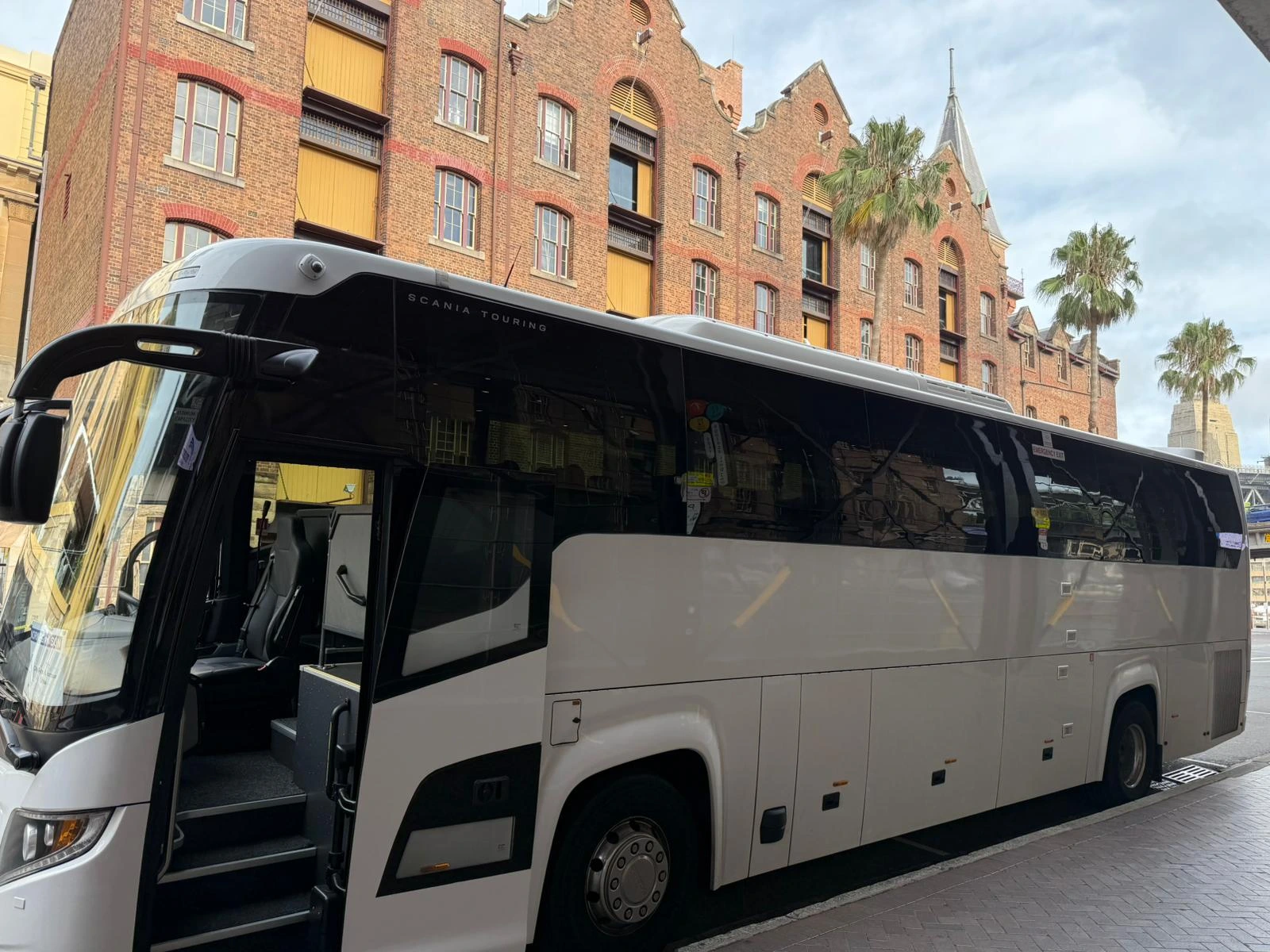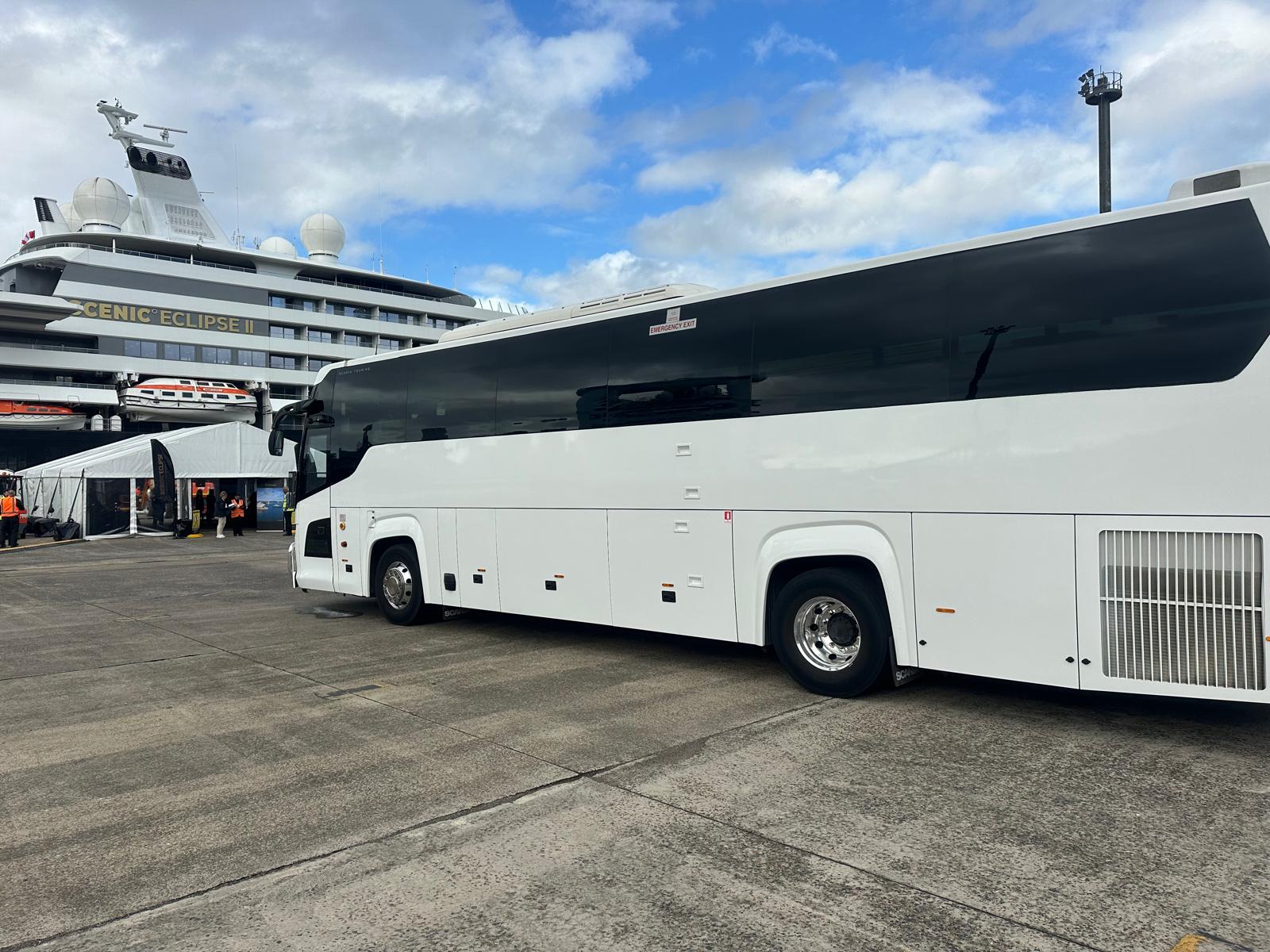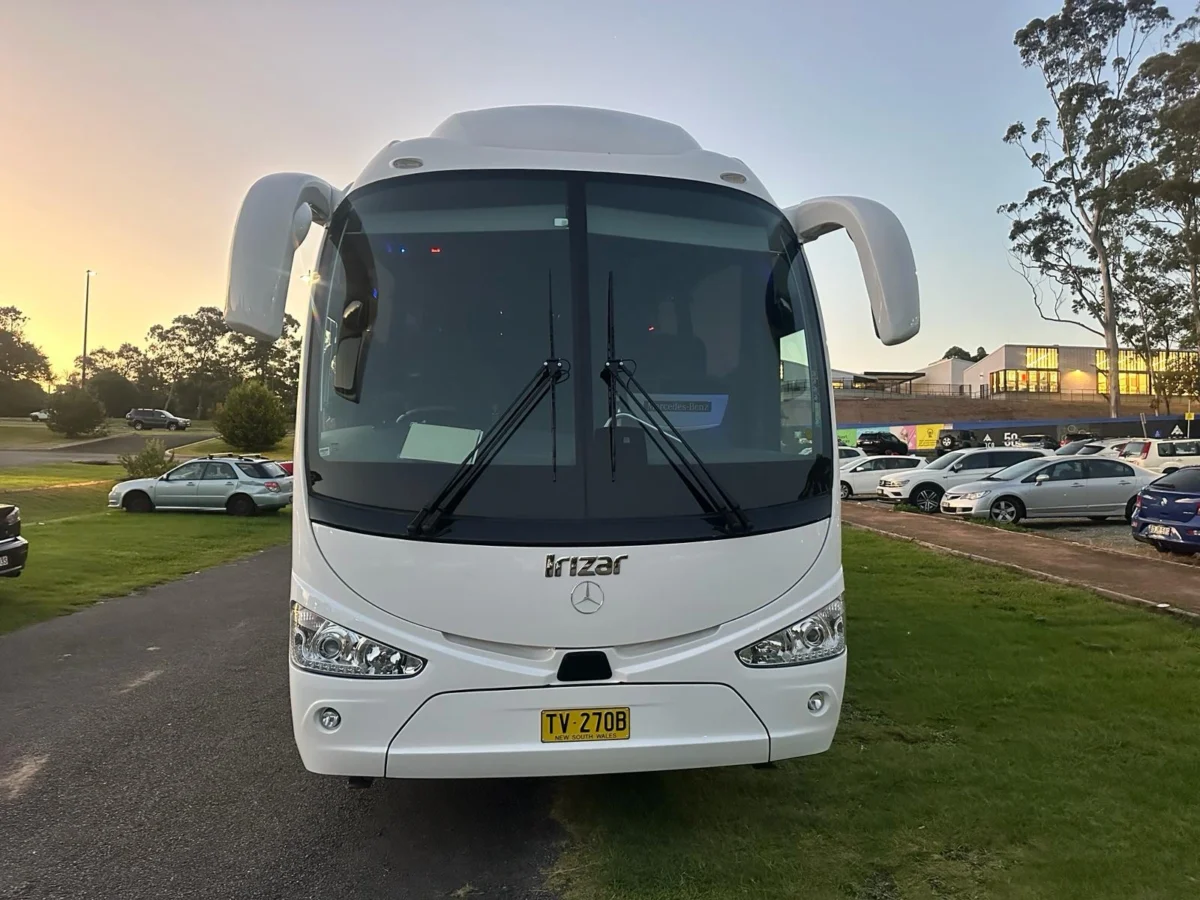
A coach can legally stop in a bus zone outside a Sydney school to set down or pick up passengers, but it cannot wait there. That single distinction decides most school loading plans. The workable arrangement is a nominated loading point away from the parent drop-off queue, a coach that arrives inside a tight window rather than early, and staff at both doors counting on and counting off. Confirm the exact stop with the operator before the day.
What the road rules actually allow
The NSW road rules prohibit stopping in a bus zone unless the driver is driving a public bus that is dropping off or picking up passengers. The definition of a public bus is wider than most people expect: it includes a coach, defined as a vehicle seating more than eight adults used to convey passengers for hire or reward or in the course of a business. A charter coach is therefore a public bus for that rule and may lawfully stop in a bus zone to load and unload.
Two limits sit on top of that, and both matter at a school.
Set down and pick up only. No waiting and no layover. A coach that drops a year group at 9:00am cannot sit in the bus zone until 2:30pm, and it cannot arrive at 8:15am and idle until the group is ready.
The sign governs. The rule gives way to information on the bus zone sign itself. If the sign restricts the zone to particular services or times, that restriction applies to your coach too. Read the sign rather than assuming the general rule covers you.
That is the legal frame. Everything else about school loading is site management.
Choosing the loading point
There are usually three candidates outside any Sydney school, and they rank in this order.
| Option | When it works | What to check |
|---|---|---|
| On site, inside the school grounds | The school has a driveway, turning space and an exit a full-size coach can use | Overhead clearance at the entry, gate width, turning space, and whether the surface takes the weight. A full-size coach exceeds 2.8 metres in height, so height barriers and low awnings rule out many car park entries |
| Kerbside, away from the parent queue | Most common. There is a legal stopping place within safe walking distance of the assembly point | Whether it is a bus zone, a no stopping length or ordinary kerb, and what the sign says. Distance and route from the assembly point |
| A nearby side street | The frontage is unusable in the morning peak | Whether the walk crosses traffic, and whether the street is wide enough for a coach to pull in and rejoin |
The one option that is not on the list is the parent drop-off queue itself. Loading fifty students from the same kerb space parents are using to drop off puts children between moving cars, and it puts the coach in the way of the queue it is trying to work around. It is the single most common school loading mistake.
Send the address to the operator early. A coach that has never been to your site benefits from someone looking at it before the morning of the excursion, and send us the pick-up address is a two minute job that removes the most likely thing to go wrong.
The school zone you are loading inside
Most NSW school zones operate at 40 km/h between 8:00 and 9:30am and between 2:30 and 4:00pm. Transport for NSW says most, not all, so non-standard times exist and the sign always governs. Zones apply on all notified school days, and they do operate on school development days, which catches out coordinators planning a staff-day activity.
For a loading plan, two things follow. The environment around your coach is a slow, dense, pedestrian-heavy one for exactly the periods when excursions load and return. And the coach’s own approach is slower than a route planner suggests, because the last kilometre is inside a 40 km/h zone with parked cars on both sides.
Timing the coach around the bell
The instinct is to load before the bell so the day starts early. It is usually the wrong call, because the pre-bell window is the parent peak.
A workable morning shape looks like this.
- Bell rings. Roll marked in class, as normal.
- Group assembles at a nominated point inside the school grounds, not at the kerb.
- Coach arrives at the agreed time, after the parent queue has cleared.
- Staff walk the group to the loading point as one movement.
- One staff member at the door counting on, one at the rear of the group.
- Count confirmed on board before the doors close.
Loading after the queue clears usually costs less time than loading into it. A group that walks out at 9:05 into an empty kerb boards faster than a group that walks out at 8:40 into forty cars.
For the return, the same logic runs backwards. A 2:20pm arrival lands before the afternoon zone period and the afternoon queue. A 3:10pm arrival lands in the middle of both. If the itinerary allows either, choose the earlier one and give the day a buffer at the venue end instead.
What the school should have ready
- The exact loading point, agreed with the operator and drawn on a one page site sketch for the day plan.
- The assembly point inside the grounds, and the walking route to the coach.
- Named staff at the door and at the rear of the group.
- A headcount taken on board, not on the footpath.
- Bus lists posted at the door where more than one vehicle is loading.
- The driver name, mobile and vehicle registration, supplied twenty-four hours before travel, in the hands of the teacher leading the group rather than only the coordinator.
- A wet weather variation, because a covered assembly point is rarely next to the loading point.
Transport is an express input to the excursion risk assessment plan, and the loading point is the part of it a reviewer can actually picture. A site sketch does more for that section than three paragraphs of prose.
Loading more than one coach
Two coaches at a school gate is a different problem from one, and the fix is sequencing rather than space.
Load the vehicles in a stated order rather than simultaneously. Post the bus list at each door and have staff check names as students board, because the real risk on a multi-vehicle excursion is not supervision, it is a student on the wrong coach with the wrong staff member and the wrong medical information.
If both vehicles cannot fit the loading point at once, stage the second one away from the school and bring it in as the first pulls out. That is normal practice and worth agreeing at booking rather than improvising on the day.
Frequently asked questions
Can the coach park outside the school and wait during the excursion?
Not in a bus zone. The road rules allow a public bus to stop there to set down or pick up passengers only, with no waiting or layover. Plan the day as a set-down and a separate return at an agreed time.
Can a coach come inside the school grounds?
Sometimes, and it depends on the site rather than the rules. Check the entry height, the gate width and the turning space, and remember a full-size coach exceeds 2.8 metres in height, so a car park height barrier will stop it. Ask the operator to check the site if you are unsure.
What if the only legal stop is a short walk from the gate?
That is a normal outcome and it is usually the safer one. Write the walking route into the day plan, put a staff member at the front and one at the rear, and take the headcount on board.
Should we load before or after the morning bell?
After, in most cases. The pre-bell kerb is the parent drop-off queue, and moving a group through it is slower and less safe than waiting for it to clear.
Do school zones apply on staff development days?
Yes. School zones operate on school development days, and since those days are staff-only, an excursion cannot be scheduled on one anyway.
How much notice does the operator need to check a new pick-up address?
Send it with the booking rather than the week of travel. Published lead times are two to four weeks for most jobs and four to eight weeks in peak periods, which gives plenty of room to settle the loading point in advance.
Next step
If you have a date and a group but no confirmed stopping point, send the pick-up address with the booking request. Getting the loading point right is the part of school transport that never appears on a quote and always shows up on the day.
Sydney Buses & Coaches provides coach hire for school groups across six Greater Sydney regions with no travel surcharge inside Greater Sydney, and you can check the Greater Sydney areas we pick up from before you enquire. Call 02 9469 6600 with the school address and your date, and we will confirm where the coach can legally stop.
Sources
- NSW Legislation, Road Rules 2014, https://legislation.nsw.gov.au/view/html/inforce/current/sl-2014-0758. Accessed 7 September 2026.
- Transport for NSW, School zones, https://www.transport.nsw.gov.au/roadsafety/community/schools/school-zones. Accessed 7 September 2026.
- NSW Department of Education, Excursions and variations of routine (PD-2005-0290-04), https://education.nsw.gov.au/policy-library/policies/pd-2005-0290-04. Accessed 7 September 2026.