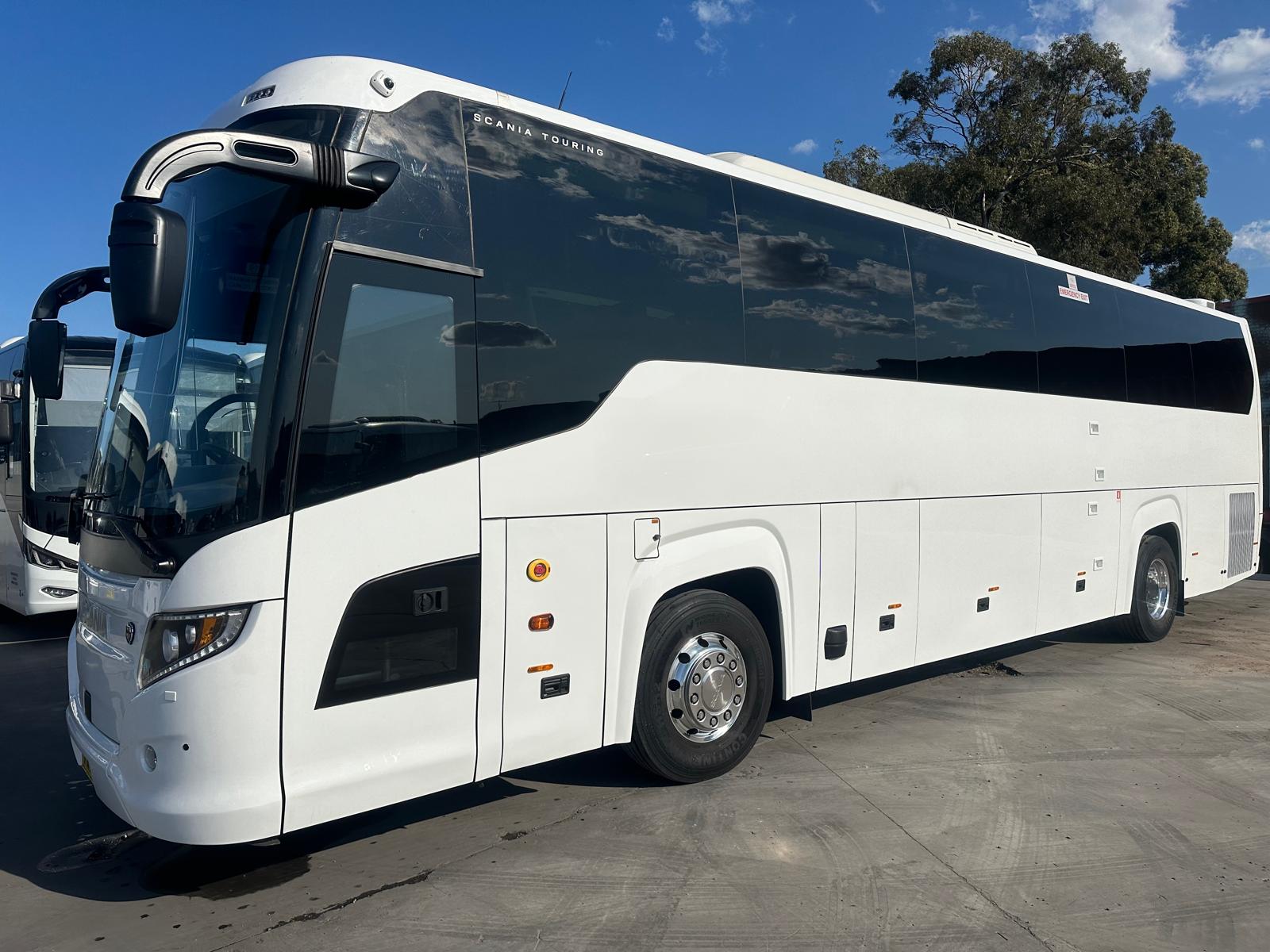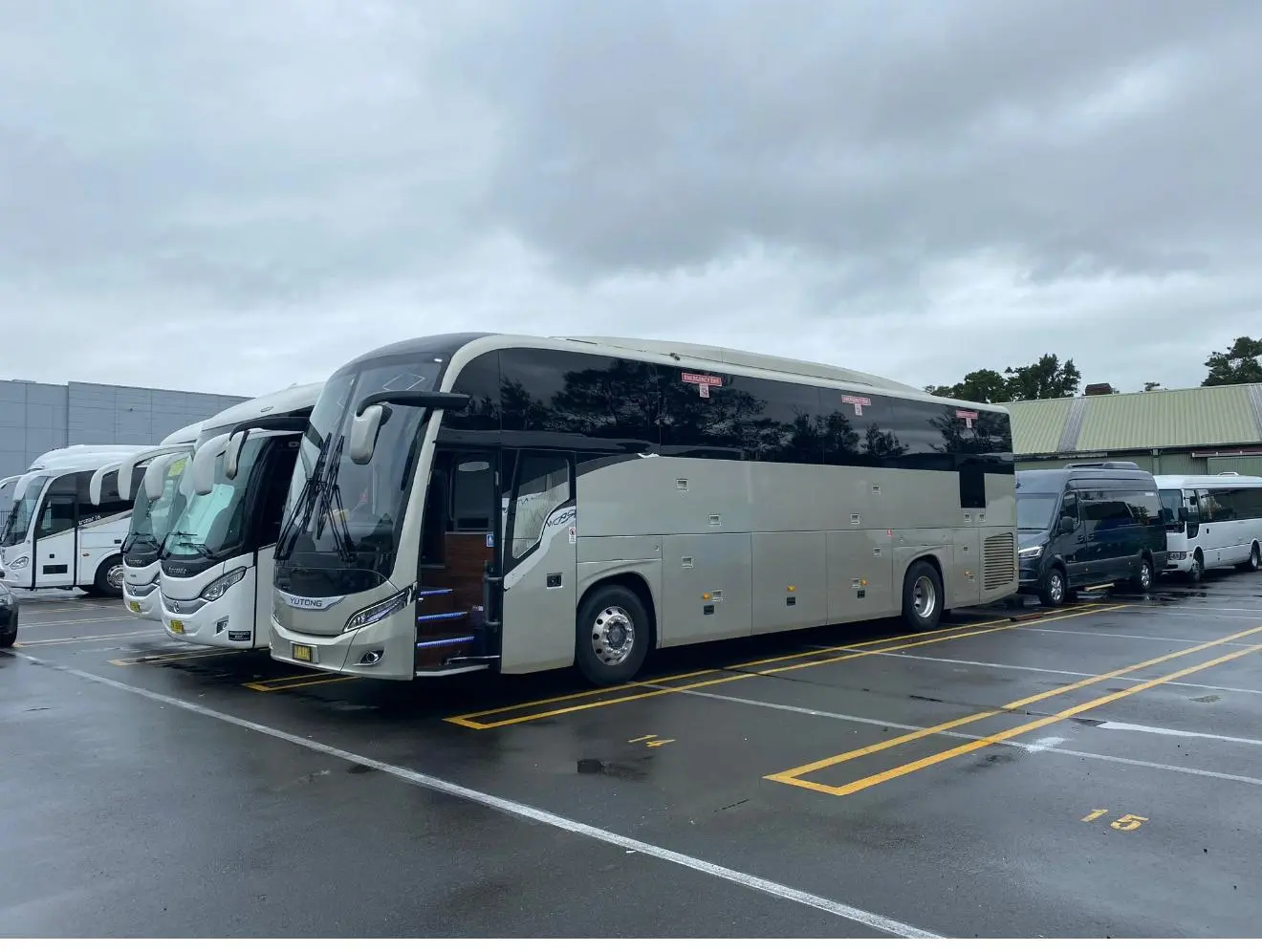
At most Sydney hotels a full-size coach does not use the driveway. It stops on the street outside, loads there, and moves on, because the covered entrance is usually too low or too short for a 12 metre vehicle and because a coach may set down or pick up in a bus zone but cannot wait in one. Plan the stop as a street address with a landmark, not as “out the front”, and the rest of the movement follows.
The porte-cochere problem
A hotel’s covered entrance is designed for cars, taxis and small vans. Three things typically rule out a coach.
Height. A full-size coach exceeds 2.8 m, which is why it falls into the higher class on Sydney’s dimension-based toll roads. Covered hotel entrances, ramps into basements and canopies frequently sit below what a coach needs. For a sense of how binding a published height gate can be, Sydney Airport’s own T2 and T3 Priority Pick-up zone carries a 2.9 m restriction, which excludes full-size coaches outright.
Length and turning. A driveway that a coach can enter is useless if it cannot leave. Ask specifically whether there is a through route or a turning area, because reversing a long vehicle out of a hotel forecourt into city traffic is not a workable plan.
The queue. Even where a coach physically fits, the driveway is usually the hotel’s taxi and rideshare rank. A coach parked across it for ten minutes of loading is a problem for the hotel, and hotels react to that by directing the vehicle to the street.
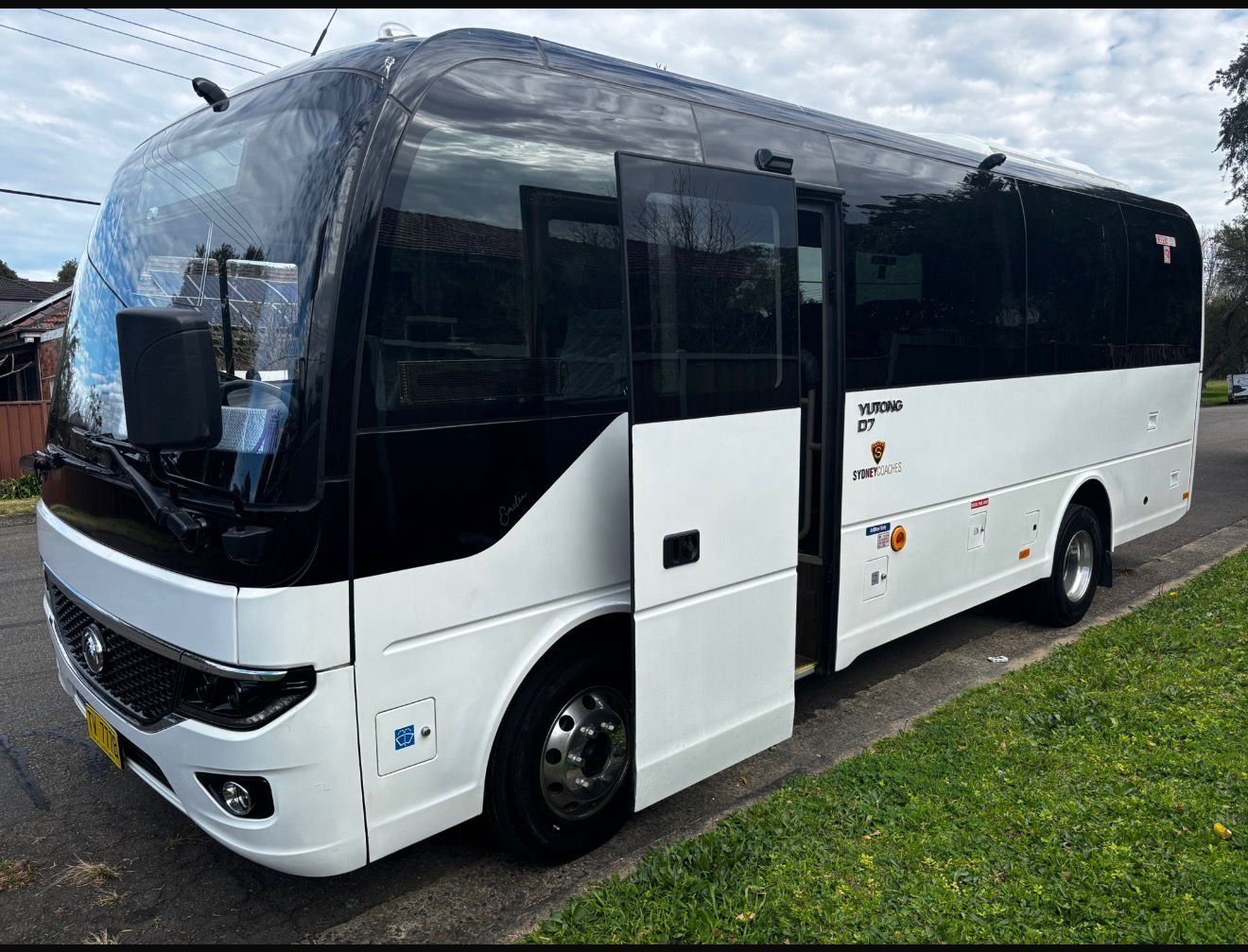
Do not assume a smaller vehicle solves it either. A 21 to 24 seat executive minibus fits into far more places than a coach, but the height of an underground entry still needs checking.
So where does the coach actually stop?
Usually the kerb outside, and there are rules attached.
Under NSW Road Rules 2014, a charter coach is a public bus and may stop in a bus zone to set down or pick up passengers. That permission does not extend to waiting, and it does not apply where information on the bus zone sign excludes that bus. There is no City of Sydney coach permit or booking system, and the City’s parking policy states it will not accommodate long-stay coach layover on-street in central Sydney.
The practical version: the coach arrives at an agreed time, the group is already outside, everyone boards, and the vehicle moves. It cannot idle at the kerb while delegates finish breakfast.
That single constraint is why the pre-departure message to a group should say “be on the footpath at 6.50am”, not “the bus leaves at 7am”. Those are different instructions and they produce different outcomes.
What to ask the hotel
Send this to the hotel’s events or concierge team and get written answers, ideally with the answer to question one as a street address.
> 1. Where do you direct coaches to load and unload groups? > 2. What is the height and length limit of your driveway or porte-cochere? > 3. Is there a turning area, or would a long vehicle need to reverse out? > 4. Can a coach wait on site at all, and if so for how long and where? > 5. Where is luggage staged, and how far is it from the coach stop? > 6. Is there a loading restriction at particular times of day? > 7. Who at the hotel is the contact on the morning of the movement?
Question five is the one that changes timings most. A group of forty with checked bags loads far more slowly than a group of forty with day packs, and if the luggage has to be wheeled fifty metres to the kerb, that time is real.
Four access patterns, and what each one means for your timing
| Pattern | What it looks like | Timing impact |
|---|---|---|
| Driveway loading | The coach enters the forecourt and loads under cover | Fastest and driest. Uncommon for full-size vehicles in the CBD |
| Kerbside outside the hotel | The coach stops on the street directly outside | The normal case. Group must be outside before the vehicle arrives |
| Nominated nearby stop | The hotel directs coaches to a specific point a short walk away | Add walking time and publish the address and a landmark to the group |
| Split loading | Passengers board at the kerb, luggage is loaded from a service entrance | Slowest. Needs a briefed contact at both points |
Whichever pattern applies, give the operator the street address of the stop rather than the hotel name. A name invites an assumption. An address with a cross street and a landmark does not.
Conference movements: the part that goes wrong at scale
One hotel and one coach is easy. Six hundred delegates across four hotels is a different exercise, and it fails on the same things every time.
Loading time compounds. Budget ten to fifteen minutes per stop plus running time, and remember that the last hotel on a loop is boarding on a schedule set by the first. Where clusters are far apart, separate vehicles running direct beat one long loop.
Staging matters more than people expect. A coach that has dropped delegates at a venue cannot legally wait nearby for three hours, so decide in advance whether it is released and returns, or held, and get that priced. It is the single most common source of unexpected cost on multi-day conference work.
And the return leg is not the mirror of the outbound. Delegates who arrived from four hotels leave from one venue, so the return is one loading point and several set-downs, which is faster and should be sequenced so the largest group comes off first.
The early morning airport departure
The hotel to airport run is the most common Sydney hotel coach movement and it has published rules worth knowing.
Sydney Airport requires commercial vehicles to be registered through its Bus and Limousine Registration System. Drop-off is kerbside at the Departures level, collection happens within dedicated zones only, and a bus holding area operates on Ross Smith Avenue, free for the first 60 minutes. Kerbside is set-down only, so the vehicle cannot wait at the terminal frontage. And the T2 and T3 Priority Pick-up zone carries a 2.9 m height restriction that excludes a full-size coach.
A workable departure timeline for a group leaving a CBD hotel for a domestic morning flight:
| Time | What happens |
|---|---|
| Night before | Group told the exact kerb address, the boarding time and the departure time, in writing |
| Departure minus 20 minutes | Luggage staged in the lobby, ready to move |
| Departure minus 10 minutes | Group on the footpath at the agreed point |
| Departure time | Coach arrives, loads, and leaves. The kerb is not a waiting bay |
| Arrival at terminal | Set-down kerbside at Departures |
The departure time is the time the vehicle moves, not the time the group starts gathering. Publishing it any other way is how a fifteen minute buffer disappears.
For a group returning rather than departing, collection is zone-only and needs to be pre-booked, which is worth settling when you arrange airport transfers for groups rather than on the morning.
Frequently asked questions
Can a coach pull into a hotel driveway in Sydney?
Often not. A full-size coach exceeds 2.8 m in height and is around 12 metres long, and most city hotel entrances cannot take that, or cannot offer a turning area. Ask the hotel for its height and length limits and whether there is a turning area, then plan a kerbside stop if the answer is no.
Where do coaches wait between a hotel drop-off and a pick-up?
Not at the kerb. A coach may set down or pick up in a bus zone but cannot wait there, and the City of Sydney will not accommodate long-stay coach layover on-street in central Sydney. Decide with your operator whether the vehicle is released and returns or is held, and get that reflected in the quote.
How long does it take to load a group at a hotel?
Roughly ten to fifteen minutes per stop for a group of any size, and longer with checked luggage or where bags have to be moved from a service entrance. The way to protect that time is to have the group on the footpath before the vehicle arrives.
Can a coach use the airport priority pick-up zone?
No. Sydney Airport’s T2 and T3 Priority Pick-up zone has a 2.9 m height restriction, which excludes a full-size coach. Commercial vehicles must be registered through the Bus and Limousine Registration System, drop-off is kerbside at Departures, and collection is within dedicated zones only.
What should I tell delegates about the pick-up point?
A street address with a number, a landmark, a boarding time ten minutes before departure, and the departure time itself. Send it the night before and again on the morning. “Out the front” is the most expensive phrase in group transport.
Next step
Tell us the hotel address and the destination and we will confirm a legal coach stop at both ends before you publish a timetable, with a fixed written quote back within two business hours and the vehicle named.
Start with corporate group transport in Sydney, or if the group needs full-size coach hire, say so in the enquiry, because vehicle height and length are what decide whether the driveway is available at all. Call 02 9469 6600, Monday to Friday 7am to 6pm or Saturday 8am to 2pm. Driver name, mobile number and vehicle registration are sent 24 hours before travel, which is what your on-site contact needs.
Sources
- Sydney Airport, Resources for registered limousines, buses and coaches, https://www.sydneyairport.com.au/corporate/partner-with-us/commercial-vehicles/resources-for-registered-limousines-buses-and-coaches. Accessed 7 September 2026.
- Sydney Airport, Pick-up, https://www.sydneyairport.com.au/pickup. Accessed 7 September 2026.
- NSW Government, Road Rules 2014 (NSW), rule 183, https://legislation.nsw.gov.au/view/html/inforce/current/sl-2014-0758. Accessed 7 September 2026.
- City of Sydney, Central Sydney On-Street Parking Policy, https://www.cityofsydney.nsw.gov.au/-/media/corporate/files/publications/policies/central-sydney-street-parking-policy/central-sydney-on-street-parking-policy_0525.pdf. Accessed 7 September 2026.