The Sydney Opera House publishes that buses and coaches cannot park onsite and that large buses must disembark passengers on Macquarie Street. That single fact shapes every group booking to the venue: the coach sets down away from the forecourt, your group walks the rest, and the vehicle has to be somewhere else during the performance. Plan the walk and the interval between drop-off and pick-up, and the rest is straightforward.
What the Opera House publishes, and what it means for your group
Two statements matter. Buses and coaches cannot park onsite. Large buses must disembark passengers on Macquarie Street.
For a group of forty on a matinee, that is a minor inconvenience. For a group of forty in their seventies attending an 8pm performance in July, it is the whole plan. The walk happens in the dark, on the way back it happens with a tired group, and it needs to be described to people in advance rather than sprung on them.
Confirm the current set-down point and the accessible route with the venue before you publish anything to your group. Large venues update access arrangements, and the venue is the only reliable source for its own site.
Circular Quay is not a coach precinct
The area around the Opera House is one of the harder places in Sydney to stop a large vehicle, and the reasons are structural rather than temporary.
George Street through the city centre is a pedestrian boulevard, a car-free path from Haymarket to Circular Quay, with extension works staged and ongoing. It is not a coach route and cannot be planned as one.
A charter coach may stop in a bus zone to set down or pick up passengers under NSW Road Rules 2014, but the permission does not extend to waiting, and the sign at the zone can exclude it. There is no City of Sydney coach permit or booking system, and the City’s parking policy states it will not accommodate long-stay coach layover on-street in central Sydney.
Put together: your coach can stop, briefly, in a lawful place, and then it must go somewhere else. Any plan that assumes the vehicle can sit near the venue for three hours is not a plan.
Where the coach goes during the performance
There are two workable answers and you should choose one at quote stage rather than on the night.
Release and return. The vehicle leaves after set-down and comes back at an agreed time. Cheaper, and fine for a performance with a predictable finish time. The risk is the return leg landing in traffic, so agree a return time that is a little earlier than the curtain, with the driver already in position.
Hold the vehicle. The vehicle stays in the area, which costs the waiting time but buys certainty. Worth it for a group that cannot stand around, or where the finish time is uncertain.
Either way, ask the operator where the vehicle actually waits and how that time appears on the quote. Transport for NSW operates the King Street Wharf Bus and Coach Layover, accessed via Lime Street, open 24 hours a day, restricted to accredited bus and coach operators with prior registration. It is an operator-side arrangement rather than something a group organiser books, but the existence of a legitimate layover facility is a reasonable thing to ask about.
Timing an evening performance
Work backwards from the curtain, not forwards from the depot. A workable framework for an 8pm performance in the city:
| Time | What happens |
|---|---|
| 5.45pm | Vehicle departs the group’s pick-up point |
| 6.30pm | Set-down at the venue’s published coach stop |
| 6.30 to 6.50pm | Walk to the venue, collect tickets, find seats |
| 7.00pm | Everyone seated with time to spare |
| 8.00pm | Performance begins |
| Curtain minus 20 minutes | Vehicle in position at the agreed pick-up point |
| Curtain plus 15 minutes | Group boards and departs |
Two deliberate choices sit in that table. The arrival buffer is generous because an evening set-down in the city runs through the afternoon traffic peak, and Transport for NSW’s traffic volume reporting treats the weekday PM peak as 3pm to 7pm. And the departure is fifteen minutes after the curtain rather than at it, because a group that leaves with the crowd spends that time standing anyway.
Add a comfort stop to the outbound leg for a longer run. It is easier to schedule one than to manage the alternative.
Planning for an older group
Seniors, Probus, RSL and community groups make up a large share of theatre bookings, and the differences are practical rather than special.
- Boarding is slower. Budget more time at the pick-up than you would for a corporate group, in both directions.
- The walk is the constraint. Ask the venue for the distance from the coach stop to the entrance and whether the route is step-free, sealed and lit. Then tell your group the number.
- Kerb height and the first step matter more than seat count. Raise this when you book so the right vehicle is allocated.
- Wheelchair-equipped vehicles with hoists are available, and that needs to be requested at booking rather than assumed. If anyone in the group uses a mobility aid, say so in the enquiry and check accessible vehicle options before you confirm numbers.
- Seatbelts. On a coach fitted with seatbelts, wearing them is mandatory in NSW for every passenger aged 16 or over. Say so at the start of the trip rather than mid-journey.
- The pick-up point after the performance should be the same place, described the same way, and repeated in writing. A tired group at 10.30pm should not be interpreting new instructions.
Choosing the vehicle
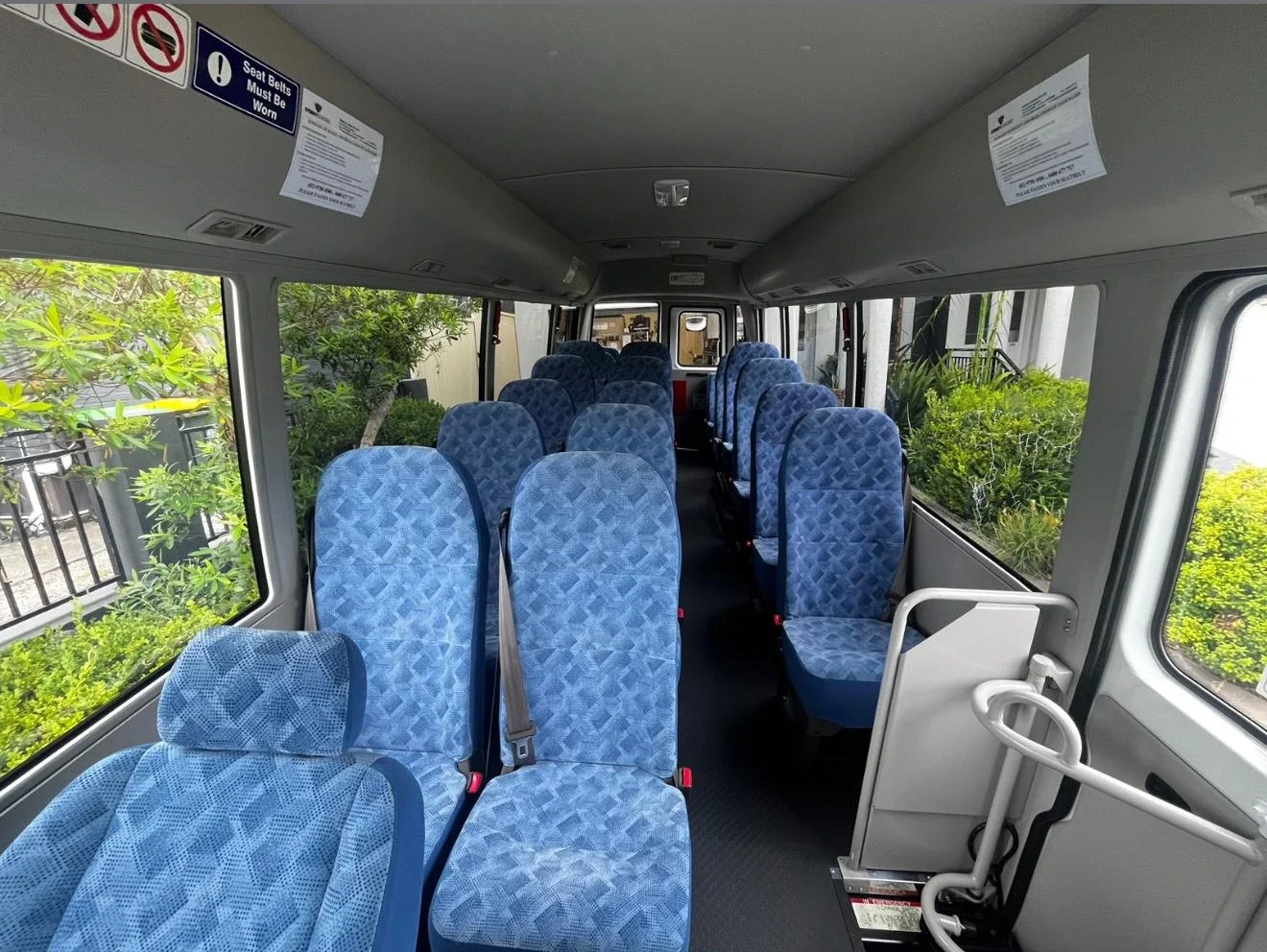
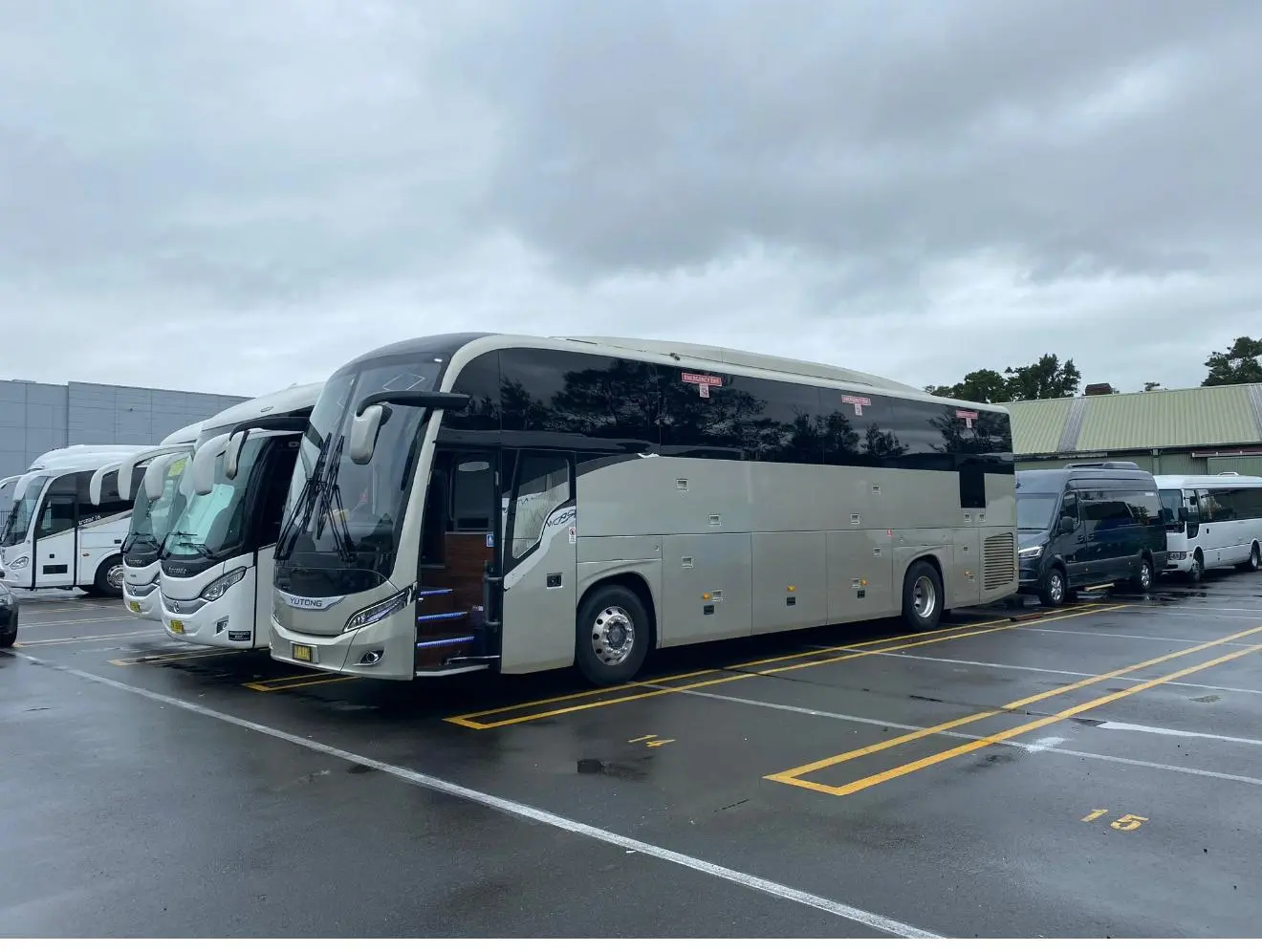
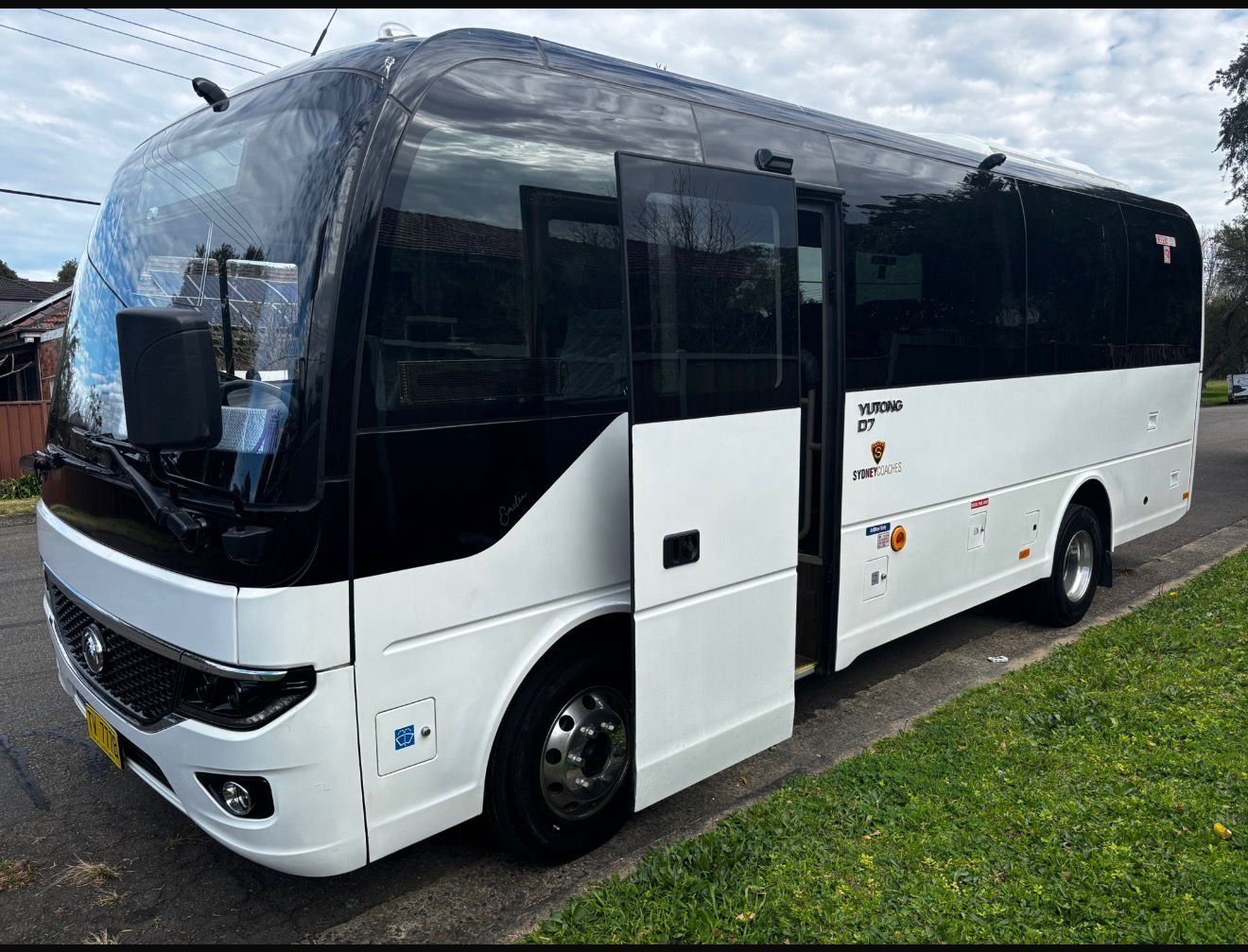
Vehicle size decides where you can stop, so it is worth deciding early. A 21 to 24 seat executive minibus can use kerb space and turn where a 53 seat coach cannot. For a group of thirty-five to fifty on a single movement, full-size coach hire is usually the better answer despite the tighter access, because one vehicle means one arrival, one head count and one departure.
Where the group is spread across suburbs, a single central pick-up beats a long loop, particularly for an evening performance where every stop eats into the arrival buffer.
Frequently asked questions
Where do coaches drop off at the Sydney Opera House?
The Opera House publishes that buses and coaches cannot park onsite and that large buses must disembark passengers on Macquarie Street. Confirm the current arrangement and the accessible route with the venue before your date, then publish the walking distance to your group.
Can the coach wait outside the theatre during the show?
No. A charter coach may stop in a bus zone to set down or pick up passengers but not to wait, and the City of Sydney will not accommodate long-stay coach layover on-street in central Sydney. The vehicle is either released and returns at an agreed time, or held nearby with that time priced into the quote.
How early should a group arrive for an evening performance?
Aim to be seated an hour before the curtain, which usually means setting down around ninety minutes before. An evening set-down runs through the weekday afternoon traffic peak, and a group of forty takes longer to move from kerb to seat than a group of four.
What about groups with limited mobility?
Ask the venue for the walking distance and whether the route is step-free, and request an appropriate vehicle at booking. Wheelchair-equipped vehicles with hoists are available and need to be arranged in advance, not on the day.
Is it better to book one coach or two smaller vehicles?
For a single movement to a city venue, one coach is usually simpler: one arrival, one head count, one departure. Two smaller vehicles make sense where the venue’s set-down cannot take a full-size vehicle, or where the group is split across distant pick-up points.
Next step
Send the venue, the performance date and start time, the pick-up suburb and the group size, and you will get a fixed written quote back within two business hours with the vehicle named, the set-down point confirmed and the return time built around the curtain rather than guessed.
Start with Sydney city tour and group coach hire or call 02 9469 6600, Monday to Friday 7am to 6pm or Saturday 8am to 2pm.
Sources
- Sydney Opera House, Plan your excursion, https://www.sydneyoperahouse.com/schools/plan-your-excursion. Accessed 7 September 2026.
- NSW Government, Road Rules 2014 (NSW), rule 183, https://legislation.nsw.gov.au/view/html/inforce/current/sl-2014-0758. Accessed 7 September 2026.
- City of Sydney, Central Sydney On-Street Parking Policy, https://www.cityofsydney.nsw.gov.au/-/media/corporate/files/publications/policies/central-sydney-street-parking-policy/central-sydney-on-street-parking-policy_0525.pdf. Accessed 7 September 2026.
- Transport for NSW, King Street Wharf Bus and Coach Layover, https://www.transport.nsw.gov.au/operations/roads-and-waterways/business-and-industry/buses/operators/king-street-wharf-bus-and. Accessed 7 September 2026.