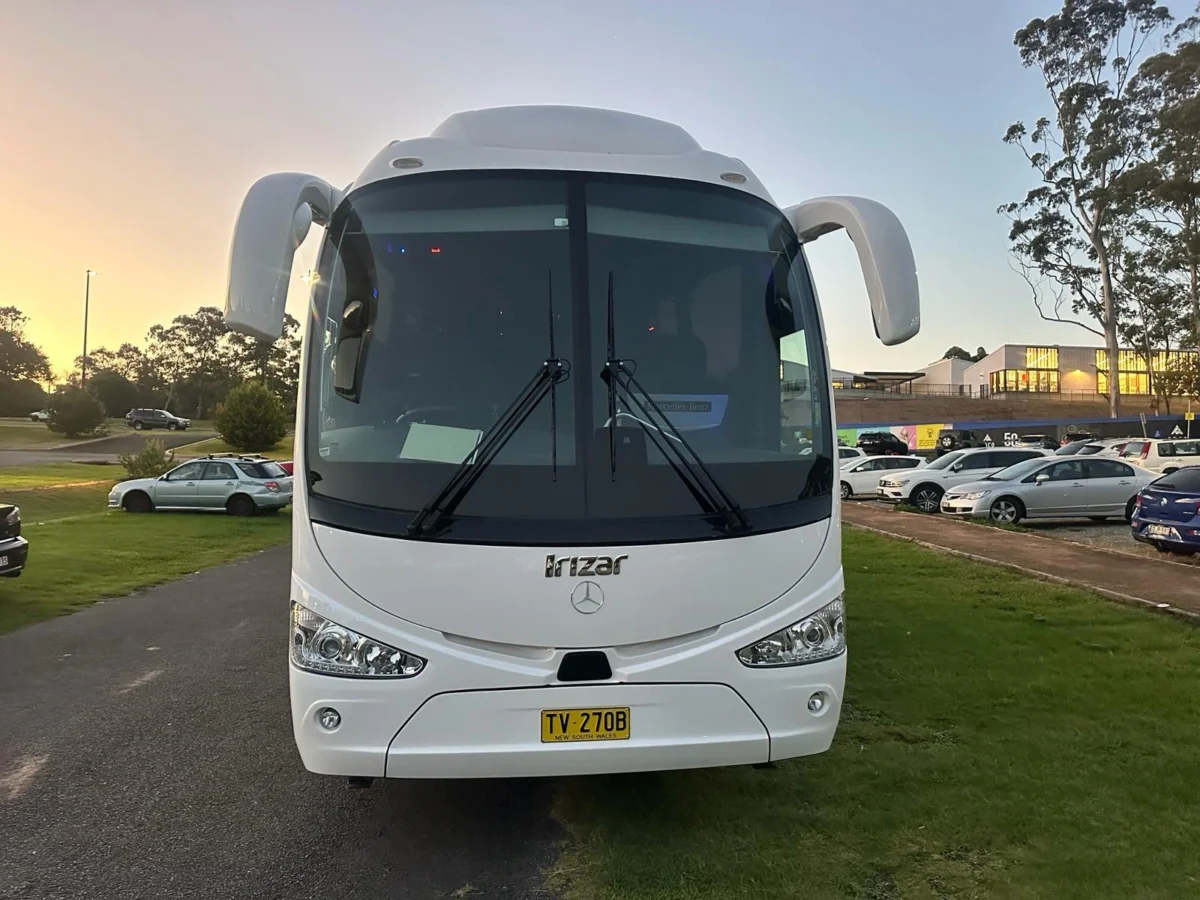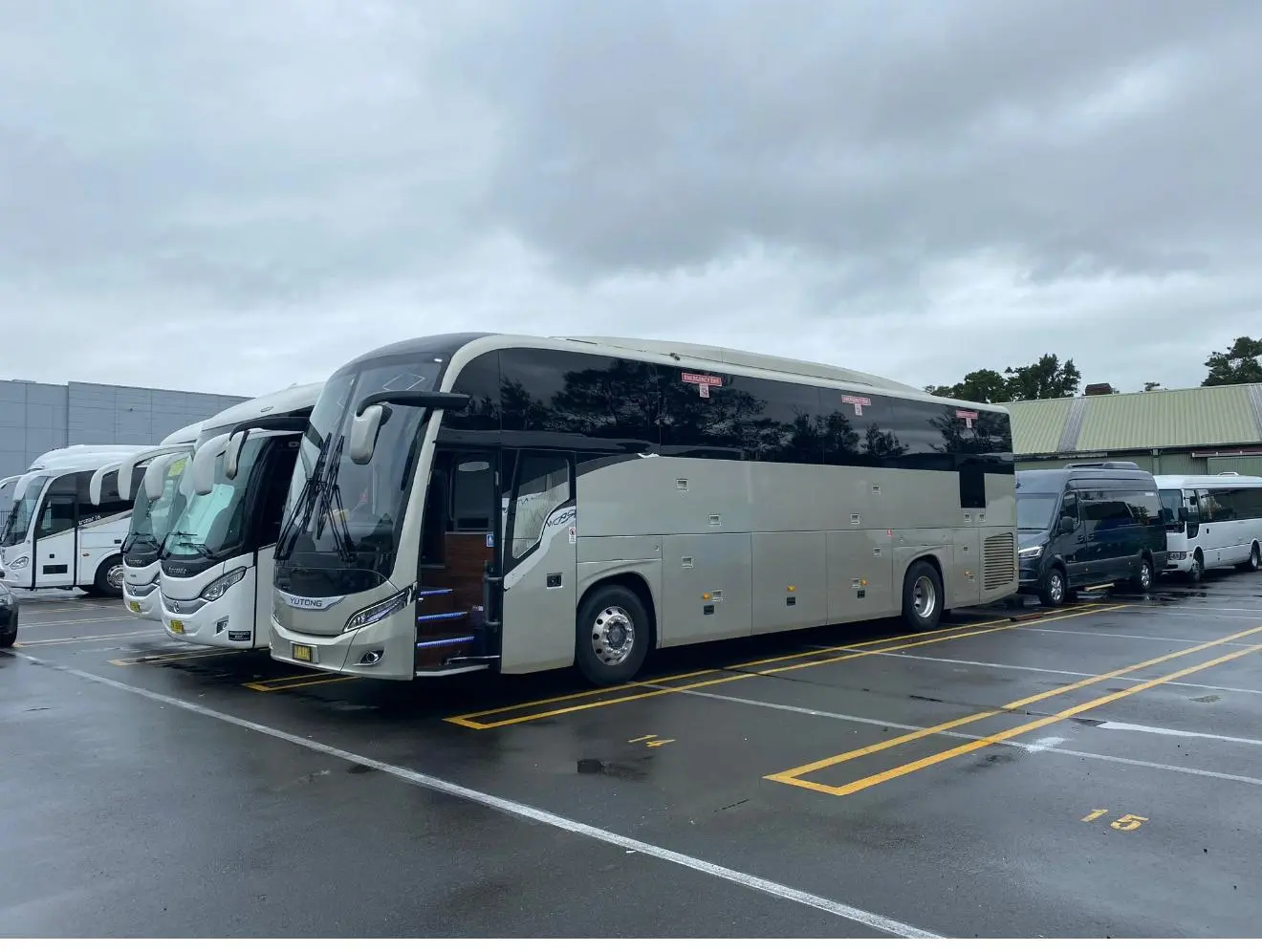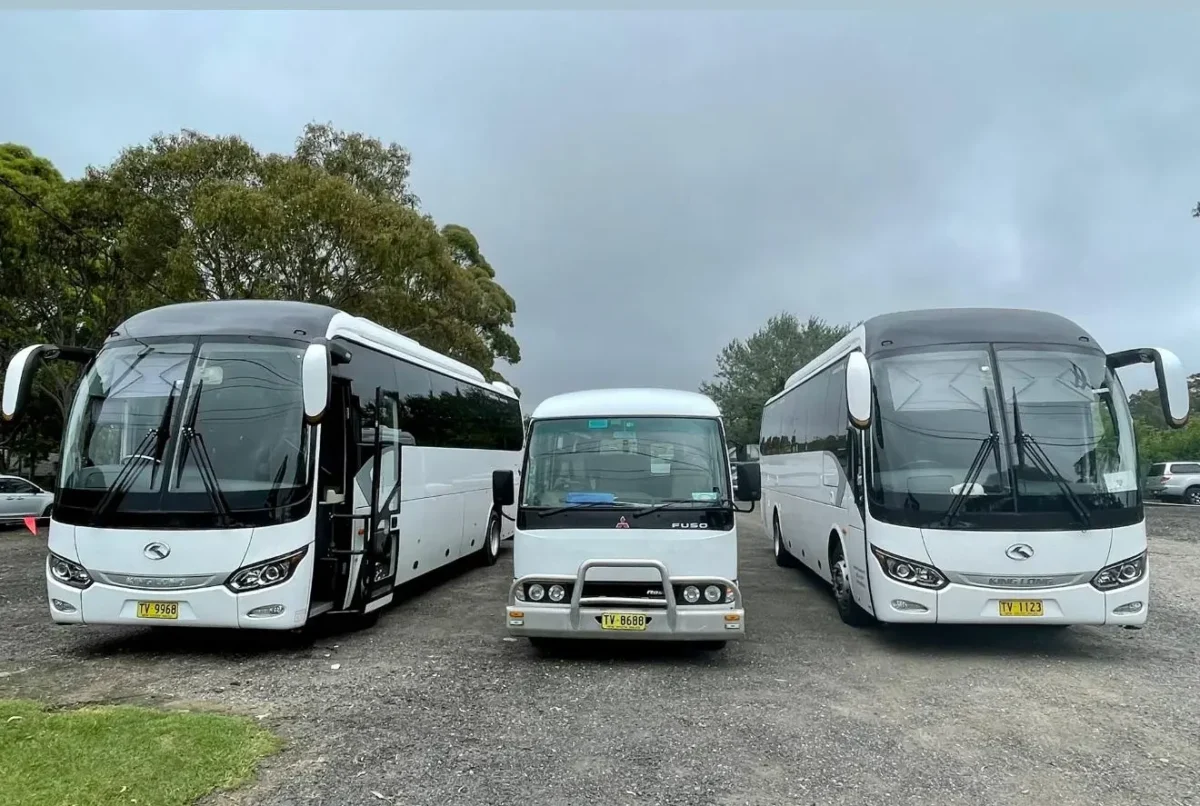
Group size narrows the choice, but in Sydney the deciding factor is usually access: whether the vehicle can physically reach your pick-up address and your venue. A 27-seat midi-coach and a 48-seat coach are not interchangeable at a Randwick race meeting, a Katoomba lookout or an Inner West terrace street. Size for the group, then test the vehicle against both ends of the trip, then check where the cost cliff sits.
Start with the group, then correct for luggage
The ladder below is the published fleet and the published rates. Seat counts exclude the driver.
| Vehicle | Seats | Hourly rate | Minimum hire |
|---|---|---|---|
| Mercedes V-Class | 7 | $125 | 3 hours |
| Toyota Commuter | 12 | $110 | 3 hours |
| Mercedes Sprinter | 11 to 14 | $145 | 3 hours |
| Executive minibus | 21 to 24 | $145 | 3 hours |
| Executive midi-coach | 27 | $165 | 4 hours |
| Luxury coach | 48 | $185 | 4 hours |
| Luxury touring coach | 50 to 57 | $195 | 4 hours |
| Executive coach | 53 | $195 | 4 hours |
| Coordinated convoy | 58 and above | Quoted per event | n/a |
Read that as three tiers rather than nine vehicles. Minibuses and people movers run to about 24 seats on a three hour minimum. The midi-coach sits alone at 27 seats on a four hour minimum. Full-size coaches start at 48. Above 57 passengers, the answer is a coordinated convoy quoted per event, not a single bigger vehicle.
One correction to apply before you go further. Seat count is not the same as comfortable count, and luggage capacity belongs to the specific vehicle rather than to its seat number. A group of 25 with day bags and the same 25 with a checked case each are different jobs on identical seats. Send both numbers, passengers and bags, and ask for the luggage answer against the vehicle assigned to your dates. The full fleet ladder from 7 to 57 seats is the shortlist; the assigned vehicle is the answer.
Access is the Sydney deciding factor
This is where most sizing conversations actually land, and it is the part that generic bus-hire content skips.
Sydney’s residential street stock is old and narrow in exactly the suburbs that generate charter work. Inner West laneways, Northern Beaches cul-de-sacs with a tight turning head, older Eastern Suburbs streets with parking both sides, and long rural driveways in the Southern Highlands all reduce what can physically reach a front gate. There is no published rule you can look up for this, and no honest operator will give you a width threshold over the phone. Send the exact pick-up address at enquiry stage and ask whether the proposed vehicle can service it, or whether the group should walk to a nearby main road.
At the venue end, the constraints are published, and several of them are height rules rather than size rules.
Royal Randwick sets the threshold at 3.1 metres. Coaches over 3.1 metres high set down and pick up on the eastern side of Darley Road, outside TAFE NSW Randwick. Mini buses under 3.1 metres use the infield car park. That is a materially different walk for your guests.
Rosehill Gardens sets it at 3.4 metres, not 3.1. Coaches over 3.4 metres set down along the western side of Arthur Street, and private coaches may park within that area for the duration of the race day. Mini buses under 3.4 metres use the Grand Ave P1 bus stop park. The two Australian Turf Club racecourses use different numbers, so do not carry an assumption from one to the other.
Scenic World in Katoomba has a 2 metre car park clearance, which no charter vehicle above people-mover size will clear. It publishes no coach parking information, and it takes reservations for groups of more than 15.
At the Sydney Opera House, buses and coaches cannot park onsite and large buses must disembark passengers on Macquarie Street.
In the CBD, George Street through the centre is a pedestrian boulevard, so it is not a coach option at all. A charter coach counts as a public bus under the Road Rules and may lawfully stop in a bus zone to set down or pick up passengers, but only to set down or pick up. It may not wait or lay over there, and a bus zone sign can exclude it. Transport for NSW operates a Bus and Coach Layover at King Street Wharf, accessed via Lime Street, for accredited operators with vehicles seating more than 12 adults, by prior registration.
The practical upshot is that a smaller vehicle sometimes wins a job on access even when a larger one wins it on seats. If your guests include older passengers or anyone with limited mobility, a 200 metre walk from Darley Road is a real cost, and it is worth paying for two smaller vehicles to avoid it.
Where the cost cliff sits
Two cliffs, and they are not where people expect.
Cliff one is at 24 to 27 seats. An executive minibus at 21 to 24 seats runs $145 per hour on a three hour minimum. The 27-seat executive midi-coach runs $165 per hour on a four hour minimum. Moving up one vehicle changes both the rate and the minimum, so a short job for 25 people costs meaningfully more than the same job for 23. If your group is genuinely 23 or 24 and unlikely to grow, that is worth knowing before you round up “just in case”.
Cliff two is at 57 passengers. Above 57 the fleet moves to a coordinated convoy quoted per event, which is two vehicles, two drivers and a coordination problem, not one bigger bus.
Between those cliffs, the increments are modest. The 48-seat luxury coach at $185 per hour and the 53-seat executive coach at $195 per hour are close enough that seat headroom is often cheap. Sizing up inside a tier is usually sensible; sizing up across a tier deserves a moment’s thought. Published hourly rates and minimum hire sets out the full picture, and a point-to-point airport run can instead be quoted as one fixed transfer fare that is not charged at a minimum.
One more cost consequence that only appears on the invoice. A full-size coach exceeds 2.8 metres in height, and Sydney toll roads classify by length and height rather than by weight or axles. Class A is 12.5 metres or less in length and 2.8 metres or less in height, so a full-size coach is Class B on every dimension-based Sydney toll road regardless of its length. The multiplier is not uniform across the network, and the Sydney Harbour Bridge and Tunnel have no heavy class at all. Tolls sit outside the hourly rate and are confirmed and priced separately, so on a toll-heavy route the vehicle tier changes the toll line as well as the rate line.
Two hours versus five: what changes on a longer trip
For a short transfer, almost any vehicle in the ladder is fine and the choice is about access and price. Longer runs change three things.
Driver hours become part of the plan. A commercial charter in NSW sits inside the heavy vehicle fatigue regime, because a charter service is a public passenger service carried for a fare. Work and rest limits apply in full, and a full-day itinerary has to be built with those limits in mind rather than around them. This is the operator’s obligation, but it shapes what you can ask for: a Blue Mountains day at 105 km each way and around two hours each way is comfortably a day trip, while an itinerary that keeps a driver moving from dawn to late evening may need a different structure.
Speed is capped for the larger vehicles. Any vehicle over 4.5 tonnes GVM is limited to 100 km/h in NSW regardless of a higher posted limit. On a Canberra run at 285 km and 3 to 3.5 hours each way, or a Hunter Valley run at 165 km, that is already priced into the operating times above, but it is worth knowing that a coach is not going to make up time on a motorway.
Specification matters more the longer people sit. Amenity fit-out varies by vehicle across any fleet, and features are not implied by a seat count or by a vehicle’s name. If recline, air conditioning zones, a public address system, charging or an onboard restroom matter for your run, specify each one in writing and ask for confirmation against the assigned vehicle rather than the model.
A three-question decision framework
Work through these in order. The first question that gives a hard constraint decides the vehicle.
- Can the vehicle reach both ends? Send the pick-up address and the venue. If the venue publishes a height threshold, like Randwick at 3.1 metres or Rosehill at 3.4 metres, that threshold outranks everything else on this list. If a smaller vehicle avoids a long walk for your guests, price two of them before dismissing the idea.
- Does the load fit, not just the group? Passengers and bags are two numbers. Ask for the luggage answer against the specific assigned vehicle. If luggage is the binding constraint, you are buying volume, and the seat count is a side effect.
- Where does the tier boundary sit relative to your number? Twenty-three passengers and twenty-seven passengers are different tiers with different rates and different minimums. Fifty-eight is a convoy. Know which side of a boundary you are on before you round the headcount up.
Answer those three in an email and the vehicle usually picks itself.
Frequently asked questions
What is the practical difference between a midi-coach and a full coach?
Capacity and access. The executive midi-coach seats 27 on a four hour minimum at $165 per hour; full-size coaches start at 48 seats at $185 per hour. The midi-coach is easier to place on constrained Sydney streets and at venues with tight approaches, while the full coach is the efficient answer once the group is genuinely large.
Which vehicle fits down a narrow Sydney street?
There is no published width rule, and vehicle dimensions vary within a fleet, so the answer has to come from the operator for the specific address. Send the exact pick-up address with your enquiry. Where a street cannot take the vehicle, the usual solution is a nearby main road meeting point agreed in advance rather than on the day.
Is a minibus more comfortable than a coach for a two hour trip?
Not inherently. Comfort on any run depends on the individual vehicle’s specification rather than its category, so ask for seat pitch, recline, climate control and charging to be confirmed for the assigned vehicle. For access-constrained pick-ups, a minibus may still be the better overall trip even where a coach seats everyone.
How many people before I need two vehicles?
Fifty-seven is the top of the single-vehicle ladder on our published fleet. From 58 passengers the job is quoted as a coordinated convoy. Below that, two vehicles can still be the better answer if access at either end favours smaller vehicles.
Does the vehicle size change what I pay in tolls?
Yes, on most of the network. Sydney toll classes are based on length and height, and a full-size coach exceeds the 2.8 metre Class A height limit, so it travels as Class B. The multiplier differs by road and there is no heavy class at all on the Sydney Harbour Bridge and Tunnel. Tolls are confirmed and priced separately from the hourly rate.
Next step
Send your passenger count, your luggage count and both addresses, and we will name the vehicle that fits the group, the street and the venue, with the rate and minimum hire stated. Written quotes come back within two business hours, or call 02 9469 6600. If you are at the small end of the ladder, minibus hire in Sydney is the place to start; at the large end, see coach hire in Sydney.
Sources
- Australian Turf Club, “Travel and parking at Royal Randwick”, https://www.australianturfclub.com.au/travel-parking-at-royal-randwick/. Accessed 7 September 2026.
- Australian Turf Club, “Travel and parking at Rosehill Gardens”, https://www.australianturfclub.com.au/travel-parking-at-rosehill-gardens/. Accessed 7 September 2026.
- Sydney Opera House, “Plan your excursion”, https://www.sydneyoperahouse.com/schools/plan-your-excursion. Accessed 7 September 2026.
- Linkt, “Vehicle class, Sydney”, https://www.linkt.com.au/help/travelling-toll-roads/vehicle-class/sydney. Accessed 7 September 2026.
- NSW Legislation, “Road Rules 2014”, https://legislation.nsw.gov.au/view/html/inforce/current/sl-2014-0758. Accessed 7 September 2026.
- Transport for NSW, “King Street Wharf bus and coach layover”, https://www.transport.nsw.gov.au/operations/roads-and-waterways/business-and-industry/buses/operators/king-street-wharf-bus-and. Accessed 7 September 2026.