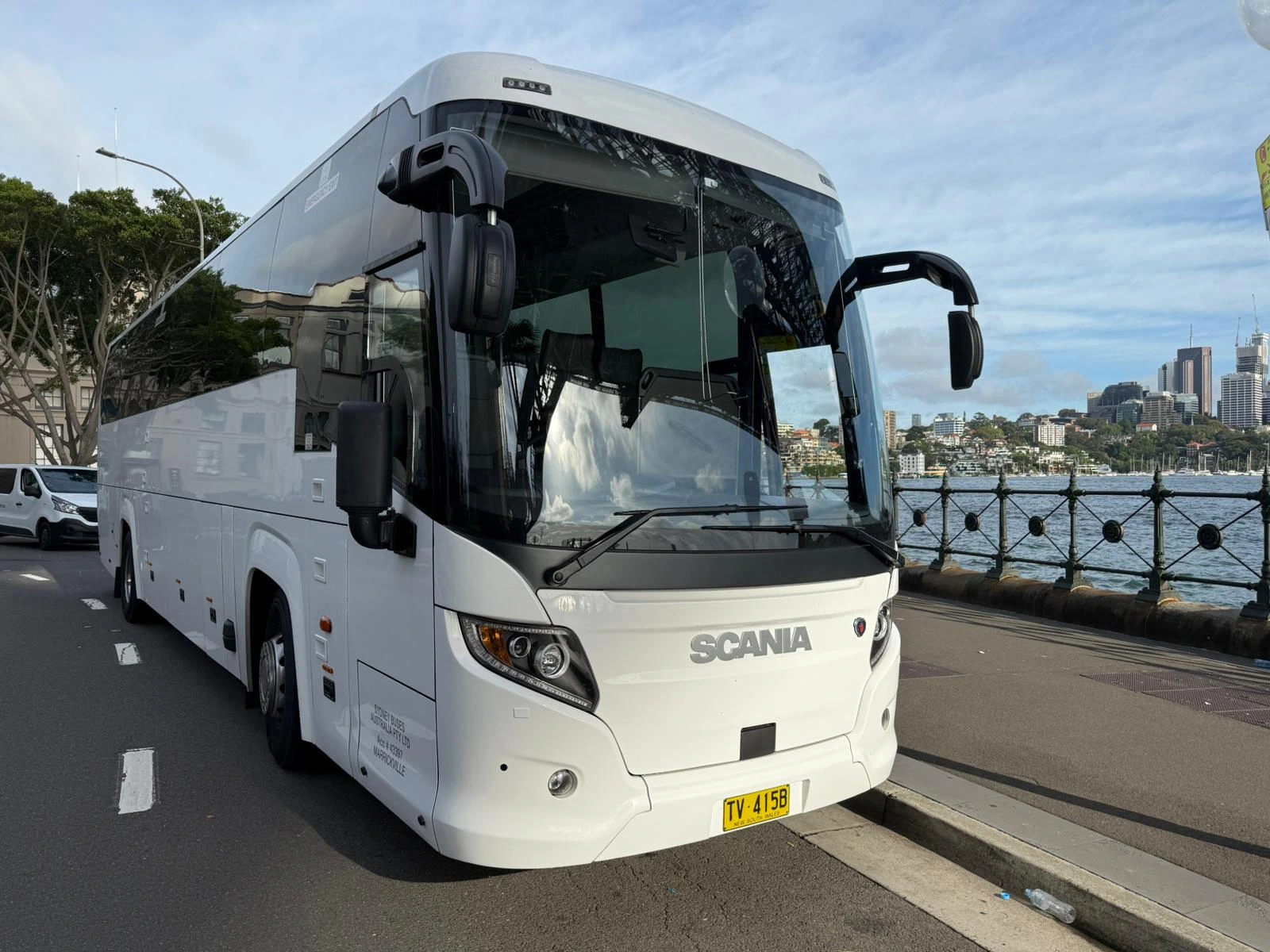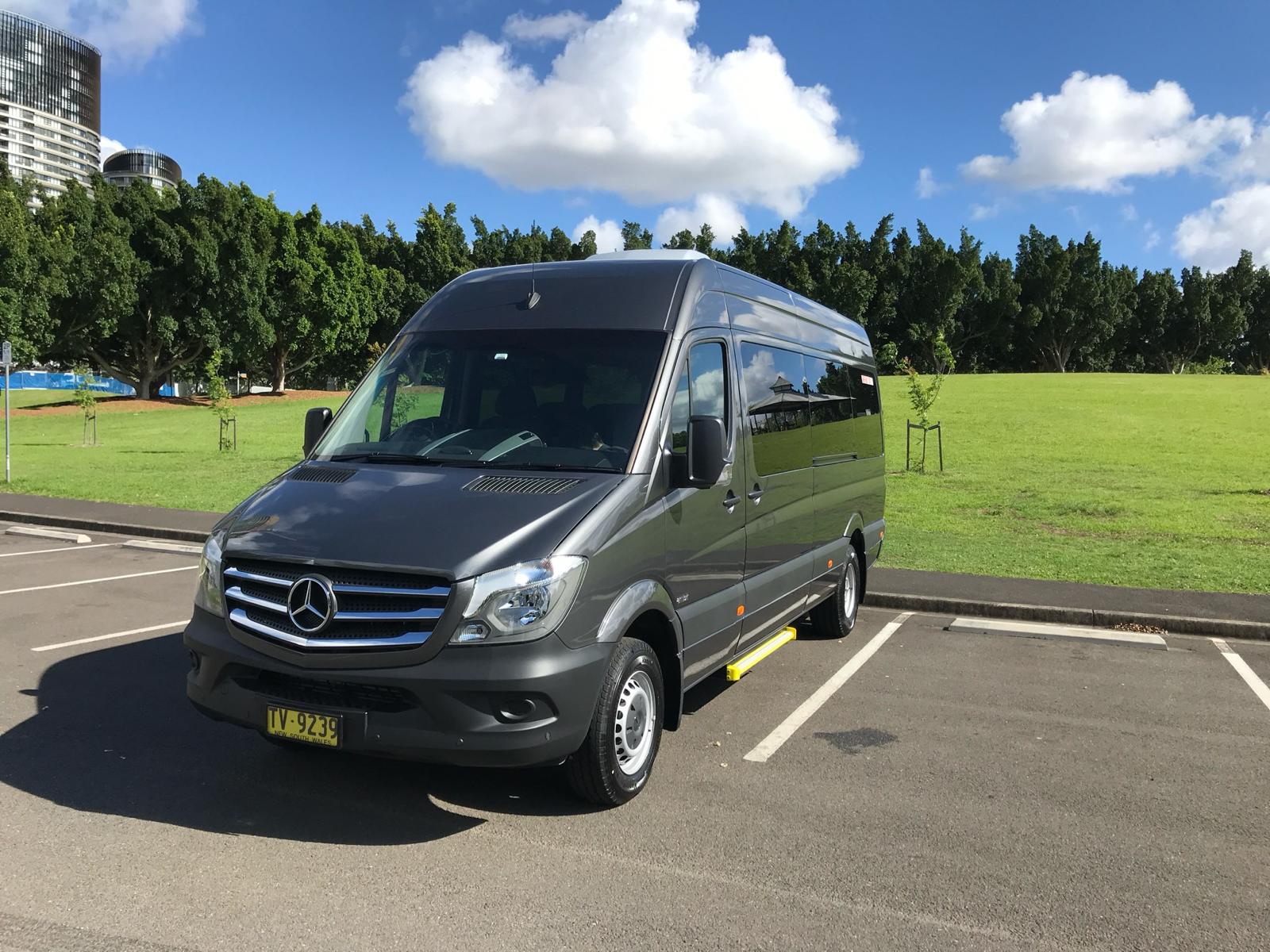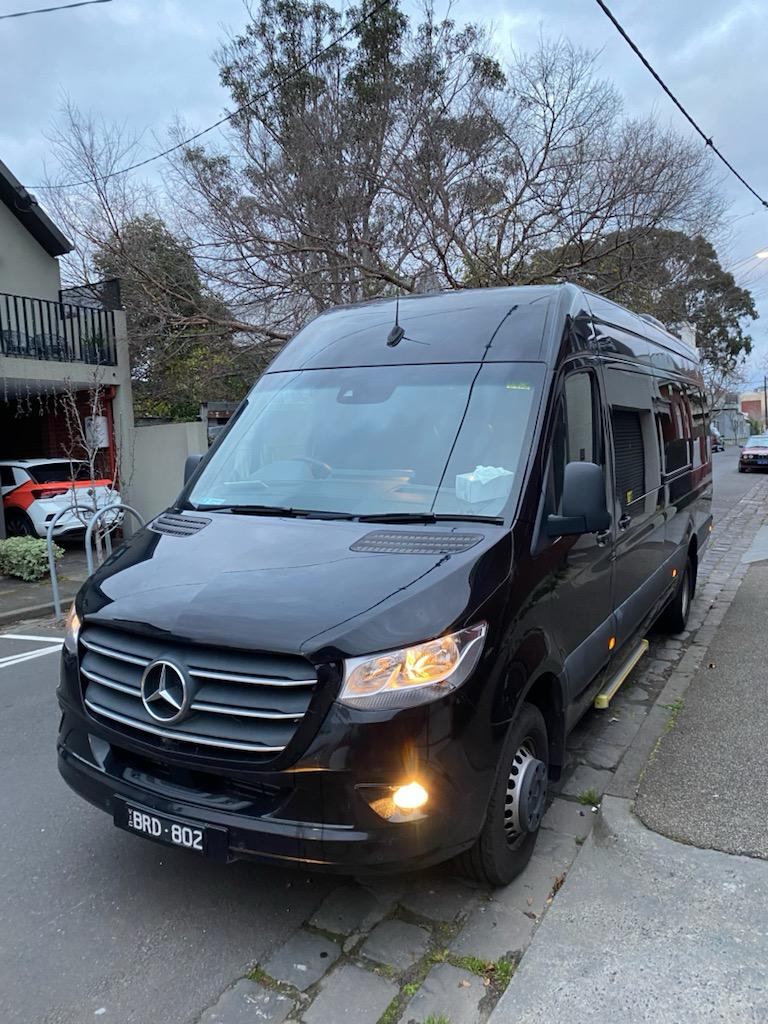
For eight to fourteen people, two cars are often cheaper on raw cash, and any comparison that pretends otherwise is not worth reading. What usually decides it in Sydney is not fuel. It is parking at the destination, paying two sets of tolls instead of one, and whether the group arrives together. A 13-seat minibus starts at $110 per hour on a three hour minimum, so the honest comparison is total cost against total outcome.
What a 12 seater actually holds
Two conventions circulate, and the difference is exactly one seat. On our fleet list, seat counts exclude the driver, so a 13-seat Toyota Commuter carries 12 passengers with a driver supplied. Listings that count total seating positions, common in vehicle sales and self-drive rental, would call the same vehicle a 13-seater and give you 12 including whoever drives.
That matters for a group of twelve. On our convention, twelve passengers fit a 13-seat Commuter with a spare seat. Under the other convention you would be one seat short. Confirm which convention a quote uses before you commit.
The relevant part of the ladder for this decision:
| Vehicle | Passenger seats | Hourly rate | Minimum hire |
|---|---|---|---|
| Mercedes V-Class | 7 | $125 | 3 hours |
| Toyota Commuter | 13 | $110 | 3 hours |
| Mercedes Sprinter | 11 to 14 | $145 | 3 hours |
Seat count is not the same as comfortable count. Twelve adults with day bags fit a 13-seat minibus easily. Twelve adults with a checked case each is a different job, and on small vehicles the luggage space runs out before the seats do. Give the operator both numbers.
Run the comparison properly
Most people compare a fuel estimate against an hourly rate, which is not a comparison at all. Fill in the six lines below for your actual trip and the answer stops being a matter of opinion.
Two cars
- Fuel for both vehicles, return.
- Tolls for both vehicles. Two cars pay two tolls on every tolled road on the route.
- Parking for two spaces, for the full duration of the event, at the destination.
- Whether either driver is giving up drinking, and whether that changes anything for them.
- The cost of the group arriving in two waves, which is time rather than money but usually the thing people actually mind.
- Wear, and whether anyone is being asked to put twelve people’s worth of driving on a private car.
One minibus
- Hours needed, multiplied by the hourly rate, against the three hour minimum. A 13-seat Commuter is $110 per hour, so a short evening job is a $330 minimum.
- Tolls and parking, which are confirmed and priced separately from the rate rather than included.
- Nothing else. The driver, fuel, vehicle insurance and GST are already in the quote.
One structural point worth knowing before you run the numbers. An airport or point-to-point run can be quoted as a single fixed transfer fare instead of an hourly booking, and a fare quoted that way is not charged at a minimum. If your trip is genuinely one movement rather than a vehicle held for an evening, ask for it to be priced that way. Our published hourly rates and minimum hire set out both structures.
What Sydney adds that fuel maths misses
Tolls are per vehicle, and two cars means two of them. Sydney toll roads classify by length and height rather than weight or axles, and Class A covers vehicles 12.5 metres or less long and 2.8 metres or less high. A minibus that stays inside both limits travels as Class A, the same class as a car. So the toll comparison is not car versus bus, it is one Class A vehicle versus two. On the Sydney Harbour Bridge and Tunnel it is starker again: those crossings use a fixed toll where every vehicle pays the same, with time-of-day pricing and no heavy class at all. Two cars pay it twice.
Parking is two spaces, for the whole event. Sydney venue and CBD parking for a full evening, twice over, is frequently the largest single line in the two-car column, and it is the one people forget when they are thinking about petrol. It is also the line that varies most by destination, so use the actual venue’s actual rate rather than a guess.
A minibus can park where a coach cannot. At Royal Randwick, coaches over 3.1 metres high set down on the eastern side of Darley Road, outside TAFE NSW Randwick, while mini buses under 3.1 metres use the infield car park. For a group of ten at the races, that is the difference between a walk and a door. It is a genuine advantage of the small end of the fleet that larger-vehicle content never mentions.
Central Sydney does not accommodate long-stay layover. The City of Sydney’s Central Sydney On-Street Parking Policy states plainly that the City will not accommodate long-stay coach layover on-street in central Sydney, and there is no council coach permit or booking system. This is why a driven vehicle is a different proposition from a self-driven one: it drops the group, leaves, and returns.
Alcohol changes the shape of the evening. Alcohol is permitted on private function bookings by prior arrangement only, and never on school or youth charters. More to the point, two cars means two people are not drinking, at an event where the whole group was invited.
When two cars genuinely win
Being straight about this is more useful than a sales argument.
Short, local, daytime trips. Ten people going twenty minutes across the Inner West on a Saturday morning, with free parking at the other end, is a two-car job. A three hour minimum is real money for a forty minute round trip.
Groups that need to split up. If half the group is leaving at 2pm and half at 6pm, one vehicle is a constraint rather than a convenience, unless you are willing to pay for it to wait.
Trips where everyone is already driving. If eight of the ten are coming from different suburbs and going home in different directions, forcing them through a single pick-up point can add more travel than it saves.
Very small groups. For six people, two cars or one seven-seat V-Class at $125 per hour on a three hour minimum are close enough that convenience decides it, not cost.
Where one vehicle wins clearly
Airport runs. Ten people with ten cases is a luggage problem in two sedans, and airport parking for two cars for a week is not a small number. A fixed transfer fare with a named vehicle is usually both cheaper and simpler. Group airport transfers are quoted that way as standard.
Anything with an itinerary. Blue Mountains at 105 km and around two hours each way, Hunter Valley at 165 km, Southern Highlands at 120 km. Two cars trying to hold a schedule across a day trip lose the group at the first stop.
Anything where arriving together matters. Weddings, funerals, milestone birthdays, a client day out, a team fixture. The second car is always the one stuck behind an incident on the M4.
Anything with drinking. A designated driver is a person missing the event.
Anything with older passengers or limited mobility. One vehicle, one boarding point, one driver keeping track of everyone is a materially different experience from a convoy.
A four-line test
- Is anyone drinking? If yes, price the minibus properly before you decide.
- Does the group need to arrive as one group? If yes, two cars are a compromise, not a saving.
- What does parking cost at the destination, for two vehicles, for the full duration? Use the real figure.
- Is the trip one movement or a held vehicle? One movement can be a fixed transfer fare with no minimum; a held vehicle is hourly with a three hour minimum on a minibus.
If two of those four point at one vehicle, get the quote before you commit to the convoy.
Frequently asked questions
Is a minibus cheaper than two cars?
Not always on raw cash. Fuel for two cars can undercut a three hour minimum on a short local trip. The minibus usually wins once you add two sets of tolls, two parking spaces for the full duration, and the value of the group arriving together, and it wins clearly on airport runs and day trips.
How many people fit in a 12 seater?
On our fleet list, seat counts exclude the driver, so a 13-seat Toyota Commuter carries 12 passengers with the driver seated separately. Some listings count total seating positions instead, which would give you eleven or twelve passengers in the same vehicle. Always confirm which convention the quote uses.
Do we pay less in tolls with one vehicle?
Generally yes, because tolls are charged per vehicle. Two cars pay two tolls on every tolled road on the route. A minibus within the 12.5 metre length and 2.8 metre height limits travels as Class A, the same class as a car, and on the Sydney Harbour Bridge and Tunnel every vehicle pays the same fixed toll regardless of type.
What is the minimum booking for a minibus?
Three hours for minibuses and people movers. A point-to-point run such as an airport transfer can instead be quoted as one fixed transfer fare, and a fare quoted that way is not charged at a minimum.
Can we bring drinks on board?
Food and non-alcoholic drinks are fine on all vehicles. Alcohol is permitted on private function bookings by prior arrangement only, and never on school or youth charters. Raise it when you request the quote rather than on the day.
Next step
Send your group size, both addresses and the timings, and we will price minibus hire in Sydney per head so you can put it directly against your two-car plan with nothing hidden. Written quotes come back within two business hours, or call 02 9469 6600.
Sources
- Linkt, “Vehicle class, Sydney”, https://www.linkt.com.au/help/travelling-toll-roads/vehicle-class/sydney. Accessed 7 September 2026.
- Australian Turf Club, “Travel and parking at Royal Randwick”, https://www.australianturfclub.com.au/travel-parking-at-royal-randwick/. Accessed 7 September 2026.
- City of Sydney, “Central Sydney On-Street Parking Policy”, https://www.cityofsydney.nsw.gov.au/-/media/corporate/files/publications/policies/central-sydney-street-parking-policy/central-sydney-on-street-parking-policy_0525.pdf. Accessed 7 September 2026.