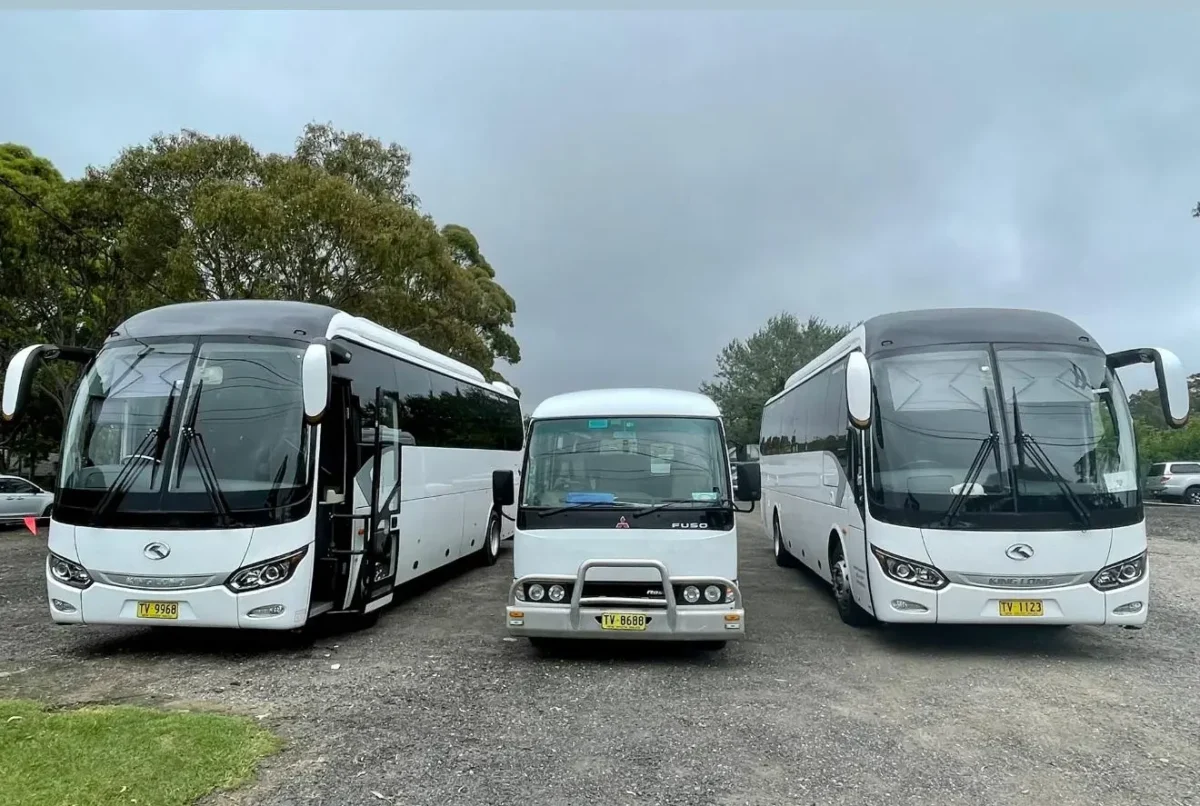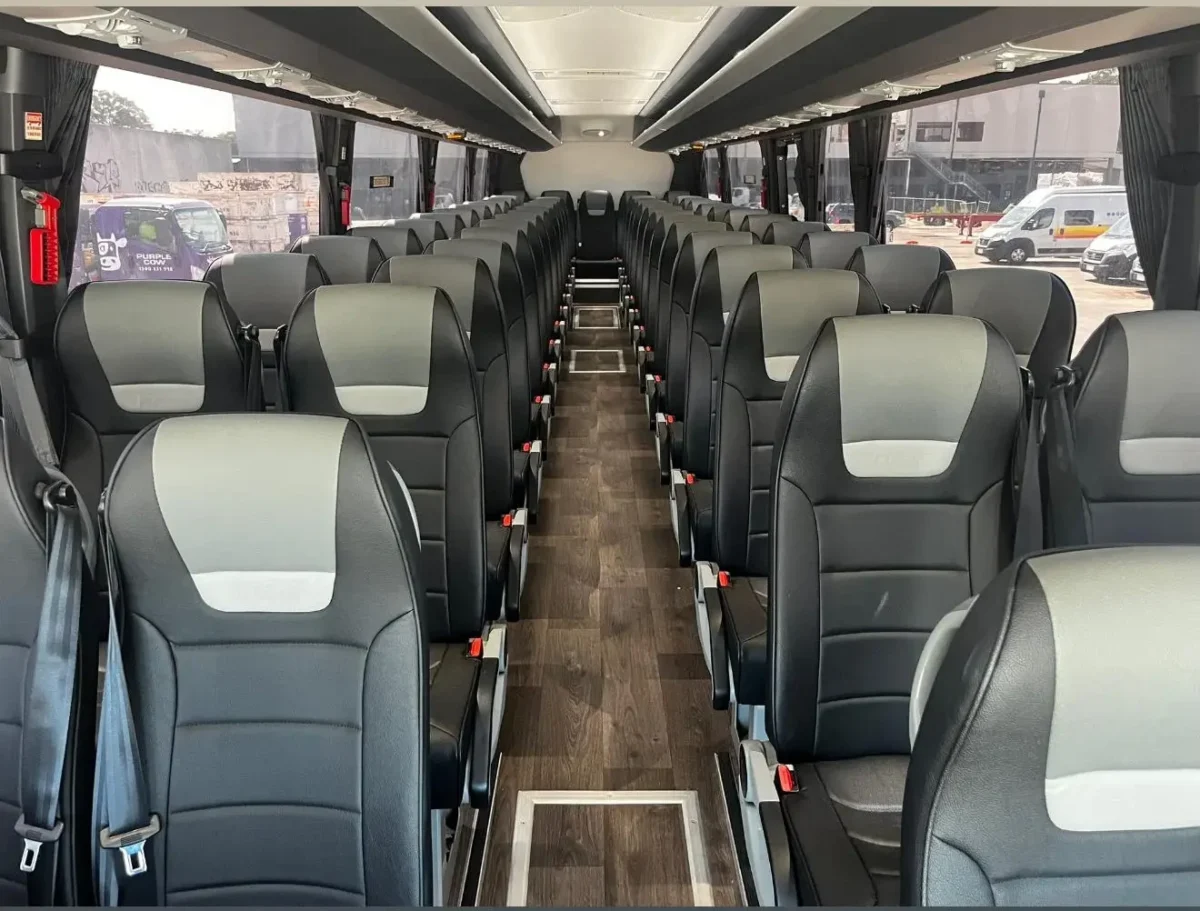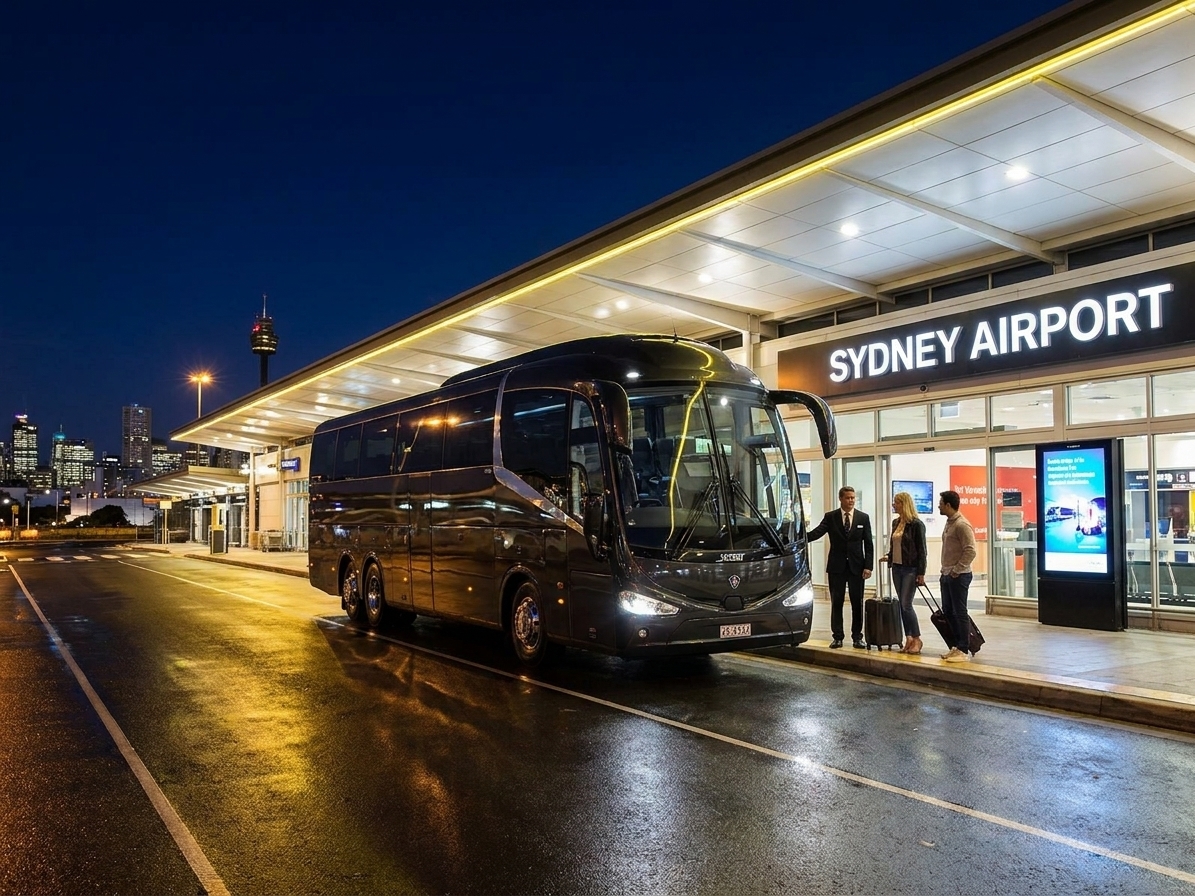
There is no fixed limit on pick-up points for a Sydney charter. The limit is the clock. Every stop adds the driving between addresses, the loading time, and the time lost to whoever is late, and a charter is billed by the hour with a minimum of 3 hours for minibuses and people movers and 4 hours for midi-coaches and full-size coaches. Three or four well-placed stops usually work. Eight scattered ones rarely do.
Why “how many stops” is the wrong question
Operators are rarely asked to refuse a stop. What happens instead is that the stops get agreed, the day runs 90 minutes long, and everybody is surprised.
The useful question is not how many stops you are allowed. It is what each stop costs you, and whether that cost buys you enough convenience to be worth it. Once you can price a stop, you can decide about it properly.
A Sydney charter is quoted either as an hourly hire or, for a point-to-point run such as an airport transfer, as a single fixed fare. On an hourly hire, extra stops turn into extra hours, and extra hours are the whole cost story. There is no mysterious per-stop surcharge to hunt for. Once you know that, planning charter bus hire across Sydney becomes an exercise in deciding which stops earn their time, and the arithmetic against the published hourly rates and minimum hire is simple enough to do yourself.
What one stop actually costs
Break a stop into its four components. You will not get a single national number for this, because a stop in a quiet street at 9am and a stop on a main road at 5pm are different events, but the components are always the same.
| Component | What it is | What makes it worse |
|---|---|---|
| Deviation | Driving off the direct route to reach the address and back | Stops that are not roughly on a line between the first and last address |
| Approach and positioning | Finding the address, positioning the vehicle safely, opening doors | Narrow streets, no lawful set-down nearby, a vehicle too big for the kerb |
| Loading | Passengers boarding, luggage stowed | Large groups, checked luggage, prams, limited mobility, no assembly beforehand |
| Waiting | The gap between arrival and the last passenger appearing | Nobody nominated a time, or the group was told the departure time rather than an assembly time |
The fourth row is where multi-stop days are lost. The first three are physics and can be planned. The fourth is human behaviour and has to be managed.
Do more stops cost more?
Yes, and here is the honest way to see it.
Take a group of 24 spread across three suburbs, travelling on an executive minibus. The published hourly rate for a 21 to 24-seat executive minibus is $145 with a 3-hour minimum. If the direct run would have taken three hours and the three pick-up points push it to four, the extra stop time has cost one additional hour at $145.
Run the same logic on a 53-seat executive coach at $195 an hour with a 4-hour minimum, and an extra hour of collecting people is $195. Nothing hidden, nothing punitive, just billable time.
That framing changes the conversation with your group. An extra stop is not free convenience, it is a specific amount of money divided among the people using it. Sometimes that is obviously worth it. Sometimes the group would rather walk five minutes.
Two more cost notes. Tolls and parking are confirmed in advance and priced separately, so a stop that pulls the route onto a toll road has a second, smaller cost attached. And a fixed transfer fare quoted for a point-to-point run is not charged at a minimum hire, but adding several collection points usually pushes a job out of fixed-fare territory and into hourly.
The three patterns that actually work
Almost every multi-stop request resolves into one of these. Pick the pattern first, then the addresses.
1. Door-to-door for a small group. Genuine door-to-door works when the group is small and the addresses are close together. It is the natural pattern for minibus hire with a driver on a wedding morning, a small corporate movement or a family group. Above roughly a dozen addresses it stops being door-to-door and starts being a bus route.
2. Cluster points. Instead of ten houses, nominate three corners and ask people to walk to the nearest one. This is the single highest-value change most organisers can make. It preserves most of the convenience, removes most of the deviation, and it is far easier to communicate. Give each cluster point a street address and a landmark, not a suburb.
3. One assembly point. Everyone meets at a single location and the vehicle does one clean pick-up. Fastest, cheapest, and the most reliable option for a large group. It works when there is an obvious shared location: a workplace, a club, a school, a hotel. It is also the only pattern that scales past about 40 passengers without the timing getting fragile.
For groups spread across the six Greater Sydney regions, there is a fourth option worth asking about: two vehicles running two shorter routes that converge at the destination. That is often faster and not always dearer than one vehicle doing a long loop, particularly when the geography is genuinely split.
The hidden cost of a stop is the person who is late
The clock does not stop for a straggler, and the vehicle cannot simply sit there. A charter coach may stop in a bus zone to drop off or pick up passengers, but not to wait, and on many suburban streets there is nowhere lawful to hold at all.
Three practices remove most of this.
- Publish an assembly time, not a departure time. Ten to fifteen minutes earlier. This is not a trick, it is realism.
- Nominate one day-of contact per stop. That person confirms the group is present and calls if someone is missing. Everybody else calls that person, not the driver.
- Agree a leave rule in advance. Decide, before the day, how long the vehicle waits at a stop and what happens to anyone who misses it. Publishing that rule alongside the times is much kinder than improvising it at the kerb.
Driver name, mobile and vehicle registration are sent 24 hours before travel. Give the mobile to the day-of contacts, not to the whole group.
Sydney factors that change the maths
School zones. Most NSW school zones run at 40 km/h from 8:00 to 9:30am and 2:30 to 4:00pm on notified school days, and the sign always governs. A suburban collection run in either window will be slower than the same run at 11am, and multi-stop routes thread more zones than direct ones.
Street access. Some addresses will not take a full-size coach at all. Parked cars, low branches and the absence of anywhere to turn stop a 53-seat vehicle far more often than road width does. If several of your stops are on tight streets, the answer may be a smaller vehicle or cluster points on through roads.
Driver hours. A long day with many stops is still a working day. Standard hours for a solo driver allow 12 hours of work with 7 continuous hours of stationary rest in any 24-hour period, and a separate standard hours table applies to bus and coach solo drivers. A route that looks clever on paper can push a day past what one driver can cover, which is a planning constraint rather than a cost one.
A short planning process
- List every passenger and their suburb. Not their address yet.
- Group them into clusters of three or more, and find one nominated street address per cluster.
- Order the clusters so the route runs roughly in one direction rather than doubling back.
- Count the clusters. Three or four is comfortable. Six is a conversation with your operator. Ten is a different pattern.
- Set assembly times working backwards from the destination arrival time, and publish them ten to fifteen minutes early.
- Name a contact per cluster and give them the plan in writing.
- Send the whole thing with the enquiry, including the addresses, so the quote reflects the real day.
Frequently asked questions
How many pick-up points can a Sydney charter have?
There is no fixed limit. Three or four well-placed points usually work comfortably. Beyond that the time cost grows quickly, and the better answer is often cluster points, a single assembly point, or two vehicles running shorter routes.
Does each extra stop cost more?
It costs whatever additional time it adds, billed at the hourly rate for the vehicle. On a 21 to 24-seat executive minibus at $145 an hour, an extra hour of collecting people is $145. Tolls and parking are confirmed in advance and priced separately.
Can we do genuine door-to-door pick-ups?
For a small group with addresses close together, yes, and it is a common way minibus charters are used. For a larger or more scattered group, cluster points preserve most of the convenience without the time cost.
What happens if someone is late to a pick-up point?
Agree the rule before the day. A charter coach cannot lawfully wait in a bus zone and often has nowhere to hold on a suburban street, so a fixed waiting time per stop, published in advance, is fairer than deciding on the spot.
Is one big vehicle always cheaper than two smaller ones?
No. Two vehicles running shorter routes can be faster and are not automatically dearer, particularly when the group is split across distant parts of Sydney. Ask for both structures priced.
Next step
Send the list of suburbs, the group size, the date and the destination, and you will get a fixed written quote back within two business hours with the vehicle named and the stop pattern reflected in the hours rather than discovered on the day. Start from charter bus hire across Sydney.
Call 02 9469 6600, Monday to Friday 7am to 6pm or Saturday 8am to 2pm. Coverage runs across six Greater Sydney regions with no travel surcharge inside Greater Sydney, and most jobs need two to four weeks of lead time.
Sources
- Transport for NSW, School zones, https://www.transport.nsw.gov.au/roadsafety/community/schools/school-zones. Accessed 7 September 2026.
- NSW Government, Road Rules 2014 (NSW), rule 183, https://legislation.nsw.gov.au/view/html/inforce/current/sl-2014-0758. Accessed 7 September 2026.
- NHVR, Heavy vehicle fatigue management, bus industry, https://www.nhvr.gov.au/safety-accreditation-compliance/fatigue-management/heavy-vehicle-fatigue-management-bus-industry. Accessed 7 September 2026.