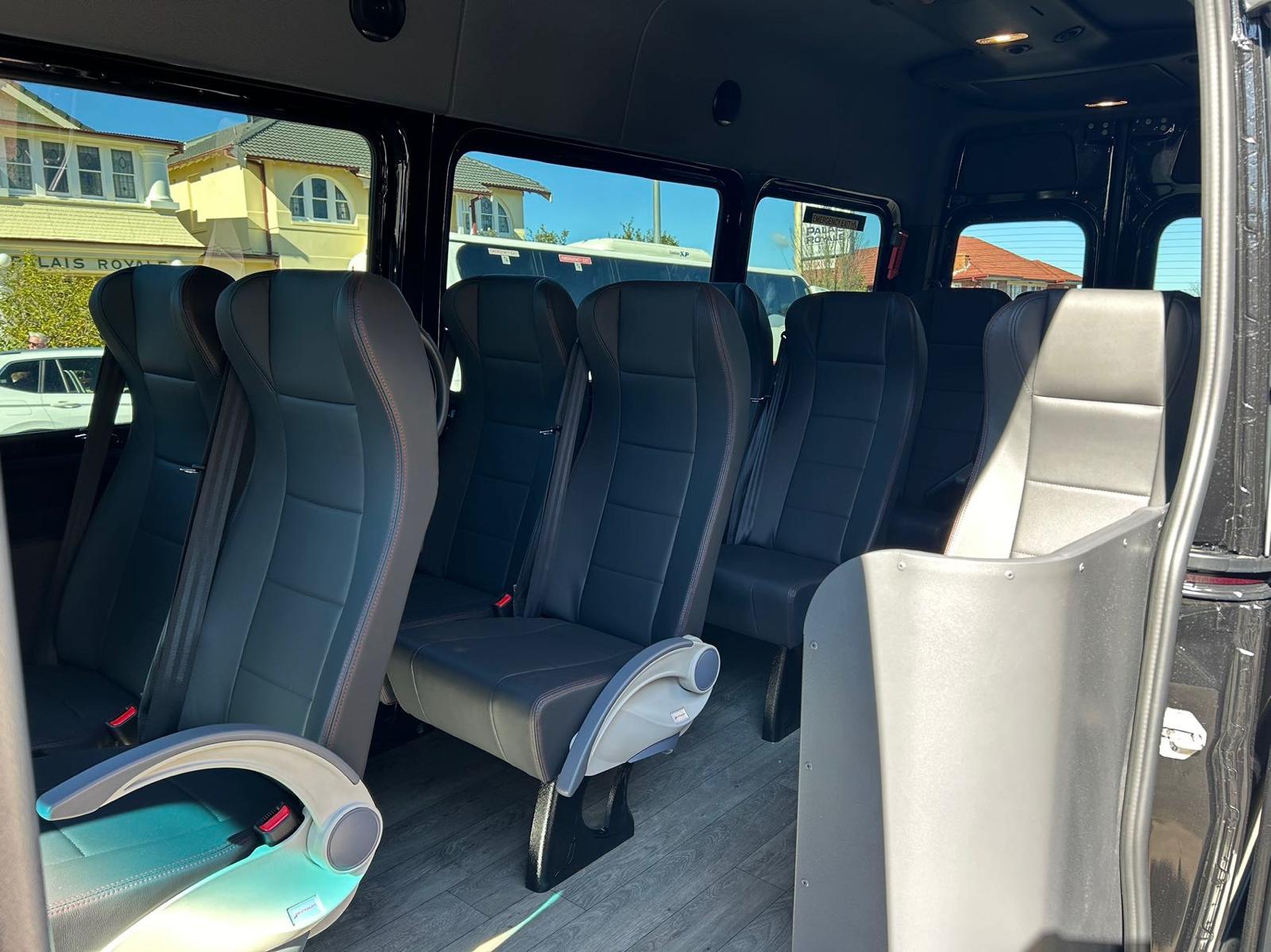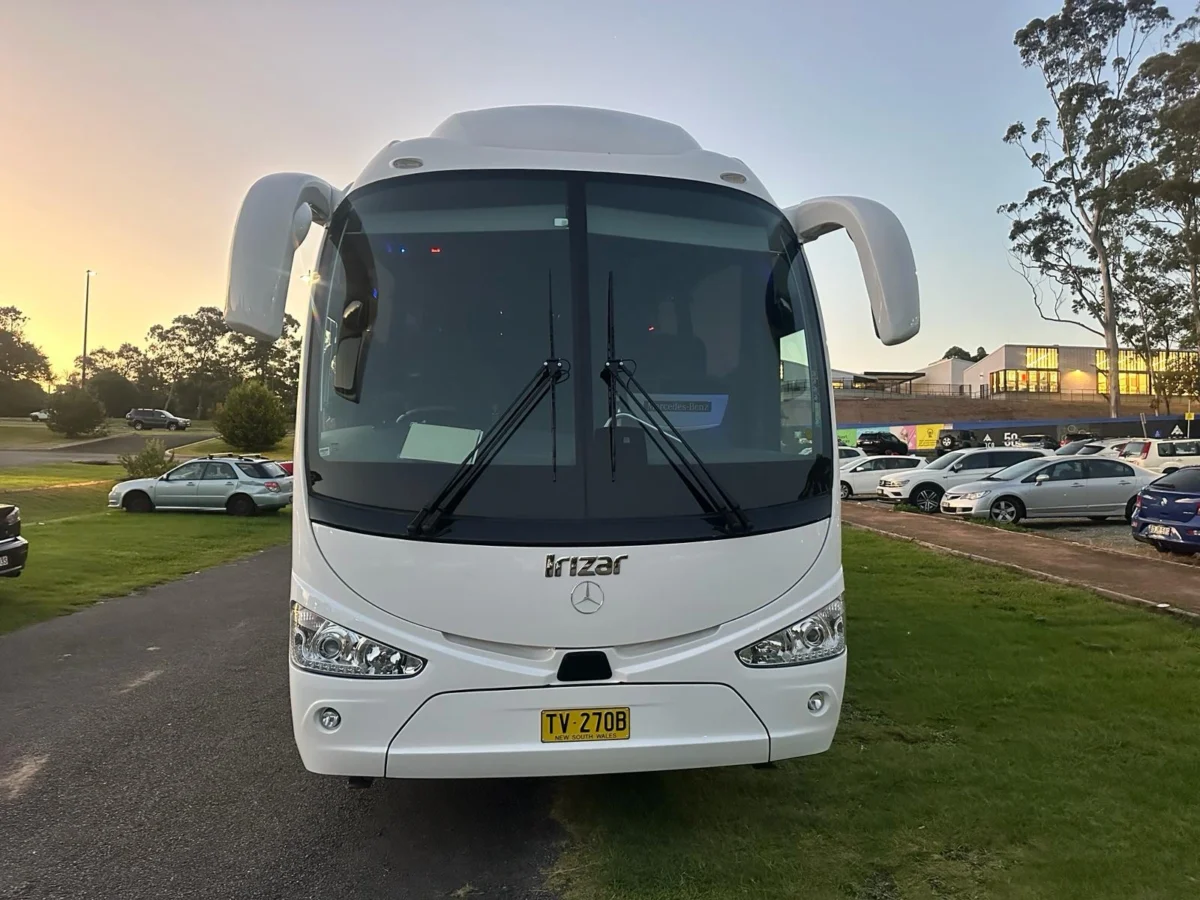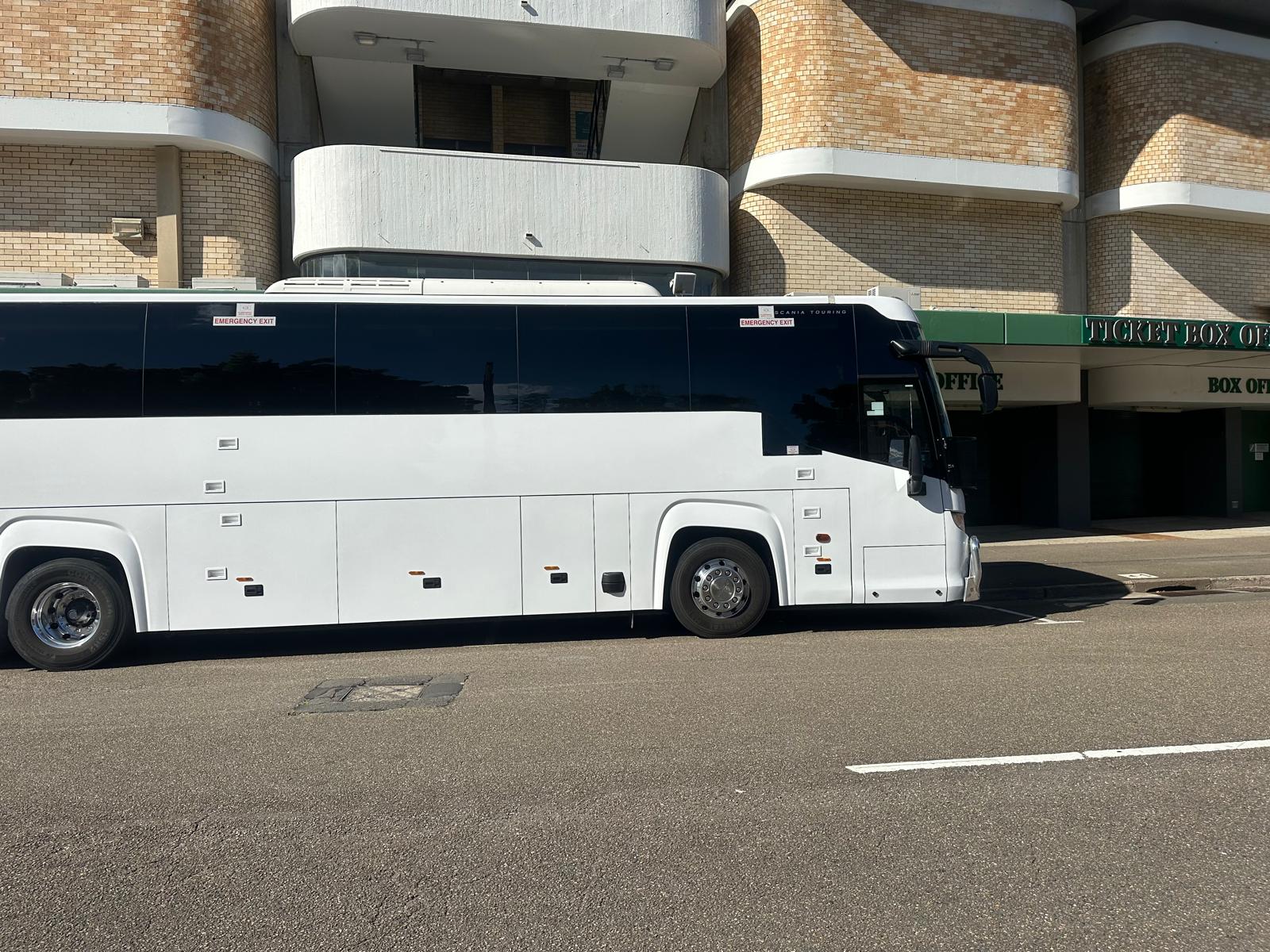
A continuous loop buys frequency. Timed point-to-point departures buy a deadline. Run a loop when people move across a spread and no single moment matters, so nobody needs to consult a timetable. Run timed departures when a known number of people must be somewhere by a fixed time, because only a scheduled wave guarantees arrival. The arithmetic that separates them is capacity per hour against capacity at a moment, and most multi-day events need both patterns on different days.
The two patterns, defined precisely
A continuous loop is a vehicle, or several, running a fixed circuit repeatedly for a defined window. Passengers turn up at a stop rather than booking a seat on a departure. The service is measured by headway, the gap between vehicles.
Point-to-point is one or more vehicles running a scheduled departure from A to B, arriving before a stated time. Passengers know the departure time. The service is measured by whether everyone got there before the deadline.
The two are often described as if one is simply the busy version of the other. They are not. They optimise for different things and they fail in different ways. A loop fails by making people wait. A timed departure fails by leaving people behind.
The one formula that decides it
Loop capacity is a rate, not a total:
> Seats per hour = (60 / cycle time in minutes) x vehicles x seats per vehicle
Cycle time is the whole round trip: running time out, dwell for boarding, running time back, dwell for alighting, and recovery at the terminus. Headway falls out of the same numbers:
> Headway = cycle time / vehicles
Timed departures work on a different quantity entirely:
> Vehicles per wave = passengers to move / seats per vehicle, rounded up
Point-to-point capacity is capacity at a moment. A vehicle can only be counted once inside a wave, because a second run arrives after the deadline that made you schedule a wave in the first place.
That single difference is the whole decision. Ask which constraint you are actually under: a rate, or a moment.
Worked: a Darling Harbour hotel cluster to ICC Sydney
Take 300 delegates spread across four hotels in the Darling Harbour precinct, moving to ICC Sydney. Coaches drop at Iron Wharf Place off Darling Drive, with Zollner Circuit as the other approved drop point, and coach parking is arranged through the dedicated ICC Sydney Event Manager rather than found on the street.
Assume a measured cycle time of 24 minutes: out, dwell, back, dwell, recovery. Assume 48-seat coaches, and note our seat counts exclude the driver.
As a continuous loop
| Coaches on the loop | Headway | Seats delivered per hour |
|---|---|---|
| 1 | 24 minutes | 120 |
| 2 | 12 minutes | 240 |
| 3 | 8 minutes | 360 |
| 4 | 6 minutes | 480 |
Three coaches move the full 300 delegates inside an hour and give a headway short enough that nobody checks a timetable. But read the table honestly: the last delegate boards near the end of that hour. A loop does not deliver 300 people at 8:15am. It delivers them between 7:30 and 8:30.
As timed departures
If the opening plenary starts at 8:30am and every delegate must be seated, the question changes. Now you need 300 seats arriving before 8:30, which is 300 / 48 = 6.25, rounded up to seven coach loads.
Inside a single wave, that is seven coaches. If you widen the window enough for a second run (cycle time 24 minutes, so a window of roughly 50 minutes with margin), four coaches can cover it in two runs each, delivering 384 seats across two waves. The trade is that half your delegates are sitting in a plenary room for 25 minutes before it starts.
So the loop needs three coaches and an hour. The timed pattern needs seven coaches and one wave, or four coaches and two waves. Same 300 people, three different answers, all correct for different constraints.
What changes across a three-day event
Almost no conference wants the same pattern for three days.
| Day and movement | Constraint | Pattern that fits |
|---|---|---|
| Day 1 arrivals, airport to hotels | Flights land across the day | Timed departures against the flight manifest, not a loop |
| Day 1 opening plenary | Hard start time | Timed departures, sized to a wave |
| Days 2 and 3 morning | Sessions start but delegates trickle | Loop, running from roughly 90 minutes before the first session |
| Midday and afternoon | Delegates move for their own reasons | Loop at a longer headway, or nothing at all |
| Gala dinner offsite | Everyone leaves at once, returns across three hours | Timed departures out, loop back |
| Final day departures | Flights across the day, luggage in play | Timed departures against the flight manifest |
The gala dinner row is the one that catches planners. Outbound is a hard deadline with a full headcount, so it is a wave. Return is a long spread with an unpredictable tail, so it is a loop. Treating the whole evening as one pattern gets one half of it wrong.
What each pattern costs in vehicle hours
Both patterns are bought the same way: vehicles multiplied by hours. Our published minimum hire is four hours for midi-coaches and full-size coaches and three hours for minibuses and people movers, so a 90 minute movement is charged against the minimum block rather than the 90 minutes.
That single rule reshapes the comparison. Three coaches on a loop for two hours and seven coaches in a single timed wave both bill against the four hour minimum, so the timed wave is not marginally more expensive, it is more than twice as expensive. Above 58 passengers moving together, the work is quoted as a coordinated convoy priced per event rather than by adding hourly lines, which is worth raising early because it changes the shape of the quote.
Two further costs sit outside the hourly rate and are confirmed in advance: tolls and parking, and any public holiday or after-hours loading. On a loop, a tolled crossing is paid on every circuit, which is why a slightly slower untolled circuit sometimes wins on total cost. A full-size coach is over 2.8 m high, so it is Class B on every class-based Sydney toll road regardless of length.
Sydney conditions that push the answer one way
A loop needs a kerb it can use repeatedly and a place to stand between circuits, and central Sydney is strict about both.
A charter coach counts as a public bus under Road Rules 2014 r183, so it may stop in a bus zone to set down or pick up passengers. It may not wait there. The City of Sydney’s Central Sydney On-Street Parking Policy states plainly that the City will not accommodate long-stay coach layover on-street in central Sydney, so a loop terminating in the CBD needs an off-street arrangement rather than a hopeful kerb. Transport for NSW operates the King Street Wharf Bus and Coach Layover, accessed via Lime Street, for accredited operators running vehicles seating more than 12 adults, with prior registration required.
At ICC Sydney the venue side is managed rather than public. Drop-off is at Iron Wharf Place off Darling Drive plus Zollner Circuit, and coach parking is arranged through your dedicated ICC Sydney Event Manager. A loop needs that arrangement confirmed before the headway is published to delegates, because a circuit that cannot reliably access its drop point is not a circuit.
George Street through the CBD is a pedestrian boulevard rather than a coach route, so any loop drawn between the CBD and Darling Harbour has to be measured on the roads a coach can actually use.
The decision checklist
Answer these six and the pattern is chosen for you.
- Is there a hard deadline at one end? Yes points to timed departures.
- Is the movement a spread or a moment? A spread points to a loop.
- What is the largest number moving at once? If that number exceeds one vehicle, you are sizing a wave, not a headway.
- How long is the circuit, measured at the actual hour? Under about 25 minutes, a loop is efficient. Well over that, a loop needs too many vehicles to feel frequent.
- Can the vehicle stand somewhere legally at each end? A loop without a layover is a loop that breaks down under delay.
- Does the pattern need to change by day? Almost always yes on a multi-day event. Plan movement by movement, not event-wide.
Corporate bus hire in Sydney covers the service, published hourly rates and minimum hire show what each pattern costs to hold, and seat counts across the fleet give the capacity input for the formula.
Frequently asked questions
When does a continuous loop beat scheduled departures?
When people move across a spread rather than at a moment, the circuit is short enough to give a genuinely short headway, and no single arrival deadline governs. Conference mid-days, campus circuits and hotel-to-venue movement between sessions are the classic loop cases.
How do you calculate headway?
Divide measured cycle time by the number of vehicles. A 24 minute cycle gives a 24 minute headway with one vehicle, 12 minutes with two and 8 minutes with three. Cycle time must include boarding dwell and recovery time, not just driving.
What group size changes the answer?
The threshold is a vehicle load, not a headcount. Once the number of people who must move at one moment exceeds the seats on one vehicle, a loop cannot serve that moment and you are into timed waves. Above 58 passengers moving together, the job is quoted as a coordinated convoy.
How many vehicles does a loop need?
Cycle time divided by the headway you want, rounded up. There is no partial vehicle, so frequency improves in steps. Halving headway costs a whole additional coach and driver.
Can we run one pattern for a whole conference?
You can, but it will be wrong for at least one movement. Arrivals and departures follow flights, plenaries follow a clock, and the gala dinner return follows nobody. Set the pattern per movement.
Next step
Send the movement list for your event: what moves, when, how many people, and which movements have a hard deadline. We will come back with the pattern for each one, the vehicle count behind it, and a written quote naming the vehicles, usually within two business hours.
To talk through a loop before it is costed, call our operations team on 02 9469 6600 and book a shuttle plan review.
Sources
- ICC Sydney, “Getting here”, https://iccsydney.com.au/visitors/getting-here/. Accessed 7 September 2026.
- NSW Legislation, “Road Rules 2014”, https://legislation.nsw.gov.au/view/html/inforce/current/sl-2014-0758. Accessed 7 September 2026.
- Transport for NSW, “King Street Wharf Bus and Coach Layover”, https://www.transport.nsw.gov.au/operations/roads-and-waterways/business-and-industry/buses/operators/king-street-wharf-bus-and. Accessed 7 September 2026.
- City of Sydney, “Central Sydney On-Street Parking Policy”, https://www.cityofsydney.nsw.gov.au/-/media/corporate/files/publications/policies/central-sydney-street-parking-policy/central-sydney-on-street-parking-policy_0525.pdf. Accessed 7 September 2026.