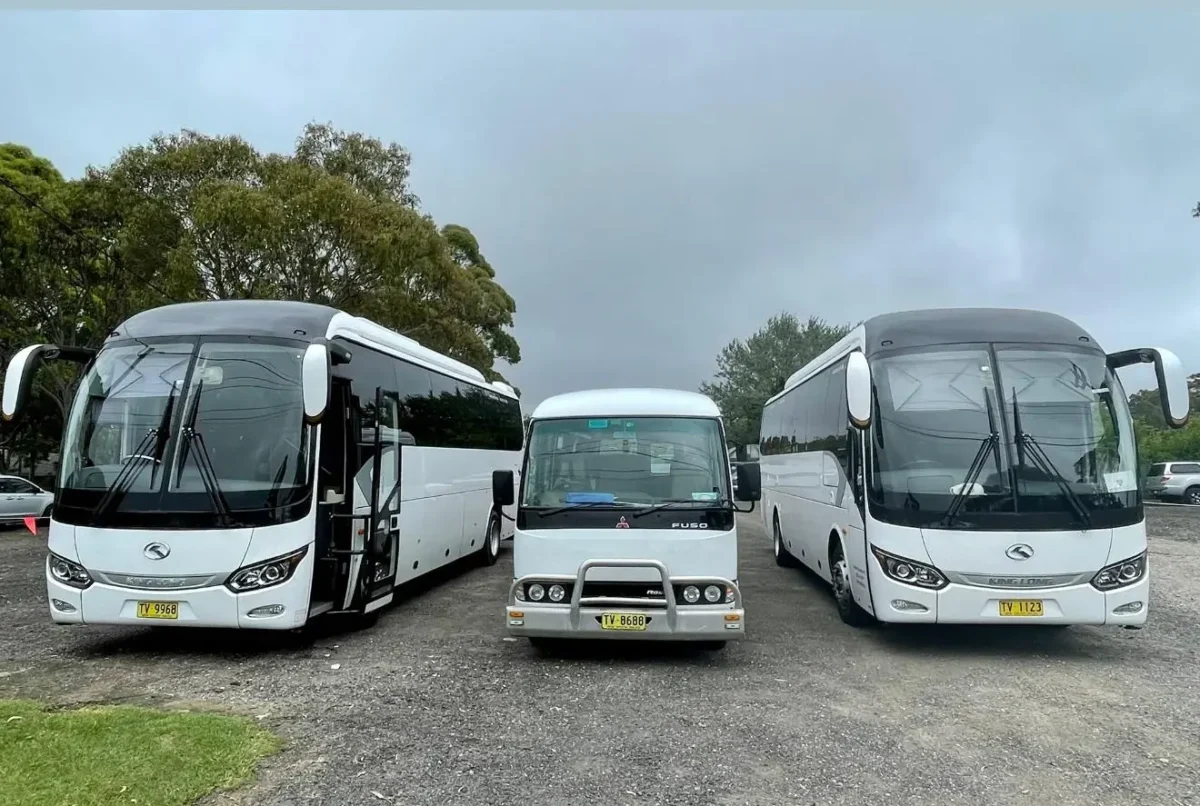
Wedding shuttles rarely fail because a coach broke down. They fail because guests were never told exactly where and when to stand, because the only person who knew the plan was getting married, and because nobody decided in advance what happens to the last four people at the bar. All three are planning failures, all three are fixable before the invitations go out, and none of them requires spending more money.
The argument against shuttles, taken seriously
There is a case circulating that wedding shuttles are more trouble than they are worth. It usually runs like this: guests end up waiting, the bus leaves without someone, everyone is herded onto a schedule on a night that should feel relaxed, and the couple could have told people to sort themselves out.
The case is not stupid. A badly run shuttle produces exactly those outcomes. What the argument misses is the alternative at most Sydney wedding venues, which is a car park full of guests who have been drinking, or a rural road at 11pm with no rideshare coverage. The shuttle is not competing with a taxi rank. It is usually competing with nothing.
So the useful question is not whether to run one. It is which specific failures produce that reputation, and what stops each of them.
The six failures, and what a guest actually experiences
| What goes wrong | What the guest experiences | What actually caused it |
|---|---|---|
| The pick-up point is described, not addressed | Guests standing on the wrong side of a hotel, watching a coach they cannot see | “Out the front of the hotel” instead of a street address and a landmark |
| The timetable lives in one email | Guests asking each other what time the bus goes, then missing it | Transport information published once, three months out, never repeated |
| The couple are the contact | Nobody can reach anyone. The driver rings a phone in a bridal suite | No day-of contact named, so the default is the two people least able to answer |
| One bus at the end of the night | A crowd of eighty trying to board at once, and a bus that leaves late | A single return run with no earlier option for guests who wanted to leave at nine |
| No straggler rule | A full coach held for one group, or someone genuinely left behind | Nobody decided in advance what happens at departure time |
| The vehicle never arrives | The worst version, and the reason people distrust shuttles | A booking chain where the party taking the money does not own the vehicle |
Read that table as a diagnostic. Every one of those has a fix that costs nothing but a decision.
Fix one: publish a timetable, not an offer
“We will have a bus” is an offer. Guests cannot plan around it, so they do not.
Publish the following, in this form, on the wedding website and again on a card at the venue: the pick-up address as a street address with a landmark, the departure time, the arrival time, the return times, and the last return time. Then repeat it. Once on the invitation insert, once on the website, once in the week-of email, and once printed at the welcome table.
The single most important line is the last return time, because it is the one guests plan the end of their night around. A last bus published as “around midnight” tells a guest nothing. A last bus published as 11.45pm tells them when to start saying goodbye.
Fix two: name a day-of contact who is not getting married
On the day, the couple cannot answer a phone and should not be asked to. Name one person, put their mobile number on the printed timetable and give it to the operator in advance.
That person’s job is small and specific: be reachable, be at the pick-up point five minutes before departure, count heads, and make the call at departure time. In return they get the driver’s name, mobile number and vehicle registration, which are sent 24 hours before travel and should be forwarded straight to them rather than sitting in the couple’s inbox.
Fix three: give the operator a street address and let them check it
A coach cannot stop wherever a car can. Narrow streets, low branches, tight driveways, no legal set-down within sight of the door: all of these are ordinary and all of them are solvable when raised early rather than discovered at 4pm.
Send the pick-up address and the venue address as addresses, not names, and ask the operator to confirm the vehicle can set down there. Where it cannot, the answer is usually a different stop fifty metres away or a smaller vehicle, and either is fine if you know in advance. What is not fine is a driver improvising a stop while eighty guests watch.
Add one wet-weather line while you are at it. Where do guests stand if it is raining, and is that place visible from where the coach stops? A covered assembly point that guests can find in the dark is worth more than a closer one they cannot.
Fix four: stagger the returns instead of running one bus at the end
A single return run concentrates every problem into one moment. Eighty people board at once, the slowest determine the departure, and anyone not ready is a crisis.
Two or three published return times spread the load and solve several problems at once. Guests with children and older guests leave early on the first run without feeling they are cutting the night short. The last run carries a smaller, more manageable group. And the crowd that has to be counted at the end is half the size.
Whether you can stagger depends on the cycle time between the venue and the pick-up point, which is a distance question. Over a short run it is easy. Over a long one, staggering means a second vehicle rather than a second trip, so raise it when you get the quote rather than after.
Fix five: write the straggler rule down before the day
The bus is due to leave at 11.45pm. Four guests are still at the bar. What happens?
There are only three honest answers, and you should pick one in advance: the coach leaves on time and those guests make their own way, the coach holds for a stated number of minutes and then leaves, or the coach holds indefinitely and everyone else waits. Most couples choose the middle one, publish it as “the last coach departs at 11.45pm and cannot wait”, and brief the day-of contact to enforce it.
What you cannot rely on is the driver simply agreeing to stay later. Bus and coach driver fatigue is regulated, and charter work carried out for a fare sits inside that regime. The driver’s day has a legal end, and it is set well before the night starts, which is exactly why the last departure time needs to be published to guests rather than negotiated on the night.
Fix six: book from the party that owns the vehicle
The failure that damages trust most is the vehicle that never turns up. It is almost always a booking-chain failure rather than a mechanical one: money paid to a party that does not own a coach, does not employ the driver and does not control the schedule.
Two questions filter this quickly. Ask who owns the vehicle and who employs the driver. Then ask for the booking in writing with the vehicle named, not a category. Booking with an operator that owns the vehicles and employs the drivers removes the intermediary that most of these stories have in common, and a written quote with the vehicle named gives you something concrete to hold.
Ask one more thing while you are there: whether the vehicle waits between movements or is released and returns, and how that is priced. Half the confusion on a wedding night traces back to nobody agreeing which of those two things was happening. It is worth checking how waiting time and after-hours running are quoted before you sign anything.
The 48-hour checklist
- Printed timetable cards on the welcome table, with addresses and the last return time.
- Day-of contact confirmed, with the driver’s name, mobile and vehicle registration forwarded to them.
- Straggler rule agreed and published to guests.
- Wet-weather assembly point identified and communicated.
- Pick-up and set-down points confirmed with the operator as addresses.
- Final rider number sent to the operator, including anyone who has decided since the RSVP to leave the car at home.
Frequently asked questions
Are wedding shuttles actually worth it?
At a venue where guests have a genuine alternative, a shuttle is a convenience. At a venue with limited parking, a bar running late and poor rideshare coverage after dark, it is the difference between guests getting home and guests improvising. The complaints attached to shuttles are almost all information failures rather than transport failures.
How do you stop guests missing the bus?
Publish a street address rather than a description, publish exact times rather than approximations, repeat the information at least three times through different channels, and have a named person at the pick-up point five minutes early counting heads. Guests miss buses they were never clearly told about.
What happens if guests are not ready when the last bus is due to leave?
Whatever you decided in advance and told them. Publish the last departure as a fixed time, brief your day-of contact to enforce it, and make clear the coach cannot wait indefinitely. A driver’s working hours are regulated, so extending the night is not a decision that can be made at the venue.
Should the couple hold the driver’s phone number?
No. The driver’s details should go to a named day-of contact who is not part of the wedding party. Driver name, mobile number and vehicle registration are provided 24 hours before travel, which is enough time to pass them on properly.
Can guests drink on the bus?
Alcohol is permitted on private function bookings by prior arrangement only, and never on school or youth charters. Arrange it in advance rather than assuming, and tell your guests what has been agreed so nobody is surprised at the door.
Next step
Send the venue address, the pick-up point, the date and the number of guests you expect on the return leg, and you will get a fixed written quote back within two business hours with the vehicle named and the timetable built in rather than left to the night.
Start with wedding bus hire in Sydney or call 02 9469 6600, Monday to Friday 7am to 6pm or Saturday 8am to 2pm. Most bookings need two to four weeks of lead time, and December and long weekends need four to eight.
Sources
- National Heavy Vehicle Regulator, Bus and coach driver fatigue and health and wellbeing, https://www.nhvr.gov.au/safety-accreditation-compliance/chain-of-responsibility/regulatory-advice/bus-and-coach-driver-fatigue-and-health-and-wellbeing. Accessed 7 September 2026.