At Sydney Airport a chartered vehicle cannot wait outside arrivals for an executive group. Collection happens inside dedicated ground transport zones, and vehicles must not be left unattended at terminal frontages at any time. The driver is permitted to leave the vehicle and meet passengers inside the terminal, and the vehicle waits at the Ross Smith Avenue bus holding area until the group is ready. Build the protocol around that, then agree the meeting point in writing before anyone flies.
What the airport allows, and what it quietly rules out
Two published Sydney Airport rules shape every corporate meet, and neither is negotiable.
Collection is zone-only. Registered commercial vehicles use the dedicated ground transport zones, and when they are not actively collecting a pre-booked passenger they use the vehicle holding areas. The frontage outside arrivals is not a waiting place for a chartered vehicle, no matter who is on board.
Drop-off is different. Kerbside set-down at the Departures level is permitted, capped at one minute, and the driver must remain with the vehicle. That asymmetry surprises people who have done the outbound leg and assume the inbound works the same way.
The rule that most often derails a plan is height. The T2/T3 Priority Pick-up zone carries a 2.9 metre height restriction, and a full-size coach exceeds it. If your visiting group is twelve people, that zone may be available to the vehicle assigned. If it is forty, it will not be. Sizing the vehicle and choosing the collection point are the same decision, not two.
Where this leaves an assistant organising airport transfers for corporate groups in Sydney is straightforward: you are not choosing between kerbside convenience and a zone. You are choosing how well the zone meet is run.
What the group actually sees
An executive group’s impression of the ground arrangements is formed in about ninety seconds, and almost all of it happens before they reach the vehicle.
They come through the arrivals door tired, holding phones with no local data, looking for one recognisable thing. If that thing is present and confident, the rest of the day starts well. If it is absent, the group forms a huddle, someone starts calling the office, and the coach that was perfectly positioned three hundred metres away becomes irrelevant.
Sydney Airport permits bus and coach drivers to leave the vehicle to meet passengers inside the terminal. That allowance is the whole basis of a proper corporate meet, and it is worth using deliberately rather than treating the driver as someone who waits at a bay.
Terminal by terminal: where the meet happens
Sydney Airport publishes passenger meeting points at two of its three terminals, and the third is the one that needs planning.
| Terminal | Meeting point published by Sydney Airport | What an assistant should brief |
|---|---|---|
| T1 International | Arrivals level, between exits A and B (currently signposted) | Send the wording verbatim to the travelling party before they depart. It survives a flat phone battery; a text message sent after landing may not. |
| T2 Domestic | Arrivals level, opposite baggage carousel 6 (currently signposted) | A named carousel is the most reliable instruction available at a domestic terminal. Use it as written. |
| T3 | None published | Agree a specific meeting point with the operator in writing at booking. T3 also separates Bus Pickup from Coach Pickup, so the vehicle location depends on which vehicle is assigned. |
Treat all of these as current signage rather than permanent addresses. Exits and carousels are furniture, and Sydney Airport has been rebuilding around its terminals for years. Confirm in the week of travel.
The pre-arrival brief: what to send the operator
Most failed executive meets are failures of information, not of driving. This is the brief that prevents them. Send it at booking, not the night before.
- Flight number, operating carrier and date. The operating carrier matters on codeshares, because the terminal follows the operator rather than the ticket.
- Terminal. Say it explicitly even when it looks obvious. T3 changes the plan.
- Headcount, split by arriving party. Four executives arriving together is a different job from four arriving separately.
- Bag profile per person. Cabin only, or checked cases. This decides the vehicle more often than the seat count does.
- Name of the on-the-ground contact and their mobile. Not the booker’s number if the booker is in another building.
- Whether a name board or signage is wanted, and what name goes on it. Confirm with the operator whether that is available for your booking.
- The destination address and any building access constraint. Loading docks, boom gates and one-way approaches are worth flagging early.
- What happens if the flight is delayed. Get the answer in writing before the deposit.
- Whether the same vehicle is required for the return. Round trips are easier to schedule than two separate jobs.
- Any accessibility requirement. Wheelchair-equipped vehicles with hoists are available, but they are specified, not assumed.
Sydney Buses & Coaches sends the driver’s name, mobile number and vehicle registration twenty-four hours before travel. Put that number in the hands of whoever is physically meeting the group, and give it to the senior person travelling as well.
Timing: what you control and what you do not
The interval between wheels down and an executive group standing at the meeting point is the number the whole plan hangs on, and it is not a number to take from a blog post. It varies by terminal, by aircraft size, by how many flights land in the same window, by whether anyone in the party is selected for further processing, and by how quickly a group of six agrees to leave the terminal together.
What you can control is where the vehicle sits while that plays out. Sydney Airport’s bus holding area on Ross Smith Avenue exists precisely so that a driver can be on airport before the aircraft lands and be called forward when the group is genuinely ready. That is a better arrangement than a vehicle circling, and a far better one than a vehicle penalised at a kerb.
So the sequence for a corporate meet is: driver on airport early, holding; driver walks in to the published meeting point; group assembled and counted; vehicle called forward; single loading movement; away. The group waits for the vehicle for a couple of minutes at most, and the vehicle never waits at a frontage at all.
The vehicle is part of the impression
For a small senior group, the vehicle choice is a visible decision. Our published rates are GST inclusive and include the driver, fuel and vehicle insurance.
| Vehicle | Seats | Hourly rate | Minimum hire |
|---|---|---|---|
| Mercedes V-Class | 7 | $125 | 3 hours |
| Toyota Commuter | 12 | $110 | 3 hours |
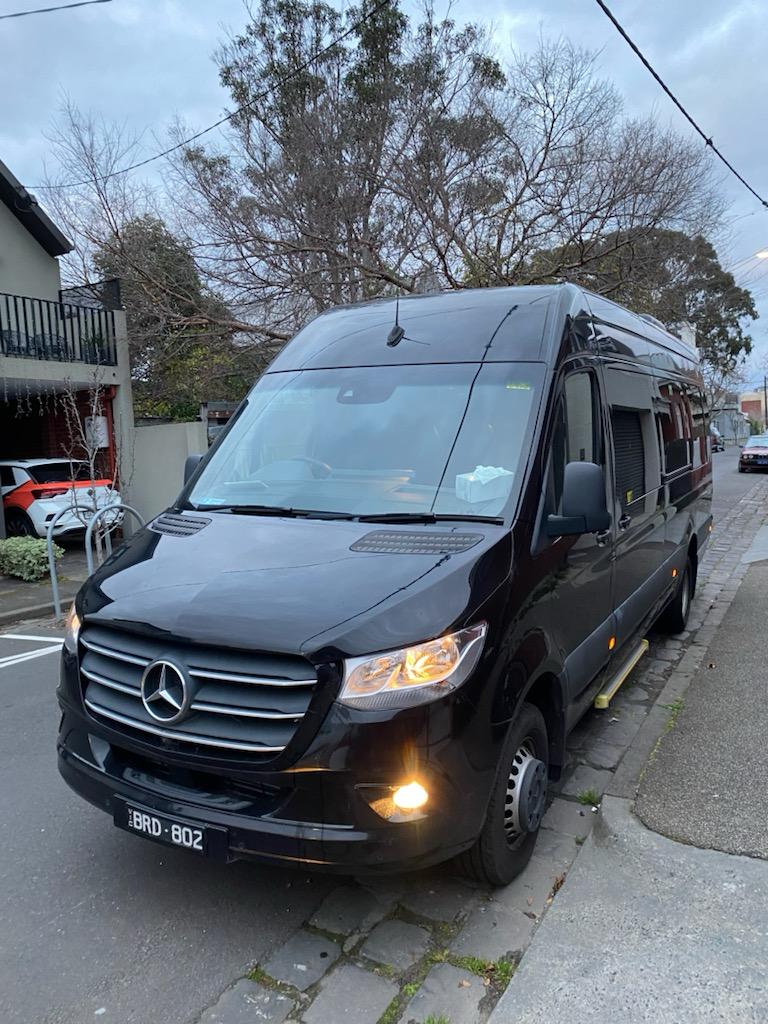
| Mercedes Sprinter | 11 to 14 | $145 | 3 hours |
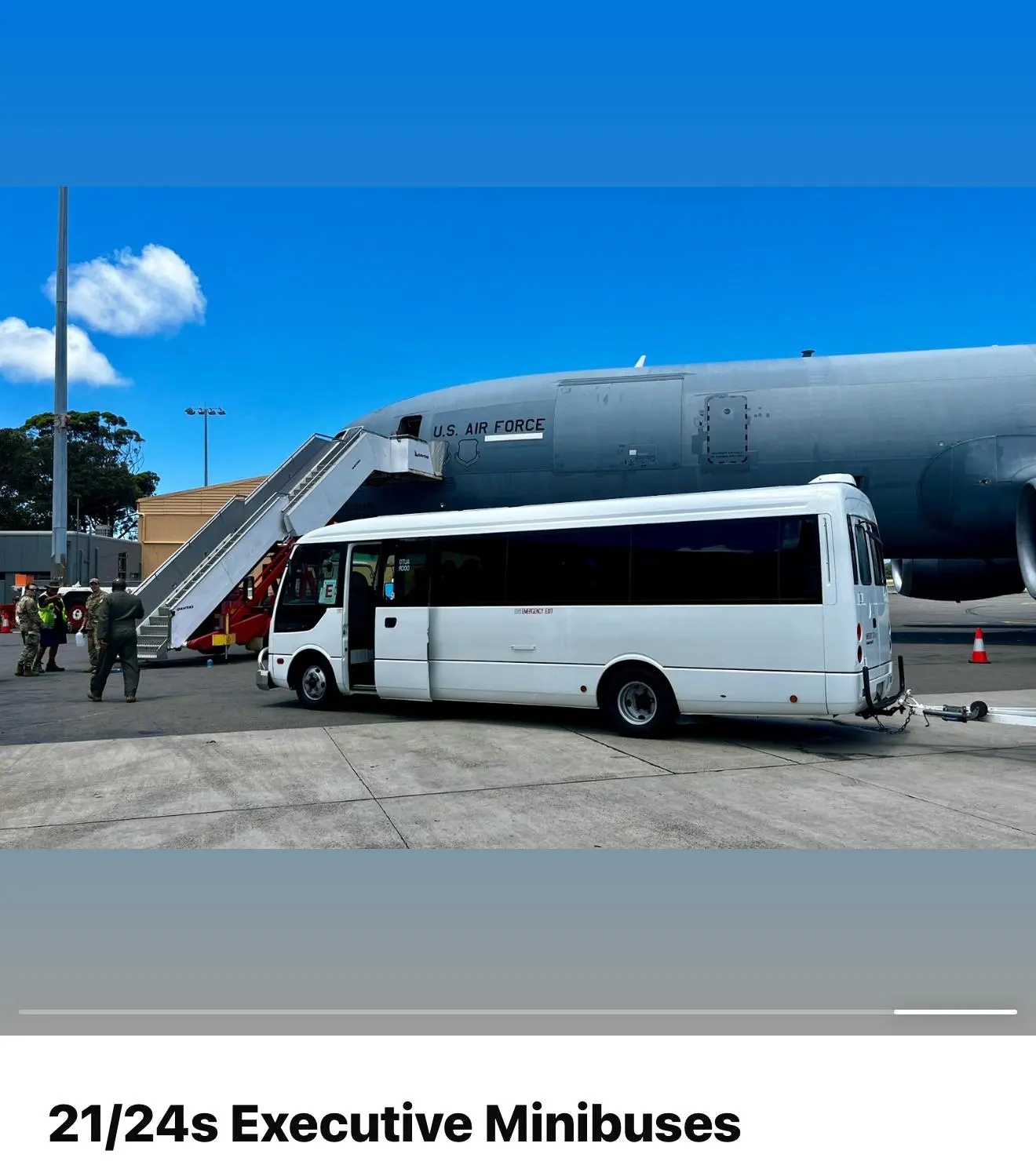
| Executive minibus | 21 to 24 | $145 | 3 hours |
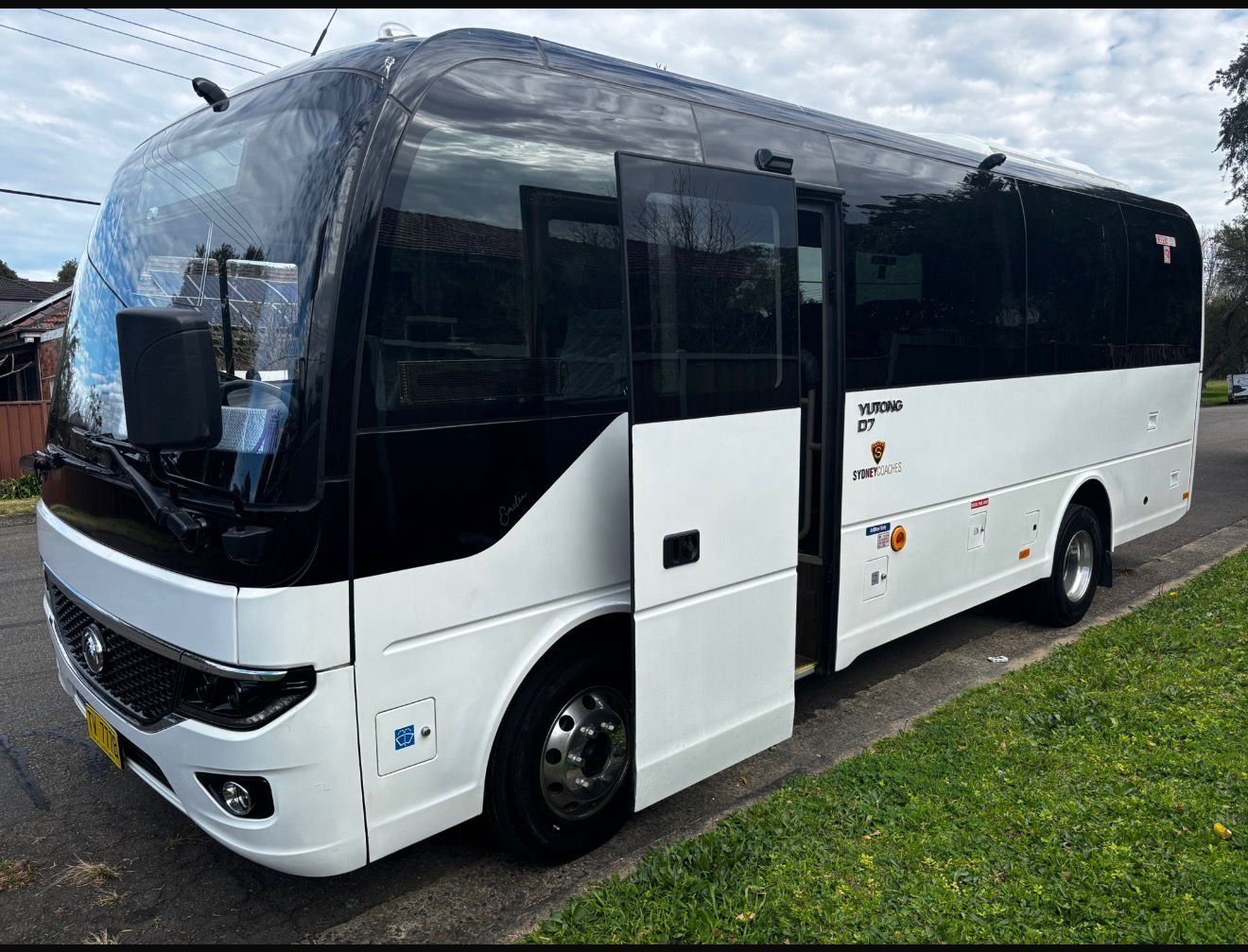
| Executive midi-coach | 27 | $165 | 4 hours |
Seat counts exclude the driver. Two things about that table are worth an assistant’s attention. First, an airport run does not have to be booked hourly: a point-to-point transfer can be quoted as a single fixed transfer fare, and a fare quoted that way is not charged against a minimum hire block. Second, the seat count is the wrong sizing input for an inbound international party. Eight people with eight checked cases and eight cabin bags is a luggage problem before it is a seating one. The published vehicle list and rates name the vehicle, and the quote should too.
When the flight moves
Executive itineraries move. The flight is delayed, the connection is missed, or the group is rebooked onto a different terminal entirely.
Three provisions make that survivable, and all three belong in the booking rather than in a phone call on the day:
- Who is watching the flight, and how. Ask the operator directly whether inbound flight monitoring is performed as standard on your booking, who does it, and what triggers a change to the pick-up time. Get the answer in writing.
- What waiting is included, and what waiting costs after that. Waiting time beyond the booked window is confirmed in advance and priced separately in our quotes. You want the number before the day, not after.
- What happens on a terminal change. A rebooking from T1 to T3 is not a minor amendment. It changes the meeting point, the zone and possibly the vehicle.
If the group is arriving into one terminal and departing from another on the same visit, that inter-terminal movement is a separate piece of planning and worth treating as its own job.
Frequently asked questions
Can the driver meet our visitors inside the terminal?
Yes. Sydney Airport permits bus and coach drivers to leave the vehicle to meet passengers inside the terminal. The vehicle is not left at the terminal frontage while that happens, so allow a few minutes for the driver to walk in and back.
Can the vehicle wait outside arrivals so the group does not have to walk?
No. Commercial vehicles must not be left unattended at terminal frontages at any time and must use the vehicle holding areas when they are not collecting pre-booked passengers. Collection is from the designated ground transport zone.
Where do we tell the group to meet at T3?
Sydney Airport publishes no meeting point at T3, so it has to be agreed with the operator in advance and sent to the travelling party in writing. T3 also separates Bus Pickup from Coach Pickup, which means the vehicle’s location depends on the vehicle assigned to your booking.
What if our group is too large for a Priority Pick-up zone vehicle?
The T2/T3 Priority Pick-up zone has a 2.9 metre height restriction, which excludes a full-size coach. For a larger group the collection point moves to the terminal’s bus and coach arrangements, so confirm which zone applies to the specific vehicle rather than assuming from the seat count.
How far in advance should a corporate airport meet be booked?
Two to four weeks covers most jobs. Four to eight weeks is safer in December, around race days, in school excursion season and over long weekends.
Can we get the driver’s details before the day?
Yes. The driver’s name, mobile number and vehicle registration are sent twenty-four hours before travel.
Next step
Send the flight number, terminal, date, headcount and bag profile, and we will come back with a fixed written quote naming the vehicle, usually within two business hours. Office hours are Monday to Friday 7am to 6pm and Saturday 8am to 2pm.
If the visit involves several movements rather than one, it is worth a short call on 02 9469 6600 to review the whole shuttle plan at once. We also handle the wider programme of corporate charter work around conferences and client hosting, and it is usually cheaper to plan the movements together than to book them one at a time.
Sources
- Sydney Airport, “Resources for registered limousines, buses and coaches”, https://www.sydneyairport.com.au/corporate/partner-with-us/commercial-vehicles/resources-for-registered-limousines-buses-and-coaches. Accessed 7 September 2026.
- Sydney Airport, “Pick-up”, https://www.sydneyairport.com.au/pickup. Accessed 7 September 2026.
- Sydney Airport, “Drop-off”, https://www.sydneyairport.com.au/dropoff. Accessed 7 September 2026.