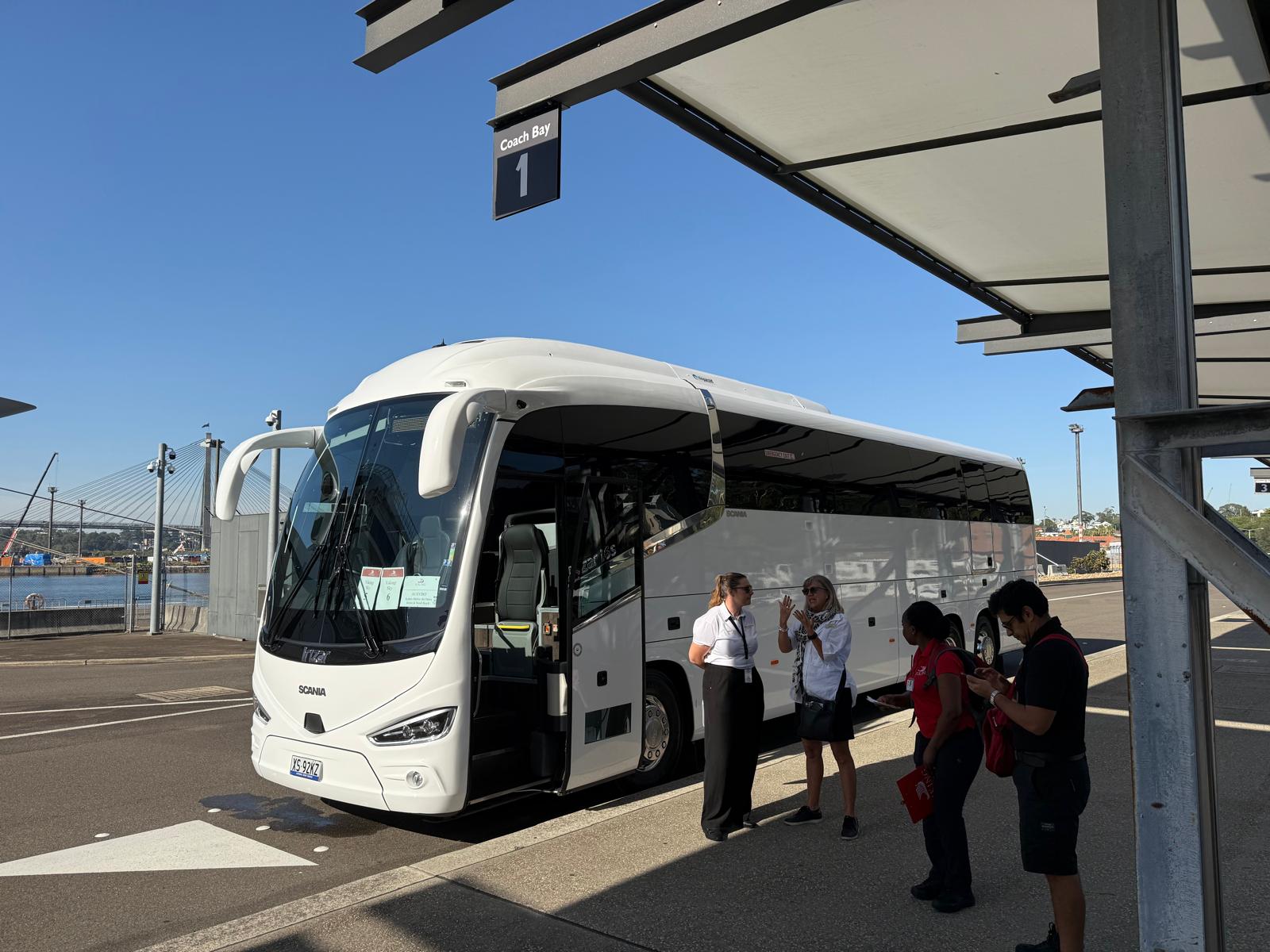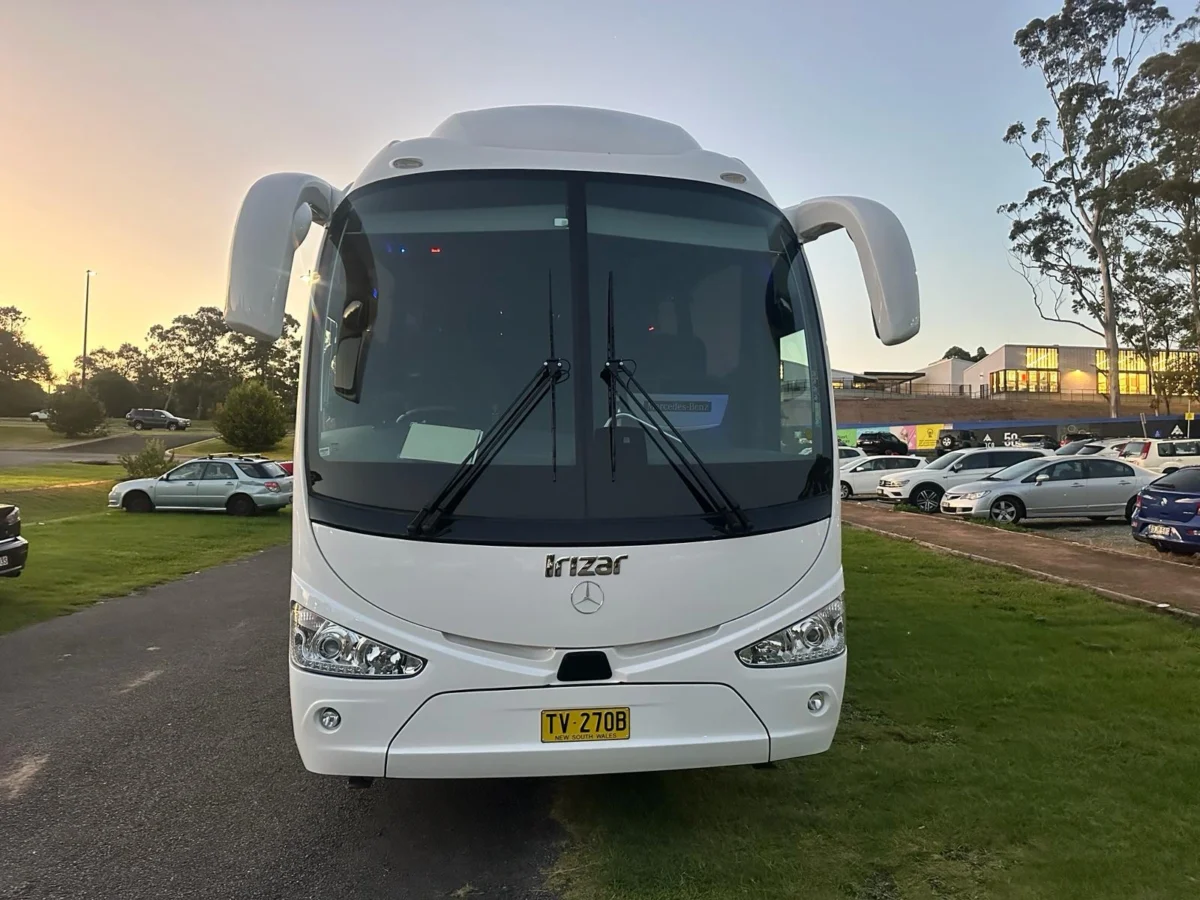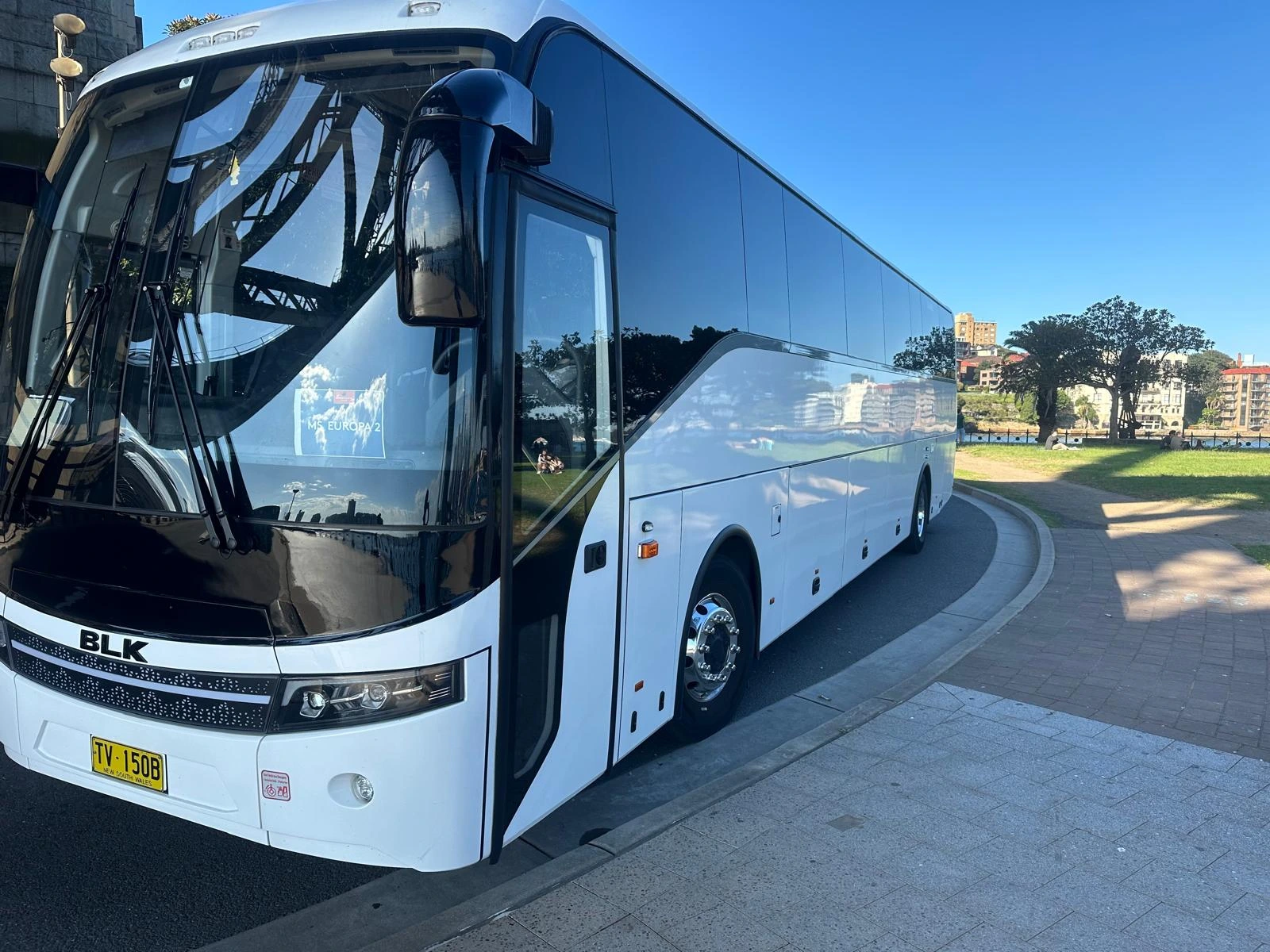
Sydney Airport treats drop-off and collection as two different problems. Drop-off is kerbside at the Departures level and is set-down only. Collection happens inside dedicated ground transport zones, never at the arrivals kerb. T1 and T2 each have a Bus/Coach Pickup area, and T3 splits Bus Pickup from Coach Pickup. Every commercial vehicle must be registered before it enters, and a coach that is not actively collecting waits in the bus holding area on Ross Smith Avenue.
That single distinction, kerb for departures and zone for arrivals, is the thing most group organisers get wrong. It changes where you tell fifty people to stand, how long the vehicle can be there, and whether the driver is allowed to walk into the terminal to find you.
The two rules that shape every Sydney Airport transfer
Departures kerbside is set-down only. Sydney Airport publishes drop-off at the Departures level as a set-down movement with a one-minute cap, and the driver must remain with the vehicle. That is enough time to open the bay, put bags on the footpath and move off. It is not enough time to hand out boarding passes, take a group photo or wait for the two people still in the toilet.
Arrivals collection happens in a zone, not at the kerb. Commercial vehicles collect from dedicated ground transport zones. Sydney Airport is explicit that operators must not leave vehicles unattended at terminal frontages at any time, and must use vehicle holding areas when they are not collecting pre-booked passengers. There is no version of this where a 53-seat coach idles outside arrivals while a tour group filters out one at a time.
Both rules exist for the same reason: the frontage road at each terminal is a moving lane, not a car park. Planning Sydney airport transfers for groups starts by accepting that the vehicle and the passengers arrive at the pick-up point separately and meet there.
Registration is the gate, not the parking
A charter operator cannot simply drive a coach into a Sydney Airport ground transport zone. Access is granted through the airport’s Bus and Limousine Registration System, and registration is mandatory. To register, the operator must hold Transport for NSW bus and coach operator accreditation and carry a published minimum level of property-damage liability insurance for each bus. An e-TAG is also mandatory for zone access.
For a group organiser, that has one practical consequence worth knowing before you compare quotes. If an operator cannot tell you plainly that its vehicles are registered for airport ground transport access, the pick-up plan you have been sold may not be executable. It is a fair question to ask in writing at quote stage, alongside the operator’s accreditation number.
Sydney Buses & Coaches holds NSW operator accreditation number 43397, and the certificate is available on request for tender and procurement paperwork.
Terminal by terminal
The table below sets out what Sydney Airport currently publishes for each terminal. It deliberately contains no bay numbers. The airport’s downloadable zone maps in general circulation are dated 2019, the road network around the terminals has been rebuilt since, and a bay number printed in an article is exactly the kind of detail that quietly goes stale and strands a group.
| Terminal | Coach and bus collection | Meeting point published by Sydney Airport | What this means for a group |
|---|---|---|---|
| T1 International | A dedicated Bus/Coach Pickup area | Arrivals level, between exits A and B (currently signposted) | The published meeting point and the vehicle zone are separate places. Brief the group on the meeting point, not the vehicle. |
| T2 Domestic | A dedicated Bus/Coach Pickup area | Arrivals level, opposite baggage carousel 6 (currently signposted) | A named carousel is the clearest instruction you can give a domestic group. Use it verbatim. |
| T3 | Bus Pickup and Coach Pickup are separate areas | None published | The only terminal where the vehicle class changes the location, and the only one where you must agree a meeting point with the operator in advance. |
Two details in that table do real work.
T3 is the odd one out, twice. It is the only Sydney Airport terminal that separates Bus Pickup from Coach Pickup, so the answer to “where is the vehicle” depends on which vehicle was assigned to your job. It is also the only one of the three with no published passenger meeting point, which means the airport will not do the wayfinding for you. If your group is arriving into T3, the meeting point has to be agreed with the operator, written into the booking, and sent to the group before they board their outbound flight.
The T1 and T2 meeting points are described by furniture. Exits A and B, and baggage carousel 6, are physical features that can be renumbered or repositioned during works. Treat them as current signage rather than permanent addresses, and check the airport’s own pick-up page in the week before travel.
The 2.9 metre problem
Sydney Airport applies a 2.9 metre height restriction to the T2/T3 Priority Pick-up zone. A full-size coach is taller than that, so the Priority Pick-up zone is not available to it.
This catches out organisers who have collected a small group before and assume the same arrangement scales. It does not. A 13-seat Toyota Commuter and a 53-seat executive coach are not interchangeable in an airport zone plan, and the difference is measured in vertical metres rather than seats. If a quote for a large group promises collection from the Priority Pick-up zone, that quote has a problem.
Height governs a good deal of Sydney coach work beyond the airport. The same dimension puts a full-size coach into the heavier toll class on Sydney’s class-based toll roads, because those roads classify by length and height rather than weight.
Where the coach waits between flights
Sydney Airport operates a Bus Holding Area on Ross Smith Avenue, currently published as free for the first sixty minutes. That is where a coach sits when it is not actively collecting, and it is the direct consequence of the rule against leaving vehicles unattended at terminal frontages.
For planning purposes, the holding area is good news. It means a driver can be on airport before your flight lands rather than circling, and can be called forward when the group is genuinely ready rather than at the scheduled landing time. It also means the vehicle is not accruing kerbside pressure while your group clears the terminal.
What it does not do is make waiting free indefinitely. A long hold has two costs: the published holding-area terms beyond the initial period, and the driver’s own clock. A charter driver operating a fatigue-regulated bus is inside the Heavy Vehicle National Law work and rest regime, and time spent waiting at an airport is not neutral for that purpose. A three-hour hold after a delayed arrival can compress what the driver is legally able to do afterwards.
How the vehicle and the group find each other
Sydney Airport permits bus and coach drivers to leave the vehicle to meet passengers inside the terminal. That is a genuinely useful allowance and it sits alongside, not against, the rule that a vehicle must never be left unattended at a terminal frontage. The meet happens from the pick-up area or the holding area, not from a coach parked at the arrivals door.
Here is a protocol that works for a group of any size at Sydney Airport.
- Fix the meeting point at booking, not on the day. For T1 and T2, use the airport’s published meeting point wording exactly. For T3, agree a point with the operator in writing, because the airport publishes none.
- Give the group one instruction, in the language they read. “T1 Arrivals, between exits A and B” beats “look for the bus”. Send it before they fly, not after they land.
- Exchange direct mobile numbers. Sydney Buses & Coaches sends the driver’s name, mobile number and vehicle registration twenty-four hours before travel. Put that number in the hands of the person who is physically with the group, not only the person who made the booking.
- Nominate one group leader and one sweeper. The leader goes to the meeting point. The sweeper stays with the stragglers. Nobody moves to the vehicle until the leader confirms the count.
- Confirm the count before the vehicle is called forward. The driver is holding on Ross Smith Avenue. Calling the coach forward for a group that is still at baggage reclaim wastes the one thing the zone system gives you.
- Load in one movement. Bags first, passengers second, doors closed. The zone is a working area shared with other operators.
Full detail on how flight monitoring and delay handling should be written into the booking belongs in its own discussion, and it is worth having that conversation before you pay a deposit rather than after.
Choosing a vehicle that fits the zone and the bags
Airport work is the one job where the vehicle is sized by luggage first and seats second. A 27-seat executive midi-coach suits a group of about twenty-five with day bags. Once every passenger has a checked suitcase and a cabin bag, the underfloor bay becomes the constraint rather than the seat count, and the honest answer may be a larger vehicle or a second one.
Our published fleet ladder runs from a 7-seat Mercedes V-Class to a 57-seat luxury touring coach, with coordinated convoys quoted per event above fifty-eight passengers. Seat counts exclude the driver, and the vehicle sizes we run list the current rate against each one.
| Vehicle | Seats | Hourly rate | Minimum hire |
|---|---|---|---|
| Toyota Commuter | 13 | $110 | 3 hours |
| Mercedes Sprinter | 11 to 14 | $145 | 3 hours |
| Executive minibus | 21 to 24 | $145 | 3 hours |
| Executive midi-coach | 27 | $165 | 4 hours |
| Luxury coach | 48 | $185 | 4 hours |
| Executive coach | 53 | $195 | 4 hours |
| Luxury touring coach | 50 to 57 | $195 | 4 hours |
Rates are GST inclusive and include the driver, fuel and vehicle insurance. An airport run does not have to be booked hourly at all. A point-to-point transfer can be quoted as one fixed transfer fare, and a fare quoted that way is not charged against a minimum hire block, which matters when an arrival is late.
Tolls and parking are confirmed in advance and priced separately, which is worth knowing because a full-size coach travels as the heavier toll class on Sydney’s class-based toll roads by virtue of its height.
Why this article has no bay numbers
Every operator page that publishes a specific Sydney Airport coach bay number is publishing something with a shelf life. The zone maps most of them are working from are dated 2019. The terminals and the surrounding roads have been rebuilt in the years since.
The arrangements that have held, and that you can plan around, are structural rather than numeric: registration through the airport’s system is mandatory, drop-off is kerbside at Departures and set-down only, collection is zone-only, pre-booking is required, a bus holding area exists on Ross Smith Avenue, and the T2/T3 Priority Pick-up zone excludes anything over 2.9 metres. Build the plan on those, then confirm the current signage in the week of travel.
Frequently asked questions
Can a charter coach wait outside arrivals at Sydney Airport?
No. Commercial vehicles must not be left unattended at terminal frontages at any time, and must use the vehicle holding areas when they are not collecting pre-booked passengers. Waiting happens at the Ross Smith Avenue bus holding area, and the vehicle is called forward when the group is ready.
Where should I tell my group to meet the coach?
At T1 International, Sydney Airport currently signposts a meeting point on the Arrivals level between exits A and B. At T2 Domestic it is on the Arrivals level opposite baggage carousel 6. There is no published meeting point at T3, so agree one with your operator in writing before the day.
Can the driver come inside the terminal to find us?
Yes. Sydney Airport permits bus and coach drivers to leave the vehicle to meet passengers inside the terminal. The vehicle is not left at the frontage while that happens, so build a few minutes into the plan for the driver to walk in and back.
Why can’t a coach use the Priority Pick-up zone at T2 and T3?
The T2/T3 Priority Pick-up zone has a 2.9 metre height restriction. A full-size coach exceeds it. Smaller vehicles may fit, but confirm the specific vehicle’s height with the operator rather than assuming by seat count.
Do I need to book the pick-up in advance?
Yes. Airport ground transport access is for registered commercial vehicles collecting pre-booked passengers. A group transfer at Sydney Airport is a booked movement, not a hail.
What is different about T3?
Two things. T3 is the only terminal that separates Bus Pickup from Coach Pickup, so the location depends on which vehicle is assigned to your job. It is also the only one of the three terminals with no meeting point published by the airport.
Next step
Send the flight details through with the terminal, the arrival date and the headcount, plus a rough bag count per person, and we will come back with a fixed written quote naming the actual vehicle. Written quotes go out within two business hours during office hours, which are Monday to Friday 7am to 6pm and Saturday 8am to 2pm.
If you would rather talk it through, call 02 9469 6600. Airport work rewards a five-minute conversation about where the group will actually be standing.
Sources
- Sydney Airport, “Resources for registered limousines, buses and coaches”, https://www.sydneyairport.com.au/corporate/partner-with-us/commercial-vehicles/resources-for-registered-limousines-buses-and-coaches. Accessed 7 September 2026.
- Sydney Airport, “Bus and Limousine Registration System (BLRS)”, https://blrs.sydneyairport.com.au/BLRSPublic/. Accessed 7 September 2026.
- Sydney Airport, “Pick-up”, https://www.sydneyairport.com.au/pickup. Accessed 7 September 2026.
- Sydney Airport, “Drop-off”, https://www.sydneyairport.com.au/dropoff. Accessed 7 September 2026.
- Transport for NSW, “Applying for bus operator accreditation”, https://www.nsw.gov.au/departments-and-agencies/transport-for-nsw/bus-operators-nsw/applying-for-bus-operator-accreditation. Accessed 7 September 2026.
- Linkt, “Vehicle class, Sydney”, https://www.linkt.com.au/help/travelling-toll-roads/vehicle-class/sydney. Accessed 7 September 2026.
- National Heavy Vehicle Regulator, “Heavy vehicle fatigue management, bus industry”, https://www.nhvr.gov.au/safety-accreditation-compliance/fatigue-management/heavy-vehicle-fatigue-management-bus-industry. Accessed 7 September 2026.