Moving a group between Sydney Airport terminals is a luggage and cohesion problem, not a distance problem. For one traveller with a cabin bag it is trivial. For thirty people with checked cases it becomes a sequence of transfers, queues and headcounts, and every step is where a group loses ten minutes. A chartered vehicle turns the move into one loading, one drive and one set-down, and the airport’s own rules decide where that loading and set-down can happen.
What actually goes wrong on a terminal move
The failure is rarely dramatic. It is cumulative.
Thirty people take longer to do everything than one person does. They queue in sequence rather than in parallel. They stop at different points. Somebody’s bag comes off the belt last. Somebody needs the toilet at the worst possible moment. A move that a solo traveller completes without thinking becomes, for a group, a chain of small waits where the whole party is held by its slowest link at each stage.
Add checked luggage and the arithmetic gets worse, because bags have to be physically moved by the people carrying them, twice, and trolleys do not travel well through every part of a transfer.
The result is that groups miss connections not because the terminal move is long, but because the planned time was built for an individual and executed by a crowd.
What the airport’s rules do to a terminal move
A chartered terminal move at Sydney Airport is shaped by four published facts, and each one changes the plan.
Collection is zone-only. Commercial vehicles collect from dedicated ground transport zones, not the arrivals kerb. Vehicles must not be left unattended at terminal frontages at any time and must use vehicle holding areas when they are not collecting pre-booked passengers. That means the group assembles first and the vehicle is called forward second.
Set-down at Departures is kerbside and brief. Drop-off at the Departures level is a set-down movement, capped at one minute, with the driver remaining at the vehicle. On a terminal move that is your unloading window, and it is the reason bags should be sorted on board rather than on the footpath.
T3 has no published meeting point, and splits Bus from Coach. Sydney Airport publishes meeting points at T1 International (Arrivals level, between exits A and B) and T2 Domestic (Arrivals level, opposite baggage carousel 6). It publishes none at T3, and T3 is the only terminal that separates Bus Pickup from Coach Pickup. So a move that involves T3 needs the meeting point agreed with the operator in writing, and needs to account for which vehicle class was assigned.
The Priority Pick-up zone is not available to a coach. The T2/T3 Priority Pick-up zone carries a 2.9 metre height restriction. A full-size coach exceeds it. A smaller vehicle may fit, but that is a question about the specific vehicle, not the seat count.
The vehicle waits between movements at the bus holding area on Ross Smith Avenue, which is what makes a coordinated terminal move possible at all.
The decision: charter or self-manage
There is no single right answer. There is an arithmetic one, and it turns on three inputs you already know.
| Group profile | What usually happens without a charter | Reasonable approach |
|---|---|---|
| Under about 10 people, cabin bags only, generous connection window | Works fine. The group moves as a unit and reassembles easily. | Self-manage. A charter is unlikely to earn its cost. |
| 10 to 25 people with checked luggage | Bag handling and headcounts stretch the move well past the planned time. | Charter is usually worth it, particularly if anyone in the party has mobility needs. |
| 25 or more with checked luggage | The group fragments. Somebody is always the last one. | Charter. One loading, one drive, one set-down, one person accountable. |
| Any group with a tight or non-refundable onward connection | The risk is the tail, not the average. | Charter, and build the buffer around the last passenger rather than the first. |
| Any group carrying oversize items, event freight or mobility equipment | Not practically self-manageable. | Charter, and specify the items at quote stage so the right vehicle is assigned. |
The pattern is simple: charter buys you a single, controlled movement and a known set-down point. It does not buy you speed. The drive itself is the shortest part of any terminal move.
Building the timing, without borrowing someone else’s numbers
Do not plan a terminal move from a published transfer time. Build it from your own group’s numbers, in this order.
- Start at the departing flight’s check-in cut-off, confirmed with the operating airline for that specific flight. This is the only fixed point in the plan, and it belongs to the airline rather than the airport.
- Subtract the group’s own check-in and bag-drop time, which scales with headcount and bag count rather than staying constant.
- Subtract the set-down and unloading window at the departing terminal. Kerbside is a one-minute set-down, so bags must be sorted before arrival.
- Subtract the drive, which is the shortest element. Ask the operator for their own figure for the specific terminal pair.
- Subtract the loading window at the collecting terminal, including the walk from the meeting point to the pick-up area.
- Subtract the assembly time at the arriving terminal, measured from the arrival of the last group member, not the first.
- Add a deliberate buffer on top, sized to how much the onward connection would cost if missed.
Work that backwards and you get the time the vehicle must be on airport, which is the number the operator actually needs.
Bags are the reason this is hard
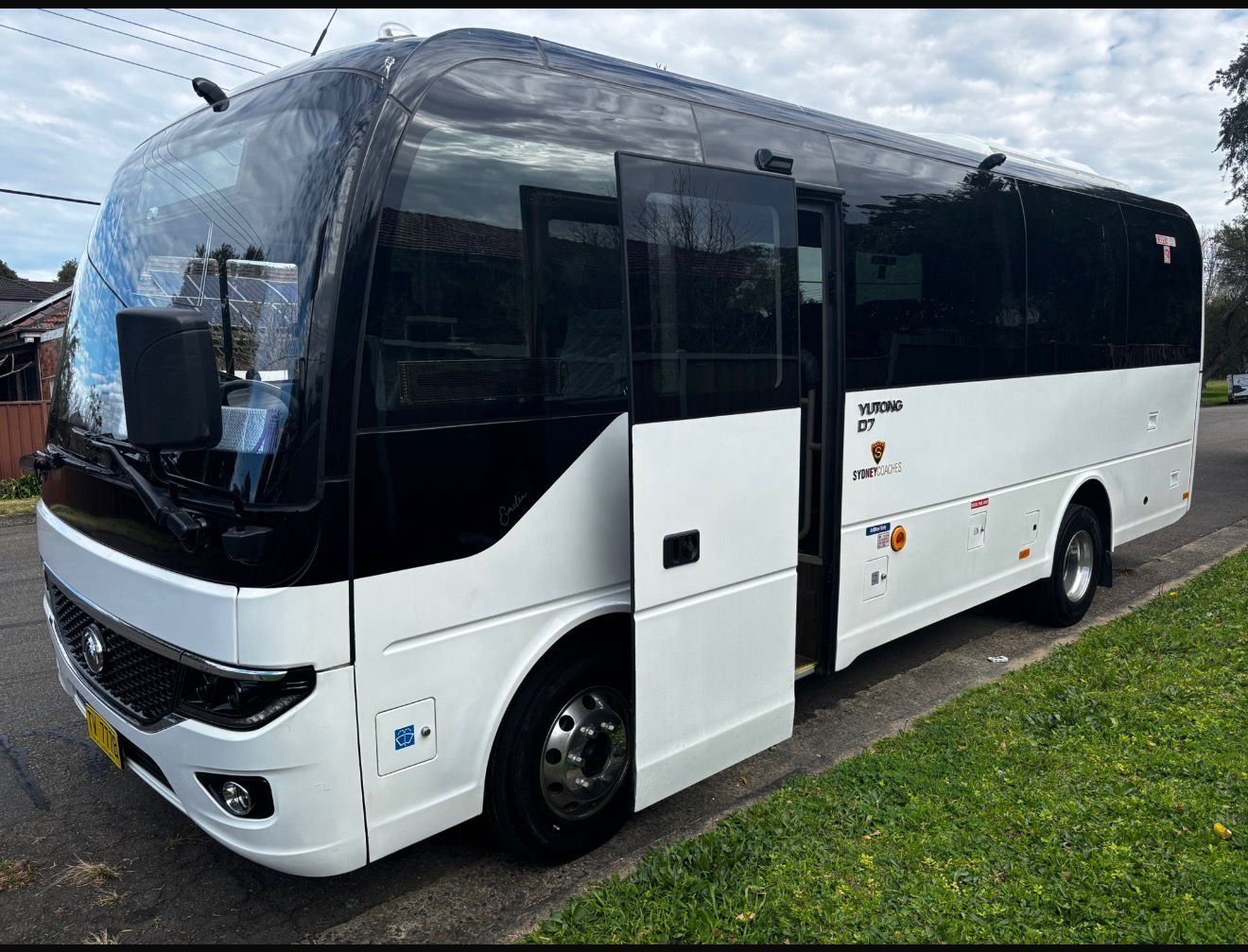
For a terminal move, luggage is the sizing constraint. A group that fits comfortably in a 27-seat midi-coach with day bags may not fit in the same vehicle once every passenger has a checked case plus a cabin bag. The underfloor bay becomes the limit before the seats do.
Two practical consequences. First, size the vehicle on the bag manifest, not the headcount, and put the bag count in the quote request. Second, keep the bags in one place on board so the one-minute set-down at Departures is a single unload rather than a search.
What a chartered terminal move costs
Our published rates are GST inclusive and include the driver, fuel and vehicle insurance.
| Vehicle | Seats | Hourly rate | Minimum hire |
|---|---|---|---|
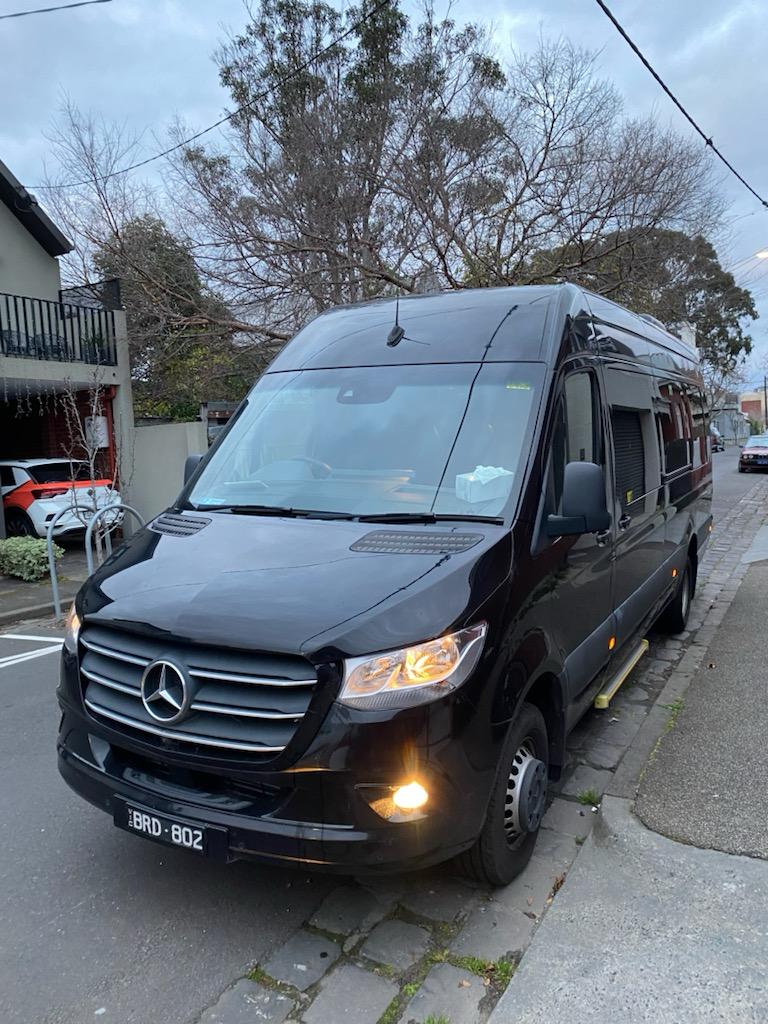
| Toyota Commuter | 12 | $110 | 3 hours |
| Executive minibus | 21 to 24 | $145 | 3 hours |
| Executive midi-coach | 27 | $165 | 4 hours |
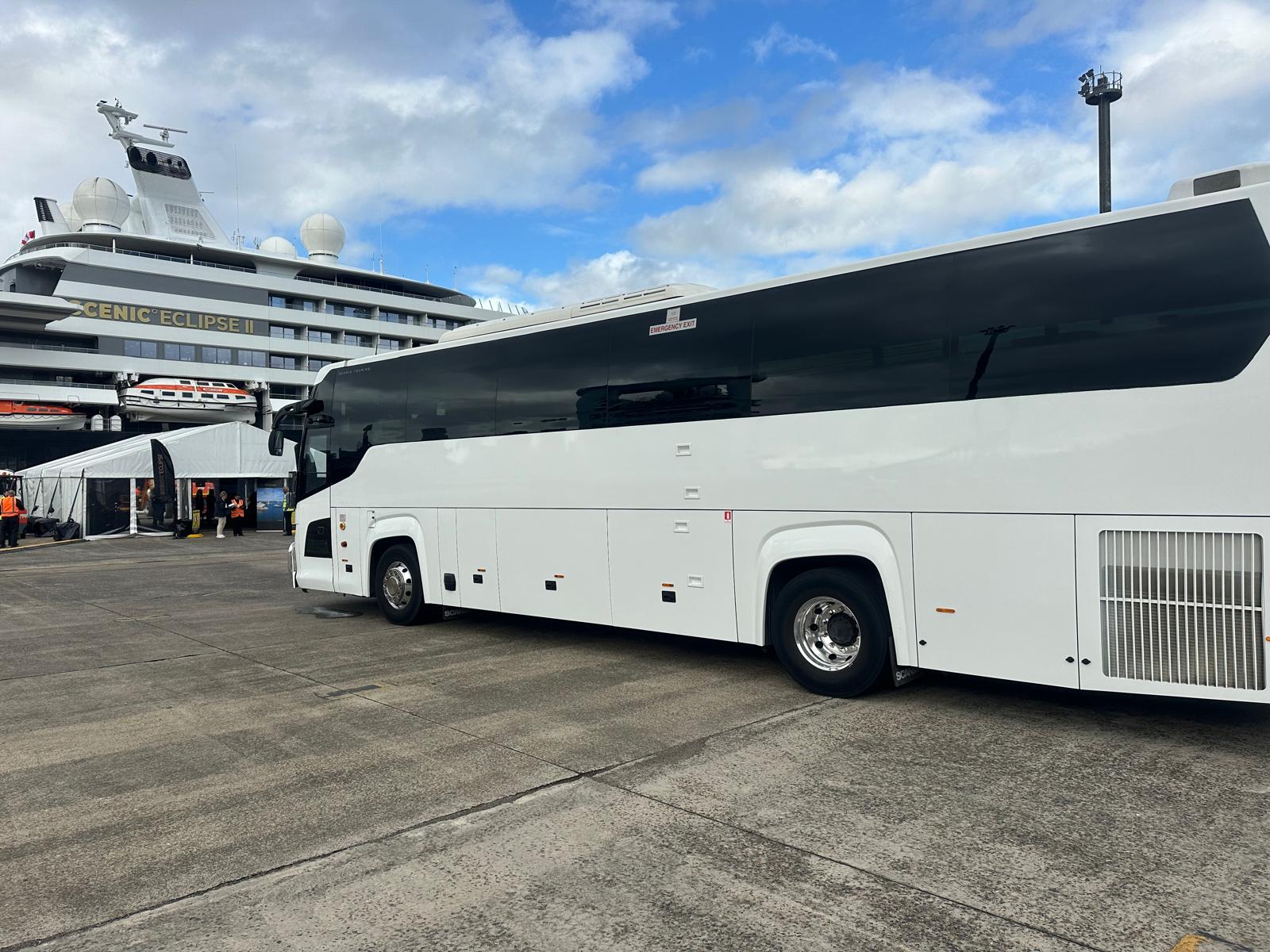
| Luxury coach | 48 | $185 | 4 hours |
| Executive coach | 53 | $195 | 4 hours |
Seat counts exclude the driver. A terminal move is short, so booking it hourly against a three or four-hour minimum is usually the wrong structure. A point-to-point run can instead be quoted as a single fixed transfer fare, and a fare quoted that way is not charged against a minimum. Ask for it that way. Full detail on vehicle sizes and hourly rates and on how charter pricing is structured sits on those pages, and Sydney airport group transfers covers the wider service.
Divide the fixed fare by the headcount before deciding it is expensive. For a group of forty with checked luggage and a connecting flight, the per-head figure is usually smaller than the cost of one missed connection.
Frequently asked questions
Can a charter coach collect us from one terminal and drop us at another?
Yes. Collection happens at the arriving terminal’s designated bus and coach pick-up zone, and set-down at the departing terminal is kerbside at the Departures level as a brief set-down movement.
Where do we meet the vehicle if we are arriving into T3?
Sydney Airport publishes no meeting point at T3, so it must be agreed with the operator in writing before the day. T3 is also the only terminal that separates Bus Pickup from Coach Pickup, so the location depends on the vehicle assigned to your booking.
Can the coach wait while our group clears the terminal?
Not at the kerb. Commercial vehicles must not be left unattended at terminal frontages and use the holding areas when they are not collecting pre-booked passengers. The vehicle waits at the bus holding area on Ross Smith Avenue and comes forward when the group is assembled.
Is a charter faster than the airport’s own transfer options?
Not necessarily, and speed is the wrong reason to book one. A charter buys a single controlled movement with the bags and the group together, and a known set-down point. For a large group with checked luggage that is usually what determines whether the connection is made.
How much time should we allow?
Build it backwards from the departing flight’s check-in cut-off, which you confirm with the airline, and size each step to the group rather than to an individual. The step that gets underestimated is assembly at the arriving terminal, because it is measured from the last person out.
Do small groups need a charter for a terminal move?
Often not. Under about ten people with cabin bags only and a generous connection, self-managing is reasonable. Checked luggage, mobility needs or a tight connection change the answer quickly.
Next step
Send the arriving flight, the departing flight, the headcount and the bag count, and we will quote the move as a fixed transfer fare with the meeting point written into the booking. Quotes come back within two business hours during office hours, Monday to Friday 7am to 6pm and Saturday 8am to 2pm.
If the terminal move is one leg of a longer itinerary, call 02 9469 6600 and we will look at the whole sequence rather than the single hop.
Sources
- Sydney Airport, “Resources for registered limousines, buses and coaches”, https://www.sydneyairport.com.au/corporate/partner-with-us/commercial-vehicles/resources-for-registered-limousines-buses-and-coaches. Accessed 7 September 2026.
- Sydney Airport, “Pick-up”, https://www.sydneyairport.com.au/pickup. Accessed 7 September 2026.
- Sydney Airport, “Drop-off”, https://www.sydneyairport.com.au/dropoff. Accessed 7 September 2026.