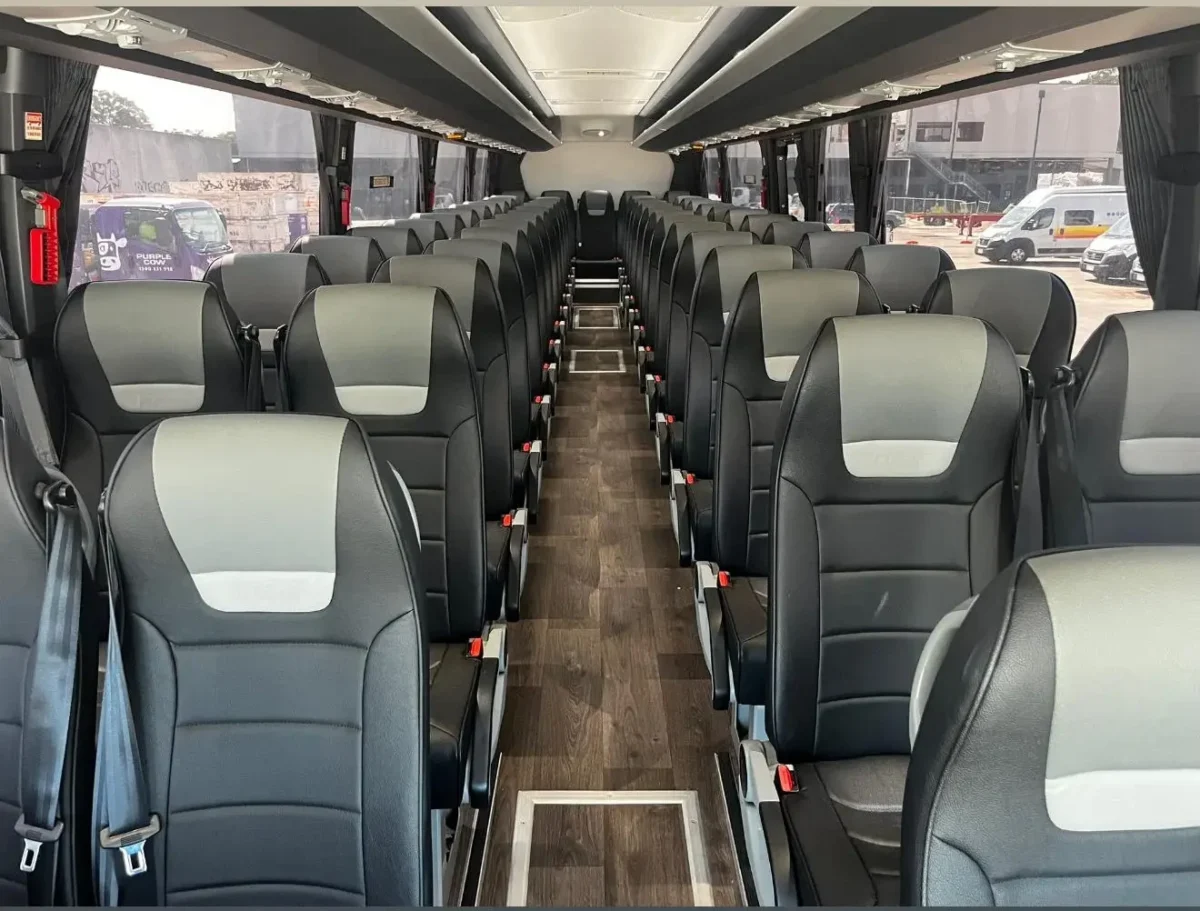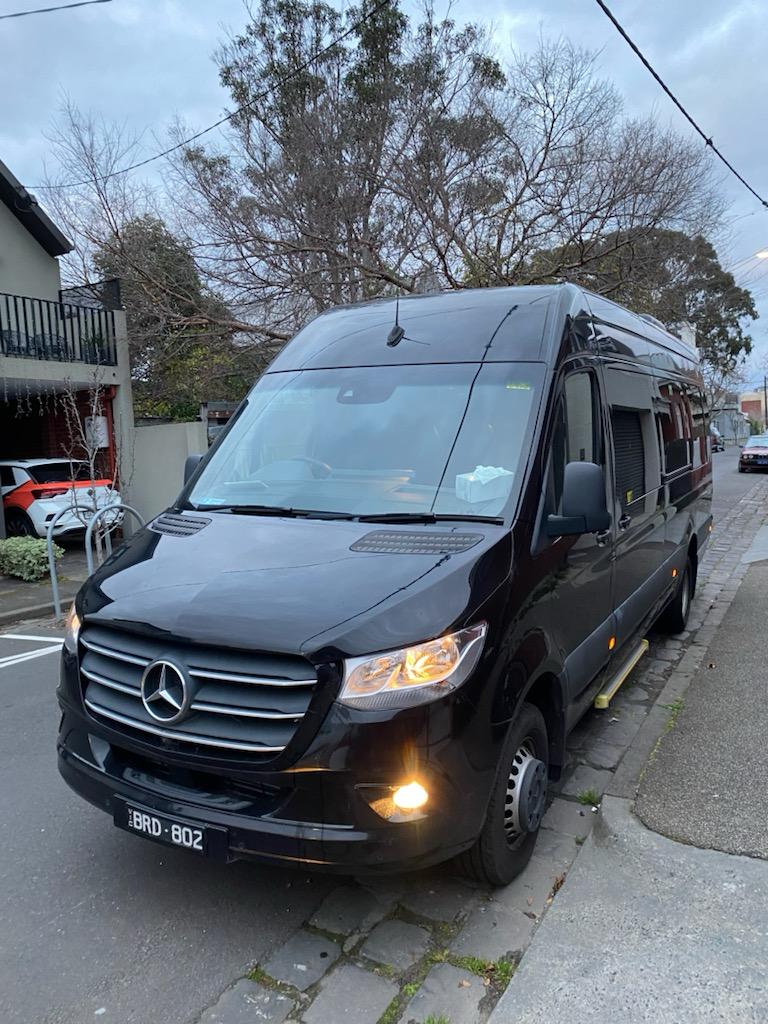
Two smaller vehicles almost never cost less than one large one. On the published rates, a 48-seat luxury coach is $185 an hour while two executive minibuses are $290 an hour between them, and each vehicle carries its own minimum hire. Groups split for five reasons, and price is not one of them: the group is bigger than the biggest single vehicle, the vehicle cannot reach the place, people start from different areas, people travel at different times, or the venue can only load one coach at a time.
Start with the number: 40 people is one vehicle
A 40-person group is the most common version of this question, and it has a simple answer. Forty people fit inside a single 48-seat luxury coach with eight seats to spare for coats, bags and anyone who joins late. There is no capacity reason to split, and splitting costs more.
Here is the arithmetic on the published rates, at each vehicle’s minimum hire.
| Option for 40 passengers | Hourly rate | Minimum | Cost at the minimum | Per head |
|---|---|---|---|---|
| One 48-seat luxury coach | $185 | 4 hours | $740 | $18.50 |
| One 53-seat executive coach | $195 | 4 hours | $780 | $19.50 |
| Two executive minibuses (21 to 24 each) | $145 each, $290 together | 3 hours each | $870 at 3 hours, $1,160 at 4 | $21.75 at 3 hours, $29.00 at 4 |
| Two 27-seat midi-coaches | $165 each, $330 together | 4 hours each | $1,320 | $33.00 |
Seat counts exclude the driver and rates are GST inclusive. You can check every figure against the published fleet ladder and hourly rates.
The single coach wins on every line, and it wins by more the longer the booking runs, because the gap is $105 or more for every additional hour. For a 40-person function, party bus hire in Sydney on one vehicle is both the cheaper answer and the simpler one.
The arithmetic: one large vehicle against two smaller ones
The reason two vehicles cost more is structural, not incidental. You are buying two drivers, two vehicles and two minimum hires. Minimum hire is 3 hours for minibuses and people movers and 4 hours for midi-coaches and full-size coaches, and it applies per vehicle.
| Group size | Cheapest single vehicle | Cost at the minimum | Two-vehicle alternative | Cost at the minimum |
|---|---|---|---|---|
| 24 | Executive minibus, $145, 3 hours | $435 | Two Toyota Commuters, $220 an hour, 3 hours | $660 |
| 40 | Luxury coach, $185, 4 hours | $740 | Two executive minibuses, 4 hours | $1,160 |
| 50 | Executive or luxury touring coach, $195, 4 hours | $780 | Two 27-seat midi-coaches, 4 hours | $1,320 |
| 54 | Luxury touring coach at 57 seats, $195, 4 hours | $780 | Two 27-seat midi-coaches, 4 hours | $1,320 |
At 54 passengers, one vehicle costs $780 and two cost $1,320 for the same four hours. That is a $540 difference for an identical trip, and the single coach is also easier to manage. See how minimum hire hours are applied for the underlying structure.
There is one genuine exception, and it is worth naming because it is not obvious. If collecting everyone requires a long circuit, the large vehicle is billed for every hour of that circuit. Two smaller vehicles each doing a short local run can then come out ahead. The crossover depends on real drive times rather than on the rate card, so ask for both structures priced and compare.
Reason one: the group is bigger than the biggest single vehicle
The largest single vehicle is a luxury touring coach at 50 to 57 seats. At 58 or more, the booking becomes a coordinated convoy, quoted per event rather than at an hourly rate.
That threshold is worth remembering when your numbers are near it. A group of 57 is one vehicle and one price. A group of 58 is a different kind of booking with a different pricing structure, so if your final number might land either side of that line, say so at enquiry stage rather than after the deposit.
Reason two: the vehicle that fits the group cannot reach the place
This is the most common legitimate reason to split, and it has nothing to do with head count.
Sydney venues set access by vehicle height and by which road a coach may use, and those rules do not care how many people are aboard.
- At Royal Randwick, coaches over 3.1 metres high set down and pick up on the eastern side of Darley Road, outside TAFE NSW Randwick, while mini buses under 3.1 metres use the infield car park.
- At Rosehill Gardens, the threshold is different: 3.4 metres, with taller coaches using the western side of Arthur Street, where private coaches may park for the duration of the race day.
- At Sydney Airport, the T2 and T3 Priority Pick-up zone carries a 2.9 metre height restriction, which excludes full-size coaches entirely.
- At the Sydney Opera House, buses and coaches cannot park onsite and large buses disembark on Macquarie Street.
Residential streets add the same problem at the other end of the trip. Where the address will not take the vehicle the group size needs, the options are a nominated meeting point, a smaller vehicle feeding a larger one, or two smaller vehicles throughout. All three are cheaper than discovering the constraint on the morning.
Reason three: the group starts from genuinely different places
If half the group is on the Northern Beaches and half is in the Inner West, one vehicle collecting both is buying a long circuit at the coach rate, and everyone on the first pick-up sits through the second one.
Two vehicles from two origins, arriving at the destination together, is often both faster and better for the passengers even when it costs more. The test is whether the circuit time added to a single vehicle is longer than the trip itself. If it is, split.
Reason four: the group does not travel at the same time
Weddings and functions rarely end at one moment. Some guests leave at 10pm and some at midnight. One vehicle cannot do both without waiting, and waiting is billed.
Two vehicles running two departures is a legitimate answer here, but so is one vehicle doing two runs, which is usually cheaper. Which is better depends on how far apart the two departures are and whether the vehicle has anywhere legal to wait in between. Settle it at quote stage.
There is also a hard limit that catches people. Charter drivers in NSW work inside the heavy vehicle fatigue regime, so a driver at the end of a legal shift cannot simply agree to stay another hour. A late second run needs to be planned, not improvised.
Reason five: the venue can only load one coach at a time
This is the Sydney-specific reason and it is the one organisers discover latest.
Several major Sydney venues manage coaches by the individual vehicle, not by the booking. At Sydney Olympic Park, coaches use Coach Pod C off Edwin Flack Avenue, reached from Uhrig Road via Carter Street, and access is pre-booked through an Ebusticket that is valid only for the date and location shown. A convoy therefore needs one per vehicle, and the booking window closes at 11:59pm the day before the event, with no refund except on event cancellation. At Allianz Stadium, private coaches access Driver Avenue via Lang Road rather than Moore Park Road, and parking at the southern end of Driver Avenue depends on space being available and cannot be reserved at all. At ICC Sydney, coach parking is arranged through a dedicated Event Manager.
The practical consequence is staggered loading. Two coaches at a single-bay venue do not load simultaneously, they load one after the other, and the second group waits. Build that into the run sheet: a nominated order, a holding position for the second vehicle, and a realistic gap between the two departure times. Groups that plan for it board calmly. Groups that do not end up with 50 people standing on a footpath.
Running a convoy without losing control of it
If you are running two or more vehicles, six things need to be settled before the day.
- One point of contact on your side, with a mobile, who is not the host, the bride or the person running the event.
- A nominated vehicle order, so drivers and passengers know which coach is first and which group is on it.
- Driver details for every vehicle. Driver name, mobile and vehicle registration are sent 24 hours before travel. Ask for all of them, not just the lead vehicle.
- A named person on each vehicle who counts their own group on and off. Nobody can count 58 people across two coaches from the footpath.
- A venue arrangement per vehicle, including a booking per coach where the venue books by vehicle, as Sydney Olympic Park does.
- A departure sequence with a real gap in it, sized to how long one vehicle takes to load at that particular bay.
Frequently asked questions
How many people fit on a 40 passenger party bus?
Forty people fit comfortably on a single 48-seat luxury coach, which is the vehicle a 40-person group is normally quoted. There is no need to split at that number, and splitting is more expensive: one coach is $185 an hour on a 4-hour minimum, while two executive minibuses are $290 an hour between them with a minimum each.
Is two smaller buses cheaper than one big one?
Almost never. Two vehicles means two drivers, two vehicles and two minimum hires. At 40 passengers, one 48-seat luxury coach is $740 at the 4-hour minimum against $1,160 for two executive minibuses over the same four hours. The exception is where collecting a scattered group would add several hours of circuit time to the single large vehicle.
At what group size do we need two vehicles?
Fifty-eight. The largest single vehicle is a luxury touring coach at 50 to 57 seats, and at 58 or more the booking becomes a coordinated convoy, quoted per event. Below 58, a split is a choice driven by access, origin or timing rather than by capacity.
Can a convoy use different sized vehicles?
That is a question for the quote rather than a rule. A group of 60 could in principle travel as one large coach plus one small vehicle, which is usually more efficient than two half-full coaches. Send the total and the shape of the group and both configurations can be priced.
How do we keep two coaches together in Sydney traffic?
You generally do not, and you should not plan on it. Vehicles are given the same destination, the same arrival target and the same run sheet, and they arrive within a few minutes of each other rather than nose to tail. Each vehicle carries its own named group leader and its own head count, which matters far more than convoy formation.
Next step
Send the head count, the pick-up points and the destination venue, and we will price both structures side by side: one vehicle running the whole job, and a split where a split genuinely helps. A fixed written quote naming the vehicles comes back within two business hours. Call 02 9469 6600, Monday to Friday 7am to 6pm or Saturday 8am to 2pm.
Sources
- Sydney Olympic Park Authority, Bus and coach parking, https://www.sydneyolympicpark.com.au/parking/bus-and-coach-parking. Accessed 7 September 2026.
- Allianz Stadium, Plan your visit, transport, https://www.allianzstadium.com.au/plan-your-visit/transport. Accessed 7 September 2026.
- Australian Turf Club, Travel and parking at Royal Randwick, https://www.australianturfclub.com.au/travel-parking-at-royal-randwick/. Accessed 7 September 2026.
- Sydney Airport, Resources for registered limousines, buses and coaches, https://www.sydneyairport.com.au/corporate/partner-with-us/commercial-vehicles/resources-for-registered-limousines-buses-and-coaches. Accessed 7 September 2026.