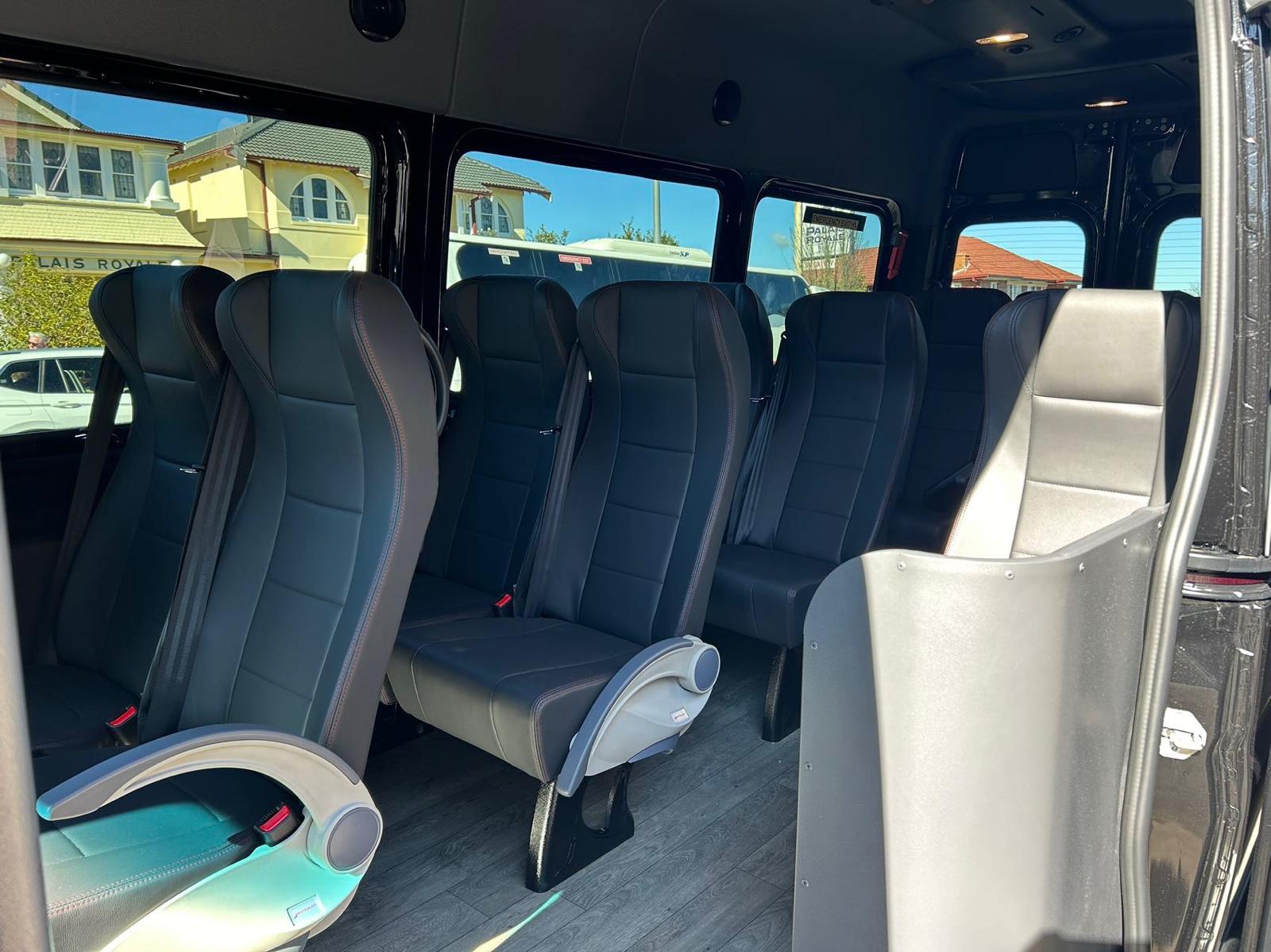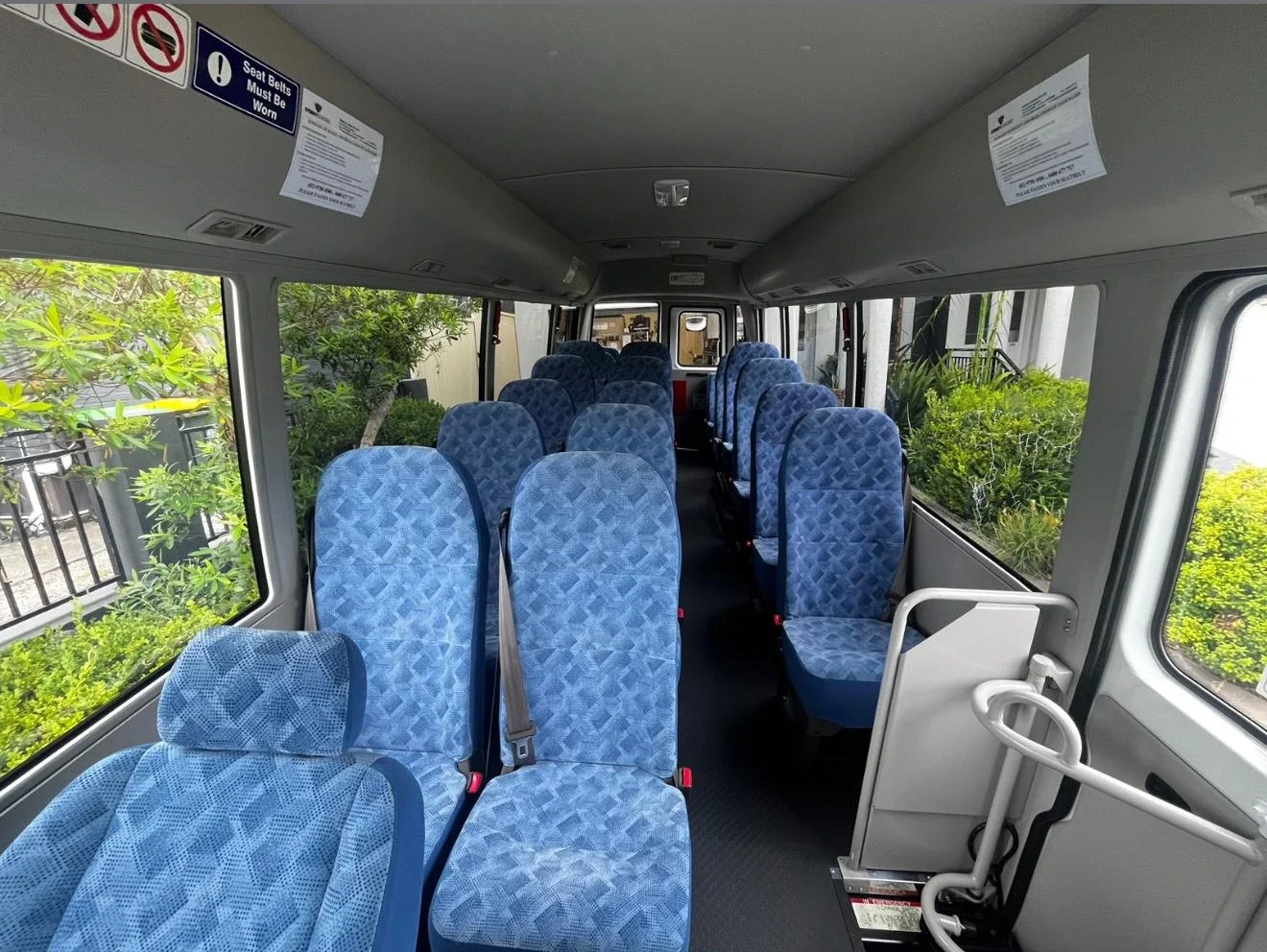
This guide covers what to specify to a transport operator, not what any scheme will fund. Funding rules change and sit outside a bus operator’s expertise, so take those questions to the National Disability Insurance Agency, your plan manager or your support coordinator. What an operator can answer precisely is the vehicle, the boarding device, the allocated wheelchair spaces, the securement, the timing and the paperwork. Those six items are what a good specification contains, and getting them in writing is what makes a booking usable in a file.
Where this guide stops
We are a Sydney charter operator. We can tell you what a vehicle has, how long a group takes to board it, what a quote will include and what it will not. We are not qualified to tell you what is claimable, what line an outing sits under, or how a plan should be structured, and any operator who offers you a confident answer on that is guessing with your money.
So the split is clean. Funding, eligibility and claiming go to the NDIA, your plan manager or your support coordinator. Vehicle, access, timing, cost structure and documentation come to the operator. This article is about the second half, written so that the answers you collect are precise enough to be used by whoever handles the first half.
What the accessibility rules actually say about charter
Worth settling before the specification, because this is one of the most misstated areas in Australian transport content.
The Disability Standards for Accessible Public Transport 2002 apply to buses and coaches. There is no charter or tour bus exemption. The conveyances excluded from the Standards are charter boats including water taxis, limousines including chauffeured hire cars, and self-drive rental cars. The claim that charter and tour coaches fall outside the Standards circulates widely and appears to come from misreading “charter boats”.
What genuinely exists is narrower. Section 9.8 provides that an operator need not supply an allocated wheelchair space where every passenger uses a fixed seat, which describes most Sydney charter coaches. Other duties, covering access paths, boarding devices, signage, information, direct assistance and equivalent access, continue to apply. The Standards sit under the Disability Discrimination Act 1992, so this is a discrimination question rather than a penalty regime.
The practical consequence for a coordinator is one sentence: do not assume a charter coach is accessible and do not accept that it does not have to be. Ask what the specific vehicle assigned to your dates has, and get it in writing. None of this is legal advice.
What to specify to the operator
Send these as a list. Each one either changes the vehicle or changes the price, and every one of them can be answered with a fact.
| What to specify | Why it matters | What a usable answer looks like |
|---|---|---|
| Total passengers including support workers | Sizes the vehicle. Published seat counts exclude the driver | A named vehicle type with a seat count above your total |
| Number travelling in a wheelchair, with measurements | Decides whether an allocated space is needed and whether the chair fits | Confirmation of the number of allocated spaces on that vehicle |
| Manual or powered chairs, and combined mass | The boarding device must support 200 kg under the Standards | Confirmation the device is rated for the heaviest combination travelling |
| Boarding device type | A lift and a ramp are different sequences and different timings | “Lift fitted” or “ramp fitted”, named, not “accessible vehicle” |
| Securement system | Determines how the chair is held in transit | The system named, and whether a shoulder belt is available |
| Seats that must be adjacent | Support workers often need to sit beside the person they support | A seating plan confirmed before the day |
| Equipment travelling | Frames, oxygen, assistance animals, folded chairs | Where each item travels on that specific vehicle |
| Boarding time allowance | The most common cause of an itinerary running late | A stated allowance per stop, built into the schedule |
| Set-down point at each venue | Decides how far the group walks | The point identified, with distance and surface to the entrance |
| Driver details before travel | Needed by many providers before a participant leaves | Driver name, mobile and vehicle registration ahead of the day |
What the quote should contain
A quote that is going into a coordinator’s file has to do more than name a price.
Sydney Buses and Coaches publishes a fixed written quote with the vehicle named, returned within two business hours, and states that professional driver, fuel, vehicle insurance and GST are included in every quote. Four things are confirmed in advance and priced separately: tolls and parking, driver accommodation on multi-day trips, public holiday and after-hours loading, and waiting time beyond the booked window. Ask any operator to set those out the same way, so nothing lands as a surprise on the invoice.
Two structural points are worth knowing when you compare quotes.
Minimum hire periods. Three hours applies to minibuses and people movers, four hours to midi-coaches and full-size coaches. A short local outing is still charged against that floor. An airport or point-to-point run can instead be quoted as one fixed transfer fare, and a fare quoted that way is not charged at a minimum.
Tolls are not a flat add-on. Sydney’s toll roads classify vehicles by length and height rather than weight. Class A is 12.5 m or less in length and 2.8 m or less in height, and anything exceeding either limit is Class B. A full-size coach exceeds 2.8 m in height, so it is Class B on every class-based Sydney toll road regardless of length. The ratio between the classes is not uniform across the network, and the Sydney Harbour Bridge and Tunnel use a fixed toll with no heavy class at all. That is why tolls are quoted against the route rather than as a standard percentage, and why a route change can move the number.
The documentation to collect
Ask for these at quote stage rather than after the booking. An operator that holds them can send them the same day.
- A written quote naming the vehicle type, with inclusions and separately priced items set out.
- The NSW bus operator accreditation number and a copy of the Certificate of Accreditation. Accreditation is administered by Transport for NSW, and a charter operator holds Long Distance, Tourist or Charter accreditation. There is no public register to search, so the certificate is the verification route. Sydney Buses publishes its NSW accreditation number as 43397 and states the certificate is available on request for tender and procurement paperwork.
- A certificate of currency for insurance, in the name of the entity that appears on your quote.
- Written confirmation of the access specification: vehicle type, boarding device, number of allocated spaces, securement.
- Driver name, mobile and vehicle registration before travel. Sydney Buses publishes this as 24 hours before the trip.
- An itemised tax invoice that matches the quote line for line.
That set is enough for most provider files, and it is the same set a school or a council procurement officer would collect. If an operator cannot produce it, the issue is not your paperwork.
Timing, staffing and the parts people underestimate
Two things routinely go wrong on supported group travel, and neither is about the vehicle.
Boarding time. It is the biggest single scheduling variable and it is almost never in a quote. Do not accept a published average from anyone, including us. Measure a real boarding on the same vehicle type from door open to belt fastened, count each person who uses the boarding device separately, time alighting on its own, add the walk from the legal set-down point to the entrance, and apply the total at every stop. A four-stop day contains eight of those movements.
Staffing on the vehicle. A driver drives. Personal support, medication, behaviour support and personal care are the provider’s responsibility and need to be rostered onto the trip, with those people counted in the passenger total. Decide before you book who is doing what at the kerb, and write it into the run sheet alongside the timing.
Frequently asked questions
Can you tell me whether this trip is funded?
No, and be careful with anyone who says yes. Funding rules change and sit outside a transport operator’s expertise. Take that question to the NDIA, your plan manager or your support coordinator, and bring them a written quote with the vehicle named so they are working from a real figure.
Are charter buses exempt from the accessibility standards?
No. The Transport Standards apply to buses and coaches, and the excluded conveyances are charter boats, limousines and self-drive rental cars. Section 9.8 is the narrow provision that matters: an operator need not provide an allocated wheelchair space where every passenger uses a fixed seat. Other duties continue. This is background rather than legal advice.
What documents will a provider file usually need?
A written quote naming the vehicle, the operator’s accreditation number and certificate, a certificate of currency, written confirmation of the access specification, driver and vehicle details before travel, and an itemised invoice that matches the quote.
Can we get an invoice split between participants?
Ask the operator directly at quote stage, because it depends on how they issue invoices rather than on any rule. Raising it before the booking is much easier than requesting a reissue afterwards.
Does the driver provide personal support?
Treat that as the provider’s responsibility unless the operator states otherwise in writing. Agree in advance who assists at the kerb, who manages medication and who supports a participant during the trip, and roster those people onto the vehicle as passengers.
Next step
Send the passenger split, the wheelchair measurements, the stops and the date, and we will come back with a written quote naming the vehicle and confirming the boarding device and allocated spaces, plus the documents your file needs. Call 02 9469 6600, or read how accessible bus hire in Sydney is specified here. If you are building a budget first, how Sydney bus hire is costed sets out the published structure, and the office contact details show when someone is available to talk it through.
Sources
- Federal Register of Legislation (Australia), “Disability Standards for Accessible Public Transport 2002”, https://www.legislation.gov.au/F2005B01059/latest/text. Accessed 7 September 2026.
- Australian Human Rights Commission, “Public transport frequently asked questions”, https://humanrights.gov.au/our-work/disability-rights/public-transport-faq. Accessed 7 September 2026.
- NSW Government (Transport for NSW), “Applying for bus operator accreditation”, https://www.nsw.gov.au/departments-and-agencies/transport-for-nsw/bus-operators-nsw/applying-for-bus-operator-accreditation. Accessed 7 September 2026.
- Linkt, “Vehicle classes on Sydney toll roads”, https://www.linkt.com.au/help/travelling-toll-roads/vehicle-class/sydney. Accessed 7 September 2026.