Plan the event so that not driving is normal rather than a problem to solve at the end. Make the shuttle the default way everybody arrives and leaves, publish the times with the invitation, and size it for the whole guest list rather than for the people you think need it. That covers the guests who never drove, the ones who stopped driving, the ones who cannot drive at night, and the ones who intend to drink, without anyone having to explain which group they are in.
Who actually gets stranded
The list is longer than most organisers expect, and only one item on it is about drinking.
| Guest | What goes wrong | What fixes it |
|---|---|---|
| Never held a licence | No car, and a venue with no realistic public transport | Shuttle from a meeting point on the rail network |
| Stopped driving with age | Can get to a suburban meeting point, cannot drive 90 minutes each way | Shuttle, plus a seat near the door |
| Cannot drive at night | Fine at 3pm, will not drive home at 11pm | An earlier return run, published in advance |
| Vision impaired | Needs a known meeting point and a person to ask | Named pick-up point, named contact, and a driver expecting them |
| Uses a mobility aid | Can travel, but not the last 200 m of a gravel driveway | Vehicle that can reach the entrance, or a closer set-down agreed with the venue |
| Travelling with young children | Car seats, prams, and a long drive home after bedtime | Early return run and space for a folded pram |
| Intends to drink | The obvious one, and the easiest to plan for | Return shuttle at a sensible hour |
| Flying in | No car at all, and unfamiliar with the area | Pick-up from an accommodation cluster |
Look at that list and the pattern is clear. Every fix is the same fix. One well-planned shuttle covers all eight, which is why organising it as an exception for a few people is both more work and worse.
The regional venue problem
Sydney’s most popular function regions are exactly the ones where not driving strands people, and the distances are the reason.
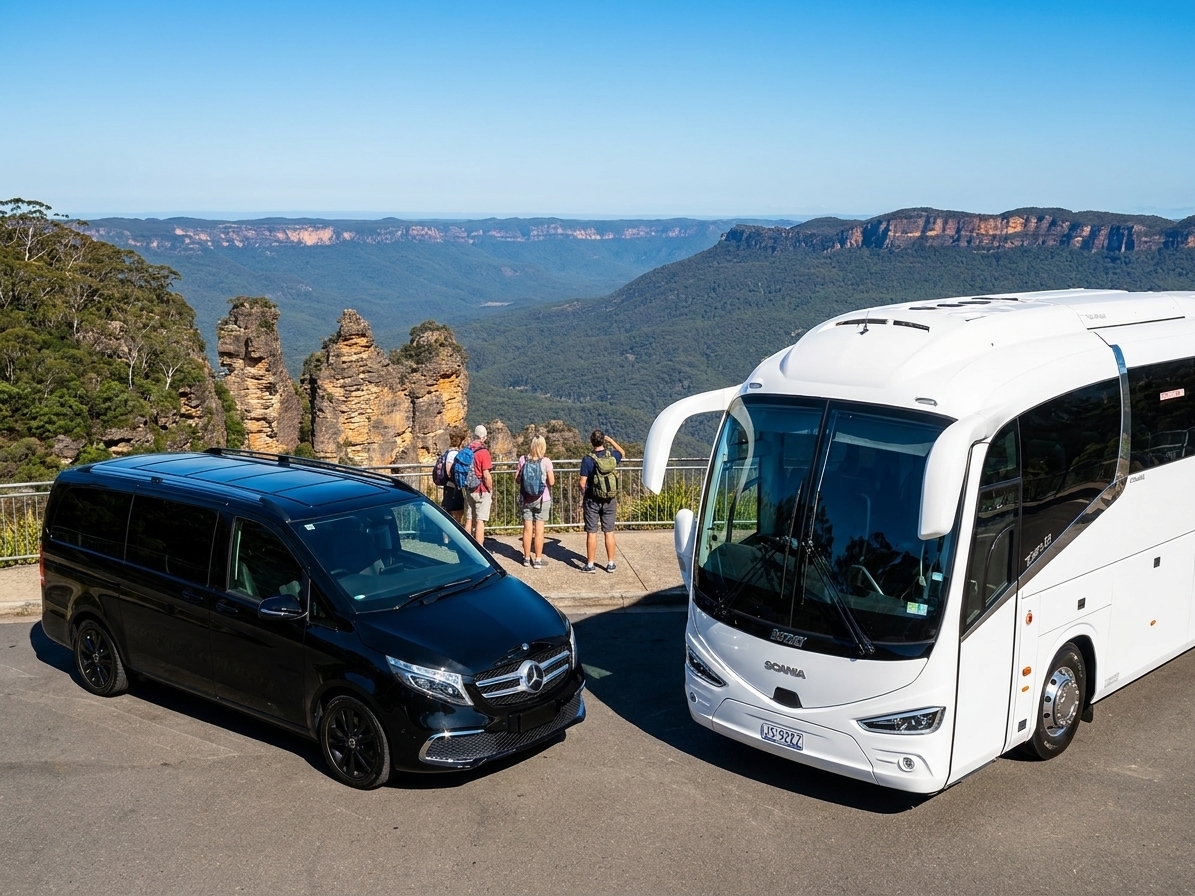
Using the operating figures for a coach out of Sydney: the Southern Highlands is about 120 km and roughly 1.5 hours, the Blue Mountains at Katoomba about 105 km and roughly 2 hours each way, or 2.5 hours from the eastern suburbs or northern beaches, and the Hunter Valley at Pokolbin about 165 km and 2 to 2.5 hours each way. Those are real driving legs, at both ends of a long day, often finishing in the dark on unfamiliar roads.
For a guest who does not drive at night, or who would be fine on a 20 minute suburban trip but not a two hour one, the venue choice has already decided whether they can come. Deciding transport at the same time as the venue, rather than three months later, is what keeps that list of guests intact.
The long legs also carry an operational limit worth knowing. A solo driver under standard hours may work a maximum of 12 hours with 7 continuous hours of stationary rest in any 24 hour period. A morning pick-up in Sydney, a wait through a long reception and a late return from the Hunter is a genuinely long day, so the shape of the plan needs to be agreed with the operator rather than assumed.
Make the shuttle the default
The framing does most of the work. Two ways of saying the same thing produce completely different uptake.
“There is a bus for anyone who needs it.” This is an offer to a special category. People self-assess, decide they are not the intended category, and drive anyway. The guests who most need it are often the least likely to claim it.
“Everyone travels together. Coaches leave the hotel at 2:15pm and return at 10:30pm and 11:45pm.” This is a plan. Nobody has to identify as anything to be on it.
Practical version of the default:
- Pick one or two meeting points, not eight. A hotel, or a station with parking. Guests who drive can leave the car there.
- Publish the times with the invitation, not in a later email. People book accommodation and flights around them.
- Run at least two returns. One earlier for anyone who wants to leave, one at the end. This single decision does more for older guests than any other.
- Size it for everyone, and treat the seats as free capacity rather than a per-head cost decision.
- Name a contact for the day who is not the host, with a mobile number on the printed detail.
Telling people, without a survey
You still need some information, and there is a way to collect it that does not feel like a form.
Put one line on the RSVP that goes to everybody: “We are running coaches to and from the venue. Let us know if you would find steps difficult, use a walking frame or wheelchair, or would prefer a seat near the door, so we can plan the right vehicle.”
Then follow up privately with anyone who flags something, and ask for what you actually need: whether the person travels in a wheelchair or transfers to a seat, occupied width, length and combined mass if it is a chair, and whether a companion needs the adjacent seat.
Include in the guest information: where the vehicle stops, roughly how far that is from the door, what the surface is between the two in plain terms, the return times, and the fact that on a coach fitted with seatbelts, wearing them is required in NSW for every passenger aged 16 and over.
The vehicle and the last 200 metres
Once the shuttle is the default, the remaining questions are about the stop rather than the seat.
Under the NSW Road Rules, a charter coach counts as a public bus, so it may stop in a bus zone to set down or pick up passengers but may not wait or park there. At a private venue the constraint is the driveway rather than the law. Either way, the vehicle sets down and leaves, and the distance from that point to the entrance is what your guests actually experience.
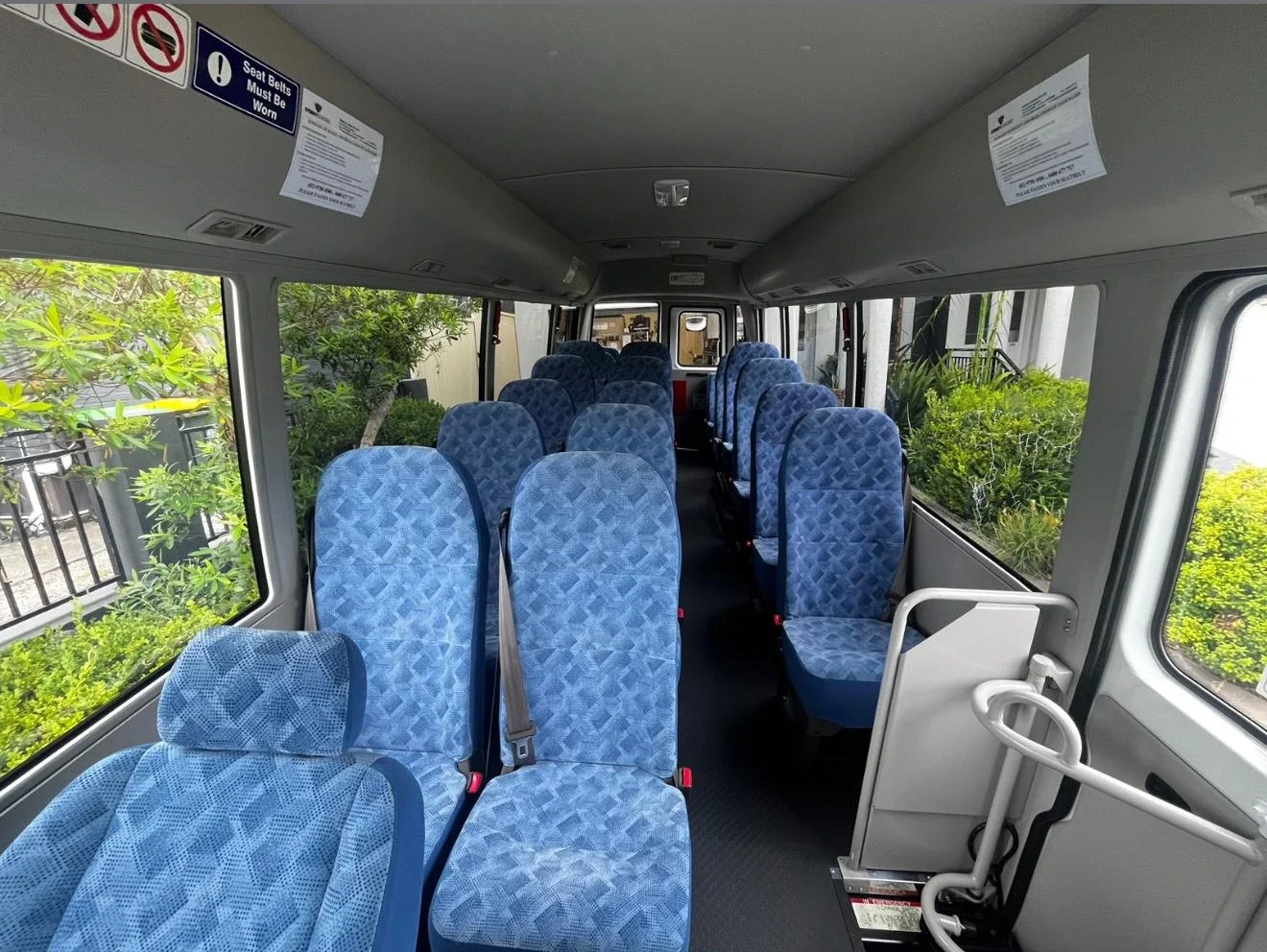
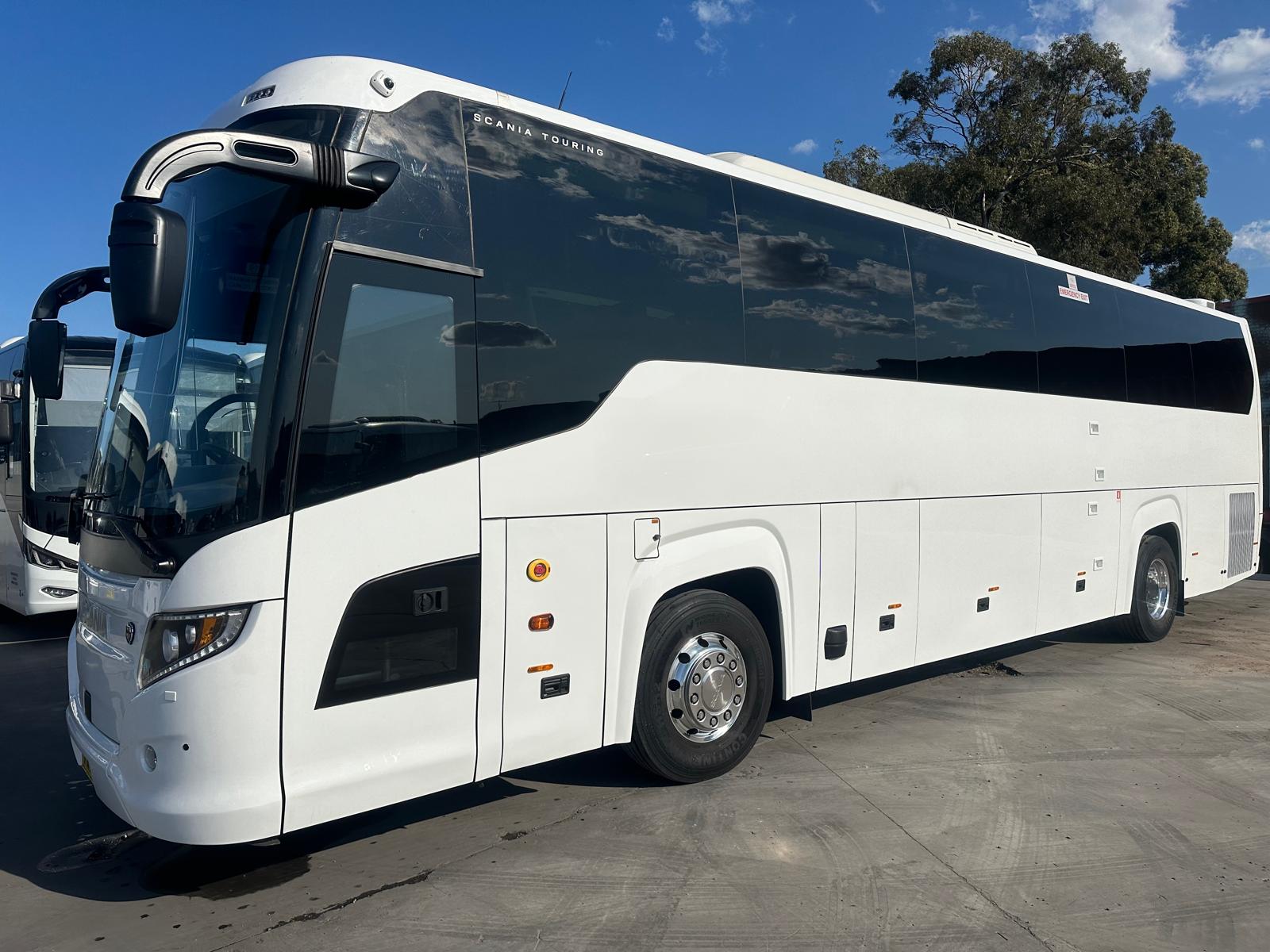
A smaller, lower vehicle can often reach the entrance where a full-size coach stops at the gate. If any guest travels in a wheelchair, you need a vehicle with a boarding device and an allocated space, confirmed in writing for the specific vehicle on your date. Most charter coaches have a fixed seat for every passenger and carry no allocated space, because section 9.8 of the Transport Standards means one is not required in that configuration. The Standards do apply to buses and coaches, so the right move is to ask about your vehicle rather than to assume either way. This is background rather than legal advice.
If the walk is the problem and the vehicle cannot be changed, ask the venue whether a closer set-down point can be opened for arrivals. Many can, and few offer.
Costing it honestly
Two published facts help you budget without guessing.
Minimum hire is three hours for minibuses and people movers and four hours for midi-coaches and full-size coaches. An event with a long gap between the arrival run and the return is therefore priced on the shape of the day, and a run sheet with realistic gaps is easier to quote than a vague one. Waiting time beyond the booked window is confirmed and priced separately, as are tolls and parking, so agreeing the timing properly is also a cost decision.
Coverage across the six Greater Sydney regions carries no travel surcharge inside Greater Sydney, so collecting guests from a couple of suburban points is usually about the run sheet rather than a geographic penalty. You can check the pick-up range on the Greater Sydney pick-up areas page.
Frequently asked questions
How do I ask about mobility and driving without embarrassing anyone?
Ask everybody the same question, phrased around what would help rather than around a condition, and put it on the RSVP so it arrives early. Follow up privately with anyone who flags something.
Is one bus enough?
For arrival, usually. For the return, two runs at different times serve a mixed guest list far better than one at the end of the night, and the earlier run is the one older guests and families with children will use.
What if only a few guests need transport?
Then the shuttle costs the same and carries more people. Sizing it for the whole guest list removes the need for anyone to identify as a person who needs help, which is the point.
What about rideshare as a backup?
Do not build the plan on it, particularly at a regional venue late at night. Plan the transport you control and treat anything else as a bonus.
Can guests be picked up from home?
A door-to-door run for a scattered guest list is slow and expensive. One or two meeting points with parking works better, with a separate smaller vehicle if a handful of guests genuinely cannot reach a meeting point.
Next step
Send the venue, the guest numbers, the suburbs your guests are coming from and any access requirements, and we will build a run sheet with realistic timings and a second return run. Call 02 9469 6600, or start with wedding bus hire in Sydney. If a guest travels in a wheelchair, the detail is on accessible bus hire in Sydney.
Sources
- NSW Legislation, “Road Rules 2014 (NSW)”, https://legislation.nsw.gov.au/view/html/inforce/current/sl-2014-0758. Accessed 7 September 2026.
- National Heavy Vehicle Regulator, “Heavy vehicle fatigue management: bus industry”, https://www.nhvr.gov.au/safety-accreditation-compliance/fatigue-management/heavy-vehicle-fatigue-management-bus-industry. Accessed 7 September 2026.
- Federal Register of Legislation (Australia), “Disability Standards for Accessible Public Transport 2002”, https://www.legislation.gov.au/F2005B01059/latest/text. Accessed 7 September 2026.