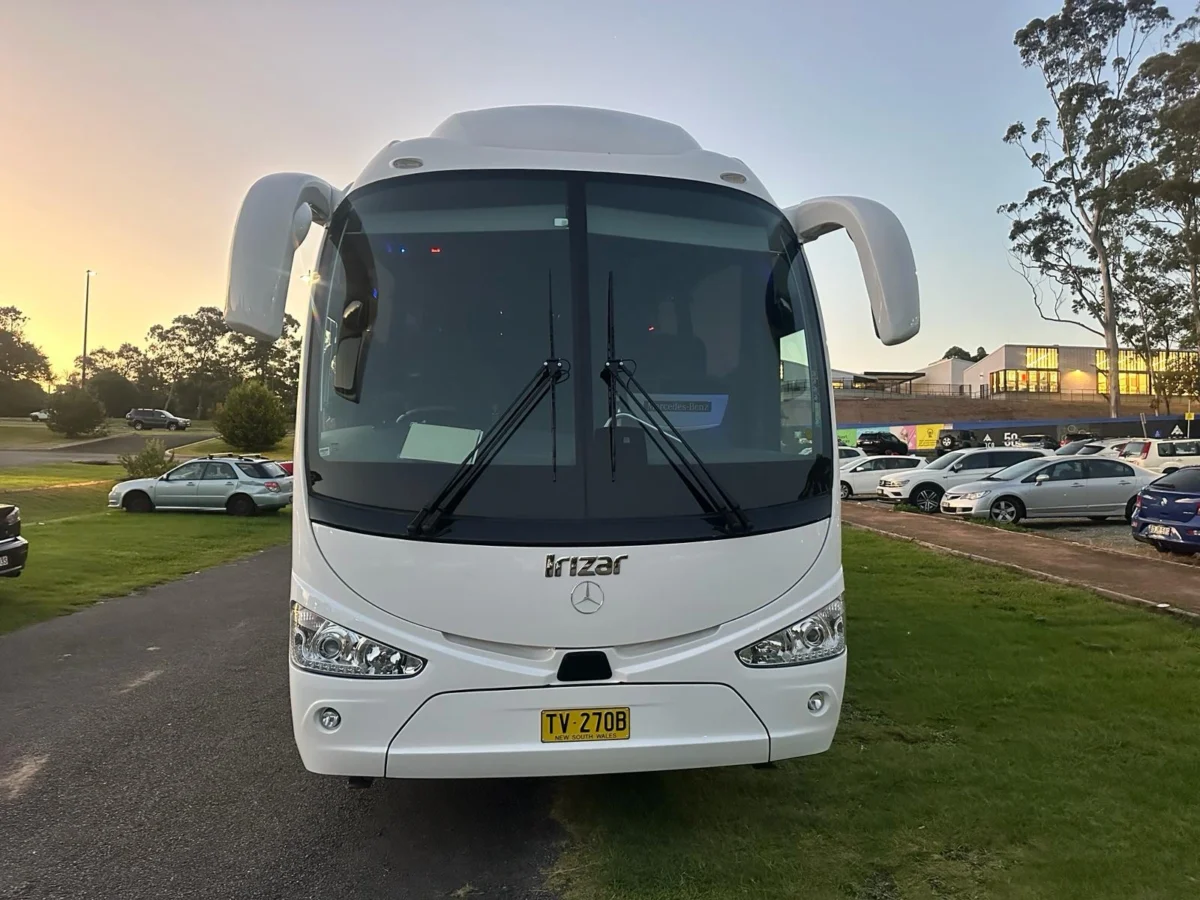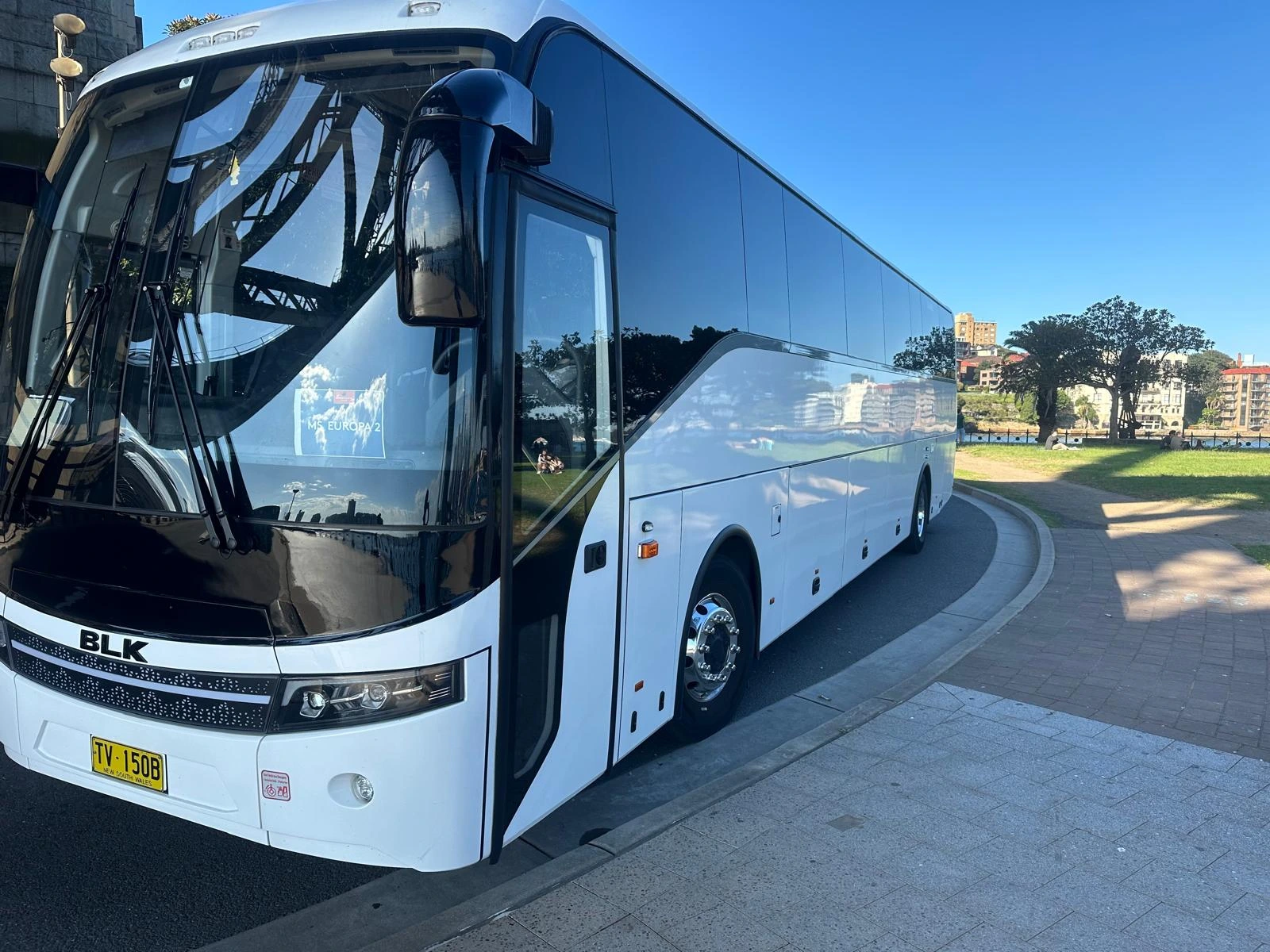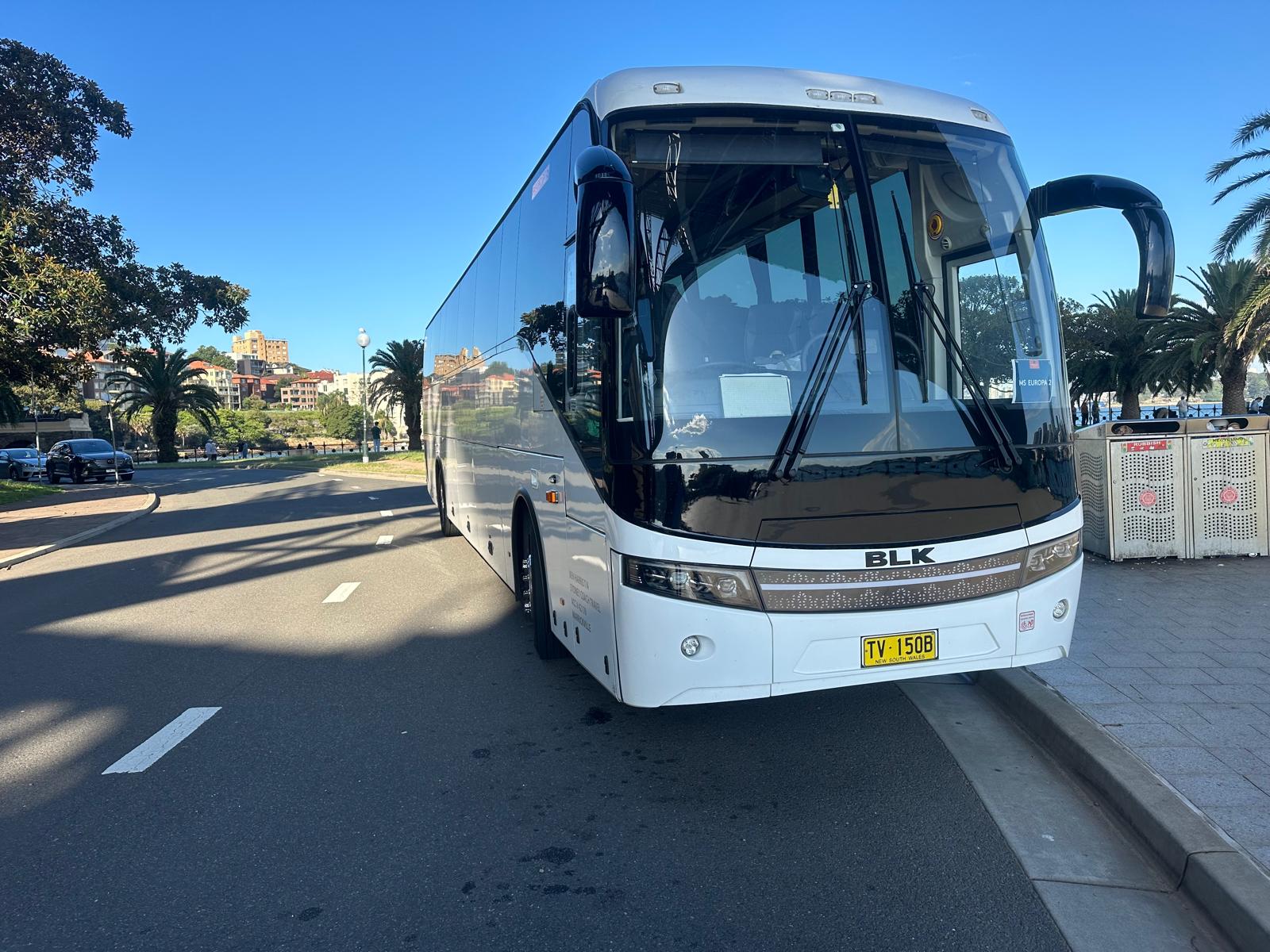
December is a published peak for Sydney charter work, and peak periods need four to eight weeks of lead time rather than the two to four weeks that covers most jobs. If your function is in the first three weeks of December, the practical deadline for locking a coach is October. The decision that actually determines your quote is not the vehicle size. It is the shape of the return: one departure, staggered departures, or a shuttle loop running until the venue closes.
Why December is not like the rest of the calendar
Two things happen at once, and only one of them is about parties.
The first is obvious. End of year functions cluster. Most organisations hold them on a Friday or Saturday evening in the first three weeks of December, which means a very large share of the month’s demand lands on roughly six evenings. Vehicles are not the constraint across December as a whole. They are the constraint on those six evenings.
The second is less obvious and it is the reason the squeeze starts earlier than people expect. NSW government schools in the Eastern division do not finish Term 4 2026 until Thursday 17 December. Excursion and school transport work is still running through the first half of December, on weekdays, using the same coaches and the same drivers. Your Thursday afternoon pre-function pick-up is competing with a school run that was booked in October.
Put those together and the sequence is: school work holds weekday daytime capacity into mid-December, function work holds Friday and Saturday evenings from late November, and the last dates to go are the ones nobody wanted anyway.
The booking countdown from September
This is a working backwards schedule, not a marketing urgency device. Nothing in it expires.
| Timing | What has to happen | Why this is the moment |
|---|---|---|
| September | Venue and date locked, headcount estimated to plus or minus 20 | Transport cannot be quoted against an unknown date. Everything downstream waits on this. |
| Early to mid October | Send the trip and get a written fixed quote with the vehicle named | This sits inside the four to eight week window published for peak periods. A written quote comes back within two business hours. |
| Mid to late October | Confirm with the deposit set out in the quote | A quote is a price, not a held date. The deposit is what removes the vehicle from the pool. |
| Early November | Confirm the return pattern and the finish time | The finish time is the field most likely to change, and it is the one with the biggest operational consequence. |
| Late November | Lock pick-up points, assemble times and the on-site event contact | Assemble time is not departure time. Publish both to staff. |
| 24 hours before | Driver name, mobile and vehicle registration are sent to you | Forward these to your on-site contact and to whoever is running the door. |
If you are reading this in November for a December function, you are not out of options, but you are choosing from what is left rather than choosing what you want. Send the enquiry the same day and take the vehicle that is available.
Choose the return pattern before you ask for a price
Most organisers describe the outbound leg in detail and leave the return as “and back afterwards”. The return is where the money and the risk both sit, because the outbound movement is predictable and the return is not.
Four patterns, and the honest trade-off on each.
| Pattern | How it works | Suits | The catch |
|---|---|---|---|
| Single return | One departure at a stated time, everyone on board or left behind | Small groups, venues with a hard close, teams that will actually leave together | Someone always misses it. Decide in advance who has authority to hold the vehicle and for how long. |
| Staggered returns | Two or three fixed departures, for example an early, a middle and a last | Most corporate functions above about 40 pax | You are buying the vehicle for the whole span, not for three short trips. Waiting time between departures is booked time. |
| Shuttle loop | A vehicle runs a continuous circuit between venue and a single drop point at a set headway | Venue close to a transport hub or a single suburb cluster | Only works when the round trip is short enough that the headway stays useful. A long loop becomes a long wait. |
| Multi-drop return | One vehicle drops in sequence across suburbs | Groups concentrated in one direction | The last person off can be an hour behind the first. Sequence by geography, then publish the order so nobody is surprised. |
The vocabulary matters here because it changes the quote. A staggered return is usually quoted as hourly as-directed, because you are holding the vehicle across a span. A single return is often point-to-point. If you ask for “a bus at 11pm” you will be quoted one thing, and if you ask for “a vehicle held from 10pm to 1am with departures at 10.30, 11.45 and 1am” you will be quoted another. The second is the one you actually want.
Getting people home after a night with drinks
Whether, and how far, a work function sits inside your organisation’s work health and safety obligations is a question for your own WHS and legal advisers. This article does not answer it and is not legal advice. What it can do is set out the operational decisions that usually sit underneath that question, so that whatever your organisation decides, the transport supports it.
Three that matter.
Decide who the on-site event contact is, and give that person real authority. One named person, contactable by mobile, who can hold a vehicle, release it, or authorise a fourth departure. The driver needs one point of contact, not a committee. Put the name and number on the run sheet and on the driver’s copy.
Publish assemble time separately from departure time. Assemble time is when people gather at the loading point. Departure is when the doors close. A fifteen minute gap between the two is the difference between a coach that leaves on time and a coach that leaves twenty minutes late because three people are still saying goodbye.
Sort the alcohol question at booking, not on the night. Alcohol on board is permitted on private function bookings by prior arrangement only. It is never permitted on school or youth charters. Food and non-alcoholic drinks are fine on all vehicles. If you want drinks on the outbound leg, say so in the enquiry so it is written into the booking.
One more practical point. A vehicle that is held across a long evening is not a vehicle whose driver can simply agree to stay another hour at 1am. Charter driving in NSW sits inside the heavy vehicle fatigue regime, and a driver’s day is measured from sign-on, not from your first pick-up. That is why the finish time belongs in the quote rather than in a conversation on the night.
Sydney venue access that changes the plan
Where the coach can physically stop is a venue question, and the answers are not uniform across the city.
ICC Sydney and Darling Harbour. Drop-off is at Iron Wharf Place off Darling Drive, plus Zollner Circuit. Coach parking is not something you arrange on the night: it is arranged through a dedicated ICC Sydney Event Manager. If your function is at ICC, that conversation belongs in your venue planning, not your transport planning.
Sydney Opera House. Buses and coaches cannot park onsite, and large buses must disembark passengers on Macquarie Street. Build the walk from Macquarie Street into your timings.
Anywhere in the central city. The City of Sydney has adopted a policy position that it will not accommodate long-stay coach layover on-street in central Sydney. A coach may stop to set down and pick up, but it cannot sit and wait at the kerb. For a function that runs four hours, the vehicle has to go somewhere in between. Transport for NSW operates the King Street Wharf Bus and Coach Layover, accessed via Lime Street, open 24/7 with a 24 hour maximum stay, restricted to accredited bus and coach operators and requiring prior registration by email.
That last point is worth understanding even though it is the operator’s problem to solve, not yours. It explains why a four hour evening booking costs what it costs. The vehicle is committed for the span whether it is at your venue or in a layover.
What to send with the enquiry
Pick-up suburb, date and group size is enough to start a quote. To get a quote you will not have to revise twice, send this instead.
- Function date, venue name and venue address
- Estimated pax, and the number you would be comfortable committing to
- Pick-up point or points, with assemble time and departure time stated separately
- Return pattern, in the terms above, with the latest realistic finish time
- Whether alcohol will be carried on board on any leg
- Name and mobile of the on-site event contact
- Any accessibility requirement, including whether a wheelchair-equipped vehicle with a hoist is needed
- Invoice details and a purchase order number if your finance team requires one
Frequently asked questions
How far ahead should we book a Christmas party coach in Sydney?
Published lead times are two to four weeks for most jobs and four to eight weeks for peak periods, which expressly include December. For a function on a December Friday or Saturday evening, work to the four to eight week end and send the enquiry in October.
Does a written quote hold the date?
No. A quote is a fixed price against a named vehicle. The booking is confirmed with the deposit set out in the quote, and that is what takes the vehicle out of the available pool.
Can we add another departure on the night?
Sometimes, and it is much easier if the possibility was built into the booking. A vehicle held on an hourly as-directed basis has more flexibility than one quoted as a point-to-point transfer. Either way the driver’s available hours are a real limit, not a negotiation.
Can we serve drinks on the bus?
On a private function booking, by prior arrangement only. Raise it in the enquiry so it is written into the booking rather than discussed at the door.
What if some people want to leave much earlier than the group?
Build that into the pattern rather than solving it on the night. A first departure ninety minutes before the main one costs you booked time, not a second vehicle, and it removes the most common cause of a coach leaving late.
Next step
Send the date, the venue and a rough headcount and you will have a written quote back within two business hours with the vehicle named. If you want a second opinion on the return pattern before you commit, ask for a shuttle plan review and our operations team will work through the departures with you. Booking corporate bus and coach hire in Sydney for a December function is a scheduling exercise more than a purchasing one, and October is when it is easy. Call 02 9469 6600, or send the trip details and check how charter hours and minimum hire periods are priced while you wait for the quote.
Sources
- NSW Department of Education, “School calendar 2026”, https://education.nsw.gov.au/schooling/calendars/2026. Accessed 7 September 2026.
- City of Sydney, “Central Sydney On-Street Parking Policy”, https://www.cityofsydney.nsw.gov.au/-/media/corporate/files/publications/policies/central-sydney-street-parking-policy/central-sydney-on-street-parking-policy_0525.pdf. Accessed 7 September 2026.
- Transport for NSW, “King Street Wharf Bus and Coach Layover”, https://www.transport.nsw.gov.au/operations/roads-and-waterways/business-and-industry/buses/operators/king-street-wharf-bus-and. Accessed 7 September 2026.
- ICC Sydney, “Getting here”, https://iccsydney.com.au/visitors/getting-here/. Accessed 7 September 2026.