Count carers and support workers as passengers, because they occupy seats. A group of 18 participants with a one-to-three support ratio is a group of 24, not 18, and that difference moves the booking from one vehicle to the next one up. Published seat counts exclude the driver, so every other person travelling needs a seat. Then decide where each carer sits, because seating position affects boarding speed, comfort and how quickly someone can be helped.
The headcount error that costs a vehicle
The most common sizing mistake in disability and aged care transport is a passenger list that counts the people the outing is for and treats staff as an afterthought.
It happens because the two numbers live in different documents. The participant list comes from the activity plan. The staffing comes from the roster. Nobody adds them together until the vehicle arrives with 22 seats and 24 people standing on the footpath.
Add them at the start. One list, one number, everybody who will physically be on the vehicle: participants, carers, support workers, volunteers, the activities officer, a family member who has asked to come, and the person from the office who is coming to take photographs for the newsletter.
Sizing the vehicle once carers are counted
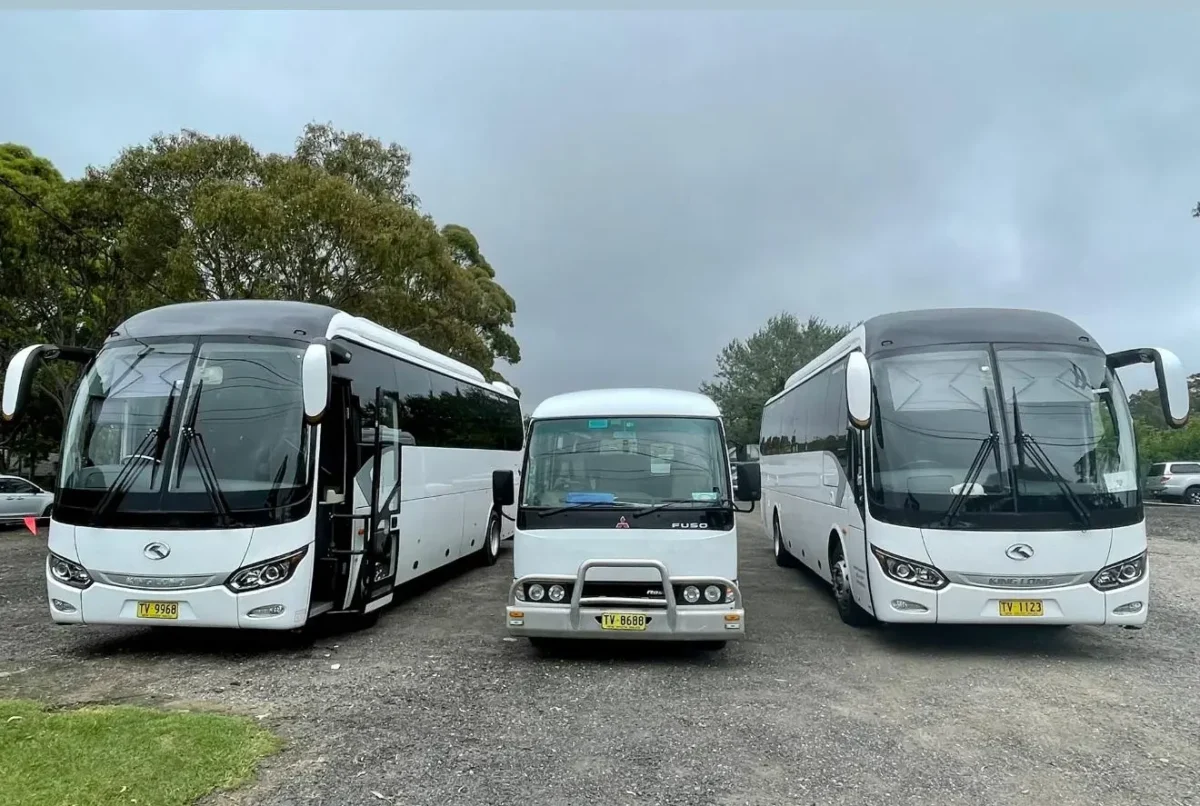
The Sydney fleet runs in a ladder, and where you land on it changes both the vehicle and the minimum hire period. Seat counts exclude the driver.
| Vehicle | Seats | Hourly rate | Minimum hire |
|---|---|---|---|
| Mercedes V-Class | 7 | $125 | 3 hours |
| Mercedes Sprinter | 11 to 14 | $145 | 3 hours |
| Toyota Commuter | 12 | $110 | 3 hours |
| Executive minibus | 21 to 24 | $145 | 3 hours |
| Executive midi-coach | 27 | $165 | 4 hours |
| Luxury coach | 48 | $185 | 4 hours |
| Executive coach | 53 | $195 | 4 hours |
| Luxury touring coach | 50 to 57 | $195 | 4 hours |
| Coordinated convoy | 58 or more | Quoted per event | Not applicable |
Rates are GST inclusive and published on the published fleet, seat counts and hourly rates page. Two planning points fall straight out of the table.
The minimum hire steps up with the vehicle. Minibuses and people movers carry a three hour minimum, midi-coaches and full-size coaches four hours. A short local outing that needs 24 seats is therefore priced against a different floor than one that needs 20. An airport or point-to-point run can instead be quoted as one fixed transfer fare, and a fare quoted that way is not charged at a minimum.
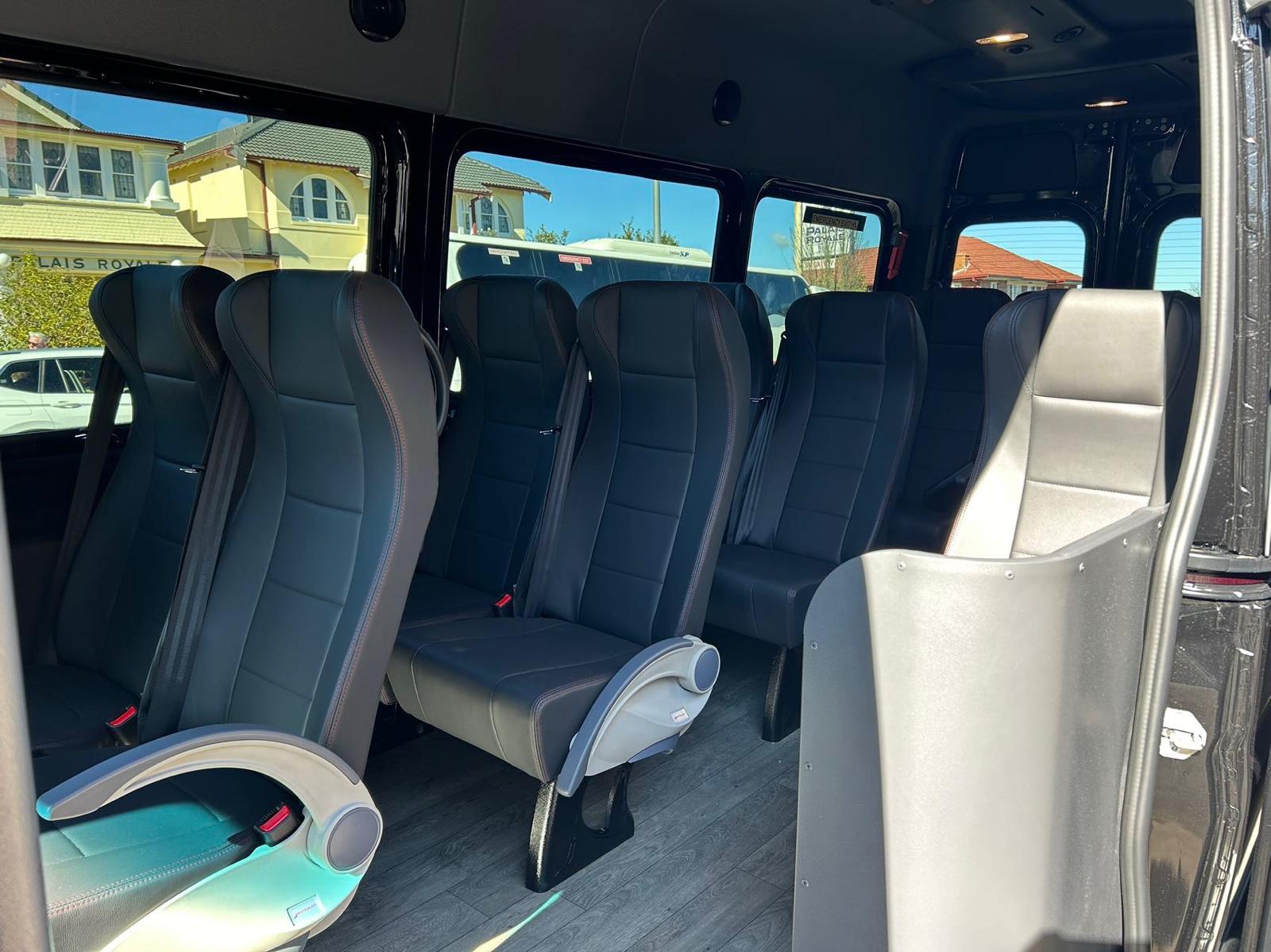
Seat count is not comfortable count. A vehicle rated for 24 seats will carry 24 adults. Whether it comfortably carries 24 adults plus four walking frames, a folded wheelchair and a esky of morning tea is a different question, and it is the question to ask when your group is close to the top of a vehicle’s range.
There is also a regulatory line worth knowing. A vehicle seating 13 or more sits with Transport for NSW operator accreditation, while 12 seats or fewer falls to the Point to Point Transport Commission instead. And if anyone in your organisation is thinking of driving a van themselves, a NSW Class C licence covers vehicles seating up to 12 adults including the driver and up to 4.5 tonnes GVM. Both limits apply at once, and plenty of 12-seat vans exceed 4.5 tonnes, so the seat count alone does not settle it.
Where people sit changes how fast you board
Seating is not only about comfort. It is about the sequence of the boarding, which is the part of an accessible outing most likely to run over.
Next to the person they support. For a participant who may need prompting, reassurance or physical assistance during the trip, the carer needs the adjacent seat rather than a seat three rows back. Say so in the booking rather than sorting it out in the aisle.
Near the door. Anyone likely to need to alight quickly, or who becomes unwell on longer legs, belongs near the door, and their carer belongs beside them.
Beside the allocated space. If a passenger travels in their wheelchair, ask whether a seat can be held next to the allocated space so their support worker is within reach. This is worth confirming with the operator, since it depends on the layout of the specific vehicle.
First on, last off. Passengers who take longest to settle should board first and alight last, which means they need to be seated where a slower movement does not block everyone behind them.
Front for motion sickness and vision. A forward seat with a clear view of the road helps passengers prone to motion sickness, and helps some passengers with dementia stay oriented on a longer drive.
Write the seating plan into the run sheet and hand a copy to the driver. It takes five minutes and it removes the entire negotiation that otherwise happens at the door.
Equipment is part of the passenger list
Mobility equipment does not disappear when its owner sits down.
- Folded manual wheelchairs usually travel in a luggage bay on a coach. On a minibus, ask where.
- Powered wheelchairs and scooters generally do not travel stowed. If the passenger is transferring to a seat, the chair needs a plan of its own.
- Walking frames and rollators need a stowage point that is reachable at the other end without unloading half the vehicle first.
- Portable oxygen needs to be declared in advance, not mentioned at the kerb.
- Assistance animals need floor space and should be named on the passenger list.
- The group’s own gear counts too: morning tea, folding chairs, an esky, a first aid kit.
Ask the operator where each item travels on the specific vehicle. Equipment that ends up on seats turns a 24-seat booking into a 21-seat booking.
The passenger list template
Send this with your enquiry. It is the fastest way to get a correctly sized quote.
| Field | Example of what to write |
|---|---|
| Participants seated | 15 |
| Participants travelling in a wheelchair | 2, both manual, occupied dimensions supplied separately |
| Participants transferring from a chair or frame to a seat | 3, frames to be stowed |
| Carers and support workers | 6 |
| Volunteers, family and staff | 2 |
| Assistance animals | 1 |
| Total people needing a seat | 26 |
| Seats that must be adjacent | 4 pairs, listed |
| Equipment to be carried | 3 walking frames, 2 folded wheelchairs, 1 esky |
| Anything to be declared | 1 portable oxygen cylinder |
The total at the bottom is the number that sizes the vehicle. Everything above it is the reason the operator can size it properly instead of guessing.
What the operator needs from you
Alongside the passenger list, three practical items help.
Confirmation of the vehicle in writing. The vehicle type assigned to your dates, the boarding device fitted if one is needed, and the number of allocated wheelchair spaces.
The stops. Each address, and where the vehicle can legally set down at each one. Vehicle height decides some of those points, which in turn decides how far your group walks.
One named contact for the day. With a mobile number, and a note of who is authorised to change the plan if something needs to change.
One rule to pass on to the group before travel: on a coach fitted with seatbelts, wearing them is required in NSW for every passenger aged 16 and over. It is much easier to say that in a pre-trip note than at the kerb.
Frequently asked questions
Do carers get counted in the passenger number?
Yes. Anyone who is physically on the vehicle needs a seat, and published seat counts exclude the driver. Count participants, carers, support workers, volunteers and family members as one number before you look at vehicle sizes.
Can we reserve a seat next to a wheelchair space?
Ask the operator, because it depends on the layout of the specific vehicle. Raise it at enquiry rather than after the booking is confirmed, since it can influence which vehicle is allocated.
Should we book one bigger vehicle or two smaller ones?
It depends on where you are going more than on the headcount. A larger coach is taller, and height decides where it can legally set down at several Sydney venues, which decides how far the group walks. Two smaller vehicles can also mean two drivers and two sets of boarding, so weigh the walk against the boarding time.
What if our numbers change close to the date?
Tell the operator as soon as the number moves rather than at the end. A change of two passengers can move a group across a vehicle boundary, and a vehicle change is easier to arrange with notice than on the morning.
Does equipment reduce the number of seats?
It can. Frames, folded chairs and eskies that end up on seats reduce the seats available for people. List the equipment separately in the enquiry so it is planned for rather than discovered.
Next step
Send the passenger list with carers and equipment included and we will size the vehicle against it and confirm what fits. Call 02 9469 6600 or send the trip details through for a written quote within two business hours. If your group sits in the smaller range, minibus hire for smaller groups is the usual starting point, and access requirements are handled through accessible bus hire in Sydney.
Sources
- NSW Government (Transport for NSW), “Applying for bus operator accreditation”, https://www.nsw.gov.au/departments-and-agencies/transport-for-nsw/bus-operators-nsw/applying-for-bus-operator-accreditation. Accessed 7 September 2026.
- NSW Government, “Licence classes and conditions”, https://www.nsw.gov.au/driving-boating-and-transport/driver-and-rider-licences/licence-classes-and-conditions/classes. Accessed 7 September 2026.
- NSW Legislation, “Road Rules 2014 (NSW)”, https://legislation.nsw.gov.au/view/html/inforce/current/sl-2014-0758. Accessed 7 September 2026.
- Federal Register of Legislation (Australia), “Disability Standards for Accessible Public Transport 2002”, https://www.legislation.gov.au/F2005B01059/latest/text. Accessed 7 September 2026.