Plan a multi-generational group around its two extremes rather than its average. The youngest passengers set the vehicle’s luggage and restraint requirements, the oldest set boarding time, seat position and route length, and the middle of the group will fit whatever those two decide. Size the vehicle for prams and mobility aids as well as heads, confirm what the specific vehicle can carry, and if you split the group, split it by need rather than by household.
Start with the two ends, not the headcount
A family group booking usually starts with a number: twenty-two people, or thirty-one. That number is the least useful thing about the group.
What actually determines the vehicle is who sits at the edges. A group of twenty-two adults is a straightforward 24-seat minibus. The same twenty-two people including a baby in a capsule, a toddler with a pram and a grandparent using a walking frame is a different job, and the seat count barely moved.
Work outward from both ends. Ask what the youngest passenger needs to travel safely, and what the oldest passenger needs to board comfortably. Everything in between is easy.
The youngest end of the group
Small children bring two requirements, and only one of them is about seats.
Restraints. Whether child restraint duties apply depends on the vehicle assigned rather than the type of booking, because the NSW Road Rules treat a vehicle seating more than 12 adults including the driver differently from a smaller one. Whatever the duty, a properly fitted, age-appropriate restraint is the safest way for a small child to travel. Whether a capsule or child seat can actually be fitted is a question about the specific vehicle’s belts and anchorage, so ask about the vehicle being assigned rather than the vehicle type.
Space. Prams take real room. On a coach or midi-coach they travel in the underfloor bay with the luggage; on a smaller minibus they compete with suitcases in the rear luggage area. Count prams the way you count bags, and say whether each one folds flat, because a large travel system takes several times the space of a compact fold.
The oldest end of the group
Older passengers rarely need a different vehicle. They frequently need a different plan.
Boarding. Step height and handrails matter more than seat width. A group with several passengers who board slowly needs boarding time built into the schedule, especially at the start of a wedding day when everything downstream is timed.
Mobility aids. A walking frame or folded wheelchair is luggage that has to travel in the same vehicle as its owner, which is not always automatic on a tightly packed job. If anyone in the group uses a wheelchair they cannot transfer out of, the vehicle question changes entirely. Wheelchair-equipped vehicles with hoists are available, and the practical step is to ask whether the specific vehicle being assigned has a hoist or ramp and an allocated space, rather than assuming any minibus will do.
Seat position. Front seats, aisle access and a short walk from the door are worth requesting by name. They cost nothing and they are the difference between a comfortable trip and a difficult one.
Route length. On a longer run such as a reunion day trip to the Blue Mountains, which is around 105 km and roughly two hours each way, comfort stops stop being optional. Agree them in advance rather than improvising.
Sizing the vehicle for a mixed group
Seat counts across our fleet exclude the driver. The table below sizes for people plus the gear that travels with a mixed-age group.
| Group size | Vehicle | What to check before confirming |
|---|---|---|
| Up to 7 | Mercedes V-Class | Whether a capsule can be fitted, and where a folded wheelchair travels |
| 8 to 13 | Toyota Commuter | Luggage space runs out before seats do once prams are added |
| 11 to 14 | Mercedes Sprinter | Which build is assigned, because seat counts vary across the range |
| 15 to 24 | Executive minibus | Boarding step and whether a hoist is required |
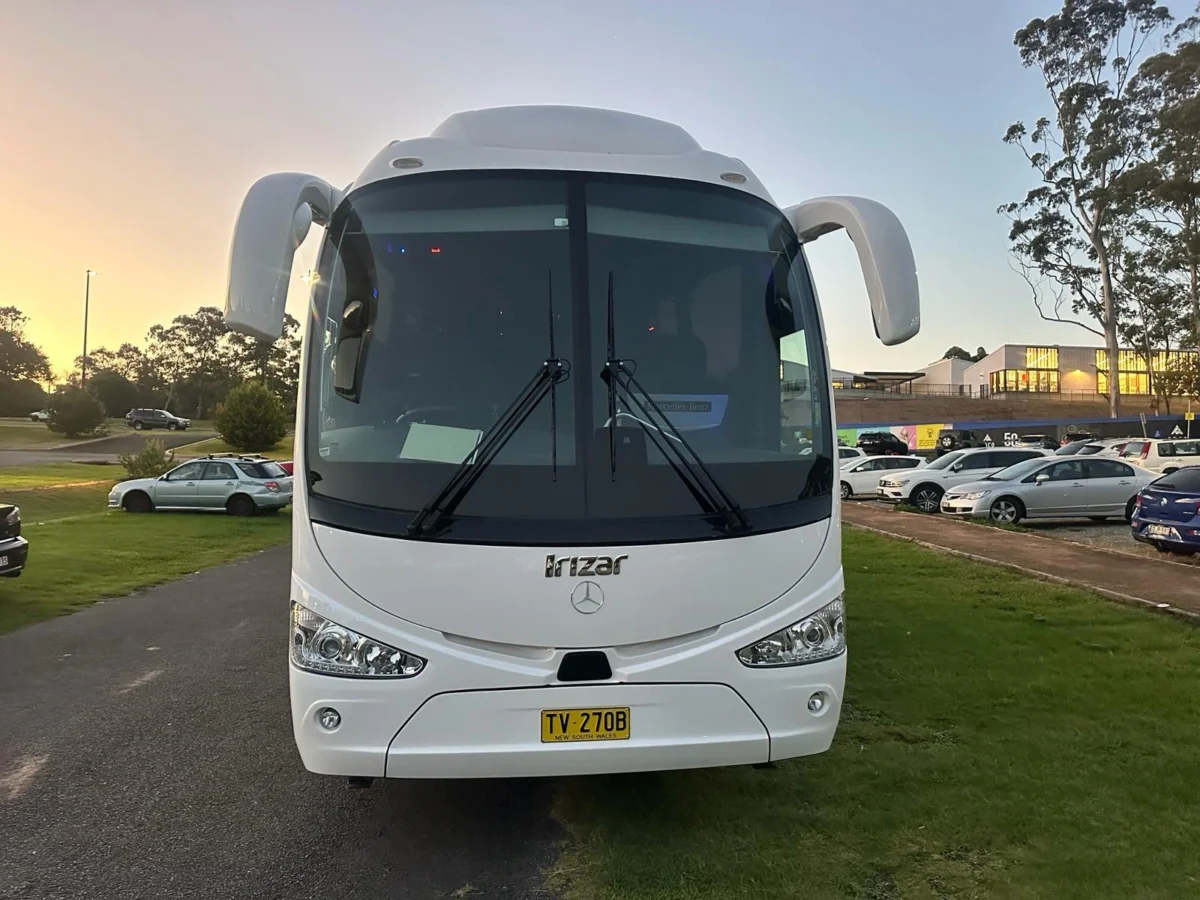
| 25 to 27 | Executive midi-coach | Underfloor bay makes prams and aids much easier |
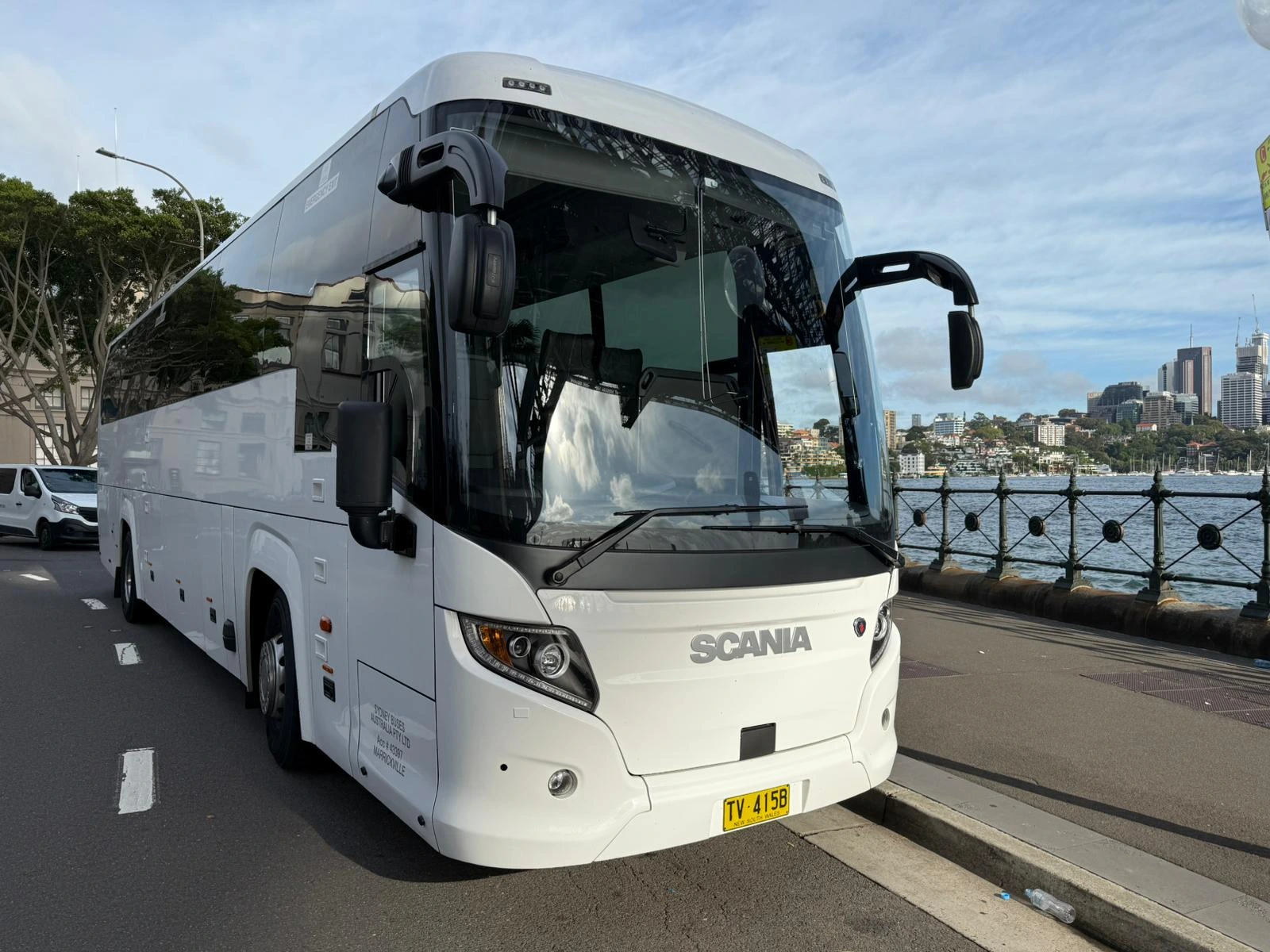
| 28 to 57 | Luxury or executive coach | Boarding time through one door for a slow-moving group |
The recurring trap is sizing on heads alone. A family group of twelve adults fits a 13-seat minibus comfortably. Add three prams, twelve suitcases from an airport run and a folded wheelchair and it does not, even though nobody new has joined.
Minimum hire is three hours for minibuses and people movers and four hours for midi-coaches and full-size coaches. A wedding or reunion usually fills that comfortably, but a short airport run may be better quoted as a fixed transfer fare instead, which is not charged against a minimum.
When relatives are flying in
Sydney family groups usually have someone arriving by air, and airport collection has rules that a family kerbside pick-up does not.
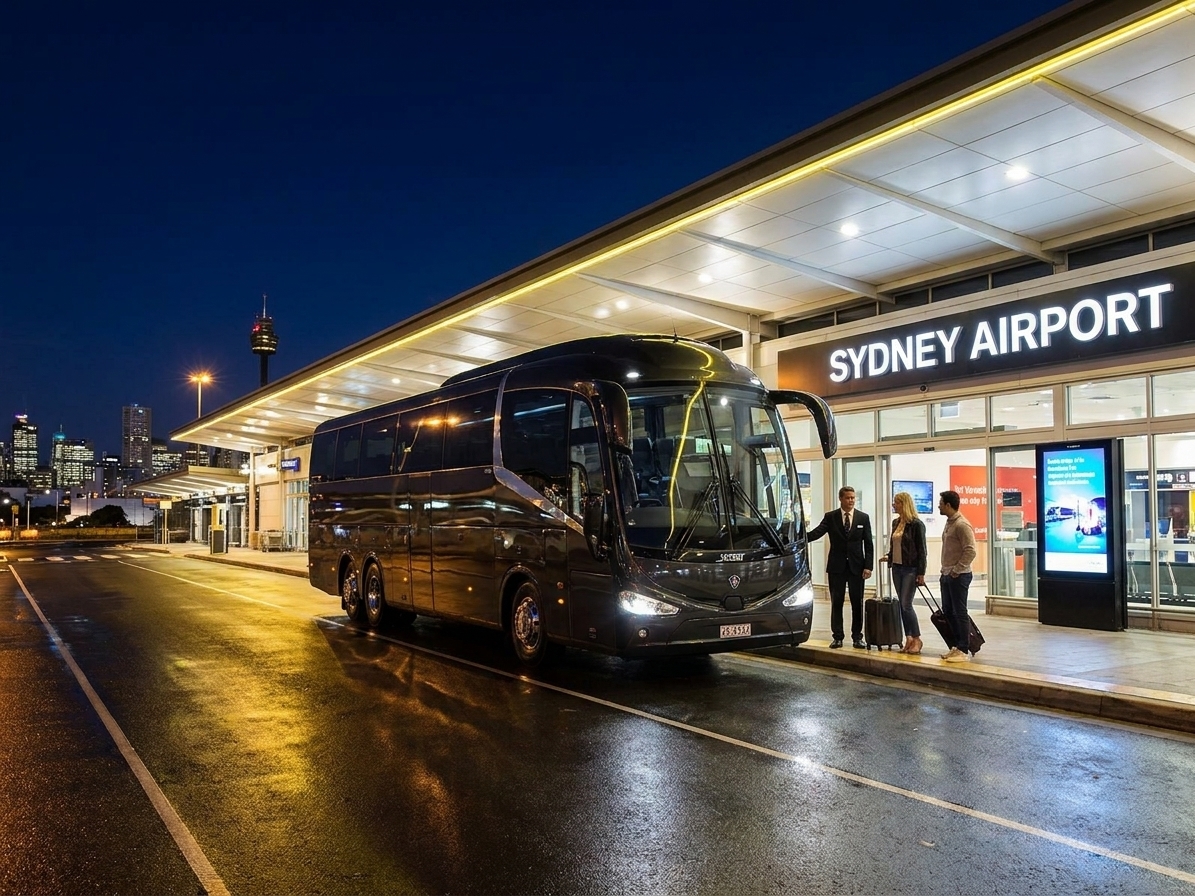
Collection happens in dedicated ground transport zones rather than at the kerb, so the group needs to know where they are meeting the vehicle before they land. Sydney Airport publishes a meeting point at T1 International on the Arrivals level between exits A and B and at T2 Domestic on the Arrivals level opposite baggage carousel 6. There is no published T3 meeting point, so a T3 arrival needs its meeting point agreed with the operator in advance. Drop-off on the departure leg is kerbside at Departures and is set-down only, which means the group needs to be organised before the vehicle stops.
If relatives arrive on several different flights, decide early whether one vehicle waits for everyone or the arrivals are collected in two runs. The gap between the first and last person reaching the meeting point is always wider than the gap between scheduled landings, and it is wider again when bags and small children are involved.
Splitting the group: by need, not by household
Once a family group needs two vehicles, the instinct is to split it by family. That is almost always the wrong cut.
Split by need instead. Put everything that slows a vehicle down on one run and everything that does not on the other:
Vehicle one, the direct run. Passengers with mobility aids, the youngest children, prams and capsules, anyone who boards slowly. Fewest possible stops, closest set-down to the door, most boarding time.
Vehicle two, the collector. Everyone else. Multiple pick-ups across suburbs, a longer route, a tighter schedule.
The result is that the people who need an easy trip get one, and the people who can absorb three extra stops absorb them. Splitting by household produces two vehicles that are both slow, and it usually means a grandparent doing a suburban tour before reaching the venue.
Ask the operator how many pick-up points a single job can practically take. Every additional stop adds time to the run, and on a wedding morning that time comes out of the buffer at the far end.
Minibus hire in Sydney covers most family group sizes, the fleet from 7 to 57 seats shows the full ladder, accessible bus hire in Sydney is the page to read if anyone in the group uses a wheelchair, and the Greater Sydney regions we cover matters when relatives are spread across the city.
The enquiry checklist
Send these nine lines and the vehicle can be matched to the group rather than to a headcount:
- Total travelling, adults and children separately.
- Ages of any children under 7, and whether a capsule or child seat is needed.
- Number of prams, and whether each folds flat.
- Anyone using a walking frame, folded wheelchair, or a wheelchair they remain seated in.
- Whether a hoist or ramp is needed.
- Luggage, especially if any leg is an airport run.
- Pick-up points, listed with suburbs.
- The time the group must arrive, and at what address.
- Whether the trip is one leg or a return, and how long the gap is.
Written quotes name the vehicle and come back within two business hours. Published lead times run two to four weeks for most work and four to eight weeks in peak periods including December and long weekends, which is when family reunions cluster, so book earlier than feels necessary.
Frequently asked questions
How do you fit babies through to grandparents in one vehicle?
Size for the extremes. The youngest passengers determine restraints and luggage space, the oldest determine boarding time and seat position, and the rest of the group fits around those decisions. Ask the operator to confirm the specific vehicle rather than the vehicle type.
Can a wheelchair travel on the same vehicle as the rest of the family?
Ask whether the vehicle being assigned has a hoist or ramp and an allocated space. Wheelchair-equipped vehicles with hoists are available, but this needs confirming for the specific job rather than assuming, and it is worth doing early because it can change the vehicle.
What size vehicle does a family group need?
More than the headcount suggests once prams, mobility aids and airport luggage are counted. Twelve adults fit a 13-seat minibus. Twelve adults with three prams and airport cases usually do not.
Should we book one vehicle or two?
One if everyone can board in a reasonable time and the gear fits. Two once the vehicle is full, once the pick-up list is long enough to make the trip uncomfortable for older passengers, or once a wheelchair space and a large luggage load compete for the same room.
How should the group be split across two vehicles?
By need. Put mobility aids, prams and slow boarding on a direct run with few stops, and everyone else on a multi-stop collector. Splitting by household gives you two slow vehicles instead of one fast one and one slow one.
Do older passengers have to wear a seatbelt?
Where seatbelts are fitted, passengers aged 16 and over are required to wear them in NSW. Mention it to the group before travel rather than on the day, particularly for anyone who finds a belt awkward, so the driver can help with seat choice.
Next step
Tell us who is travelling, including ages, prams and any mobility aids, along with your pick-up suburbs and the time you need to arrive. We will confirm the vehicle and whether one is enough before anything is booked, usually within two business hours.
If access needs are involved, call 02 9469 6600 and we will confirm the vehicle with you directly rather than leaving it to a form.
Sources
- Sydney Airport, “Pick-up”, https://www.sydneyairport.com.au/pickup. Accessed 7 September 2026.
- Transport for NSW, “Seatbelts”, https://www.transport.nsw.gov.au/roadsafety/topics-tips/seatbelts. Accessed 7 September 2026.