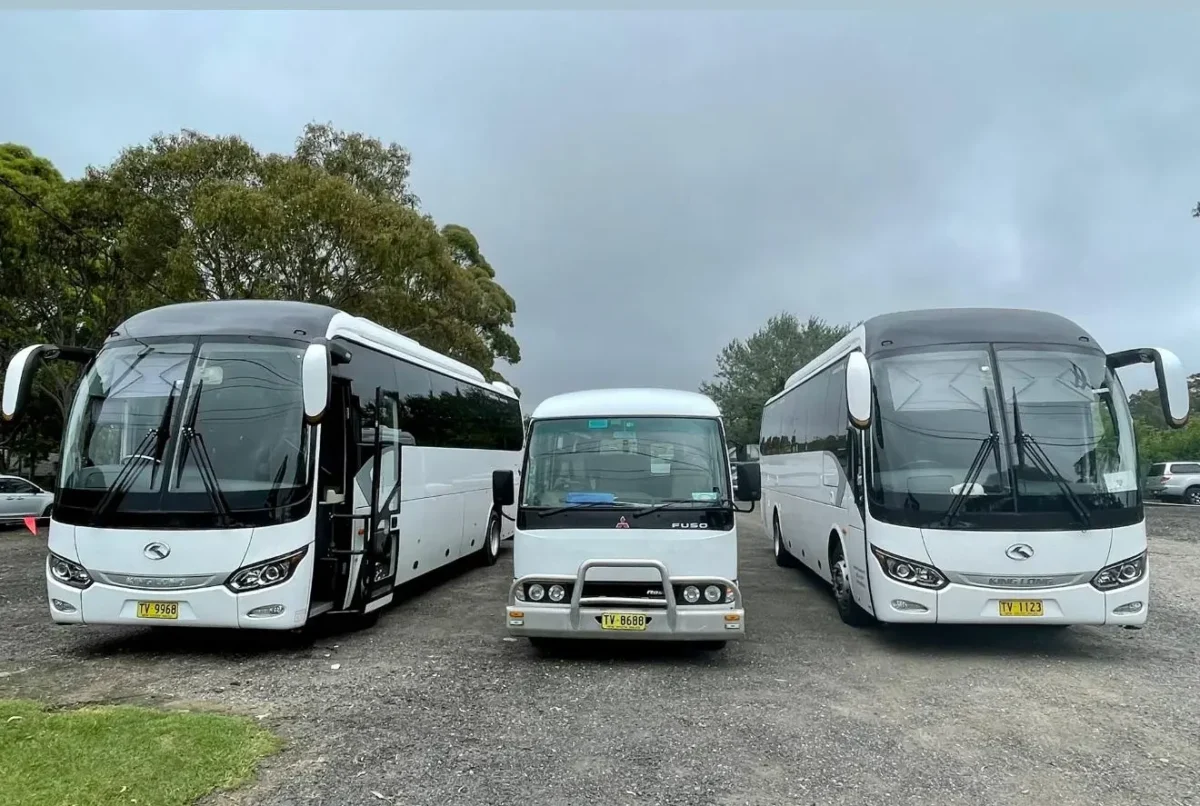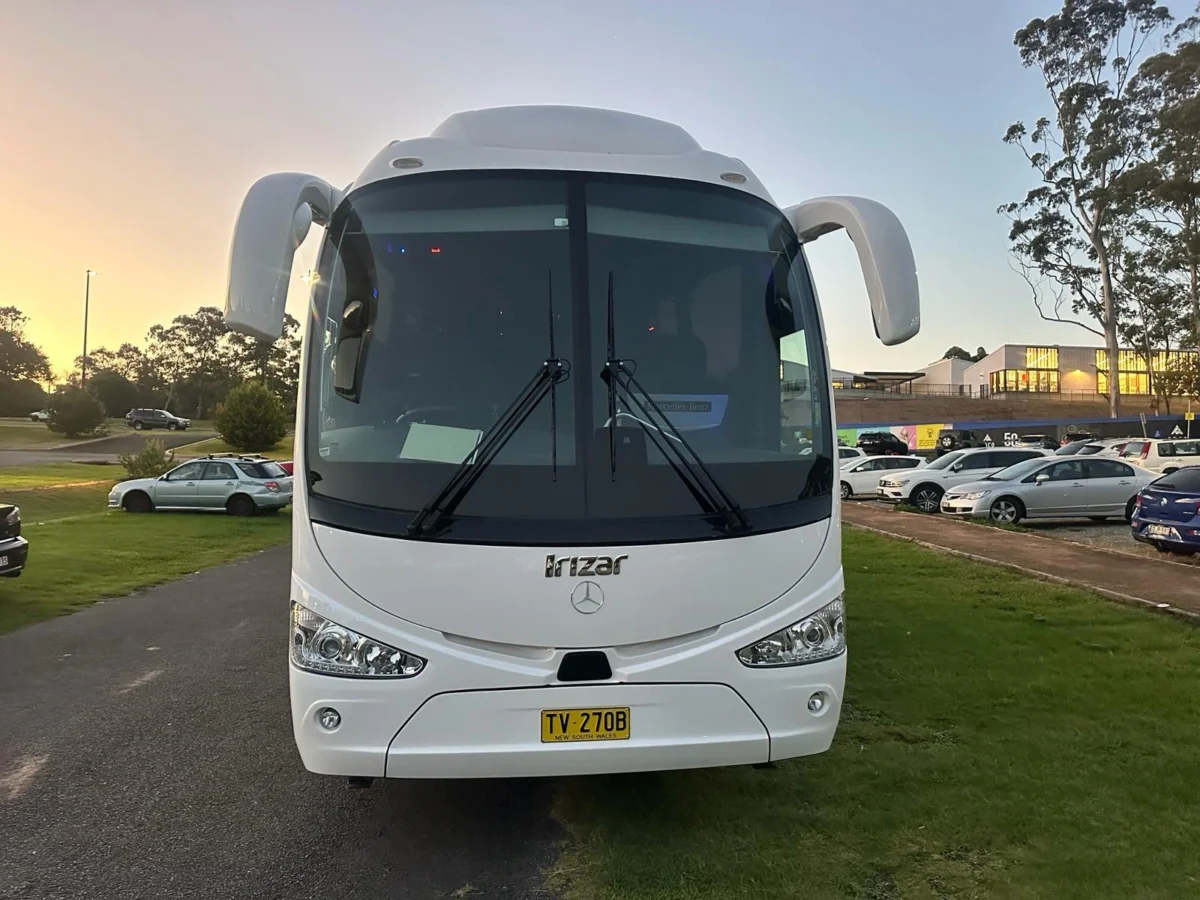
The two formats solve different problems. A harbour cruise gives you one place, one view and a fixed window: everyone arrives at a wharf, boards, and comes back when the vessel does. A charter bus gives you movement: multiple pick-up points across Sydney suburbs, several venues in a night, and a door-to-door return. Choose the cruise when the venue is the point. Choose the bus when getting people there and home is the point. In Sydney you can also do both.
The structural difference, before any price is compared
Almost every practical difference between the two comes from one thing: a vessel is a venue that moves, and a coach is a venue-to-venue connection.
That produces consequences most organisers only discover late.
On a cruise, the group is together for the whole booked window, and nobody can leave. That is a genuine advantage when the point is to keep 40 people in one place, and a genuine problem when someone needs to go home at nine.
On a coach, the group can be collected from three suburbs, moved between venues, and dropped at individual addresses at the end. That solves the two hardest parts of a Sydney night, which are getting everyone to the same place at the same time and getting them home afterwards. It also means the group is only together while the vehicle is moving.
Neither is better. They are answers to different questions.
Comparing them fairly
| Charter bus or coach | Harbour cruise | |
|---|---|---|
| What it is | Transport between places, with the group together while moving | A venue for a fixed window, in one place |
| Where people join | Multiple pick-up points across Sydney suburbs, at addresses you choose | One wharf, at a scheduled time |
| Group size | Set by the vehicle, from 7 up to 57 seats, with 58 or more run as a coordinated convoy | Set by the vessel |
| How it is priced | By the hour against a published rate card, with driver, fuel, vehicle insurance and GST included | Per head or per charter, set by the cruise operator |
| Minimum commitment | Three hours for minibuses and people movers, four hours for midi-coaches and coaches | The vessel’s scheduled window |
| Can someone leave early? | Yes, at any drop-off point on the route | No, not until the vessel returns to the wharf |
| Weather | Largely irrelevant | Materially affects the experience and sometimes the schedule |
| Getting home | Built in, to individual addresses | Ends at a wharf, and the return trip is a separate problem to solve |
| Step-free access | Wheelchair-equipped vehicles with hoists are available on request | Depends entirely on the vessel and the wharf |
| The failure mode | The route is too ambitious for the hours booked | Someone misses the departure and misses the entire event |
Two rows in that table decide most choices.
“Can someone leave early?” decides it for mixed-age groups, for anyone with young children at home, and for corporate functions where a few people genuinely need an exit. A missed early departure on a vessel is not a small inconvenience.
“Getting home” decides it for late finishes. A cruise ends at a wharf, usually at the same moment as several hundred other people finish nearby, and the return leg is entirely unplanned unless you plan it. A charter run ends at people’s suburbs.
Which occasions suit which format
A cruise suits a fixed-length function where the venue is the event: a milestone birthday with one guest list, a corporate end-of-year function, an engagement party, a hens or bucks event where the group wants a single setting rather than a route. It suits groups who are already comfortable making their own way to and from a wharf, and it suits daytime events where the view is doing the work.
A charter suits anything that involves more than one location, anything where the group is spread across Sydney suburbs, anything late-finishing, and anything where the organiser is going to be held responsible for how people get home. It also suits groups with a wide age range, because the run can drop some people at 10pm and the rest at 1am.
Neither suits an organiser who has not decided the finish time. Both formats punish that, in different ways.
Combining the two, which is the Sydney answer
The most common good plan is not a choice at all. It is a coach transfer at each end of a cruise.
That solves the cruise’s genuine weakness, which is that everyone has to reach a wharf independently at a scheduled time and then get home from that wharf afterwards. A coach collects the group from two or three suburban points, delivers them to the wharf with a buffer, and is back at a published time for the return.
Three things make a combined booking work.
- Build a real buffer at the front. The vessel leaves on its published time whether the group is there or not. Plan to arrive at the wharf 30 minutes before boarding, and treat that as non-negotiable rather than as slack to be spent on a late pick-up.
- Confirm the wharf set-down point in writing with the cruise operator, not with the internet. Ask for the street address where a full-size vehicle can legally set down, how far the walk to the vessel is in metres, and whether that changes at night. Foreshore access around Sydney is tightly controlled and varies point by point: at the Sydney Opera House, for example, buses and coaches cannot park onsite and large buses must disembark on Macquarie Street, while ICC Sydney publishes coach drop-off at Iron Wharf Place off Darling Drive. Every location has its own arrangement and none of them can be assumed.
- Book the return as a published time, not a phone call. A coach may stop in a bus zone to set down or pick up under NSW road rules but may not wait there, and the City of Sydney will not accommodate long-stay coach lay-over on-street in central Sydney. So the return is a scheduled arrival at a fixed time, and your group needs that time in writing before they board the vessel.
The transfer legs are usually short, and being short they usually hit the charter minimum hire rather than the number of hours actually used. That is worth knowing before you compare quotes, and it is also the reason some organisers book the vehicle for the whole span rather than as two separate short jobs.
Making the cost comparison honest
Comparing a per-head cruise price to an hourly charter rate is not a like-for-like comparison, and most people do it anyway.
Do it this way instead.
- Take the charter quote, which is priced by the hour against the published rate card, GST inclusive, with the professional driver, fuel, vehicle insurance and GST already included.
- Add the items that are confirmed in advance and priced separately: tolls and parking, public holiday and after-hours loading, and any waiting time beyond the booked window.
- Divide by the number of people actually travelling to get a per-head figure.
- Then compare that to the cruise price per head, and add whatever the group will spend getting to the wharf and home again, because that cost exists whether or not it appears on an invoice.
A 21 to 24 seat executive minibus is $145 an hour with a three hour minimum. A 53-seat executive coach is $195 an hour with a four hour minimum. Groups of 58 or more are quoted as a coordinated convoy per event. Those are the numbers to divide, and the per-head figure they produce is the only one worth putting next to a cruise quote.
Frequently asked questions
Is a party bus or a harbour cruise better for a hens night in Sydney?
It depends on whether the group is spread across Sydney or already together. A cruise gives one setting for a fixed window with no ability to leave early. A charter bus collects people from several suburbs, can take in more than one venue, and drops everyone home. Groups with a wide age range or a late finish usually find the charter easier to organise.
How do the two compare on cost?
They are priced differently, so convert both to a per-head figure. Charter is quoted by the hour against a published rate card with driver, fuel, vehicle insurance and GST included, so divide the quoted total by the number travelling. Then add the cost of getting a cruise group to the wharf and home again, which is real whether or not it is invoiced.
Can you do both on the same night?
Yes, and it is the most common good plan in Sydney. A coach collects the group from suburban points, delivers them to the wharf with a buffer, and returns at a published time for the trip home. Build 30 minutes of buffer at the front, because the vessel leaves on its own schedule.
What is the biggest risk with each option?
For a cruise, someone missing the departure and therefore missing the entire event. For a charter, an itinerary with more venues than the booked hours can carry. Both are prevented by fixing the finish time first and publishing every departure time in writing.
Which works better for guests with mobility needs?
Ask both providers directly and get the answer in writing. Wheelchair-equipped vehicles with hoists are available on the charter side on request. On the vessel side, access depends on both the boat and the wharf, so the question has to cover the gangway and the approach, not just the deck.
How far ahead should either be booked?
For the charter side, published lead times are two to four weeks for most jobs and four to eight weeks for peak periods, which include December, race days, school excursion season and long weekends. If you are combining both, book them in the same week so the transfer times are built around the vessel’s schedule rather than retrofitted to it.
Next step
If you want a real number to compare, send the date, the pick-up suburb, the group size and where you are going. You will get a fixed written quote back within two business hours with the vehicle named, which you can divide by the headcount and set beside any cruise quote you are holding.
Start with party and function bus hire in Sydney, check the published hourly rates and what they include, or call 02 9469 6600, Monday to Friday 7am to 6pm or Saturday 8am to 2pm. If anyone in the group needs step-free boarding, raise it early and see accessible vehicle options.
Sources
- NSW Government, Road Rules 2014 (NSW), rule 183 and Dictionary, https://legislation.nsw.gov.au/view/html/inforce/current/sl-2014-0758. Accessed 7 September 2026.
- City of Sydney, Central Sydney On-Street Parking Policy, https://www.cityofsydney.nsw.gov.au/-/media/corporate/files/publications/policies/central-sydney-street-parking-policy/central-sydney-on-street-parking-policy_0525.pdf. Accessed 7 September 2026.
- Sydney Opera House, Plan your excursion, https://www.sydneyoperahouse.com/schools/plan-your-excursion. Accessed 7 September 2026.
- ICC Sydney, Getting here, https://iccsydney.com.au/visitors/getting-here/. Accessed 7 September 2026.