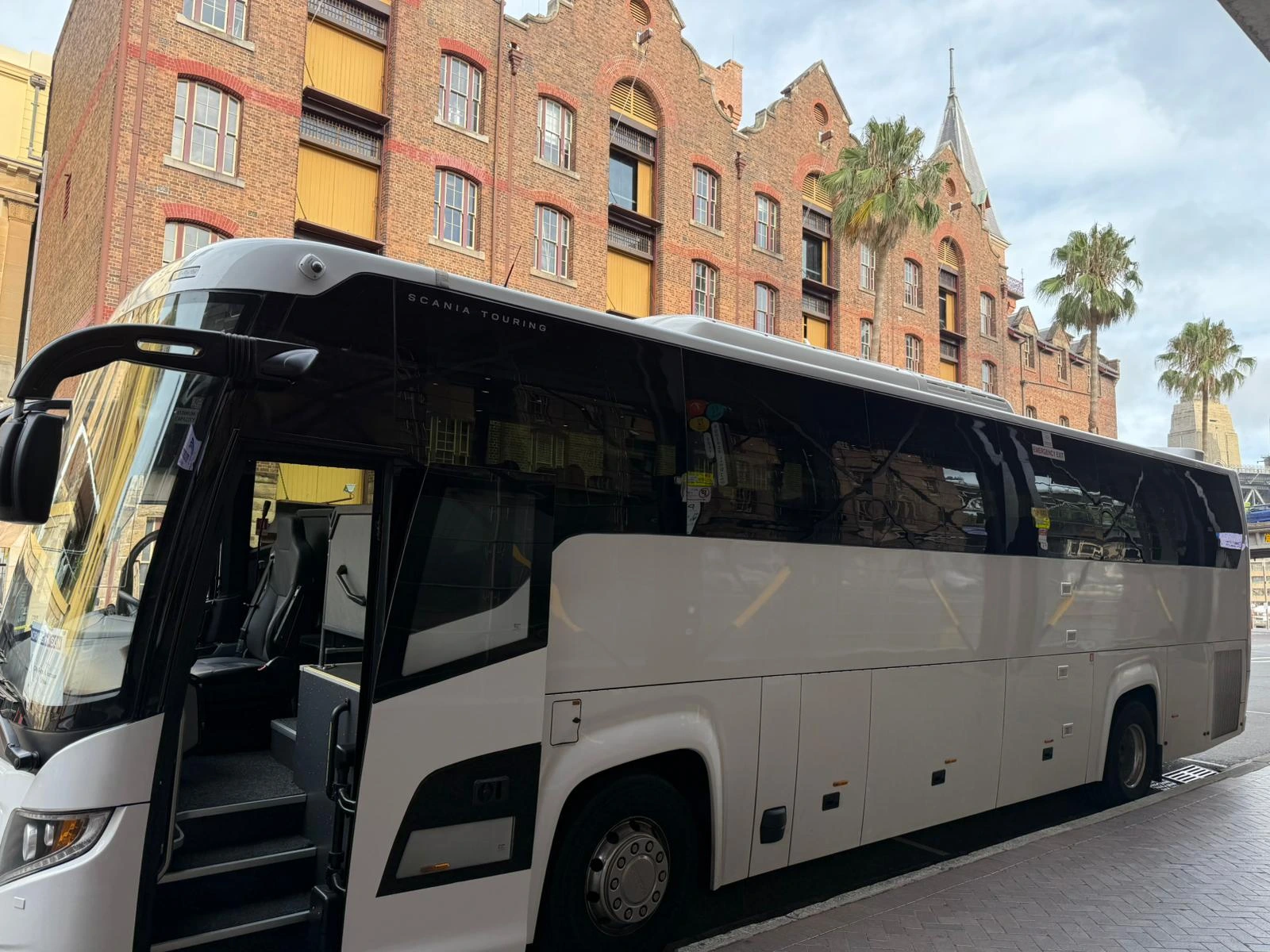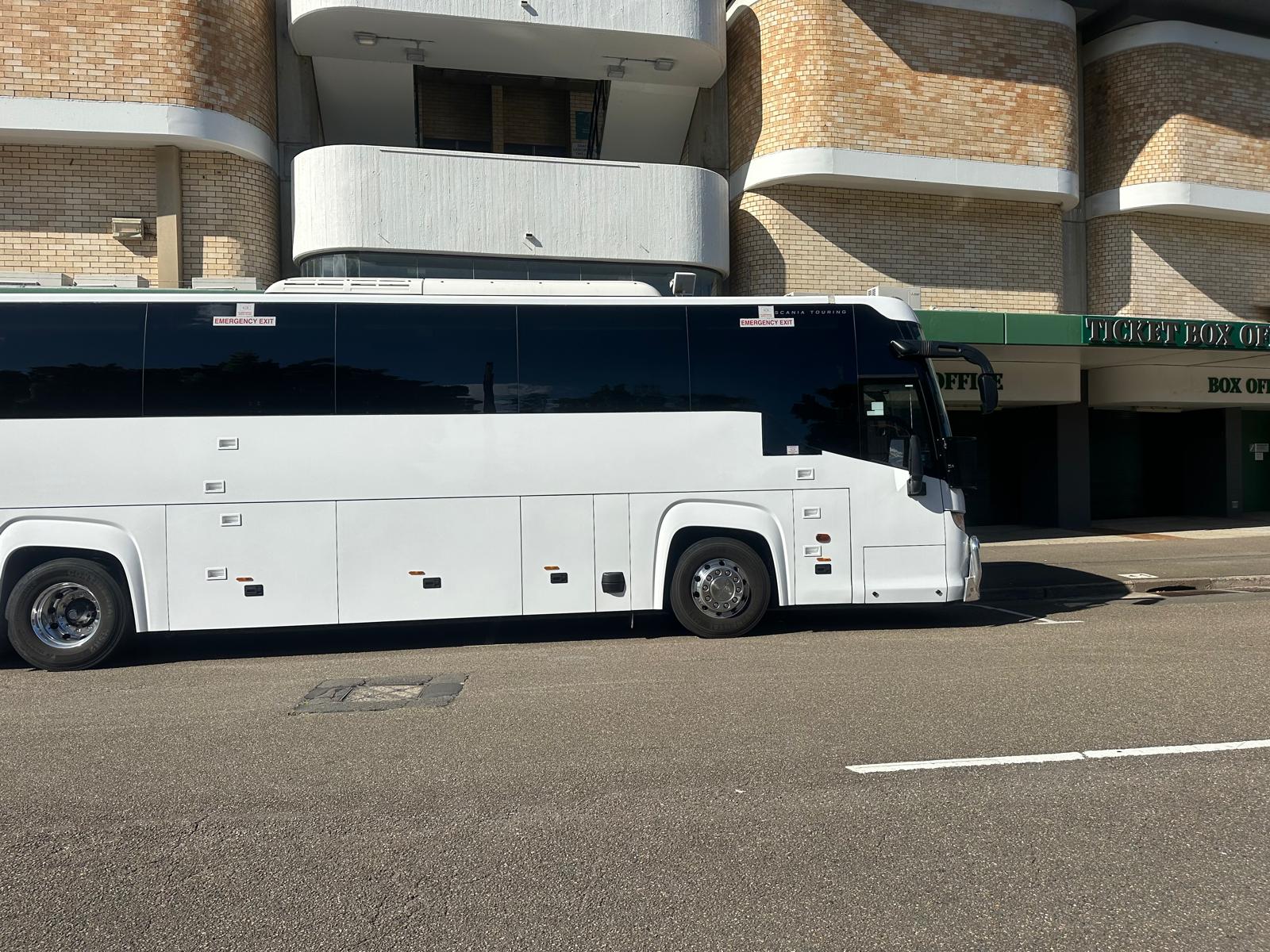
A carnival is not a big excursion. It is several excursions leaving from one gate inside a narrow window, and the constraint is almost never the number of seats. It is how many vehicles can physically present at the school frontage, how quickly each one loads, and what the venue will accept at the other end. Decide the staging sequence before you decide the vehicle mix, and settle the wet-weather call before you book anything.
The constraint is the gate, not the fleet
Seats are the easy part. A Sydney charter fleet running from 7 up to 57 seats, with groups of 58 or more handled as a coordinated convoy, will produce a vehicle combination for almost any number you give it. You can check the vehicle sizes and seat bands and build the maths in ten minutes.
What you cannot solve on a spreadsheet is the frontage. Most Sydney schools have one usable loading point, often a short stretch of kerb on a residential street, and often inside a 40 km/h school zone that is live from 8:00am at most sites. Four full-size coaches do not fit there at once. They arrive, load and leave in sequence, and the sequence is the plan.
So the first question is not “how many buses”. It is “how many vehicles can stand at our gate at the same time, and for how long”. Answer that, and the rest of the morning designs itself.
Staggered or simultaneous
Both work. They fail differently.
| Simultaneous departure | Staggered departure | |
|---|---|---|
| Vehicles needed | All at once, one per group | Fewer vehicles, each doing more than one leg only if the venue is close |
| Frontage load | Highest. Needs a frontage or a second loading point | Lower. One or two vehicles at a time |
| Supervision | Every group needs staff at the same moment | Staff can move between waves |
| Arrival at venue | Whole school arrives together, which the venue may or may not want | Venue receives the school in waves |
| Main failure mode | Gridlock at the gate; last vehicle leaves 40 minutes late | A late first wave pushes everything behind it |
| Best for | Venues that want the group together for a single start | Tight frontages, phased programme starts, split year group programmes |
Two rules of thumb hold across both.
Load the youngest group first if they leave first, and last if they leave last. Younger students take longer to load and are hardest to hold in a holding pattern.
Do not stagger across the top of the school zone window. Most school zones run 40 km/h from 8:00 to 9:30am. A wave leaving at 8:45am is driving out through the zone, past every other school on the route, at the same time as every parent in the suburb. Always check the sign at your own gate, because non-standard times exist and the sign governs.
Staging several coaches at one school gate
This is the part that is genuinely operational, and it is where a plan either holds or does not.
- Nominate a staging point away from the gate. Vehicles wait there and are called forward one at a time. Note that a bus zone is not a staging point: under the NSW Road Rules a charter coach may stop in a bus zone to set down or pick up passengers, subject to the sign, but not to wait.
- Number the vehicles, not the year groups. Vehicle 1, Vehicle 2, Vehicle 3. Put the number in the windscreen if the operator can. Students find a number faster than they find a year group sign.
- One person calls vehicles forward. One. Not the coordinator plus two head teachers with the same list.
- Group assembles before the vehicle arrives. The vehicle should never wait for the group at the kerb. That is the single biggest cause of frontage gridlock.
- Roll call at the vehicle door, not in the playground. Count as they board.
- Confirm departure by radio or phone, group by group. The coordinator should know that Vehicle 2 has left, not assume it.
- Reverse the sequence for the return. The last vehicle to arrive at the venue in the morning is usually the first one loaded to come home.
Sydney Buses and Coaches sends driver name, mobile and vehicle registration twenty-four hours before travel. On a four-vehicle morning, build that into a single contact sheet before the day and give a copy to every staff member with a loading role.
What the venue will accept
Venue access decides the vehicle mix more often than seat maths does, and Sydney venues differ sharply.
At Sydney Olympic Park, coaches use Coach Pod C off Edwin Flack Avenue, accessed from Uhrig Road via Carter Street. Pre-booking closes at 11:59pm the day before the event, the booking is non-refundable except on event cancellation, and the park is a restricted parking area where vehicles must park wholly within marked bays. That deadline is the important one: there is no same-morning fix.
At Allianz Stadium in Moore Park, private coaches should access Driver Avenue via Lang Road during events, not Moore Park Road. Coach parking at the southern end of Driver Avenue is subject to availability, so treat it as a possibility rather than a reservation.
For any other carnival venue, ask four questions in writing before you book vehicles.
- Where does a full-size coach set down, and is it the same place it collects from?
- Can coaches stay onsite for the duration, or do they have to leave and return?
- Is there a booking, a fee or a deadline for coach access?
- What is the height and length limit at the entry the coach must use?
Get the answers in writing. If a venue cannot take a full-size coach, that changes the entire vehicle mix and it needs to change it early, not in the last fortnight.
The wet-weather decision point
Carnivals get called off. Plan the call, not just the day.
Three things sit inside that decision, and they have different deadlines.
The venue booking. A coach parking booking with a cut-off at 11:59pm the day before is decided the night before, on a forecast, not on the morning’s actual weather. Somebody has to own that call and know the cut-off.
The transport booking. Cancellation terms for a charter are set out in the written quote. Read them before the carnival is booked, not on the morning it is cancelled. If you run the same carnival every year, ask about it once and file the answer.
The vehicles themselves. Once vehicles leave the depot on the morning, a cancellation is a different conversation from one made the night before. Ask your operator what its latest practical cut-off is and write it into the school’s wet-weather procedure alongside the venue’s.
The other half of the wet-weather plan is what happens instead. If the fallback is a school-based day, the transport decision is simple. If the fallback is a backup date later in the term, check that date against your term calendar first, because school development days are staff-only and an excursion cannot fall on one.
Frequently asked questions
How do you move 300 students to a carnival in one morning?
Not by seat maths alone. Work out how many vehicles your frontage can load at once, decide staggered or simultaneous on that basis, then size the vehicles. Three hundred students plus staff is a coordinated multi-vehicle job rather than several separate bookings, and it needs one arrival sequence and one person calling vehicles forward.
Is it cheaper to run fewer vehicles and do two trips?
Only if the venue is close enough that the second leg fits inside the morning, and only if the venue can hold the first wave safely with staff. Once the return leg has to happen inside the school zone window, the saving usually disappears into a late start.
What happens if the carnival is cancelled for weather?
Cancellation terms are set out in the written quote, so read them when you book rather than on the morning. Venue coach bookings can have their own deadlines: at Sydney Olympic Park, coach pre-booking closes at 11:59pm the day before and is non-refundable except on event cancellation.
How many vehicles can wait outside the school?
That depends on your frontage, not on the operator. Nominate a staging point away from the gate, call vehicles forward one at a time, and remember that a bus zone can be used to set down and pick up but not to wait.
How far ahead should a carnival be booked?
Published lead times are two to four weeks for most jobs and four to eight weeks in peak periods, which include school excursion season. A multi-vehicle carnival in Term 1 or Term 3 belongs at the longer end of that range.
Next step
Send the carnival date, the venue, the number of groups and your total headcount including staff, and ask for the vehicle mix and the staging sequence to be quoted together rather than as a seat count.
Sydney Buses and Coaches handles school and excursion transport and sports group transport across Greater Sydney, and returns a written quote naming the vehicles within two business hours. Call 02 9469 6600.
Sources
- Transport for NSW, School zones, https://www.transport.nsw.gov.au/roadsafety/community/schools/school-zones. Accessed 7 September 2026.
- Sydney Olympic Park Authority, Bus and coach parking, https://www.sydneyolympicpark.com.au/parking/bus-and-coach-parking. Accessed 7 September 2026.
- Allianz Stadium, Plan your visit: transport, https://www.allianzstadium.com.au/plan-your-visit/transport. Accessed 7 September 2026.
- NSW Legislation, Road Rules 2014, https://legislation.nsw.gov.au/view/html/inforce/current/sl-2014-0758. Accessed 7 September 2026.
- NSW Department of Education, Excursions and variations of routine (PD-2005-0290-04), https://education.nsw.gov.au/policy-library/policies/pd-2005-0290-04. Accessed 7 September 2026.