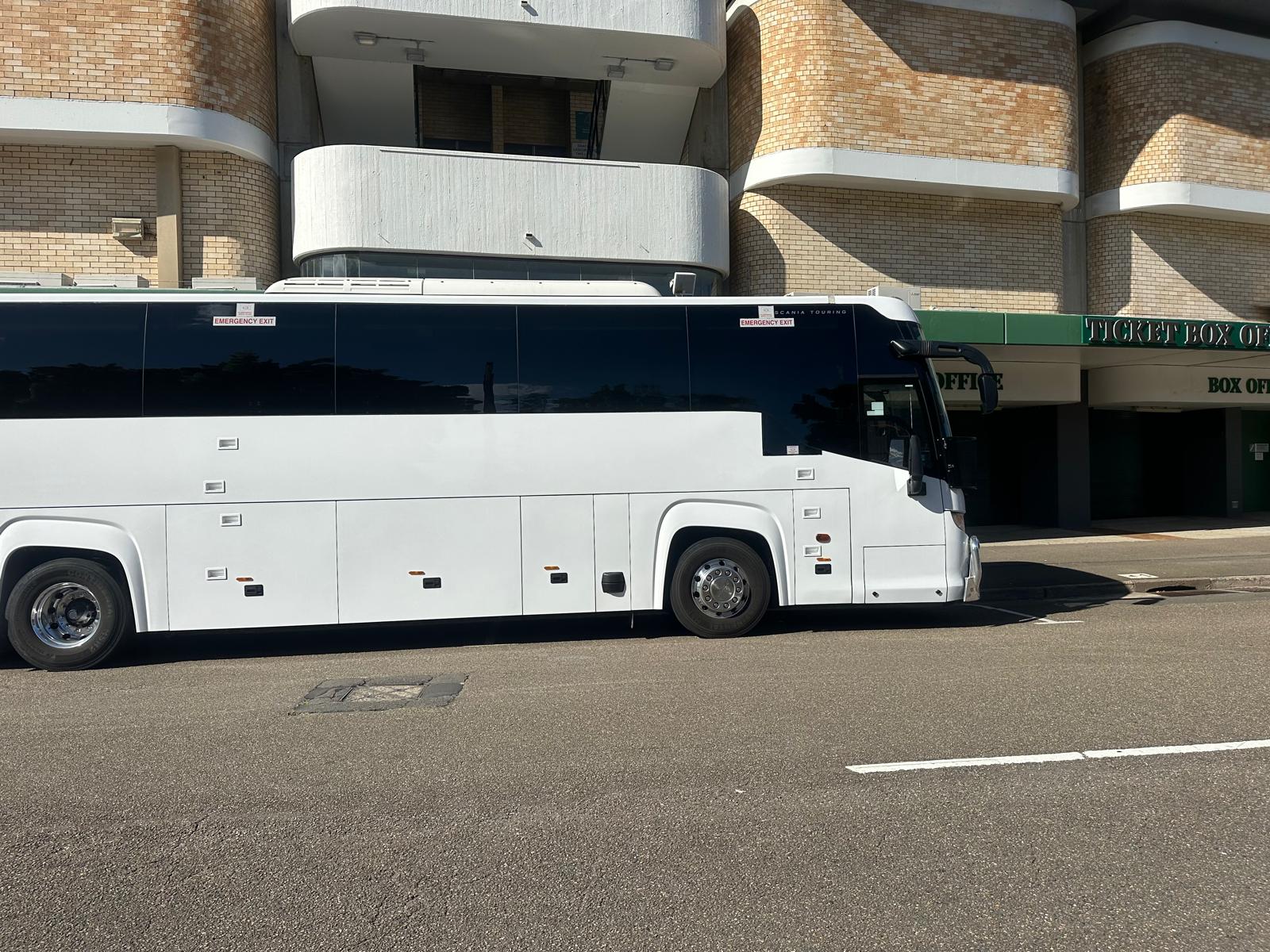
Yes, buses and coaches pay tolls in Sydney, and a full-size coach usually pays several times what a car pays on the same road. Sydney classes vehicles by dimension rather than weight: Class A is 12.5 metres or less in length and 2.8 metres or less in height, and a full-size coach is taller than 2.8 metres. That single measurement puts it in Class B on every class-based Sydney toll road. The multiple differs by road, and on one corridor the tunnel is compulsory.
How Sydney classifies a bus or coach
Sydney toll roads do not look at gross vehicle mass, and with one exception they do not count axles. They measure the vehicle.
Class A is 12.5 metres or less in length and 2.8 metres or less in height. Class B is anything that exceeds either limit. The measurement includes whatever is towed behind or mounted on the roof, so a bike rack or a luggage pod counts.
The exception: on the Eastern Distributor and the M5 South-West, Class A carries a 2.0 metre height limit for vehicles with three or more axles.
For an organiser, the useful version is short. A people mover or a minibus is normally Class A. A full-size coach is above 2.8 metres, so it is Class B regardless of length. The vehicle you choose therefore changes the toll exposure of the same route, which is worth knowing before you compare two quotes side by side. You can see how our published rates treat tolls and parking alongside everything that sits inside the hourly figure.
The heavy multiple is not one number
The most common mistake in charter content is treating Class B as three times Class A everywhere. It is not.
| Corridor | Class B relative to Class A |
|---|---|
| NorthConnex, Hills M2, M5 South-West, Westlink M7, WestConnex (M4, M8, M5 East, M4 to M8 Link) | About 3 times |
| Eastern Distributor, Cross City Tunnel | About 2 times |
| Lane Cove Tunnel, Military Road E-Ramp | Roughly 3.4 to 3.5 times |
| Sydney Harbour Bridge, Sydney Harbour Tunnel | No heavy class exists. Every vehicle pays the same fixed toll, priced by time of day |
That last row is the one people do not expect. A 53-seat coach crossing the Harbour Bridge pays exactly what a hatchback pays, and the only variable is the time of day it crosses. The same coach on the Lane Cove Tunnel is paying more than three times the car rate.
No dollar figures appear here on purpose. Sydney tolls are indexed quarterly, so any amount published today is wrong within a few months. The rule and the relative multiple stay true, and they are what you should be asking about.
Which tunnels a coach can physically use
Toll class answers what a coach pays. Clearance answers whether it fits. These are separate questions and they produce different answers on the same network.
| Tunnel | Published clearance |
|---|---|
| NorthConnex | 5.1 m |
| M8, M4 to M8 Link, M4 Tunnels | 5.1 m |
| Hills M2 | 5.0 m |
| M5 East, main tunnel | 4.6 m |
| M5 East, Cooks River tunnel | 4.4 m |
| Sydney Harbour Tunnel | 4.4 m |
| Cross City, Eastern Distributor, Lane Cove | 4.4 m |
| Airport, Domain, Kings Cross | 4.4 m |
Two things to take from that table. The M5 East corridor is not one number: the main tunnel is 4.6 metres and the Cooks River tunnel on the same corridor is 4.4 metres, so a clearance that works on one section is not automatically fine on the other. And the western motorway tunnels are the generous ones at 5.1 metres, while almost everything through the eastern half of the city sits at 4.4 metres.
Buses are permitted in the Sydney Harbour Tunnel. The binding constraint there is the 4.4 metre clearance, not a vehicle-type ban.
None of that is headroom advice. Any operator putting a vehicle into a tunnel measures that vehicle, including roof-mounted equipment, rather than working from a general figure for the class.
NorthConnex is a rule, not a route preference
If the trip runs between the M1 and the M2, the tunnel is generally compulsory rather than optional.
Under the Pennant Hills Road regulation, trucks and buses over 12.5 metres long or over 2.8 metres high travelling between the M1 and the M2 must use NorthConnex, unless the vehicle has a genuine destination only reachable via Pennant Hills Road. Two camera gantries enforce it. There is no exemption list and no application process, so this is not something an operator can apply to be released from. The tunnel speed limit is 80 km/h, with average-speed cameras for heavy vehicles, and placard loads of dangerous goods are directed to Pennant Hills Road instead.
The practical consequence for a coach run north to Port Stephens, or any trip using that corridor, is that the Class B toll is a fixed feature of the route. A quote showing no toll exposure on that corridor has not been thought through.
Toll relief does not reach a charter operator
Consumer toll relief is built for private motorists and a charter operator gets nothing from it. The NSW weekly cap requires a personal toll account with no ABN attached, on a NSW-registered private-use vehicle charged as Class A, and it expressly excludes Class B spend and business use. A charter coach fails on every limb.
One heavy-vehicle scheme is currently live: the Truck Multiplier Rebate, a one-third rebate on M5 East and M8 trips for Class B vehicles. It is a trial extended to December 2026, so treat it as temporary rather than as a standing feature of the network.
How tolls should show up on your quote
Tolls are one of the items confirmed in advance and priced separately from the hourly rate, alongside parking, driver accommodation on multi-day trips, public holiday and after-hours loading, and waiting time beyond the booked window. Everything else, including the driver, the fuel, the vehicle insurance and GST, is inside the published figure.
Five questions settle the whole category before you commit:
- Which tolled corridors does the planned route actually use?
- Is the vehicle you are quoting Class A or Class B on each of them?
- Does the route cross between the M1 and the M2, which would put a coach into NorthConnex by regulation?
- How will tolls appear: inside the quoted total, estimated up front, or billed at cost and itemised afterwards? Any of the three is workable. Silence is not.
- If we change the vehicle size, does the toll exposure change with it?
Frequently asked questions
Do buses pay tolls in Sydney?
Yes. Buses and coaches are tolled like any other vehicle on Sydney’s toll roads. The difference is the class. A vehicle over 2.8 metres high is Class B, which on most Sydney toll roads costs about three times the Class A rate, and on the Lane Cove Tunnel and the Military Road E-Ramp closer to three and a half times.
Is a minibus tolled at the same rate as a coach?
Usually not. A minibus is normally within the Class A limits of 12.5 metres in length and 2.8 metres in height, so it is tolled as Class A. A full-size coach exceeds the height limit and is Class B. On a route with several tolled corridors, that difference is one of the reasons two quotes for the same trip do not match.
Why does the coach pay the same as a car on the Harbour Bridge?
Because the Sydney Harbour Bridge and the Sydney Harbour Tunnel do not have a heavy vehicle class at all. They use a fixed toll that every vehicle pays, varied by time of day rather than by vehicle size.
Can the driver avoid the tolls by taking surface roads?
Sometimes, and sometimes not. You are charged for the route actually driven, so a surface alternative genuinely removes the toll where one exists. Between the M1 and the M2 there is no such choice for a large vehicle: a bus over 12.5 metres long or over 2.8 metres high must use NorthConnex under a Transport for NSW regulation.
Are there height limits that stop a coach using a particular tunnel?
Yes. Published clearances range from 5.1 metres on NorthConnex, the M8, the M4 to M8 Link and the M4 Tunnels down to 4.4 metres on the Sydney Harbour, Cross City, Eastern Distributor, Lane Cove, Airport, Domain and Kings Cross tunnels. The M5 East main tunnel is 4.6 metres while the Cooks River tunnel on the same corridor is 4.4 metres. The vehicle is measured against the tunnel, including anything mounted on the roof.
Next step
If you want the toll exposure worked out before you commit, send the route rather than just the head count. Pick-up address, destination, date and group size is enough to start, and a fixed written quote naming the vehicle comes back within two business hours. For full-size coach hire in Sydney, call 02 9469 6600, Monday to Friday 7am to 6pm or Saturday 8am to 2pm, and we will confirm both the corridors and a legal stop at each end.
Sources
- Linkt, Vehicle classes on Sydney toll roads, https://www.linkt.com.au/help/travelling-toll-roads/vehicle-class/sydney. Accessed 7 September 2026.
- Transport for NSW, Vehicle classes, https://www.myetoll.transport.nsw.gov.au/help-and-faqs/vehicle-classes. Accessed 7 September 2026.
- Transport for NSW, Using Sydney’s tunnels, https://www.transport.nsw.gov.au/operations/nsw-roads-network/using-sydneys-tunnels. Accessed 7 September 2026.
- Transport for NSW, Pennant Hills Road heavy vehicle road access, https://www.transport.nsw.gov.au/operations/roads-and-waterways/business-and-industry/heavy-vehicles/road-access/pennant-hills-road. Accessed 7 September 2026.