A Sydney charter price is built from two numbers and adjusted by six. The two numbers are the vehicle’s hourly rate and the chargeable hours, and they produce most of the total. The six adjustments are where the vehicle starts, how much notice it has, whether the date carries loading, the toll class it travels in, what happens at the destination, and whether anyone sleeps away from home. Four of the eight are within your control.
The two that build the number
One: which vehicle the job needs
Rate follows seats. The ladder runs from a 7-seat people mover to a 57-seat touring coach, and every step up costs more per hour and less per person.
| Vehicle | Seats | Hourly rate | Minimum hire |
|---|---|---|---|
| Toyota Commuter | 13 | $110 | 3 hours |
| Mercedes V-Class | 7 | $125 | 3 hours |
| Mercedes Sprinter | 11 to 14 | $145 | 3 hours |
| Executive minibus | 21 to 24 | $145 | 3 hours |
| Executive midi-coach | 27 | $165 | 4 hours |
| Luxury coach | 48 | $185 | 4 hours |
| Executive coach | 53 | $195 | 4 hours |
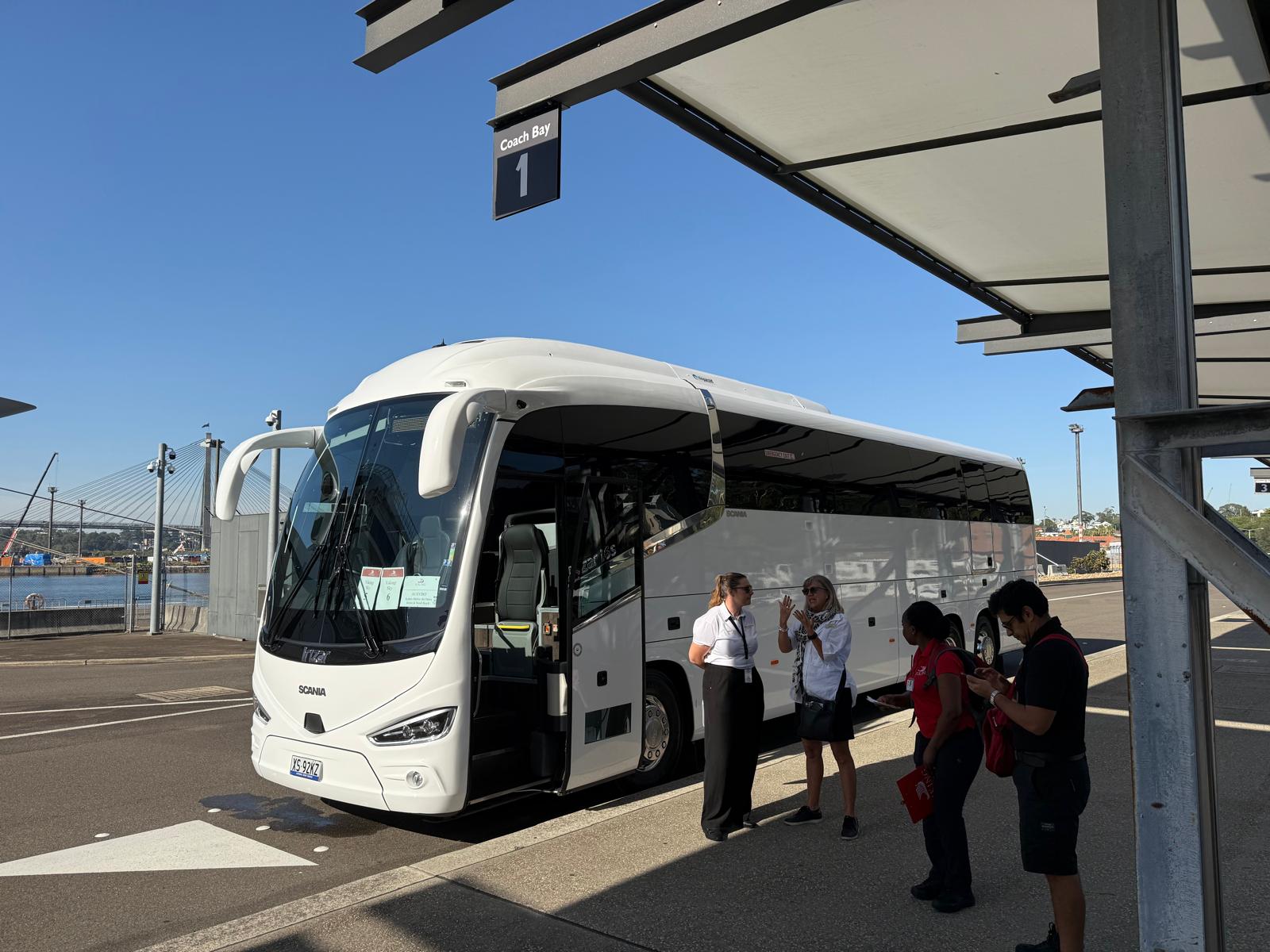
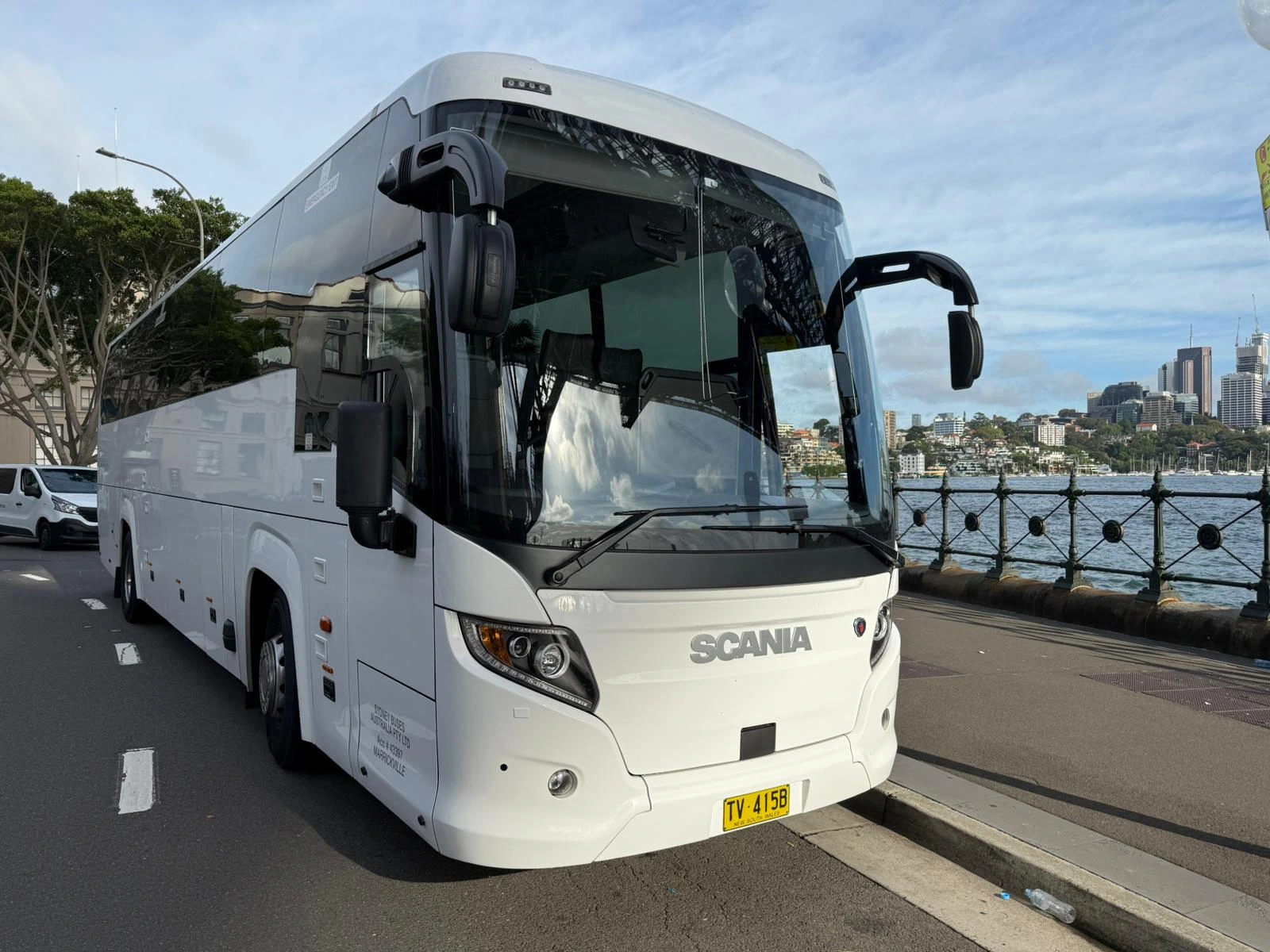
| Luxury touring coach | 50 to 57 | $195 | 4 hours |
| Coordinated convoy | 58 or more | Quoted per event | Not applicable |
Seat counts exclude the driver. The thing organisers get wrong here is not head count, it is luggage. A group of 25 with day bags fits a 27-seat midi-coach comfortably. The same 25 with check-in suitcases is constrained by the underfloor bay, not the seats, and may need the next vehicle up. Tell the operator what people are carrying, not just how many of them there are.
Two: how many hours are chargeable
Charter is priced by time, not by distance, and the clock runs from when the vehicle is due at your first pick-up to when it is released.
Minimum hire is three hours for minibuses and people movers, four hours for midi-coaches and full-size coaches. Below the floor you pay the floor. Above it you pay what you use.
Waiting counts. A coach parked at a venue for three hours of a booked day is being paid for, and it should be, because it cannot be anywhere else. This is the single biggest lever in the whole model, and it is also the one most often left out of a rival quote, which is why two prices for the same trip can look wildly different.
The six that adjust it
Three: where the vehicle comes from
Charter vehicles live at a depot, not at your address. Sydney Buses & Coaches operates from 74 Edinburgh Rd, Marrickville, so every job carries empty kilometres out to your first pick-up and back at the end.
Somebody pays for those kilometres. The two honest ways to handle it are a positioning charge on every job or a minimum hire period that absorbs it. This business uses the second, which is why no travel surcharge applies anywhere across the six Greater Sydney regions covered.
The practical consequence: a job starting and finishing near the depot and a job starting at Palm Beach and finishing at Camden are not the same job, even at identical passenger hours, because the second spends far longer positioning. That shows up in availability and in how the day has to be built, so name your pick-up address early.
Four: how much notice you give
Two to four weeks is normal notice for most Sydney charter work. Four to eight weeks is what peak periods need: December, race days, school excursion season and long weekends.
Inside those windows the constraint is availability, not appetite. When the right vehicle is already committed, the remaining options are a larger vehicle than you need, a smaller one running two trips, or a different day. All three cost more than the right vehicle booked in good time. Late bookings are rarely more expensive because of the date; they are more expensive because of the compromise.
Five: the date itself
Public holiday and after-hours loading is confirmed in advance and quoted separately from the hourly rate. Ask for it as its own line rather than folded into the total, so you can see what the date is costing you and decide whether the date is movable.
Sydney’s event calendar moves prices differently, and less obviously. An event does not usually change the rate. It changes the hours, because the same trip takes longer.
Check your date against the published 2027 calendar before you commit. Sydney Festival runs 7 to 25 January, the Mardi Gras Parade is Saturday 6 March with the parade from 7:30 to 9:30pm along Oxford Street, Flinders Street and Anzac Parade, the Sydney Royal Easter Show runs 19 to 30 March, Vivid Sydney runs 28 May to 19 June, and City2Surf closes 14 km from the CBD to Bondi on Sunday 8 August. Two of those are commonly misremembered: Mardi Gras is in March in 2027, and the Easter Show falls entirely within March, inside Term 1.
Six: the toll class your vehicle falls into
Sydney toll roads classify by dimension, not weight. Class A is 12.5 metres or less in length and 2.8 metres or less in height; Class B is anything exceeding either limit. A full-size coach is over 2.8 metres high, so it is Class B on every class-based Sydney toll road. A minibus is usually Class A.
The Class B multiple is not uniform. It is roughly three times Class A on NorthConnex, the Hills M2, the M5 South-West, Westlink M7 and the WestConnex roads; about two times on the Eastern Distributor and the Cross City Tunnel; roughly three and a half times on the Lane Cove Tunnel; and on the Sydney Harbour Bridge and Harbour Tunnel there is no heavy class at all, so a coach pays the same fixed toll as a car, priced by time of day.
One route rule catches people out. Between the M1 and the M2, buses over 12.5 metres long or over 2.8 metres high must use NorthConnex under a Transport for NSW regulation, with camera enforcement and no exemption process. On a Central Coast, Newcastle or Port Stephens run, the toll is not a routing decision.
Tolls and parking are confirmed in advance and quoted separately. No dollar figures appear here because Sydney tolls are indexed quarterly.
Seven: what happens at the destination
Access at the far end shapes the day more than most organisers expect.
A coach may lawfully stop in a Bus Zone to set down and pick up, but it may not wait or lay over there. So the question is where it goes in between. Sydney Olympic Park uses Coach Pod C off Edwin Flack Avenue with a dated Ebusticket booked by 11:59pm the night before. Allianz Stadium wants private coaches on Driver Avenue via Lang Road rather than Moore Park Road. Royal Randwick puts coaches over 3.1 metres on Darley Road; Rosehill Gardens puts coaches over 3.4 metres on Arthur Street. The Sydney Opera House cannot take buses onsite at all, and large buses disembark on Macquarie Street.
Where the venue has no nearby layover, the vehicle either waits somewhere further out or returns for a second run, and both cost hours.
Eight: whether anyone sleeps away
Multi-day work adds driver accommodation as a separately confirmed line, and it adds something less visible: legal rest.
Charter work in NSW sits inside the heavy vehicle fatigue regime. A driver cannot simply work later to rescue a schedule, which means a two-day itinerary has a shape imposed on it before anyone chooses a restaurant. Longer trips are therefore not just more hours at the same rate; they are a different planning exercise.
The Sydney factors hiding inside “hours”
Three local conditions quietly lengthen days.
Peak-direction traffic. Transport for NSW’s traffic volume reporting defines the weekday AM peak as 6:00 to 10:00am and the PM peak as 3:00 to 7:00pm for data purposes. There is no official definition of “Sydney peak hour” for advising road users when to travel, but the direction of flow is real: a 7:30am run into the CBD and a 7:30am run out of it are not the same job.
School zones. Most NSW school zones operate 8:00 to 9:30am and 2:30 to 4:00pm at 40 km/h, on all notified school days, and they do operate on school development days. Non-standard times exist and the sign always governs. A route threading several school zones at 8:15am is slower than the same route at 10:15am.
A worked example: the same job, two versions
A 27-seat executive midi-coach at $165 an hour, collecting a group in Parramatta and running to a CBD venue and back.
| Version | Chargeable hours | Total | Per head at 27 |
|---|---|---|---|
| Mid-morning start, ordinary weekday | 5 | $825 | $30.56 |
| 8am start in school zone hours, evening return through a CBD event period | 7 | $1,155 | $42.78 |
Same vehicle, same rate, same route, same passengers. The $330 difference is entirely time, and roughly half of it is avoidable by moving the start by ninety minutes.
That is the single most useful thing to take from this article: the hourly rate is published and fixed, so the number you can actually influence is the hours.
How to use the eight factors
- Fix the head count and what each person is carrying. That picks the vehicle.
- Draft the day honestly, including waiting. That sets the hours.
- Check the date against the event calendar and against school zone timing.
- Ask for public holiday or after-hours loading as its own line.
- Name the destination venue and ask who arranges coach parking.
- Ask which toll corridors the route uses and whether the vehicle is Class A or Class B.
- Book with two to four weeks’ notice, or four to eight in peak periods.
- Compare quotes on chargeable hours first and price second.
Frequently asked questions
Does distance or time matter more?
Time. Charter is priced by the hour, so a 40 km crawl through the inner west in peak and a 90 km run down the M1 at 10am can cost the same or the crawl can cost more. Distance only enters the price through the hours it consumes and through tolls.
What is dead running?
The empty kilometres a vehicle travels from its depot to your first pick-up, and back again after the final drop. It is real cost with no passengers aboard. Here it is absorbed inside the minimum hire period rather than billed as a positioning charge, which is why there is no travel surcharge inside Greater Sydney.
Will a public holiday date definitely cost more?
Public holiday and after-hours loading is one of the items quoted separately, so ask for it to be shown as its own line and you will see exactly what the date carries. If the date is movable, that line tells you whether moving it is worth it.
Why does my quote assume more hours than my itinerary says?
Usually because the itinerary has not counted the wait, the loading time at each stop, or the return leg. An operator pricing the vehicle across the real window is quoting the job you will actually run.
Next step
If you want to see which of the eight factors is doing the work on your trip, send the shape of the day rather than just the head count. Pick-up suburb, date, group size and rough finish time is enough to start, and a fixed written quote naming the vehicle comes back within two business hours. Compare it against the rate card these figures come from, or start with charter bus hire across Sydney. Call 02 9469 6600, Monday to Friday 7am to 6pm or Saturday 8am to 2pm.
Sources
- Transport for NSW, School zones, https://www.transport.nsw.gov.au/roadsafety/community/schools/school-zones. Accessed 7 September 2026.
- Linkt, Vehicle classes on Sydney toll roads, https://www.linkt.com.au/help/travelling-toll-roads/vehicle-class/sydney. Accessed 7 September 2026.
- NHVR, Heavy vehicle fatigue management, bus industry, https://www.nhvr.gov.au/safety-accreditation-compliance/fatigue-management/heavy-vehicle-fatigue-management-bus-industry. Accessed 7 September 2026.