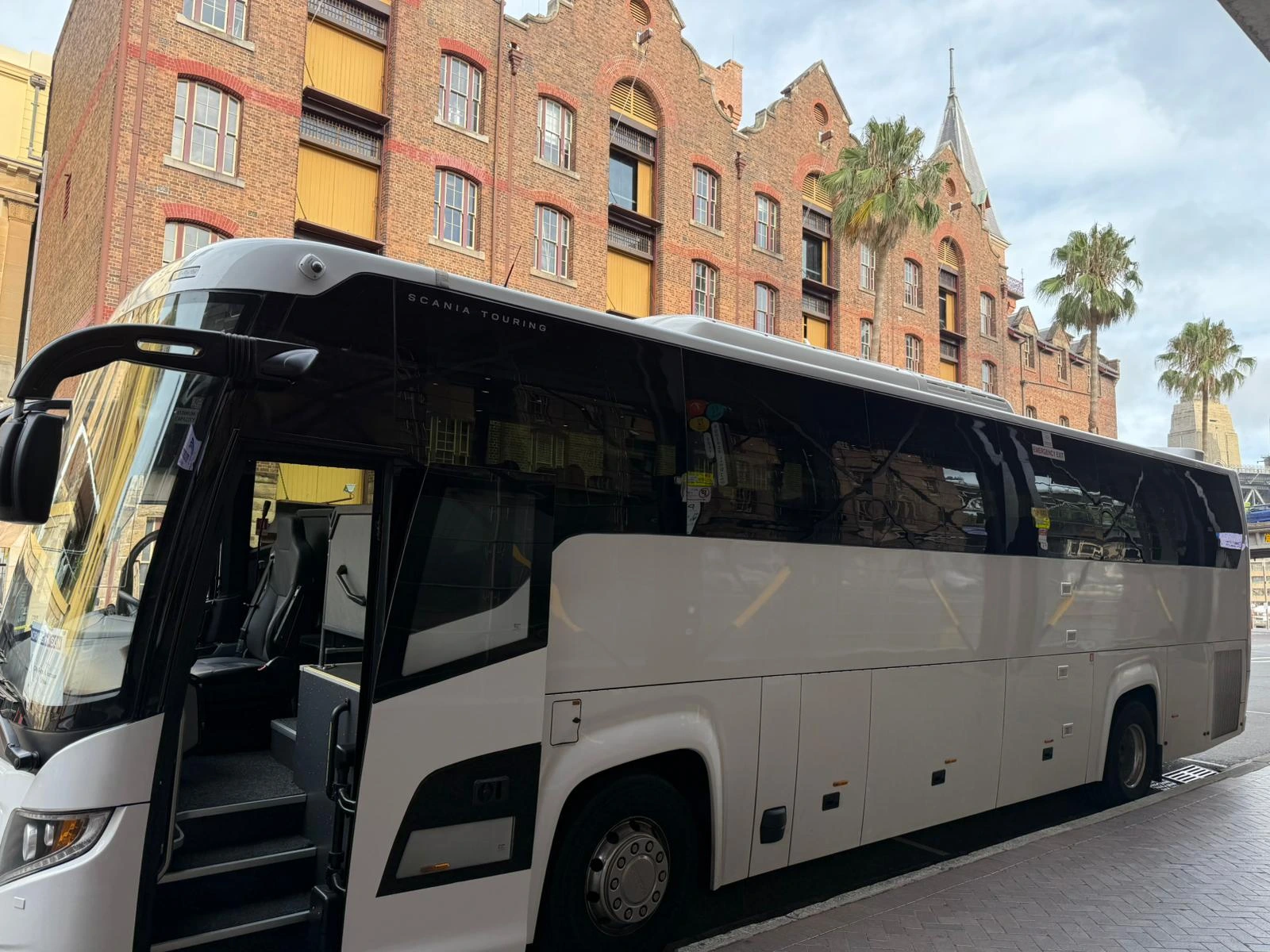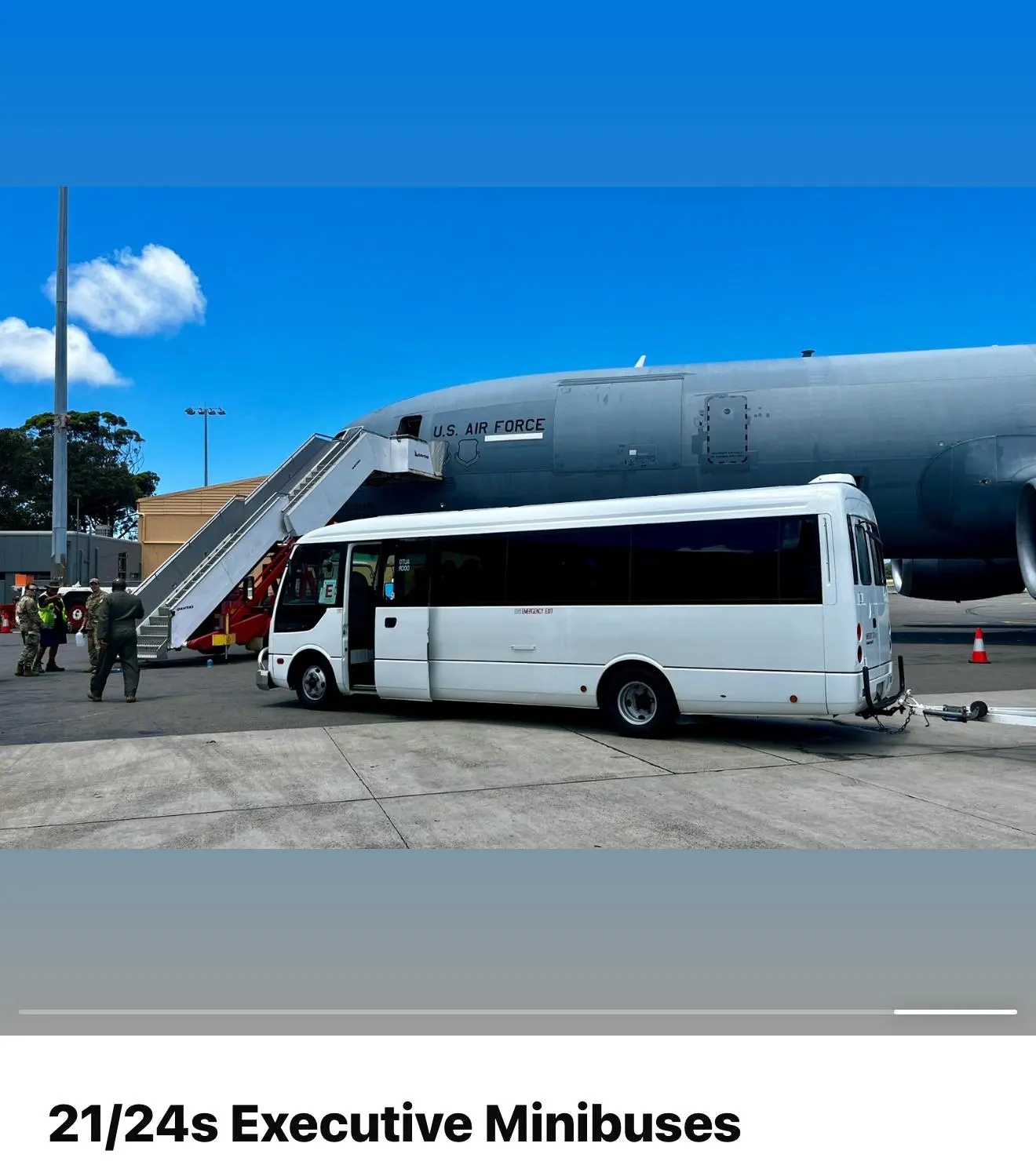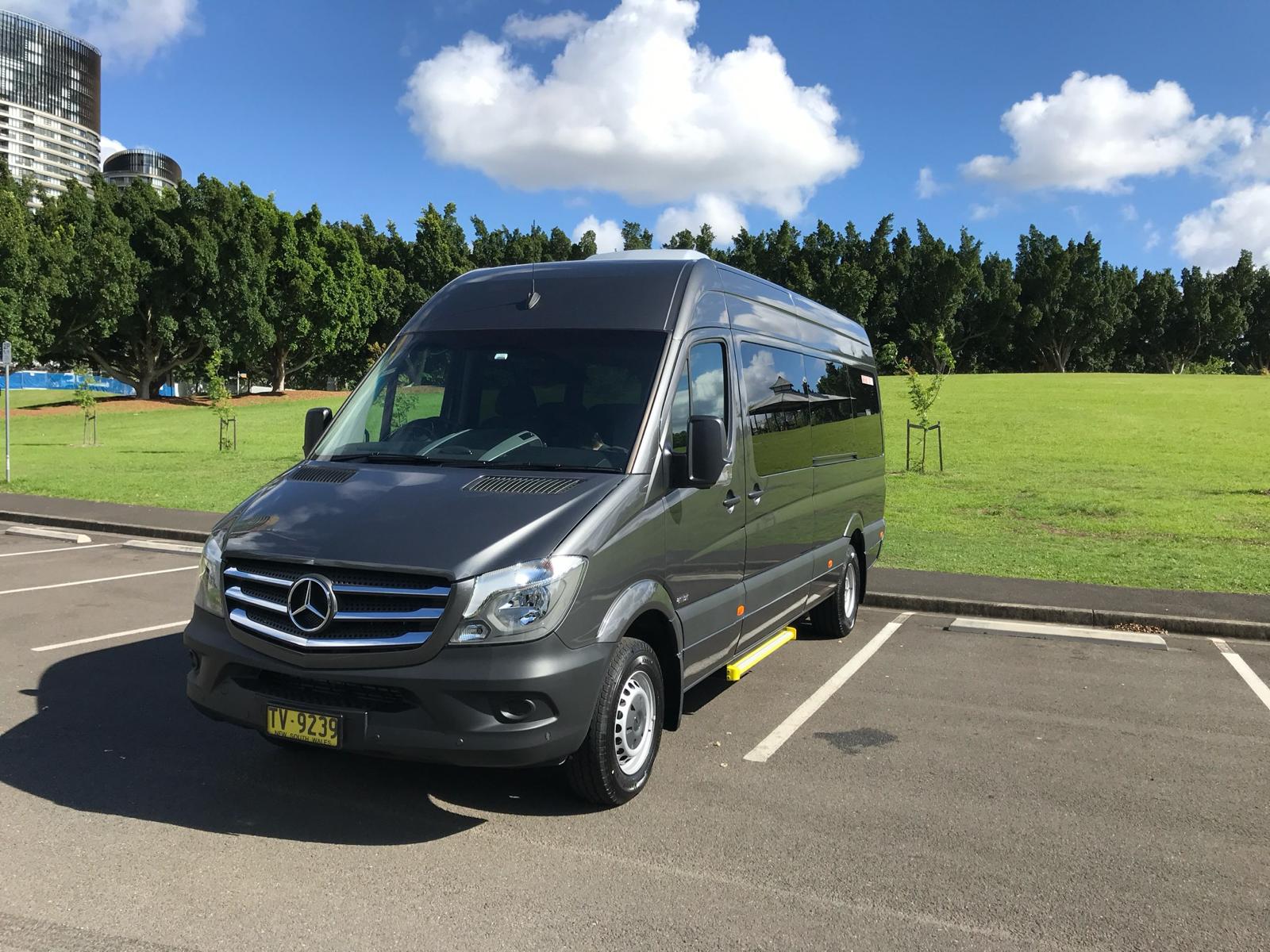
A coach can reach far fewer Sydney sporting grounds than a club expects. The constraints are street width, turning room, overhead clearance, gate width and somewhere lawful to stop, not distance. Where the ground itself will not take a full-size coach, the workable answers are a smaller vehicle, a set-down on a nearby main road, or loading at the home club and travelling in. Confirm the loading point with whoever controls the ground before the season, not on the morning.
What actually stops a coach reaching a suburban ground
Sydney sporting grounds sit where they sit for historical reasons. Many are wrapped in residential streets that were laid out before anyone imagined a 53-seat coach turning into them, with cars parked on both sides from 7am on a Saturday.
Five things decide it, and none of them is distance.
Street width with cars parked. A street that looks wide on a map is a single lane once residents have parked both sides. A coach needs a clear running lane plus room to open the door to the kerb.
Turning room. The killer is usually not the approach, it is the exit. A coach that gets in and then has to reverse out of a cul de sac has a real problem, and reversing a large vehicle around parked cars and children is exactly the situation a professional driver will refuse.
Overhead clearance. Street trees, awnings, low power lines and car park entries. A full-size coach exceeds 2.8 m in height, which is why it falls into the heavy class on Sydney toll roads, and a car park designed for cars will not take it.
The gate. School ovals and council grounds are frequently gated, and the gate is often narrower than the driveway. It may also be locked, and the person with the key may not be rostered on a Saturday.
A lawful place to stop. This is the one clubs forget. Even where a coach physically fits, it needs somewhere it is allowed to stand while 30 people and their gear get on.
The four things to measure before you book
Do this once, in the pre-season, for every away ground on your draw that you have not used before.
- The approach and the exit. Can a long vehicle drive in and drive out without reversing? If the answer is no, the ground is a set-down elsewhere.
- The kerb. Is there a continuous stretch of kerb long enough for a coach, without a driveway, a tree or a parked car in the middle of it?
- Overhead. Anything crossing the loading position lower than a coach roof.
- The gate and the surface. Width, whether it will be unlocked, and whether the surface beyond it is sealed. Grass and soft ground are a no for a heavy vehicle.
If you cannot answer all four, do not guess. Send the address to the operator at the quote stage and ask whether the allocated vehicle can work with it. That question is far cheaper to ask in February than to answer at 7.15am in June.
Who to ask, and what to ask them
The controlling authority differs by ground type, and asking the wrong body is why clubs get no answer.
| Ground type | Who controls access | What to ask |
|---|---|---|
| Council sportsground | The local council’s parks or venue bookings team | Whether a bus or coach may enter, where set-down is permitted, and whether the access gate will be unlocked |
| School oval | The school office, and the site manager or general assistant | Gate width, gate access on a weekend, and who unlocks it |
| Private or club-owned ground | The club committee or ground manager | Whether the internal driveway takes a heavy vehicle and whether there is a turning area |
| Regional or association venue | The association running the fixture | Whether the venue publishes a bus set-down point for the competition |
Ask for the answer in an email rather than over the phone. A written answer is what you hand to the next team manager when you hand over the role.
The three loading patterns, and how to choose
Almost every awkward pick-up resolves into one of three shapes.
Load at the ground. The best outcome, and the least common at small suburban venues. Use it where the ground has a sealed internal driveway with a turning area, or a long clear kerb directly outside.
Set down on a nearby main road and walk in. The standard fallback. Pick a main road with a continuous kerb, a footpath and a safe crossing, and publish the exact street address plus a landmark. Walking 300 metres with kit bags is fine. Walking 300 metres nobody was told about is not.
Load at the home club and travel in. Often the best answer for a junior team, because it puts the assembly problem somewhere you control. Parents drop at the home ground, the team loads once, and the away ground only has to handle a set-down.
Where the ground genuinely cannot take a large vehicle, the fourth option is to change the vehicle rather than the plan. A minibus instead of a full-size coach will reach places a coach cannot, and for a squad of 21 to 24 the executive minibus is often the better tool anyway. For larger groups, two smaller vehicles can beat one coach that has nowhere to stop.
Bus zones, gates and the on-street option
There is one legal point worth knowing because it decides what is possible on street.
Under NSW Road Rules 2014 rule 183, a driver must not stop in a bus zone unless driving a public bus that is dropping off or picking up passengers. A charter coach counts as a public bus for that rule, because the NSW Dictionary provides that a public bus means a coach. So a coach may lawfully stop in a bus zone to load or unload your team.
What it may not do is wait there. The permission covers the movement, not the pause. It also does not apply where the sign on the zone itself excludes the vehicle, so read the sign.
For a club, the practical consequence is simple. A bus zone near a ground is a usable loading point and is not a usable waiting point. If your team needs the vehicle to stay for two hours, that is a separate conversation about where it goes in the meantime, and it belongs in the quote rather than on the day.
Assemble time is not departure time
The most common day-of failure has nothing to do with the vehicle. It is that the team was told one time and the bus was told another.
Publish two times and label them clearly. The assemble time is when players are at the loading point with their gear. The departure time is when the doors close. Make the gap real, put the assemble time on every communication, and put only the departure time on the booking.
Then add three things that cost nothing:
- One named person on the phone. The driver’s name, mobile and vehicle registration arrive 24 hours before travel. Forward them to the team group and nominate one person who answers the phone.
- A landmark, not just an address. Street numbers are hard to see from a coach window. Name the gate, the corner or the shop.
- A head count before the doors close, and another before the return leg. Written down, not remembered.
Gear changes the answer
Seat count is not the constraint once equipment is involved. A squad of 25 with day bags fits comfortably on a 27-seat midi-coach. The same 25 with cricket bags, a keeper’s kit, a first aid box and a water urn are limited by the underfloor bay, not the seats.
Tell the operator what is travelling beyond kit bags at the quote stage. Long, rigid or awkward items are the ones that change the vehicle recommendation, and finding out at the kerb is the wrong time.
Confirm it once, use it all season
The whole point of doing this work is that you only do it once. A confirmed loading point, in writing, with a landmark and an assemble time, is an asset the club keeps. It survives a change of team manager, it goes straight into next year’s fixtures, and it removes the single most common Saturday morning phone call.
Build it into the pre-season alongside the rest of the draw. Getting the loading point right is half of what makes team transport for Sydney clubs run quietly for a whole season instead of being renegotiated every week.
Frequently asked questions
Can the coach come into the ground itself?
Sometimes, and it depends on the internal driveway, the gate width, the surface and whether there is room to turn without reversing. Ask the council, school or ground manager in writing, and send the address to the operator at the quote stage.
Can the bus wait in the bus zone outside the ground?
No. A coach may stop in a bus zone to set down or pick up passengers, but it may not wait there. If the vehicle needs to stay near the ground, ask the operator where it will actually go and how that is priced.
What if the ground is on a narrow residential street?
Set down on the nearest main road with a continuous kerb and a footpath, and publish that address plus a landmark. Alternatively, load at your home ground and travel in as one group.
How much earlier than departure should the team assemble?
Set a real gap and publish it as an assemble time, separate from the departure time. Ask the operator what buffer they recommend for your group size and gear, because a team with bulky equipment loads considerably more slowly than a team with day bags.
Is a smaller vehicle a downgrade?
Not if the ground cannot take a coach. A 21 to 24 seat executive minibus reaches places a 53-seat coach cannot, and for many junior squads it is the right size regardless.
Next step
Send the pick-up address, the away ground address and the travelling party size, and ask for the loading point to be confirmed with the quote. A fixed written quote comes back within two business hours with the vehicle named, and the driver name, mobile and vehicle registration follow 24 hours before travel.
Call 02 9469 6600, Monday to Friday 7am to 6pm or Saturday 8am to 2pm.
Sources
- NSW Government, Road Rules 2014 (NSW), rule 183 and Dictionary, https://legislation.nsw.gov.au/view/html/inforce/current/sl-2014-0758. Accessed 7 September 2026.
- Linkt, Vehicle classes on Sydney toll roads, https://www.linkt.com.au/help/travelling-toll-roads/vehicle-class/sydney. Accessed 7 September 2026.