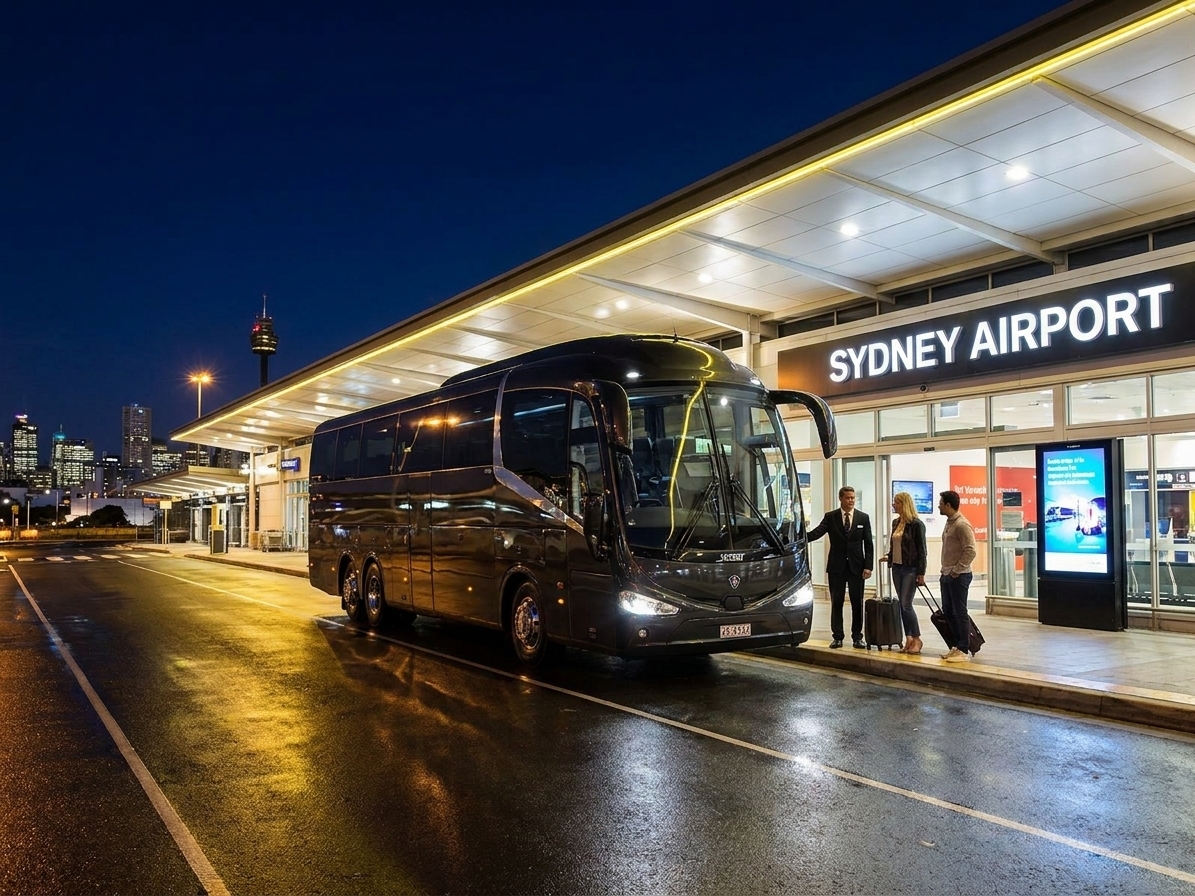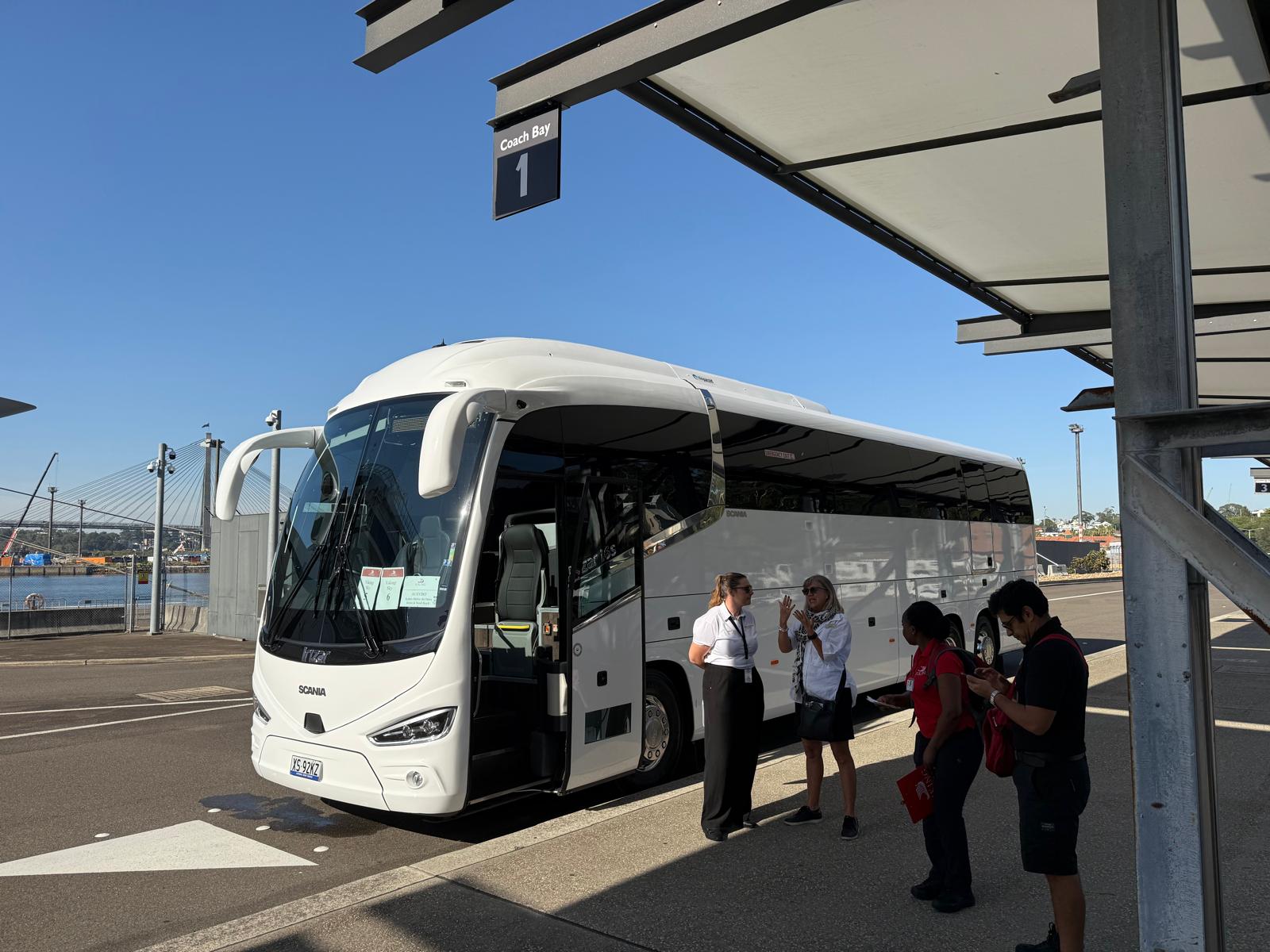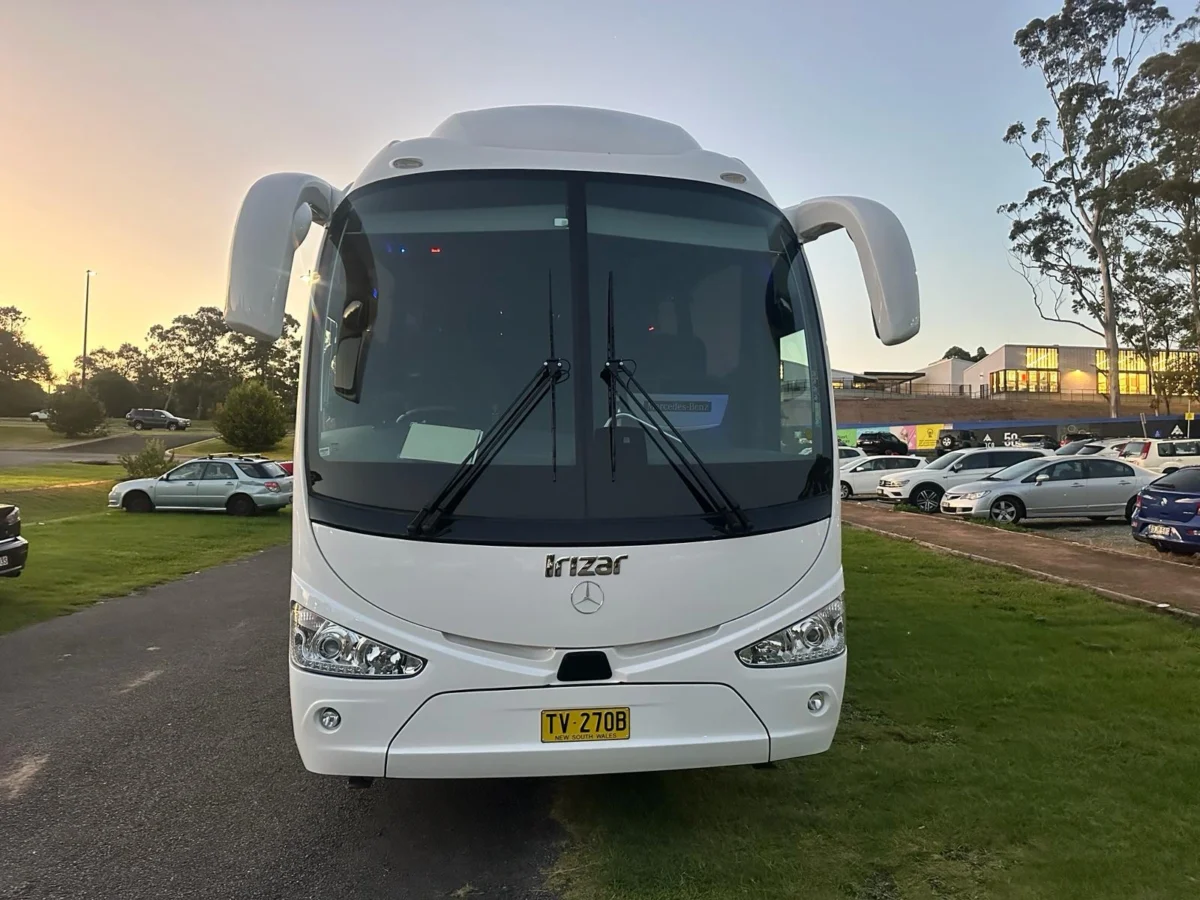
An airport charter is sized by the luggage bay, not the seat count. A 27-seat executive midi-coach suits a group of about twenty-five with day bags. Give every one of those passengers a large checked case plus a cabin bag, as an international group will have, and the underfloor bay becomes the constraint rather than the seating. Build a bag manifest before you request a quote, name the numbers in the request, and make the operator size the vehicle against the bags.
The seat count is the wrong number
Every other kind of charter is sized by headcount. Airport work is the exception, and it catches out experienced organisers because the mistake only shows up on the day.
A conference shuttle carries forty people with a laptop bag each. An airport arrival carries the same forty people with forty checked cases and forty cabin bags. Same seats, entirely different vehicle problem. The seats are still fine. The bay is not.
The failure mode is specific and expensive. The group loads, the bay fills, and somewhere around passenger thirty the driver runs out of space. At that point the options are all bad: cases in the aisle, which is not acceptable on a moving vehicle, a second vehicle at short notice, which may not exist on a Tuesday morning, or a group standing in a ground transport zone while somebody makes calls.
None of that is a driver problem. It is a quoting problem, and it is fixed at the quote stage by counting bags.
Why nobody publishes a reliable bag number
Search for luggage capacity by coach size and you will find confident numbers. Treat them carefully.
Bay capacity varies by vehicle build even within the same seat count, because the bay is shaped by the chassis, the axle positions and the body. It also varies by what is being loaded. Cases are not uniform: a group of hard-shell four-wheel spinners packs very differently from a group of soft duffels, and the same volume produces different counts. Then there is the practical loss: a bay that is loaded in a hurry at an airport zone never packs as tightly as one loaded on a depot forecourt.
So the honest position is that a bag count belongs to a specific vehicle, confirmed by the operator, for a specific bag profile. Ask about the vehicle being assigned to your job, not about a vehicle class. If an operator will not commit to that in writing, the number they have given you is a guess.
We are working with our operations team on measured bay figures for each vehicle we run. Until those are published here, ask us directly and we will answer for the actual vehicle.
Build the bag manifest first
This takes ten minutes and prevents the single most expensive airport charter failure. Fill it in before you send the quote request.
| Field | What to record | Why it changes the vehicle |
|---|---|---|
| Passengers travelling | Exact headcount, not “about 40” | Sets the seating floor |
| Large checked cases | Total count across the group | The primary bay constraint |
| Cabin bags | Total count, and whether they will be held on lap or stowed | Interior stowage and aisle safety |
| Oversize items | Golf bags, skis, instruments, prams, display crates, event freight | Each one displaces multiple cases |
| Mobility equipment | Wheelchairs, walkers, scooters, and whether folding | Changes the vehicle, not just the load |
| Group profile | International arrival, domestic arrival, conference, sporting team | International arrivals carry the heaviest profile |
| Split across flights | Whether the group arrives together | Affects loading sequence and hold times |
| Return leg | Whether the group returns with more than it arrived with | Shopping and conference material are real |
The last row is not a joke. A departing group is routinely carrying more than the arriving group did, and a return transfer quoted on the arrival manifest can be under-specified.
The kerb gives you one movement, not two
Sydney Airport’s rules make bag discipline a logistics requirement rather than a nicety.
Drop-off at the Departures level is a kerbside set-down, capped at one minute, with the driver remaining at the vehicle. That is your entire unloading window on a departure run. If bags are scattered through the vehicle, the unload becomes a search, and the search happens in a live traffic lane.
Collection at arrivals is zone-only, in a shared working area, so loading needs to be a single continuous movement rather than a stop-start. And on the T2 and T3 side, the Priority Pick-up zone carries a 2.9 metre height restriction that excludes a full-size coach, so the vehicle that can carry the bags is not always the vehicle that can use the most convenient zone.
Three habits make the difference:
- Load by drop-off point, not by passenger. If the coach is serving two hotels, the second hotel’s bags go in first.
- Tag everything before the airport. Coloured tags by sub-group turn a departure unload into thirty seconds.
- Keep cabin bags off the seats and out of the aisle. An aisle full of bags is a safety problem before it is a comfort problem.
When to go up a vehicle, and when to add one
The escalation sequence for a bag-heavy group, in order of what to try first.
Go up one vehicle size. The cheapest fix. A group of twenty-five with heavy luggage may be better on a 48-seat coach than a 27-seat midi-coach, and the price difference between the two is smaller than most organisers expect.
Split the group across two vehicles. Worth it when the headcount is near a vehicle boundary anyway, or when the group is arriving on two flights. Two vehicles also give you two loading points, which is faster at the airport end.
Ask about a separate luggage vehicle or trailer. Some jobs, particularly sporting teams and touring parties with equipment, are better served by separating people from freight. Ask the operator whether that is available for your booking rather than assuming it is.
Move to a coordinated convoy. Above fifty-eight passengers we quote a convoy per event rather than per vehicle, and the bag plan is built into it.
Our published rates, GST inclusive and including the driver, fuel and vehicle insurance:
| Vehicle | Seats | Hourly rate | Minimum hire |
|---|---|---|---|
| Toyota Commuter | 13 | $110 | 3 hours |
| Mercedes Sprinter | 11 to 14 | $145 | 3 hours |
| Executive minibus | 21 to 24 | $145 | 3 hours |
| Executive midi-coach | 27 | $165 | 4 hours |
| Luxury coach | 48 | $185 | 4 hours |
| Executive coach | 53 | $195 | 4 hours |
| Luxury touring coach | 50 to 57 | $195 | 4 hours |
| Coordinated convoy | 58+ | Quoted per event | n/a |
Seat counts exclude the driver. An airport run can be quoted as a single fixed transfer fare instead of hourly, and a fare quoted that way is not charged against a minimum hire block. Our published fleet and rates carry the current figures, and full-size coach hire covers the larger vehicles that most bag-heavy groups end up on.
What gets left behind, and who decides
If a vehicle genuinely cannot take the load, someone has to make a decision in a ground transport zone with a group watching. Decide the rule before the day rather than during it.
- Nominate one person with authority to make the call. Not a committee.
- Agree in advance what travels separately if something must: usually event freight or non-essential equipment, never a passenger’s medication, documents or mobility equipment.
- Have a fallback contact for the operator’s office: 02 9469 6600 during office hours, Monday to Friday 7am to 6pm and Saturday 8am to 2pm, and the driver’s mobile number, which we send twenty-four hours before travel.
The better outcome is that this never comes up, which is what the manifest is for.
The line to put in your quote request
Add this to the enquiry and the sizing problem largely solves itself:
> [Headcount] passengers with approximately [number] large checked cases, [number] cabin bags and [describe oversize items]. Please size the vehicle against the luggage rather than the seat count, name the vehicle in the quote, and confirm the load will fit that specific vehicle.
An operator that answers that question directly is an operator whose vehicle will fit. Airport transfers for groups in Sydney is where those jobs are quoted.
Frequently asked questions
How much luggage fits under a coach?
It depends on the specific vehicle and the shape of the bags, which is why a reliable answer comes from the operator for the vehicle being assigned rather than from a general figure. Ask the question about your actual booking and ask for the answer in writing.
Will everyone’s luggage fit if we book by seat count?
Not reliably. Seat count sets the seating floor, not the bay capacity. For an international group with one large case plus a cabin bag per person, the bay is usually the binding constraint and the vehicle should be sized against it.
What about international groups with two checked cases each?
Count them in the manifest and expect to go up a vehicle size or add a second vehicle. Two checked cases per person is a materially different load from one, and it is the profile most likely to break a plan made on headcount alone.
Can bags go in the aisle if the bay is full?
No. The aisle needs to stay clear on a moving vehicle. If the bay is full, the answer is a larger vehicle, a second vehicle, or a separate luggage arrangement, decided at quote stage rather than at the kerb.
Do sporting or music groups need a different arrangement?
Often, yes. Golf bags, instruments and equipment cases each displace several suitcases. List them individually in the manifest and ask whether a separate luggage vehicle is available for your booking.
How much unloading time do we get at Departures?
Very little. Kerbside drop-off at the Departures level is a brief set-down with the driver remaining at the vehicle, so bags need to be organised on board before arrival rather than sorted on the footpath.
Next step
Send the headcount, the checked-case count, the cabin-bag count and anything oversize, and we will quote the vehicle that actually fits the load, naming it in the written quote. Quotes come back within two business hours during office hours.
If the bag profile is unusual, whether that is a touring band, a golf group or a conference with display freight, call 02 9469 6600 before booking. It is a short conversation that avoids the most common day-of failure in airport work.
Sources
- Sydney Airport, “Drop-off”, https://www.sydneyairport.com.au/dropoff. Accessed 7 September 2026.
- Sydney Airport, “Resources for registered limousines, buses and coaches”, https://www.sydneyairport.com.au/corporate/partner-with-us/commercial-vehicles/resources-for-registered-limousines-buses-and-coaches. Accessed 7 September 2026.