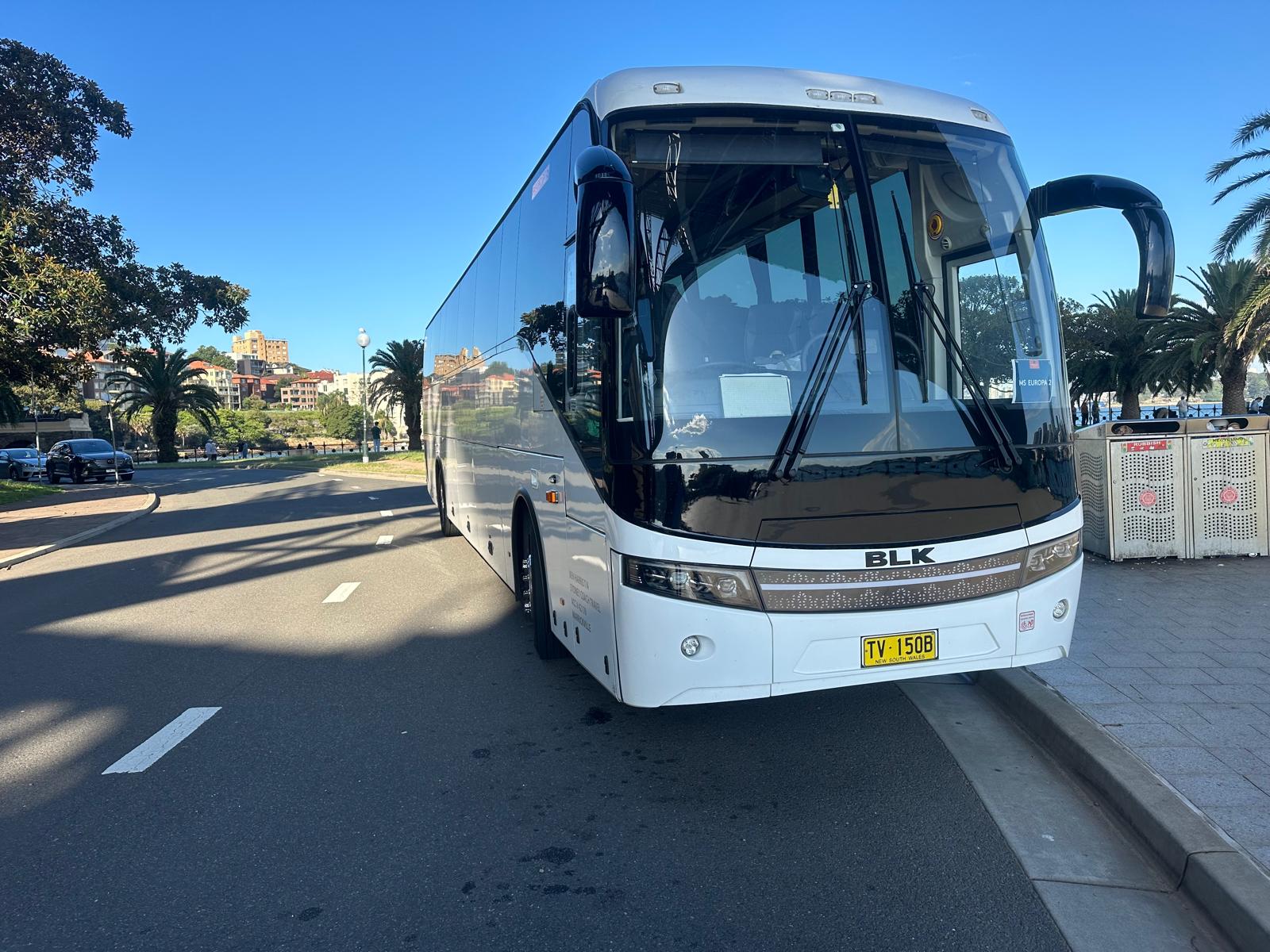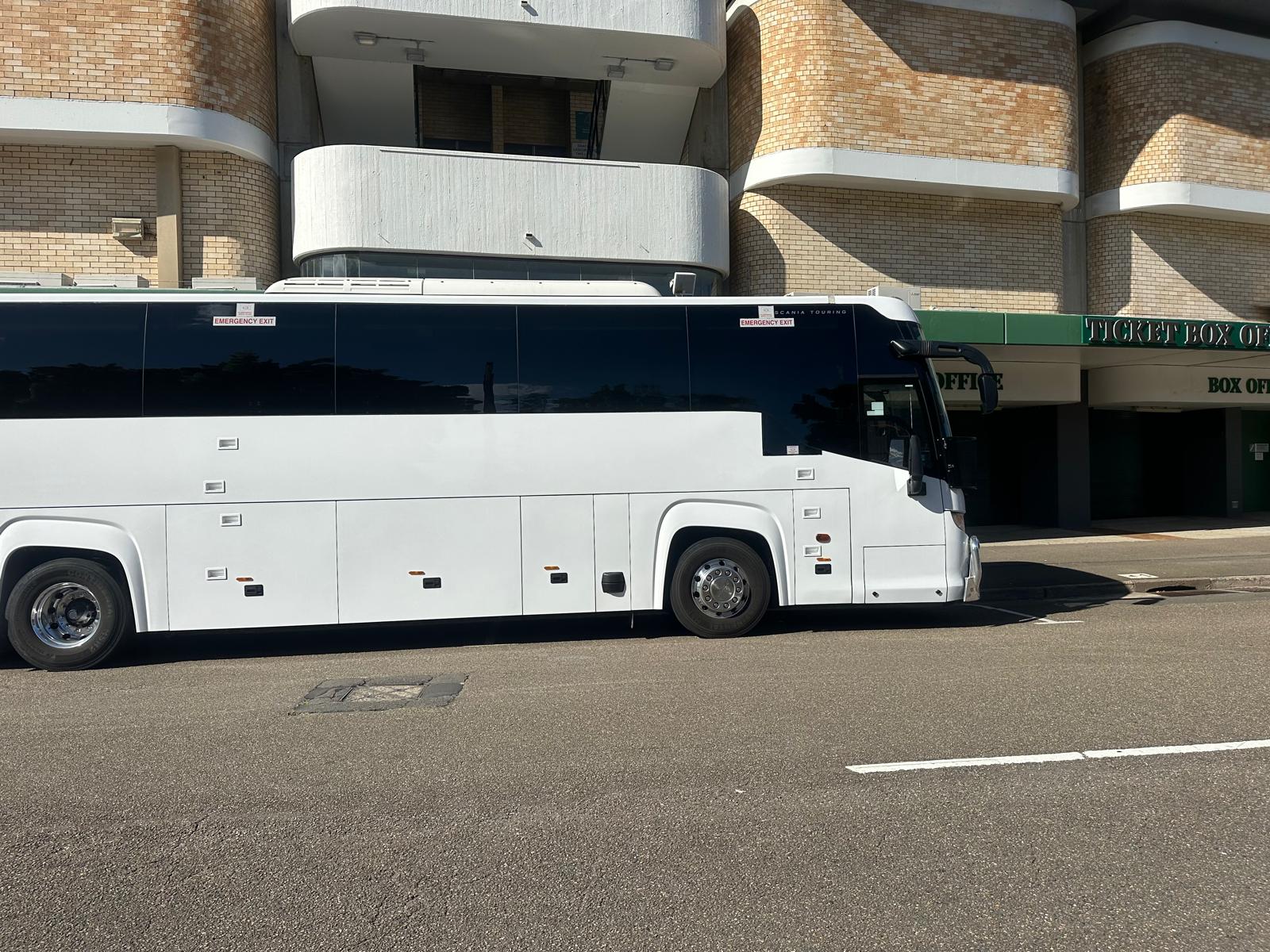
The Northern Beaches question is almost never whether a coach can reach the suburb. It is whether it can turn, clear the overheads, stop legally and load at your exact address. Four constraint categories decide that, and all four are address-specific rather than suburb-specific. So the useful thing to send an operator is the pick-up address and the group size, not the suburb name, and the answer that comes back is the largest vehicle that genuinely fits.
The four things that actually decide the vehicle
A coach is not blocked by a postcode. It is blocked by one of four things, and each has a definite answer that someone can check before the day.
| Constraint | What it means in practice | How it gets confirmed |
|---|---|---|
| Street geometry | Whether the vehicle can enter, stop alongside a safe kerb and leave without reversing. A dead-end street with no turning head means the vehicle has to reverse out, which is a decision for the operator on that specific street. | Exact address checked by operations against satellite and street imagery, and by a driver on a site visit for repeat work. |
| Overhead clearance | Trees, awnings, powerlines, and any height barrier at the entrance to a car park or venue driveway. A full-size coach is over 2.8 metres and the real figure depends on the vehicle, including anything roof-mounted. | Ask the venue or the property what the barrier is set at. The number is knowable. Guessing it at 7am on the day is not a plan. |
| Lawful stopping | Whether there is a legal place to stand still long enough to load, which is a road rules question rather than a physical one. | Operations confirms against the road rules and any signage on the specific kerb. |
| The approach corridor | Which crossings and roads the vehicle uses to get there, what they cost a coach and how long they take at your time of day. | Route confirmed at quote stage once the address and the start time are known. |
Two of those constraints, geometry and clearance, are usually solved by sending a smaller vehicle rather than by finding a different address. That is why the answer to a hard Northern Beaches pick-up is generally a change of vehicle, not a refusal. You can see the whole ladder on the published fleet and hourly rates, and our Northern Beaches service area covers the region without a travel surcharge, because there is no travel surcharge anywhere inside Greater Sydney.
Why the suburb is the wrong unit of information
Two addresses in the same Northern Beaches suburb can produce two different vehicles. One sits on a main road with a straight kerb and a clear run in and out. The other is up a narrow residential street with parked cars on both sides and no turning head. The suburb is identical. The largest workable vehicle is not.
This is why an enquiry that says “bus hire for Manly, 40 people” cannot be answered properly and an enquiry that gives the street address, the date, the start time and the head count can be. Sending the address is not a formality. It is the whole answer.
Where the address genuinely will not take the vehicle the group size needs, the standard fix is a nominated meeting point on a main road within walking distance, agreed in advance and written into the booking so the driver and the organiser are working from the same spot.
Getting there: what the crossings cost a coach
Sydney toll roads class vehicles by dimension, not weight. Class A is 12.5 metres or less in length and 2.8 metres or less in height. Class B is anything above either limit, which means a full-size coach is Class B and a minibus normally is not.
The Northern Beaches approaches are a good illustration of how uneven that is:
- The Sydney Harbour Bridge and the Sydney Harbour Tunnel have no heavy vehicle class at all. A 53-seat coach pays the same fixed toll as a car, varied only by time of day.
- The Military Road E-Ramp and the Lane Cove Tunnel charge Class B at roughly 3.4 to 3.5 times the Class A rate, among the steepest multiples on the network.
So the same coach can pay car rates on one part of a Northern Beaches run and more than triple on another. That is worth understanding before you compare two quotes that took different routes to the same address. Tunnel clearance is a separate question again: both the Sydney Harbour Tunnel and the Lane Cove Tunnel are published at 4.4 metres, and any operator putting a vehicle through measures that vehicle rather than working from a class average.
No dollar figures appear here because Sydney tolls are indexed quarterly and any amount published today is stale within months.
Timing on the peninsula
Three timing rules matter on a Northern Beaches job, and all three are checkable rather than guessable.
School zones. The limit is 40 km/h and most zones operate 8:00 to 9:30am and 2:30 to 4:00pm on notified school days. Transport for NSW says most, not all, so non-standard times exist and the sign always governs. Zones operate on school development days as well, which catches people out at the edges of term.
Manly. A 30 km/h limit applies in the Manly High Pedestrian Activity Area, which is lower than the standard school zone limit and applies to the area rather than to a school timetable. If your pick-up or set-down is in that area, build the timing around it.
Peak. There is no official Transport for NSW definition of Sydney peak hour for advising road users when to travel. Transport for NSW’s traffic-volume reporting uses 6:00 to 10:00am and 3:00 to 7:00pm for weekday data, which is a reasonable planning proxy but is not a published travel recommendation. Treat any single journey time you are quoted for a Northern Beaches run as conditional on the departure time, and ask for the assumption rather than just the number.
Where a coach may legally stop
Under the NSW Road Rules a charter coach counts as a public bus, so it may lawfully stop in a bus zone to set down or pick up passengers, unless the sign on that particular zone says otherwise. Two limits sit on that permission and both are firm. It is set-down and pick-up only, with no waiting and no layover, and a sign can exclude a public bus from a specific zone.
That distinction shapes the plan for a long function. The coach drops the group, leaves, and returns at an agreed time. Where the vehicle goes in between is a question worth settling at quote stage rather than leaving to the driver on the night.
A pre-booking access checklist
Work through this before you send the enquiry and the quote comes back accurate the first time.
- Exact pick-up address, not the suburb. Same for the destination.
- Date, start time and expected finish time.
- Confirmed head count, plus whether numbers may still move.
- Whether anyone in the group needs a wheelchair position or a hoist, which is available but needs to be specified.
- Whether the group is carrying luggage, sports gear or equipment, and roughly how much.
- Whether the pick-up is a private residence, a venue with a driveway, or a car park with a height barrier at the entrance.
- Whether there is a fallback meeting point on a main road if the address cannot take the vehicle.
- Who the day-of contact is, with a mobile number.
Frequently asked questions
Can a full-size coach get into the Northern Beaches?
Yes, on the main roads and at venues built to take one. Whether it can reach a specific residential address is a different question, decided by street geometry, overhead clearance and whether there is a lawful place to stop. That is checked against the address before the quote is issued, not on the day.
What happens if my street will not take the vehicle we need?
The usual answer is a smaller vehicle, or a nominated meeting point on a main road within walking distance. For larger groups it can also mean two smaller vehicles instead of one coach. All three are decided at quote stage, written into the booking and confirmed with the driver.
Is there a surcharge for travelling out to the Northern Beaches?
No. There is no travel surcharge anywhere inside Greater Sydney, and the Northern Beaches is one of the six Greater Sydney regions covered. Tolls and parking are confirmed in advance and quoted separately from the hourly rate.
Does a coach pay more to cross the Harbour?
Not on the Harbour Bridge or the Harbour Tunnel. Neither has a heavy vehicle class, so every vehicle pays the same fixed toll, priced by time of day. The Military Road E-Ramp and the Lane Cove Tunnel are different: both charge Class B at roughly 3.4 to 3.5 times the Class A rate.
How far ahead should a Northern Beaches booking be made?
Two to four weeks covers most jobs. Allow four to eight weeks for December, race days, school excursion season and long weekends. A written quote naming the vehicle comes back within two business hours of the enquiry, and driver name, mobile and vehicle registration are sent 24 hours before travel.
Next step
Send the pick-up address rather than the suburb, with the date, the start time and the head count, and we will confirm the largest vehicle that fits and a legal place for it to stop at both ends. Call 02 9469 6600, Monday to Friday 7am to 6pm or Saturday 8am to 2pm, or send the trip and a fixed written quote comes back within two business hours. If the address is tight, minibus hire in Sydney is often the answer rather than a compromise.
Sources
- NSW Legislation, Road Rules 2014 (rule 183 and Dictionary), https://legislation.nsw.gov.au/view/html/inforce/current/sl-2014-0758. Accessed 7 September 2026.
- Transport for NSW, School zones, https://www.transport.nsw.gov.au/roadsafety/community/schools/school-zones. Accessed 7 September 2026.
- Linkt, Vehicle classes on Sydney toll roads, https://www.linkt.com.au/help/travelling-toll-roads/vehicle-class/sydney. Accessed 7 September 2026.
- Transport for NSW, Using Sydney’s tunnels, https://www.transport.nsw.gov.au/operations/nsw-roads-network/using-sydneys-tunnels. Accessed 7 September 2026.