The train wins on price for small groups and it is not close. For one or two people heading to the Blue Mountains, a charter coach makes no sense at all. The coach starts winning somewhere above 20 people, and it wins on grounds other than price much earlier than that: multiple stops, door to door from a suburb, a fixed return time, and everyone arriving together. Work out your coach per head first, then compare it against a fare you can actually see.
Start with the coach per head, because that is the number that moves
A charter is a fixed vehicle price divided by however many people are aboard. A rail fare is a per-person price that does not care how many of you there are. That is the entire structural difference, and it is why the answer flips at a certain group size rather than being true or false in general.
Here is a full Blue Mountains day, ten chargeable hours from first pick-up to final drop-off, on the published rate card.
| Group | Vehicle | 10 chargeable hours | Coach cost per head |
|---|---|---|---|
| 8 | Toyota Commuter, 13 seats at $110 | $1,100 | $137.50 |
| 13 | Toyota Commuter, 13 seats at $110 | $1,100 | $84.62 |
| 24 | Executive minibus at $145 | $1,450 | $60.42 |
| 27 | Executive midi-coach at $165 | $1,650 | $61.11 |
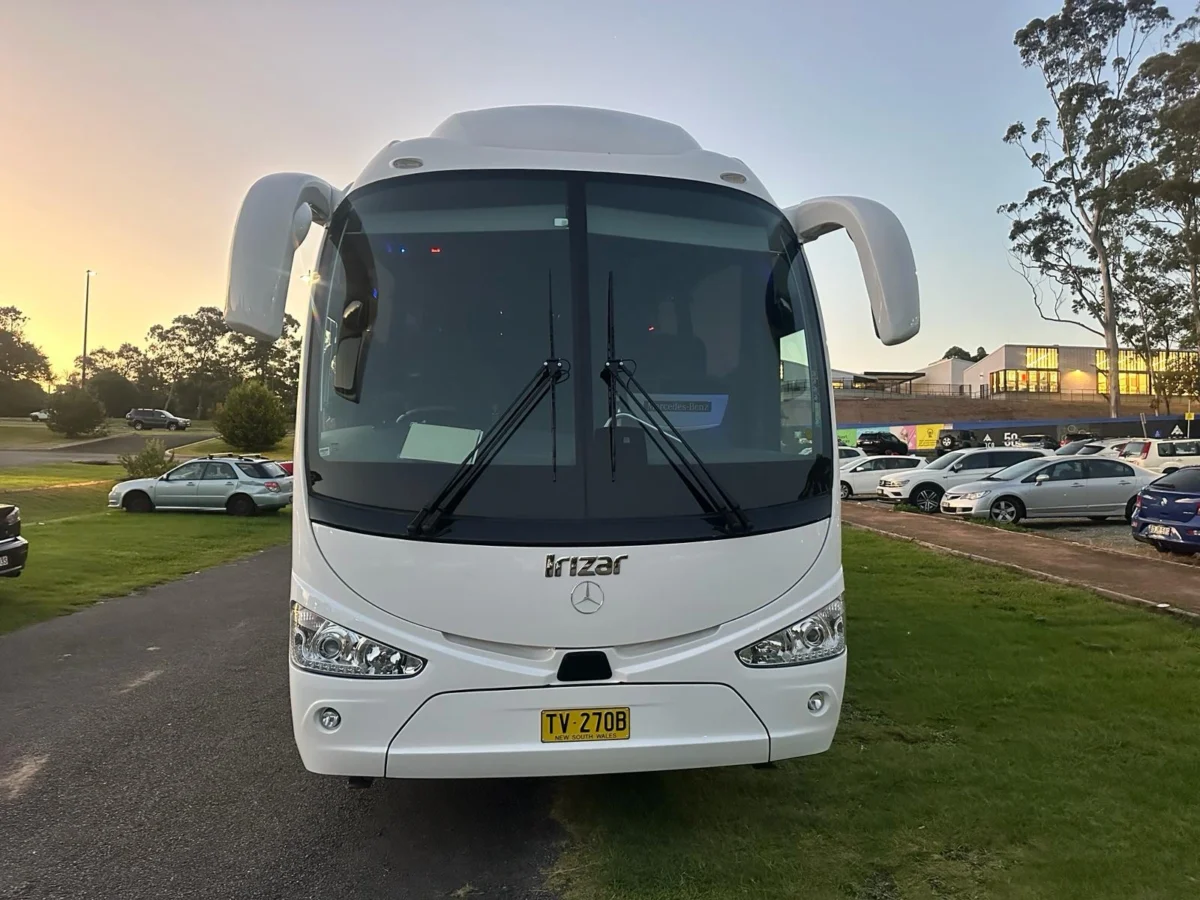
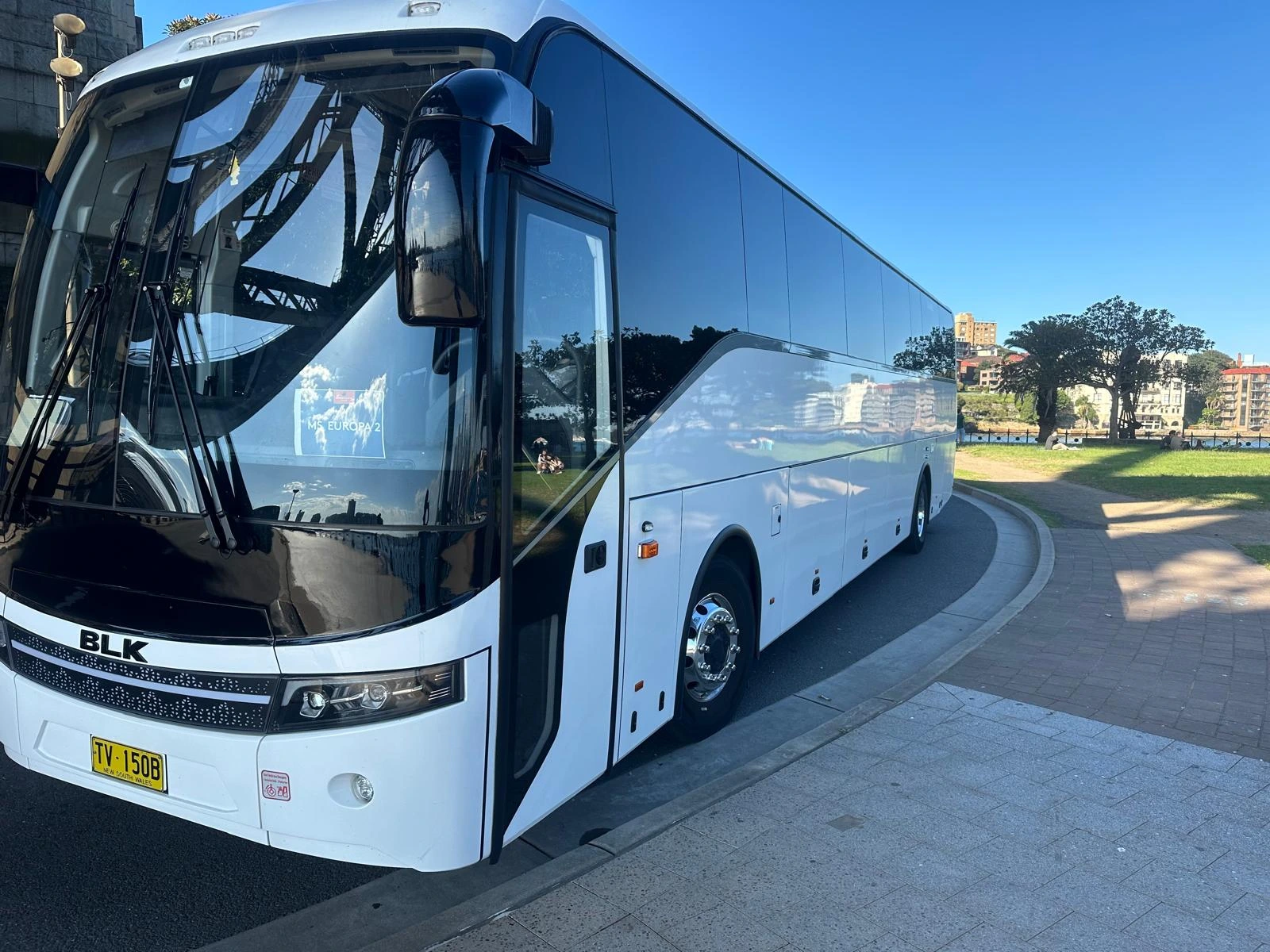
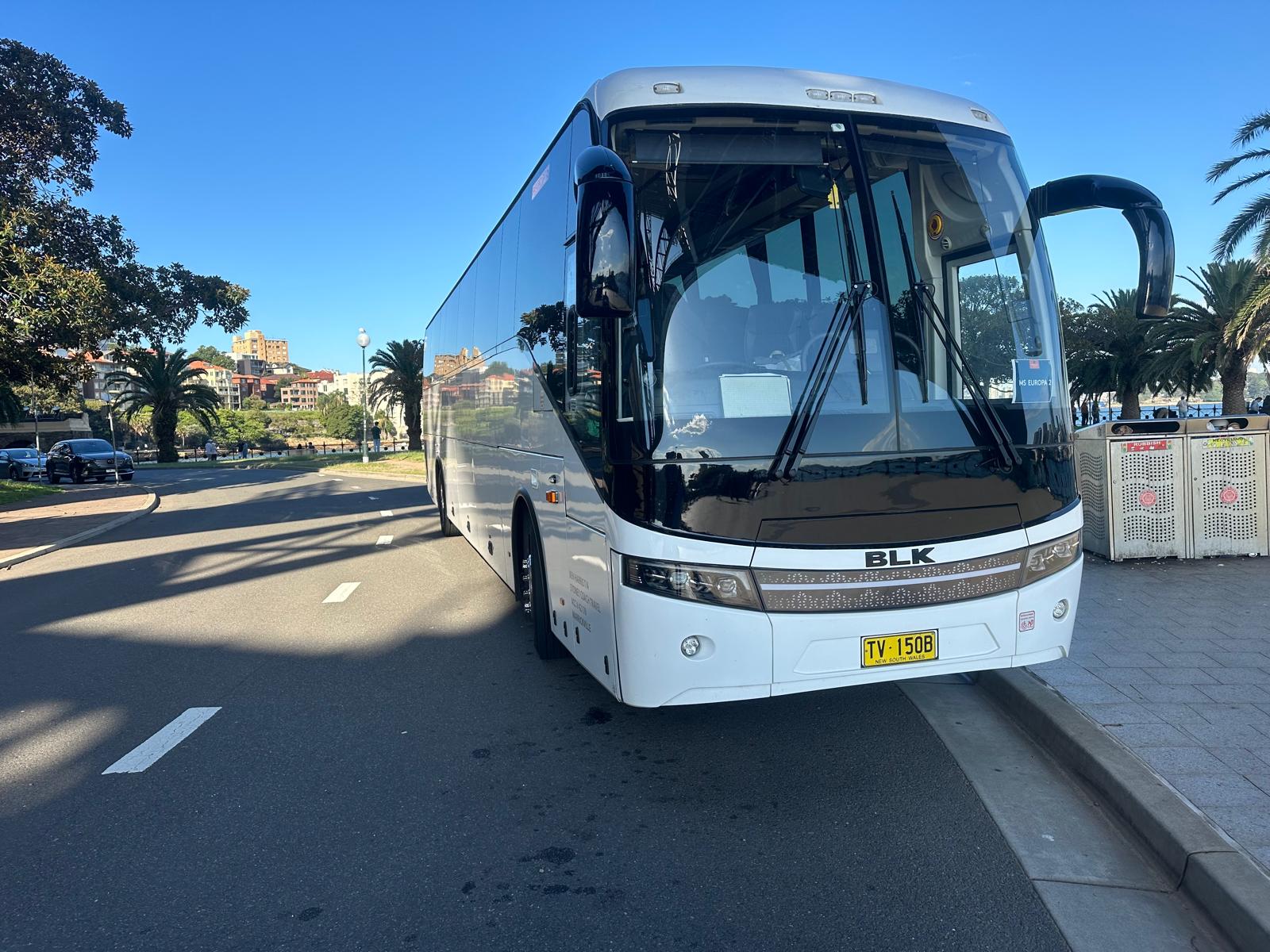
| 44 | Luxury coach, 48 seats at $185 | $1,850 | $42.05 |
| 48 | Luxury coach, 48 seats at $185 | $1,850 | $38.54 |
Every rate includes the driver, fuel, vehicle insurance and GST. Tolls, parking, public holiday or after-hours loading and waiting time past the booked window are confirmed in advance and quoted separately.
Now do the only comparison that matters: open the Transport for NSW fares page, price a return trip to your destination on your actual date, and put that number next to the relevant row. At eight people the coach is $137.50 each and the train will not be anywhere near it. At 48 people the coach is $38.54 each, and the arithmetic looks very different.
You can rebuild any row with your own hours from the hourly rates behind the per-head table.
Where the train genuinely wins
This is the part most operator content skips, so here it is plainly.
One or two people. A coach day is a four-figure sum whatever the head count, so two people would be splitting the whole vehicle. There is no argument to make.
Small groups up to roughly eight or ten. At $137.50 a head on a full day, the coach is a hospitality decision, not a cost decision.
A single destination close to a station. If everything you want to do sits within a comfortable walk of one platform, the train’s biggest weakness never appears.
Groups who want to travel separately. People who want to go up early, come back late, or peel off midway are individually served by a timetable and constrained by a coach.
Off-peak days. Opal fares are cheaper outside peak, and peak applies Monday to Thursday, excluding public holidays, between 6:30 and 10:00am and between 3:00 and 7:00pm. A weekend or Friday group trip already sits outside those windows. Opal also applies fare caps, so check the current caps for your date before assuming a long day costs proportionally more.
Anyone who wants to read, sleep or drink. Though so does a coach, so this one is only an argument against driving.
If your trip is on that list, take the train and enjoy it.
Where the day itself decides it
Price is often not what settles a group day trip. The shape of the day is.
Multiple stops. A single-destination day suits rail. A day with three or four stops does not, because each transfer becomes a timetable problem, a walk, and a headcount. A coach turns four stops into four doors opening.
Door to door. A group assembling in Penrith, Cronulla or the northern beaches spends real time getting to a station before the journey starts. The coach collects them where they are.
A hard return deadline. If people must be back by a certain hour, a booked vehicle with a driver is a commitment. A timetable is a schedule you hope to make.
Anything you have to carry. Catering, equipment, a marquee, sports gear, walking poles for twenty people. Coaches have underfloor bays. Carriages do not.
Mixed mobility. Groups including older members, young children or anyone who tires easily do better with one seat for the whole day than with platform changes and walks between attractions.
Headcount responsibility. If you are accountable for other people’s children or clients, moving as one unit with one driver and one vehicle registration is a materially different job from shepherding a group through a public network.
The Blue Mountains, specifically
This is the day trip Sydney groups take most, so it is worth being concrete.
The drive is around 105 km to Katoomba, roughly two hours each way, and about 2.5 hours each way from the eastern suburbs or the northern beaches. Note the widely repeated 60 km figure is the distance to Glenbrook, not Katoomba.
A one-stop Katoomba day and a real Blue Mountains day are different trips. A real one might take in Wentworth Falls, Govetts Leap and Echo Point, which are three separate places on the escarpment.
What a coach can and cannot do up there is specific:
- Echo Point. Blue Mountains City Council operates paid bus and coach parking along Echo Point Road and Panorama Drive, charged per half hour and banded by seat count. Council adopted a Visitor Bus Management Plan on 3 March 2026 making Echo Point the first pilot site for a bus booking system, so this is an area to check close to your date rather than assume.
- Wentworth Falls. National Parks publishes that bus parking is available.
- Govetts Leap. Large buses should drop off and park near the Blue Mountains Heritage Centre.
- Scenic World. The car park has a 2 metre clearance, which a coach cannot use, and no coach parking information is published. Reservations are taken for groups of more than 15, so book the attraction as well as the transport.
- Victoria Pass. A detour applies, and Jenolan Caves Road and the Jenolan precinct are closed, scheduled to reopen late 2026. Check before building an itinerary that depends on them.
The honest summary for the Blue Mountains: two people should take the train. Twenty-five people wanting three lookouts and a return by six o’clock should take a coach. Between those two, it is a real decision.
A decision framework
Run your trip down this list. Whichever column collects more ticks is your answer.
| Question | Train | Charter coach |
|---|---|---|
| Group of eight or fewer | Yes | No |
| Group of 20 or more | Rarely | Yes |
| One destination, close to a station | Yes | Not needed |
| Three or more stops in the day | Difficult | Yes |
| Everyone assembling in one suburb | Either | Yes |
| Everyone coming from scattered suburbs | Yes | Difficult |
| Fixed return time that cannot slip | No | Yes |
| Carrying gear, catering or equipment | No | Yes |
| Mixed mobility or young children | Depends | Yes |
| People want to travel at different times | Yes | No |
| You are responsible for other people’s children | No | Yes |
If the columns tie, price both. The coach per head from the table above is a real number you can put beside a real fare in about two minutes.
Frequently asked questions
At what group size does a coach beat the train on price?
There is no single number, because it depends on the fare to your destination and the length of your day. The method is fixed though: divide the coach total by your head count and compare that figure to a return fare you can see today. On a ten-hour Blue Mountains day, the coach falls below $45 a head at around 44 people on a 48-seat luxury coach.
Does a coach take longer than the train?
Sometimes, and it depends on the destination and the traffic. Any vehicle over 4.5 tonnes GVM is capped at 100 km/h in NSW regardless of a higher posted limit, so a coach is not doing highway speeds a car would. What a coach saves is the time before and after the journey, because it starts where your group is rather than at a station.
Can a coach follow a scenic route the train cannot?
Yes, within limits. Some roads have height, length or clearance constraints that exclude a full-size coach, and some car parks do too. Scenic World’s 2 metre clearance is the clearest local example. Ask about the specific stops on your itinerary at quote stage rather than after.
Is the coach cost affected by how long we stay?
Directly. Charter is priced by the hour from first pick-up to final drop-off, including the time the coach waits at the destination. A ten-hour day on a 27-seat midi-coach is $1,650 and a seven-hour day is $1,155. Trimming the day is the most effective way to trim the price.
What about a mixed plan, train up and coach back?
Occasionally sensible, and worth pricing. A one-way charter is still charged against the vehicle’s minimum hire period, so it rarely halves the cost, but for a group that wants a leisurely trip out and a guaranteed return it can be the right shape.
Next step
If you want to compare properly rather than argue about it, get the coach number. Send the destination, the date, the group size and the times you want to leave and be home, and a fixed written quote naming the vehicle comes back within two business hours, ready to divide by your head count. Start with the day trip routes we run out of Sydney or a Sydney to Blue Mountains coach day, or call 02 9469 6600, Monday to Friday 7am to 6pm or Saturday 8am to 2pm.
Sources
- Transport for NSW, Opal peak and off-peak fares, https://transportnsw.info/tickets-fares/fares/opal-peak-off-peak-fares. Accessed 7 September 2026.
- Blue Mountains City Council, Visitor Bus Management Plan, https://www.bmcc.nsw.gov.au/documents/visitor-bus-management-plan. Accessed 7 September 2026.