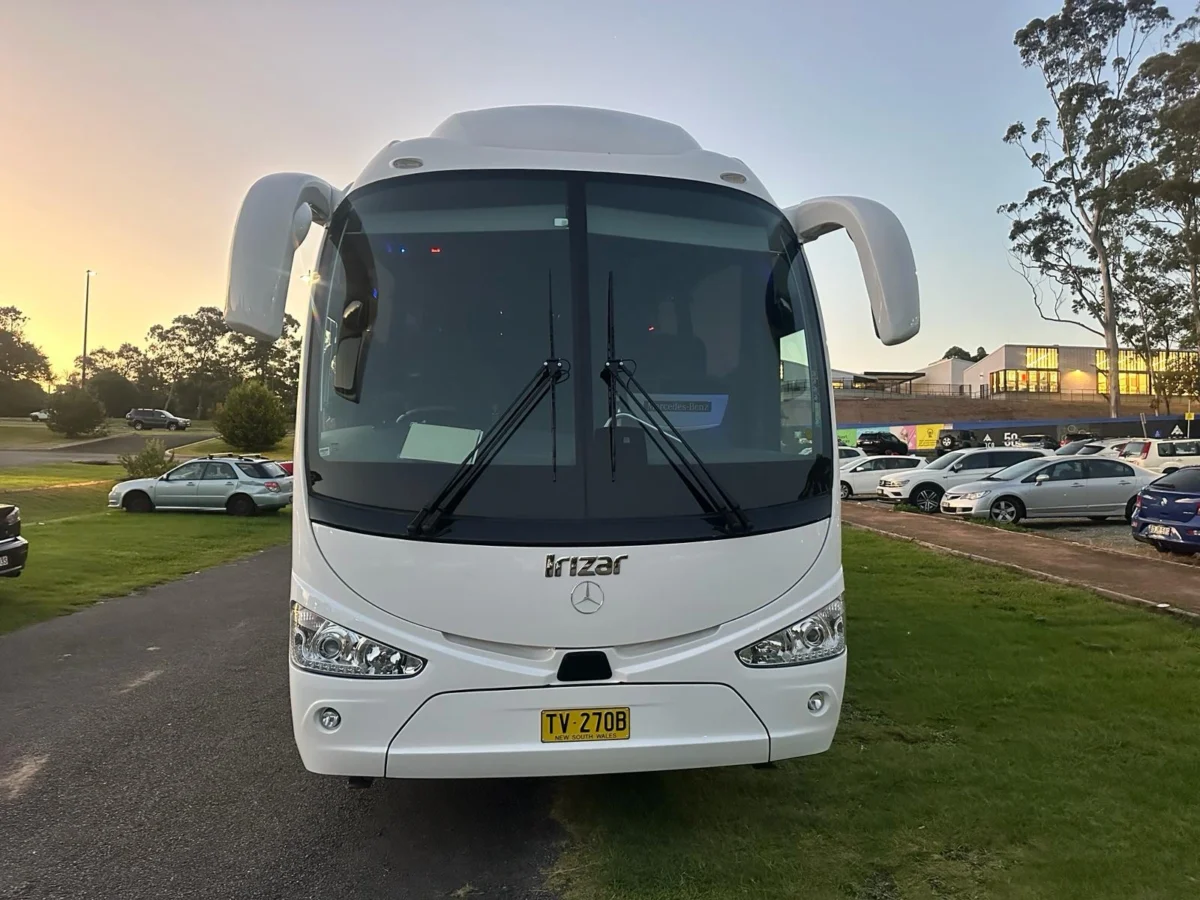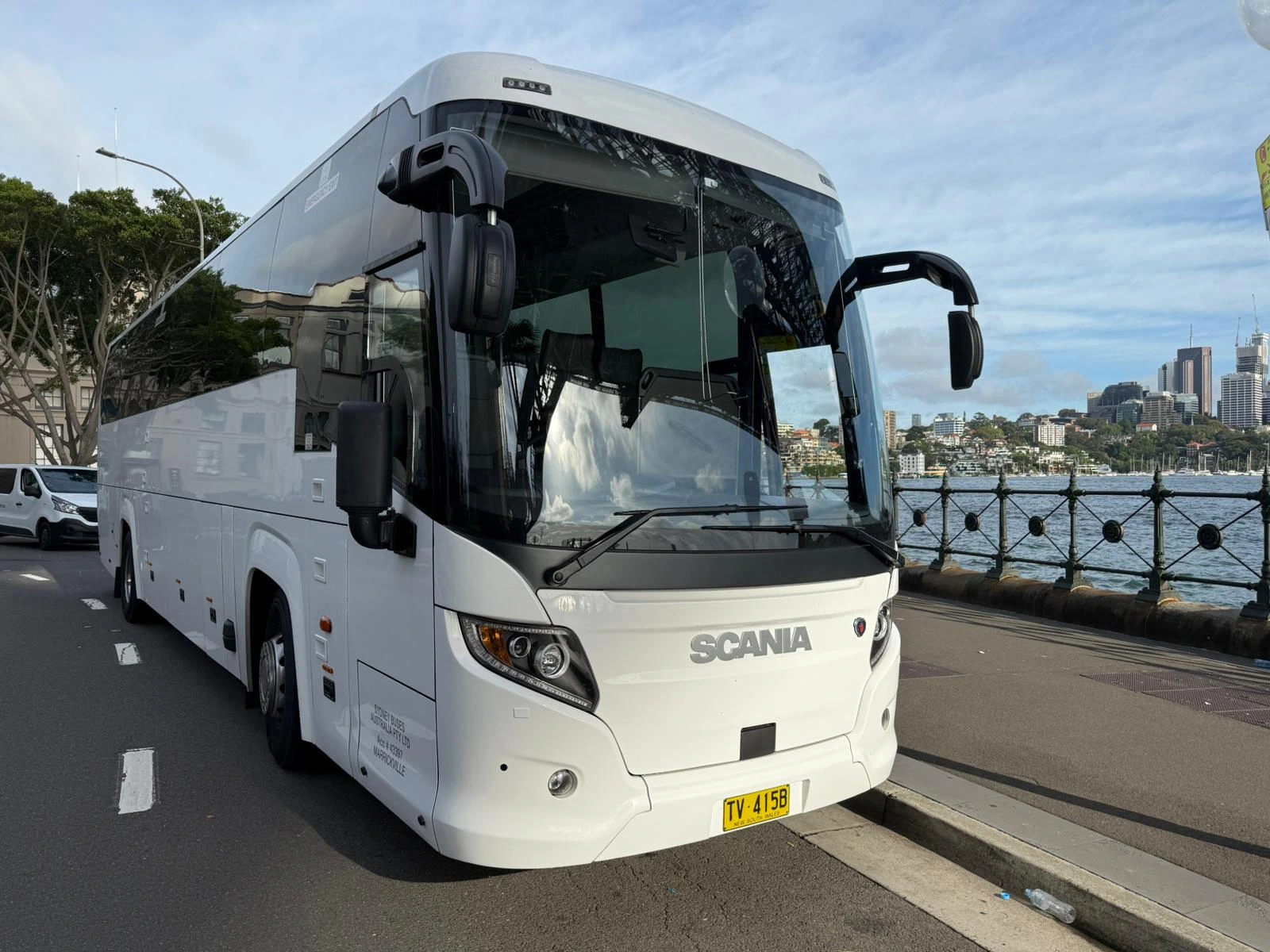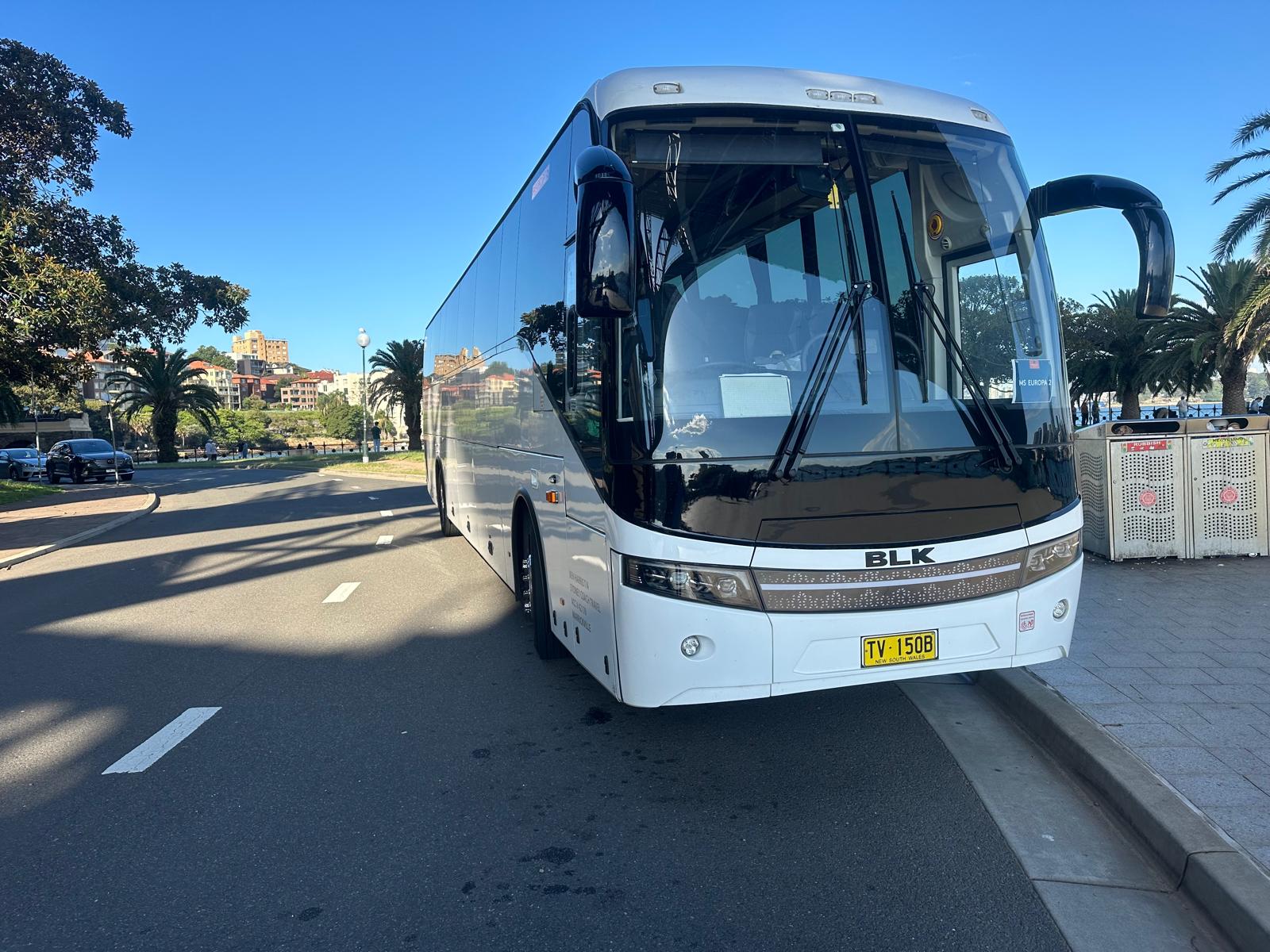
On cash out of pocket, everyone driving is usually cheaper than one coach. That is worth saying first, because most articles pretend otherwise. What the cash comparison misses is that self-drive is paid for by the people driving, in fuel, tolls, parking and a day of their attention, while a charter is one line item paid centrally. The choice is really about what you need the day to be, and for some trips the cash gap is the smallest part of it.
The cash comparison, done properly
Do both sides in the same units.
The coach side is a single number you can get in writing. Take a group of 40 heading to a Hunter Valley venue, which is about 165 km each way and 2 to 2.5 hours of driving in each direction. Allow a full day: an 11-hour window from first pick-up to final drop-off.
A 48-seat luxury coach at $185 an hour, 11 chargeable hours, is $2,035, which is $50.88 a head. That figure includes the driver, fuel, vehicle insurance and GST. Tolls and parking are confirmed in advance and quoted separately.
The self-drive side is a formula, not a number, because fuel prices move weekly, Sydney tolls are indexed quarterly and venue parking varies. Fill this in yourself:
“` Cost per car = (return km / 100 x litres per 100 km x price per litre)
- tolls out
- tolls back
- parking for the day
“`
Then multiply by the number of cars. Forty people at four per car is ten cars.
Now the useful comparison. Divide the coach total by the car count: $2,035 across ten cars is $203.50 per car for the whole return day. That is the threshold. If each carload can do the return trip, tolls and parking included, for less than $203.50, driving is cheaper on cash.
For most Sydney day trips, it will be. Say so out loud in the meeting rather than pretending otherwise, then have the second conversation.
You can rebuild the coach side with your own hours from the published hourly rates the coach figures come from.
What the cash comparison leaves out
Five things, and they are not soft.
Somebody has to drive. Ten cars means ten people who do not get the day. At a winery, a race day, a long lunch or a birthday, that is either ten people not drinking or a designated-driver conversation nobody enjoys having. A charter removes the question entirely.
Ten cars do not arrive together. They leave together and arrive across a spread, because one stops for fuel, one takes the wrong exit and one leaves twenty minutes late. If your day has a booked start, a guide, a tasting or a ceremony, the spread is the problem, not the fuel.
Ten cars need ten parking spaces. At a residence, a small venue or a busy precinct, that is a genuine constraint and it is the host’s problem as much as yours.
Costs get pushed onto individuals. A $2,035 coach is one invoice against a budget. Self-drive is the same day’s fuel, tolls and parking quietly extracted from ten households, and the people who drove also absorb the wear and the risk. It is cheaper for the group and not necessarily cheaper for them.
Nobody is accountable for the group. With one coach there is one operator, one vehicle registration, one driver whose name and mobile you have 24 hours ahead, and one insured entity. With ten cars there are ten private arrangements.
The Sydney arithmetic that does surprise people
Tolls. Sydney toll roads classify by dimension: Class A is 12.5 metres or less in length and 2.8 metres or less in height, Class B is anything over either. Cars are Class A. A full-size coach is over 2.8 metres high, so it is Class B everywhere the classes apply.
That sounds like a point against the coach until you count vehicles. Class B runs at about three times Class A on the WestConnex roads, the Hills M2, the M5 South-West, Westlink M7 and NorthConnex, and about twice Class A on the Eastern Distributor and the Cross City Tunnel. So one coach costs roughly three Class A equivalents on the western corridors, against ten cars each paying one. On the Sydney Harbour Bridge and Harbour Tunnel there is no heavy class at all, so the coach pays exactly what a car pays.
Ten of anything beats one of three times anything. On tolls, the coach wins comfortably.
Routing. One rule cuts the other way. Between the M1 and the M2, buses over 12.5 metres long or over 2.8 metres high must use NorthConnex, enforced by camera and with no exemption process. Cars can choose Pennant Hills Road. On a Newcastle, Central Coast or Port Stephens run, the coach has no toll-free option and the cars do.
Speed. Any vehicle over 4.5 tonnes GVM is capped at 100 km/h in NSW regardless of the posted limit. On a long highway leg the coach is a little slower than the cars, and the itinerary should say so honestly.
Parking at the far end. This is where ten cars and one coach stop being comparable at all. A coach cannot simply take a space. Royal Randwick puts coaches over 3.1 metres on Darley Road outside TAFE NSW Randwick; Rosehill Gardens puts coaches over 3.4 metres on Arthur Street; Sydney Olympic Park uses Coach Pod C off Edwin Flack Avenue with an Ebusticket booked by 11:59pm the night before; Allianz Stadium wants private coaches on Driver Avenue via Lang Road, not Moore Park Road. The Sydney Opera House cannot take buses onsite and disembarks large buses on Macquarie Street.
Cars have more options and worse odds. Coaches have fewer options and a defined place to be. Which is better depends entirely on the venue, so ask before you decide.
Where self-drive genuinely wins
- Small groups. Under about ten people, the coach per head climbs steeply and the cars are already there.
- Scattered origins. If your 30 people are spread from Penrith to Cronulla, a coach can only collect them with a long, slow loop that adds chargeable hours. Cars converge naturally.
- Different schedules. People arriving late, leaving early, or staying overnight while others go home are individually served.
- Free, easy parking at the destination. If the venue has a big empty car park, one of the coach’s advantages disappears.
- Nobody is drinking, and nobody minds driving. Then the cash gap is the whole story, and cash favours driving.
- Very short trips. A 20-minute run across town does not justify a minimum hire period.
Where one coach genuinely wins
- Anyone is drinking. Wineries, race days, Christmas parties, milestone birthdays.
- The arrival time matters. Ceremonies, tours, tee times, booked tastings, kick-off.
- The group is 20 or more. Per head falls fast: 40 people on that Hunter Valley day is $50.88 each, and the same coach at 48 is $42.40.
- You are responsible for other people. Clients, students, staff or anyone else’s children.
- The destination has awkward parking. Which describes most Sydney venues on an event day.
- You want the travel to be part of the day. Forty people together for two hours each way is a different experience from ten separate cars.
A framework for choosing
| If this is true | Lean |
|---|---|
| Fewer than 10 people | Drive |
| 20 or more people | Coach |
| Anyone will be drinking | Coach |
| Everyone starts in one suburb | Coach |
| Everyone starts in different suburbs | Drive |
| Fixed start time at the destination | Coach |
| People will leave at different times | Drive |
| Destination has limited parking | Coach |
| Trip is under 30 minutes each way | Drive |
| You need one accountable operator | Coach |
Count the ticks. If it is close, get the coach quote and put the per-head figure next to the per-car threshold. That conversation takes five minutes and settles most committees.
Frequently asked questions
Is a coach ever cheaper than driving on pure cash?
Sometimes, on long trips with heavy tolls and paid parking at both ends, and more often once you count the parking a group of ten cars actually needs. But for a typical Sydney day trip, honestly, driving is usually cheaper in raw cash. The coach case is built on the other four columns.
How do I work out the break-even?
Divide the coach total by the number of cars your group would otherwise take. That gives the amount each car would have to beat, for the whole return trip, in fuel plus tolls plus parking. On a $2,035 coach across ten cars it is $203.50 per car.
Do we save money by taking fewer, fuller cars?
On cash, yes, and it also narrows the arrival spread. It does not solve the designated driver problem, and it concentrates the cost and the risk on fewer people.
What about a mix, a coach for most people and cars for a few?
Common and sensible. Size the coach for the committed core, and let the people with different schedules drive. Just make sure the coach is not sized for the optimistic number, because empty seats cost the same as full ones.
Does the coach price change if the day runs long?
Yes, directly, because charter is priced by the hour from first pick-up to final drop-off. An 11-hour Hunter Valley day on a 48-seat luxury coach is $2,035 and a 9-hour version is $1,665. Trimming the window is the most effective saving available.
Next step
Get the coach number so the comparison is real rather than assumed. Send the destination, the date, the group size and the times you want to leave and be home, and a fixed written quote naming the vehicle comes back within two business hours. See charter bus hire across Sydney or a Sydney to Hunter Valley coach day, or call 02 9469 6600, Monday to Friday 7am to 6pm or Saturday 8am to 2pm.
Sources
- Linkt, Vehicle classes on Sydney toll roads, https://www.linkt.com.au/help/travelling-toll-roads/vehicle-class/sydney. Accessed 7 September 2026.
- Transport for NSW, Pennant Hills Road heavy vehicle road access, https://www.transport.nsw.gov.au/operations/roads-and-waterways/business-and-industry/heavy-vehicles/road-access/pennant-hills-road. Accessed 7 September 2026.