A group day trip is a time budget before it is an itinerary. You have a fixed number of usable hours, the driving legs consume a known share of them, and whatever is left is what the group actually gets to do. Most day trips fail because the organiser wrote the fun parts first and discovered the driving afterwards. This template builds the budget first, then fills the gaps, and it is pre-filled with published coach travel times from Sydney.
Step one: set the outer limits
Two numbers cap the day before you plan anything inside it.
The group’s day. The earliest a group will genuinely be at a pick-up point, and the latest they will accept being dropped home. Ask, do not assume. A seniors group and a staff social club give very different answers to the same question.
The driver’s day. A commercial charter in NSW sits inside the heavy vehicle fatigue regime, and standard hours for a solo driver allow a maximum of 12 hours work with 7 continuous hours of stationary rest in any 24 hour period. That 12 hours is not your on-coach time. It starts before the vehicle reaches the first pick-up and ends after it is back at the depot. A day that looks like nine hours to your group can be eleven or twelve to the driver.
Write both down first.
| Field | Enter |
|---|---|
| First pick-up time | |
| Last drop-off time, hard limit | |
| Total group day | hours |
| Vehicle departs depot | |
| Vehicle returns to depot |
If your two numbers do not leave room for the driving, the answer is a closer destination, not a tighter schedule.
Step two: the time budget
Fill this in before you write a single line of itinerary. Everything is in minutes.
| Line | Minutes | How to set it |
|---|---|---|
| A. Total group day | Last drop-off minus first pick-up | |
| B. Loading, all pick-up points | Count each stop, not each person | |
| C. Outbound driving | From the table below | |
| D. Return driving | Usually equal to C, sometimes worse | |
| E. Comfort stops, both directions | See below | |
| F. Buffers | See below | |
| G. Unloading and final drops | ||
| H. Time actually at the destination | A minus B to G | This is your real itinerary |
If line H comes out below about three hours on a full day out, the destination is too far or the departure is too late. That is a useful thing to discover on a spreadsheet rather than on a coach.
Pre-filled travel times from Sydney
These are the operating figures we publish for coach journeys, one way. They run longer than the car times tourism bodies publish, and the gap is real: a heavier vehicle capped at 100 km/h whatever the posted limit, legal driver rest requirements, and comfort stops a car does not take.
| Destination | Distance | Coach driving time, each way |
|---|---|---|
| Blue Mountains (Katoomba) | 105 km | About 2 hours, 2.5 from the eastern suburbs or northern beaches |
| Hunter Valley (Pokolbin) | 165 km | 2 to 2.5 hours |
| Port Stephens (Nelson Bay) | 205 km | 2.5 to 3 hours |
| Southern Highlands | 120 km | About 1.5 hours |
| Canberra | 285 km | 3 to 3.5 hours |
| Cruise terminals | 12 km | 25 to 45 minutes from Sydney Airport |
| Stadium shuttles | 16 km | 20 to 60 minutes |
Two adjustments to make before you use them. If your pick-up is in the eastern suburbs or the northern beaches, the Blue Mountains leg is already 2.5 hours by the published figure, which costs you an hour off line H across the day. And if any pick-up sits inside a school zone during a notified school day, the limit is 40 km/h and most zones operate from 8:00 to 9:30am, which is exactly when a day trip is loading. The sign always governs, so check the ones on your pick-up street.
More detail on the individual legs sits on the routes we run out of Sydney.
Setting line E: comfort stops
There is no rule you can look up here, so set the allowance deliberately rather than leaving it at zero, which is what most first-time itineraries do.
Size it with arithmetic rather than optimism. A 48-seat coach does not empty and refill in ten minutes. Count how many toilet cubicles the stop actually has, divide your group by that, and you will land somewhere between fifteen and twenty five minutes for a full coach. Then decide the interval. On a two hour leg, one stop is usually enough if the group boarded recently. On anything approaching three hours, plan for one and treat it as compulsory rather than optional, because a group that has not stopped will ask for one at the least convenient point.
Put the stop in the itinerary with a location and a duration. “We’ll stop somewhere on the way” is how a twenty minute allowance becomes forty.
| Field | Enter |
|---|---|
| Outbound stop location and duration | |
| Return stop location and duration | |
| Total line E | minutes |
Setting line F: buffers
Buffers go in three places and nowhere else. Scattering five minutes everywhere just hides the slack.
- Before the first hard time of the day. If you have a booked tour, a booked table or a scheduled entry, put 20 to 30 minutes in front of it.
- After the longest single stop. Groups run late leaving somewhere they enjoyed, not arriving somewhere new.
- Before the return departure. The most common failure on a day trip is the last head count, not the driving.
Everything else runs without a buffer, and if that feels uncomfortable, the itinerary has too much in it.
The itinerary template
Now fill the shape. One row per event, in clock order, with the duration alongside so you can see where the day goes.
| Time | Dur | What | Where | Who confirms | Notes |
|---|---|---|---|---|---|
| Vehicle departs depot | 74 Edinburgh Rd, Marrickville | Operator | |||
| Pick-up 1 | Street address | Organiser | Head count | ||
| Pick-up 2 | Street address | Organiser | Running total | ||
| Outbound leg | From the table above | ||||
| Comfort stop | Named location | Duration set, not open | |||
| Arrive destination | Coach set-down point | Not the visitor entrance | |||
| Activity 1 | Venue | Booked? | |||
| Meal stop | Venue | Numbers sent when? | |||
| Activity 2 | Venue | ||||
| Buffer | Before departure | ||||
| Head count and depart | Organiser | ||||
| Comfort stop | Named location | ||||
| Return drops | Reverse order of pick-up | ||||
| Vehicle released | This is your booked window end |
The final row is the one with money attached. The booked window is what waiting time beyond it is measured against, so an itinerary that quietly ends 40 minutes later than the quote is a conversation you would rather have in advance.
Block 4: the meal stop
A meal stop for a coach group is a booking, not a discovery. Fifty people arriving unannounced at a regional cafe at 12:30 is a bad day for everyone in the building.
| Field | Enter |
|---|---|
| Venue and address | |
| Booked for | Time and number |
| Can the venue seat the whole group at once | |
| Deadline for final numbers | |
| Dietary counts by code, sent when | |
| Where does the coach wait during the meal | |
| Payment: individually or one account |
That last row about the coach is the one people forget. A coach that cannot park near the meal stop has to go somewhere and come back, and that movement needs to be in the itinerary.
Destination access notes worth pre-filling
The set-down point is rarely the visitor entrance, and for several popular Sydney day trips the published position is specific.
Katoomba and Echo Point. Blue Mountains City Council operates paid bus and coach parking along Echo Point Road and Panorama Drive, charged per half hour and banded by seat count. Council adopted a Visitor Bus Management Plan published on 3 March 2026 that makes Echo Point the first pilot site for a bus booking and payment system, so this is an area worth re-checking close to your date rather than relying on last year’s arrangement.
Scenic World. Publishes no coach parking information, and its car park has a 2 metre clearance, which a coach cannot use. Reservations are taken for groups of more than 15, so book rather than turn up.
Blue Mountains lookouts. NPWS states that bus parking is available at Wentworth Falls. At Govetts Leap, large buses should drop off and park near the Blue Mountains Heritage Centre. Note also that a detour applies at Victoria Pass, and Jenolan Caves Road and the Jenolan precinct are closed with reopening scheduled for late 2026, so do not build an itinerary through there without checking.
Hunter Valley. The Hunter Valley Wine and Tourism Association states plainly that large groups require a booking prior to arrival. Treat every cellar door as a booking, and confirm coach access with each one directly, because no official body publishes coach parking guidance for the region.
Port Stephens. Port Stephens Council’s parking scheme has no bus or coach category, so coach parking is not published and needs confirming locally. For the Stockton Bight sand dunes, access requires a 4WD and a valid Worimi Conservation Lands beach vehicle permit, which means your itinerary needs a transfer to a licensed operator, usually at Anna Bay, as its own timed block.
A worked day: Sydney to Katoomba
Using the published figures, a pick-up in the inner west, and a 48-seat coach.
| Line | Minutes |
|---|---|
| A. Group day, 7:30am pick-up to 6:30pm final drop | 660 |
| B. Loading, two pick-up points | 30 |
| C. Outbound driving, 105 km | 120 |
| D. Return driving | 120 |
| E. Comfort stops, 20 minutes each way | 40 |
| F. Buffers, three placements | 60 |
| G. Unloading and final drops | 20 |
| H. Time actually at the destination | 270, or four and a half hours |
Four and a half hours in Katoomba is a genuine day: a lookout, a booked attraction, and a sit-down lunch. It is not three attractions and a walk. And note what happens if the pick-up moves to the northern beaches, where the published time is 2.5 hours each way: line H drops to 210 minutes, and one of those three things has to go.
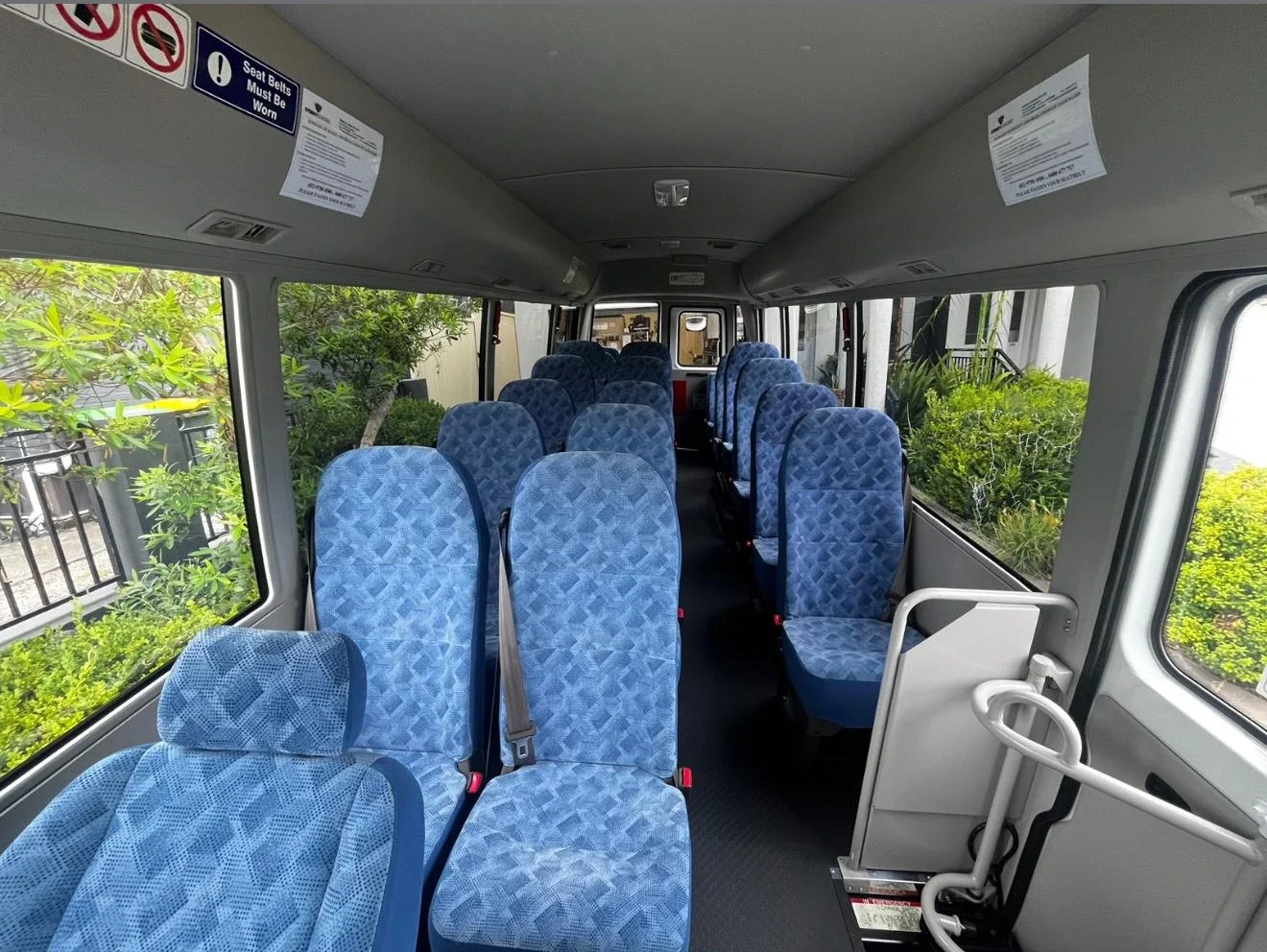
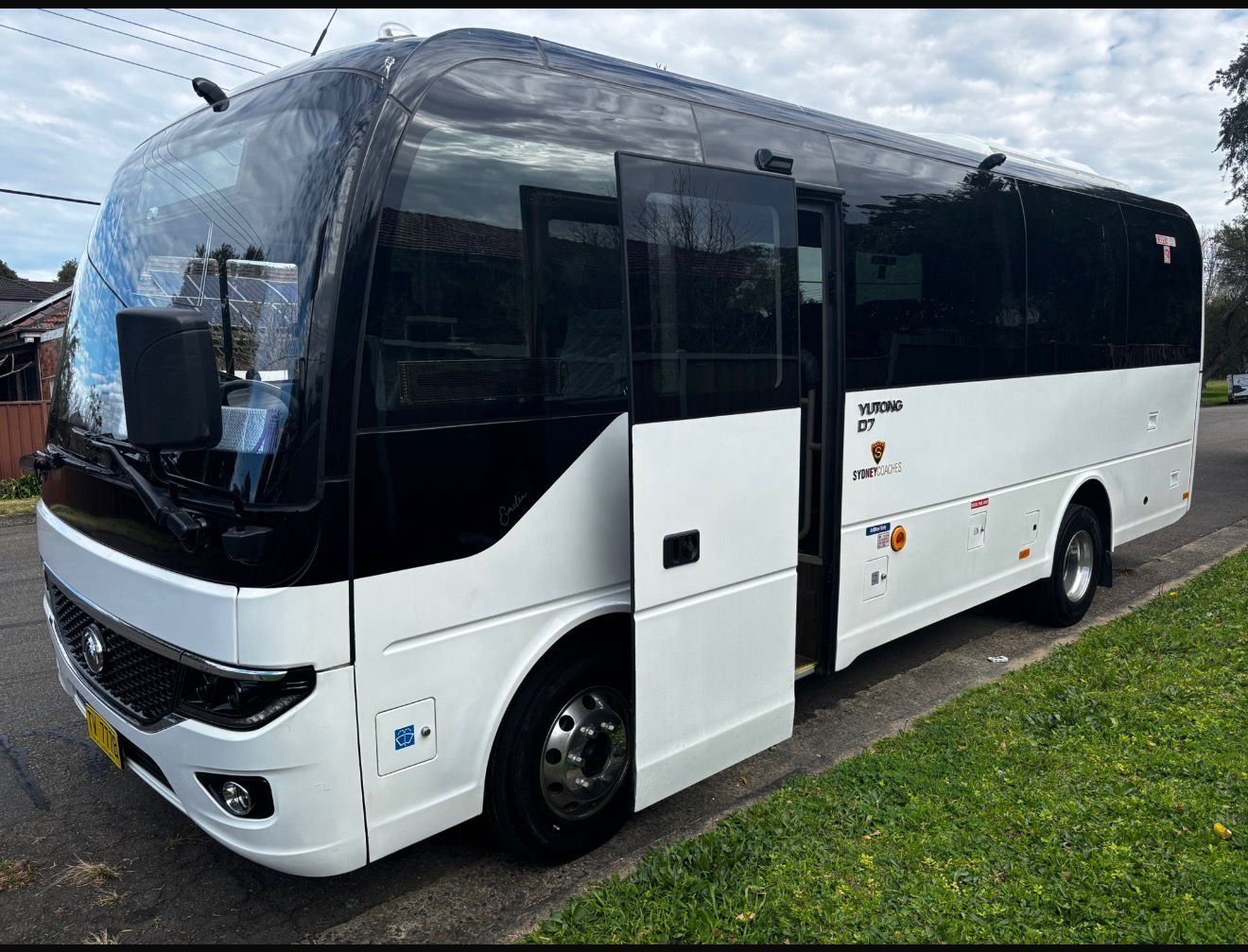
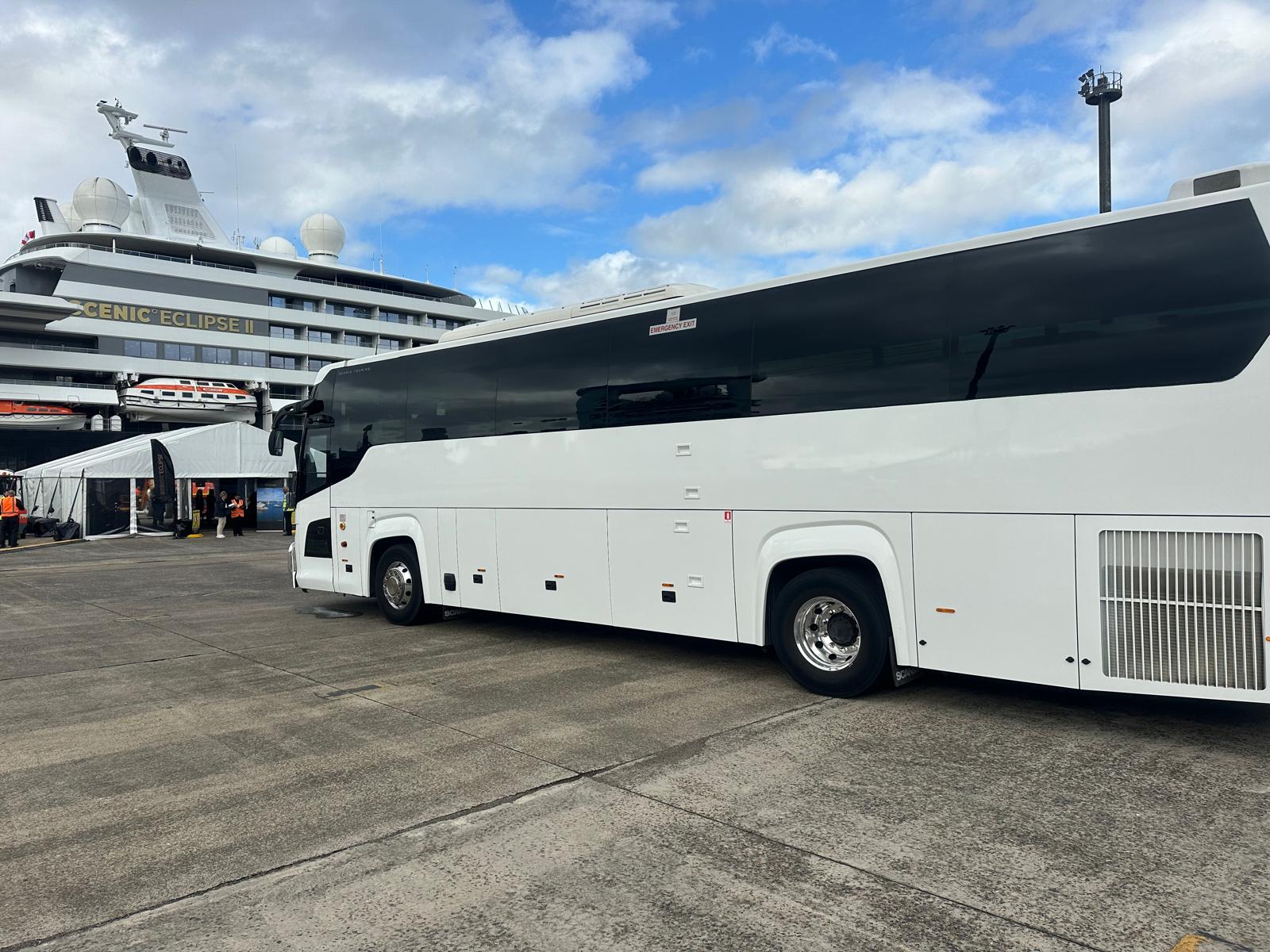
The cost side is simple arithmetic on the published GST inclusive rate card. That day is roughly an eleven hour booked window from depot to release. A 48-seat luxury coach at $185 an hour across eleven hours is $2,035, or about $42 a head with a full coach. Minimum hire is four hours on a full-size coach, which a day trip passes comfortably, so the minimum is not the constraint here. Tolls and parking are confirmed in advance and priced separately, and a full-size coach sits in Class B on Sydney’s dimension-based toll roads because it is over 2.8 metres high. You can see the leg itself on the Sydney to Blue Mountains run.
Frequently asked questions
How long can a group day trip actually be?
The binding limit is the driver’s day, not the group’s. Standard hours allow a solo driver a maximum of 12 hours work with 7 continuous hours of stationary rest in any 24 hour period, and that clock starts before your first pick-up. A day that needs more than that needs a second driver, which changes the quote.
Why are coach travel times longer than the times I find online?
Most published times are car times measured from central Sydney in free-flowing traffic. A coach is capped at 100 km/h whatever the posted limit because it is over 4.5 tonnes, it takes comfort stops a car does not, and the driver has legal rest requirements. Plan from coach figures.
Where should the comfort stops go?
Roughly every two hours of driving, at a named location with a stated duration, and long enough that a full coach can actually use the facilities. Twenty minutes is a realistic minimum for a large group, and an unplanned stop always costs more than a planned one.
Do we need to book attractions in advance for a coach group?
Assume yes. Scenic World takes reservations for groups over 15, and the Hunter Valley Wine and Tourism Association states that large groups require a booking prior to arrival. The itinerary column headed “Who confirms” exists so that every one of these has a name against it.
Next step
Build the time budget, fill in the itinerary rows, then send us the completed itinerary with your date and pick-up suburbs. We will quote against what you have planned and tell you where the timings will not hold. Call 02 9469 6600 if you would rather work through the destination first. Two to four weeks of notice suits most jobs, and four to eight over December, race days, school excursion season and long weekends.
Sources
- NHVR, Heavy vehicle fatigue management: bus industry, https://www.nhvr.gov.au/safety-accreditation-compliance/fatigue-management/heavy-vehicle-fatigue-management-bus-industry. Accessed 7 September 2026.
- NHVR, Bus and coach driver fatigue and health and wellbeing, https://www.nhvr.gov.au/safety-accreditation-compliance/chain-of-responsibility/regulatory-advice/bus-and-coach-driver-fatigue-and-health-and-wellbeing. Accessed 7 September 2026.
- Blue Mountains City Council, Visitor Bus Management Plan, https://www.bmcc.nsw.gov.au/documents/visitor-bus-management-plan. Accessed 7 September 2026.
- Hunter Valley Wine and Tourism Association, Know before you go, https://www.winecountry.com.au/plan/know-before-you-go. Accessed 7 September 2026.
- Port Stephens Council, Smart Parking, https://www.portstephens.nsw.gov.au/services/smart-parking. Accessed 7 September 2026.
- Transport for NSW, School zones, https://www.transport.nsw.gov.au/roadsafety/community/schools/school-zones. Accessed 7 September 2026.