A passenger manifest is a list of who is travelling, on which movement, from where, with anything that changes how they travel. The design decision that makes it work is one row per passenger per movement, not one row per person. Someone who rides out in the morning and back in the afternoon appears twice, because head counts are taken per movement and a person who skipped the return leg is the person you spend twenty minutes looking for. The template is reproduced in full below.
What a manifest is for, and what it is not
A manifest answers three questions on the day: is everyone here, is anyone here who should not be, and does anyone on this vehicle need something the driver should know about. It is a counting tool with a few flags attached.
It is not a contact database, not a seating plan, and not the document the driver drives from. The driver works from a run sheet, which is a timetable of movements and addresses. Those two documents get confused constantly, and the confusion produces a run sheet with 47 passenger names on it sitting face up on a dashboard.
Keep them separate. Different purpose, different audience, different handling.
The manifest layout
One row per passenger per movement. Sort by movement, then by boarding point, then by family name.
| Mvt | Boarding point | Alighting point | Family name | Given name | Sub-group | Mobile | Access flag | Meal flag | Bags | Notes |
|---|---|---|---|---|---|---|---|---|---|---|
| 1 | ||||||||||
| 1 | ||||||||||
| 2 |
Above the table, a header block that fits on the same page:
| Field | Enter |
|---|---|
| Trip name and date | |
| Organisation | |
| Manifest version, as at | Date and time, not a version number |
| Prepared by | Name and mobile |
| Movement 1 | Description, time, vehicle, booked seats, booked count |
| Movement 2 | Description, time, vehicle, booked seats, booked count |
| Total unique passengers |
The “booked seats” against each movement is the vehicle’s seat count excluding the driver. Putting it next to your booked count is what catches an overfilled movement before the morning rather than at the kerb.
The field dictionary
Every column has to earn its place. If a column does not change a transport decision, delete it.
| Field | Format | Required | What it changes |
|---|---|---|---|
| Mvt | Number matching the run sheet | Yes | Ties the passenger to a specific vehicle and time. Without it a manifest cannot be counted |
| Boarding point | The stop name used in guest communications | Yes | Lets you count per stop, which is how you know whether a stop is worth keeping |
| Alighting point | Stop name | Yes | Catches the passenger getting off early who otherwise triggers a search |
| Family name, given name | As the person uses them | Yes | The only reliable way to call a roll |
| Sub-group | Class, department, team, table | Where it exists | Lets a teacher or team manager count their own people faster than one organiser can count everyone |
| Mobile | Digits | Usually | Only for the person you would actually ring. On a school trip, this is the supervising adult, not the student |
| Access flag | Short code you define | Yes as a column | Drives the vehicle decision. See below |
| Meal flag | Short code you define | Only where a meal is booked | Goes to the venue, not the driver |
| Bags | Count, or a code for oversized | Yes on day trips | Underfloor bay space, not seat count, is the constraint once everyone has a suitcase |
| Under 18 and supervising adult | Yes or no, plus a name | On youth trips | Pairs a young passenger to a responsible adult on the same movement |
| Notes | Free text, one line | Optional | Anything the above does not cover. If a note repeats across five rows, it should be a column |
Two columns people add and should not. Date of birth is almost never needed for a bus trip. Full home addresses are needed only if you are doing door-to-door pick-ups, and if you are, they belong on the run sheet as stops rather than against names.
The accessibility column, and what to ask about the vehicle
Use a short code set rather than free text so the column can be counted. Something like: W wheelchair, M mobility aid such as a walker or frame, S needs a step-free or assisted boarding, C travelling with a carer or support worker, G guide or assistance animal.
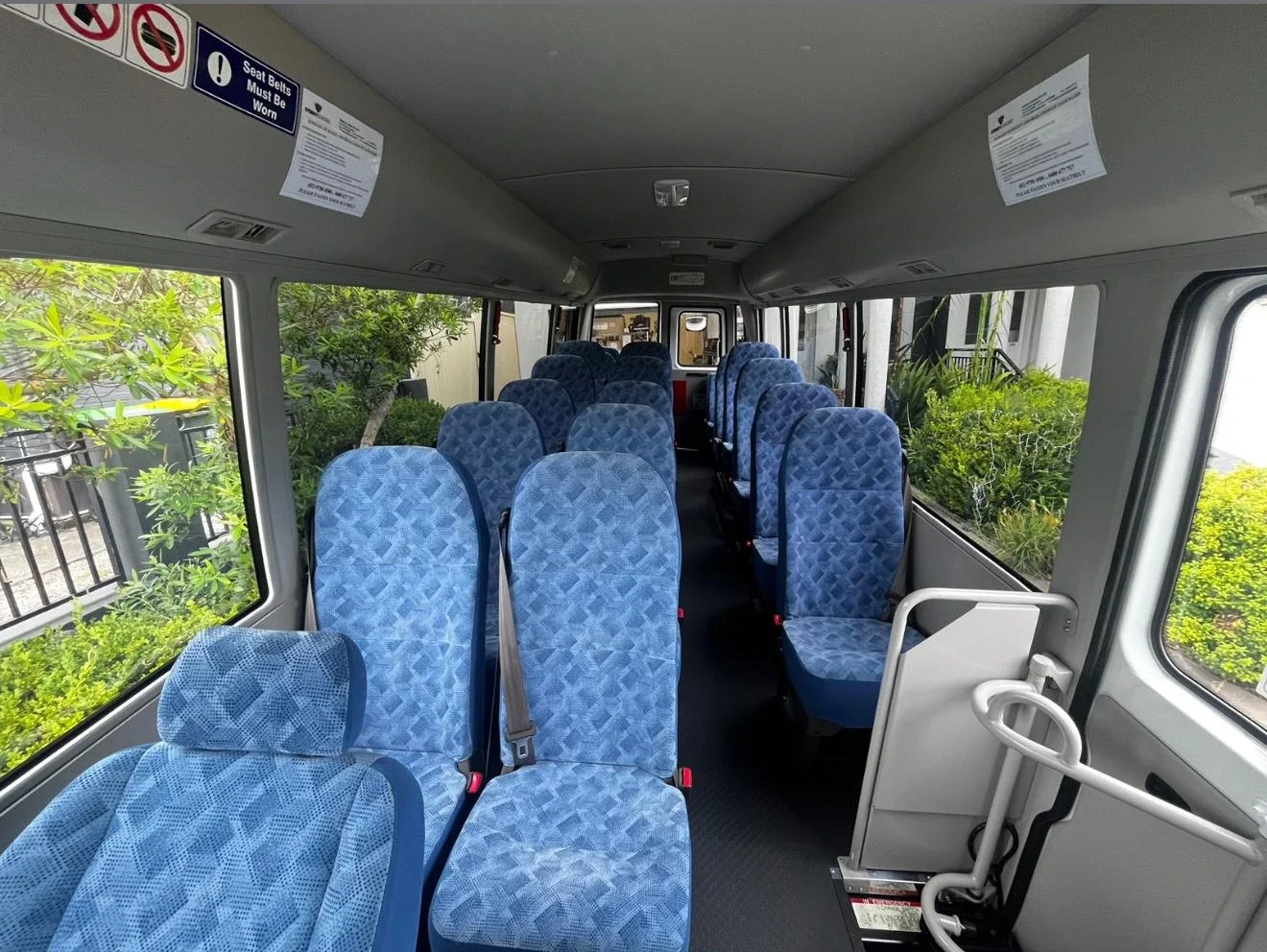
That column has to reach the operator early, because it changes the vehicle rather than the seating. Most Sydney charter coaches have a fixed seat for every passenger. Under section 9.8 of the Disability Standards for Accessible Public Transport, an operator need not provide an allocated wheelchair space where that is the case, though other obligations under the Standards continue. That means the useful question is not whether charter buses are accessible in general. It is whether the specific vehicle offered has a wheelchair lift or ramp and an allocated space. Wheelchair-equipped vehicles with hoists are available from us, but they have to be requested, not assumed.
The carer code matters as much as the wheelchair code. A carer travelling with a passenger is an additional seat, and a manifest that counts the passenger but not the carer produces a coach one seat short. Note it against both rows.
The meal flag, and why Sydney day trips need it
On a day trip with a booked lunch stop, dietary requirements are a transport document problem even though they are a catering answer. The numbers have to leave your organisation days before travel, and the manifest is where they already exist.
Use codes rather than sentences: GF, DF, V, VG, HAL, NUT, and OTH with a note. Then send the venue a count by code, not the manifest itself. The venue needs to know it is plating twelve gluten free, not who they are.
Food and non-alcoholic drinks are fine on our vehicles, so a passenger who cannot eat what the stop offers can bring their own. Alcohol is permitted on private function bookings by prior arrangement only, and never on a school or youth charter, which is worth knowing before somebody plans a hamper.
Who holds the manifest
Decide this before you write the first row.
| Copy | Held by | Format | Contains |
|---|---|---|---|
| Master | The organiser | Spreadsheet | Everything |
| Counting copy | Whoever calls the roll on each movement | Printed, one page per movement | Movement, boarding point, names, sub-group |
| Sub-group copy | Teacher, team manager, department lead | Printed, their group only | Their rows |
| Operator copy | Agreed with the operator | Agreed | Counts and flags. See below |
What the operator needs is usually not the manifest. It is the numbers off it: passengers per movement, the access flags, the bag count, and any under-18 supervision arrangement. A driver does not need 47 names to drive a coach. Agree at booking what the operator actually wants and send that, rather than emailing a spreadsheet of personal details as a matter of habit.
Handling a document full of personal information
A passenger manifest holds personal information about identifiable people, and some of the columns above go further than a name and a phone number. Accessibility and dietary flags say something about a person’s health and beliefs. That is worth handling carefully whatever the size of your organisation.
Five practices that cost nothing:
- Collect only what changes a transport decision. Every extra column is information you now have to look after. If you cannot say what a column would change, do not collect it.
- Restrict who holds a copy. Named people, for a stated reason. Not a link in a group chat and not an open folder on a shared drive.
- Send counts, not lists, wherever a count will do. The lunch venue needs a number by dietary code. The operator needs a number by movement and the access flags.
- Tell people what you are collecting and why when you ask for it, in one line on the form.
- Dispose of it when it has done its job. Delete the working copies, collect the printed counting copies back at the end of the day, and keep only what your organisation genuinely needs to retain.
If your organisation has someone who handles privacy, records management or student information, this is a five minute conversation with them before you build the template, not after the trip. Schools in particular already have an established position on this and their own retention rules, and your manifest should sit inside that rather than beside it.
A note for school and youth groups
For a NSW government school excursion, the operative policy is “Excursions and variations of routine” (PD-2005-0290-04), which makes a risk assessment plan mandatory for every planned excursion with transport an express input, and requires organisers to confirm licensed passenger capacity. Your manifest counts feed that directly, which is another reason the booked seats field belongs in the header block.
Two practical points for a youth manifest. Our drivers hold a current Working With Children Check plus a Driver Authority issued by Transport for NSW, and check numbers can be supplied to a school office before the day, so add a header row for whether that has been done. And on a coach fitted with seatbelts, wearing them is mandatory in NSW for every passenger aged 16 or over, which is a line worth putting in the pre-departure briefing rather than discovering at the first roundabout.
Frequently asked questions
Should the driver be given the manifest?
Usually not. The driver needs the run sheet, the passenger count per movement, and any flag that affects boarding or seating. A full list of names and mobile numbers on a dashboard serves nobody and creates a problem.
How far ahead does the operator need the accessibility flags?
As early as you have them, because they change which vehicle is scheduled rather than where someone sits. A wheelchair request that arrives the day before is a different conversation to one that arrives with the booking.
Do we need a manifest for a simple return airport transfer?
For a small group, a head count and one contact number is enough. A manifest earns its keep once there are multiple movements, multiple boarding points, or people who are on one leg and not the other.
What should we do with the manifest after the trip?
Collect the printed copies back, delete the working copies, and keep only what your organisation’s own records rules require. A manifest left sitting in a shared drive after the event is no longer useful and is still a document full of personal information.
Next step
Build the manifest, then tell us what the manifest shows: passengers per movement, access flags and bag counts. That is enough for a written quote with the vehicle named back within two business hours, and it is enough to check whether the vehicle you have in mind actually fits. If an access flag is involved, look at wheelchair accessible vehicles or raise it on 02 9469 6600 early. For the wider service, see corporate bus hire in Sydney.
Sources
- Australian Government, Disability Standards for Accessible Public Transport, https://www.legislation.gov.au/F2005B01059/latest/text. Accessed 7 September 2026.
- Australian Human Rights Commission, Public transport FAQ, https://humanrights.gov.au/our-work/disability-rights/public-transport-faq. Accessed 7 September 2026.
- NSW Department of Education, Excursions and variations of routine (PD-2005-0290-04), https://education.nsw.gov.au/policy-library/policies/pd-2005-0290-04. Accessed 7 September 2026.
- Transport for NSW, Seatbelts, https://www.transport.nsw.gov.au/roadsafety/topics-tips/seatbelts. Accessed 7 September 2026.