A large share of day-of transport problems are communication failures rather than operator failures. Passengers turn up at the wrong corner, at the wrong time, or not at all, because the message they were sent named a venue instead of a kerb and a departure time instead of an arrival time. Six messages, sent at six points, prevent nearly all of it. All six are written out below, ready to copy.
How to use these
Anything inside curly braces is a field you replace before sending. Fill the variable list in once, then work down the messages.
| Variable | Your value |
|---|---|
| {trip name} | |
| {date} | |
| {pick-up point} | The kerb, not the venue |
| {be there by} | Arrival time, always earlier than departure |
| {departure time} | |
| {organiser name} | |
| {organiser mobile} | |
| {return departure} | |
| {return point} |
Three rules run through every message. Publish an arrival time, never a departure time, as the headline instruction. Name a kerb, not a building. And put one mobile number in every message, the same number each time.
Message 1: the announcement
Sent when transport is confirmed, weeks out. Its only job is to establish that a bus exists and to collect who is using it.
> Transport for {trip name} > > We have a coach for {trip name} on {date}. > > Pick-up: {pick-up point} > Be there by: {be there by} > Departing: {departure time} > Returning: {return departure} from {return point} > > Please reply by {rsvp date} to let me know whether you are using the bus, and tell me now if you need step-free access or a wheelchair space so we can book the right vehicle. > > {organiser name}, {organiser mobile}
Ask the accessibility question here rather than later. It changes which vehicle is scheduled, not where someone sits, so it needs to reach the operator with the booking rather than in the final week.
Message 2: one week out
Sent seven days before. Its job is to lock the numbers and give people time to solve their own problems.
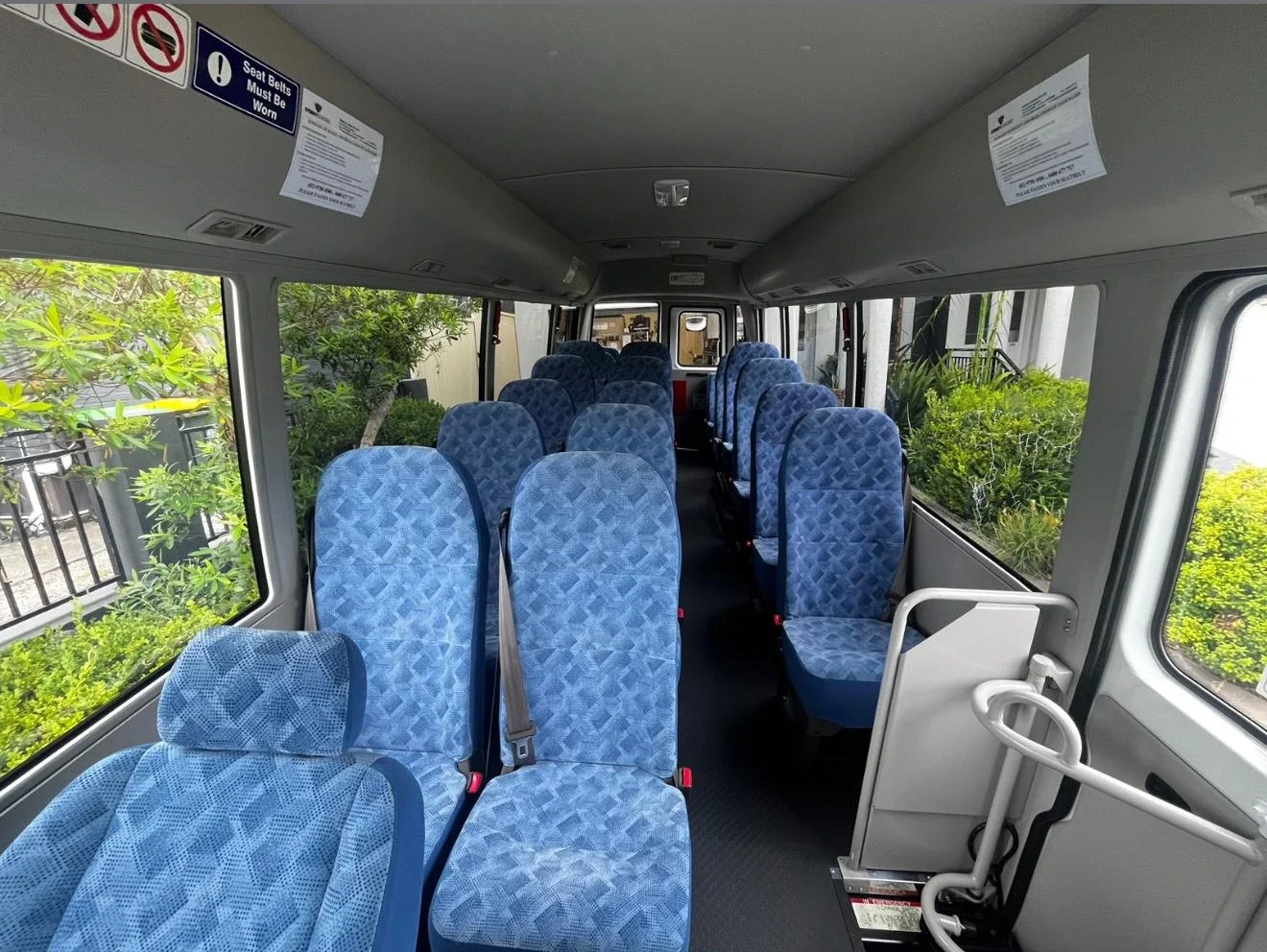
> {trip name}, one week to go > > Bus details are confirmed. > > Pick-up: {pick-up point} > Be there by: {be there by}. The coach cannot wait, so please be at the kerb by then rather than heading over at that time. > Returning: {return departure} from {return point} > > What to bring: {bags allowed} > Food and soft drinks are fine on board. {alcohol line} > Seatbelts are fitted and everyone aged 16 and over needs to wear one. > > If your plans have changed, tell me by {cutoff} so we are not holding the coach for someone who is not coming. > > {organiser name}, {organiser mobile}
Two lines in that message do disproportionate work. “The coach cannot wait” is not a scare tactic, it is often literally true: a charter coach counts as a public bus under the NSW Road Rules and may stop in a bus zone to pick up, but it may not wait there. And the seatbelt line is worth including because on a coach fitted with belts, wearing them is mandatory in NSW for every passenger aged 16 or over, which surprises a lot of adults.
For the {alcohol line}, use “No alcohol on board” for a school, youth or standard corporate trip. Alcohol is permitted on private function bookings by prior arrangement only, so if you have made that arrangement, say so explicitly.
Message 3: the day before
Sent the afternoon before. This is the message people actually screenshot.
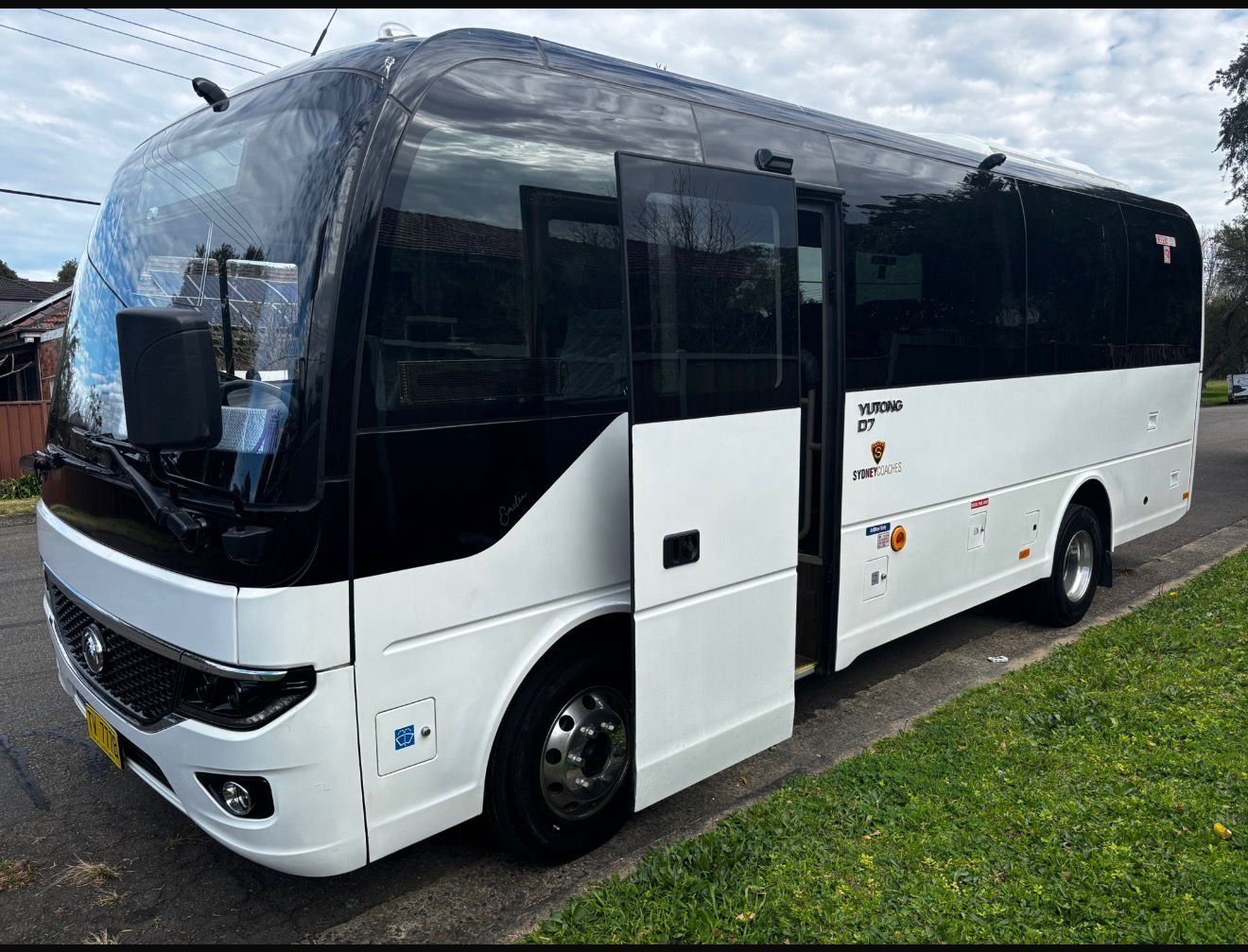
> {trip name}, tomorrow > > Pick-up: {pick-up point} > Be there by: {be there by} > Look for: {vehicle description}, registration {rego} > Driver: {driver first name} > > Running late? Text me on {organiser mobile}. Please do not ring the driver. > > Return: {return departure} from {return point}. Doors close {doors close}. > > {organiser name}
You can fill in the vehicle and driver fields because we send the driver name, mobile and vehicle registration 24 hours before travel. That is the point at which this message gets written, and it is the single highest value message in the set: a group that knows what registration plate to look for stops boarding the wrong bus at a busy kerb.
Keep the driver’s number for yourself. Forty passengers ringing a driver who is driving helps nobody.
Message 4: the morning of
Short. Sent 60 to 90 minutes before the pick-up.
> {trip name}: coach leaves {pick-up point} at {departure time}. Please be there by {be there by}. Look for {vehicle description}, rego {rego}. Text {organiser mobile} if you are held up.
That is the whole message. Anything longer is not read on a phone at 6:40am.
Message 5: the last bus reminder
Sent at the event, roughly an hour before the final departure, and repeated verbally.
> Last coach back leaves {return point} at {return departure}. Doors close at {doors close}. That is the only bus, so please make your own way if you miss it.
The doors-close time is the part people ignore in the earlier messages and act on in this one. And say plainly whether there is another bus. “The last bus is at 11:30” is heard by some people as “there will be more buses until 11:30”.
If you have chosen an early and a late departure, send this message twice, once about 30 minutes before the early one.
Message 6: after
Optional, and only worth sending if you will run the trip again.
> Thanks for coming to {trip name}. Two quick questions if you have a moment: was the pick-up point easy to find, and was {be there by} a reasonable time to be there? Reply here.
Two questions, answerable in one line. That is the input that fixes next year’s message 1.
Writing a meeting point people can find
The commonest mistake is naming a venue when the coach is stopping at a street. A pin dropped on a building takes a passenger to a front door a coach cannot use.
| Instead of | Write |
|---|---|
| “Outside the hotel” | “On {street name}, at the corner of {cross street}, outside {landmark}” |
| “The Opera House” | “Macquarie Street, at the {named point}. This is a short walk from the venue” |
| “Darling Harbour” | “Iron Wharf Place, off Darling Drive” |
| “The airport” | See below |
| “The stadium” | “The coach pick-up area at {named access road}, not the main gates” |
Sydney Airport needs its own wording, because the constraint is invisible from inside the terminal. Registered buses and coaches collect passengers within dedicated ground transport zones, not at the kerb, and drivers may leave the vehicle to meet passengers inside the terminal. Kerbside at Departures is set-down only and the driver has to stay with the vehicle. So for an arrival, send passengers to a meeting point rather than to a kerb.
Sydney Airport publishes signposted meeting points at T1 International Arrivals between exits A and B, and at T2 Domestic Arrivals opposite baggage carousel 6. There is no published meeting point at T3, so if your group is arriving there, nominate a specific point yourself, describe it in words, and say it in message 1 rather than message 4. Signage and furniture move, so write “currently signposted as” and check before you send.
What not to put in a group message
- The driver’s mobile number
- The full itinerary. Passengers need their bit, not the run sheet
- A departure time as the headline instruction, with the arrival time buried underneath
- A map pin without a written street address, because pins do not survive being forwarded
- Anyone’s dietary or accessibility information. That belongs on the manifest, not in a group chat
- Three different phone numbers
Channel and timing
| Message | When | Channel |
|---|---|---|
| 1. Announcement | On confirmation | Email or invitation |
| 2. One week out | 7 days before | Email, plus the group chat |
| 3. Day before | Afternoon before | Group chat or text |
| 4. Morning of | 60 to 90 min before | Text |
| 5. Last bus | 1 hour before departure | In person and text |
| 6. After | Within a few days |
Messages 3, 4 and 5 need to arrive on a phone. Message 1 needs to be findable later, which a group chat is not.
Frequently asked questions
How early should I tell people to arrive at the pick-up point?
Ten to fifteen minutes before departure for a small group, and fifteen to twenty for a full coach. Publish that as the headline time and mention the departure time second, because whichever number you put first is the one people will aim at.
Should passengers have the driver’s number?
No. Give the group one number, yours, and hold the driver’s yourself. We send the driver name, mobile and vehicle registration 24 hours before travel so the organiser has them, not so they can be forwarded to forty people.
What is the minimum message if I only send one?
Message 3. Kerb, arrival time, what the vehicle looks like, registration, one contact number, and the return time with a doors-close time. That single message prevents most of the problems the other five are insuring against.
Someone missed the last bus. What should the message have said?
That there was only one bus, what time the doors closed, and what the alternative was. Check the alternative genuinely exists at that hour at that specific location before you promise it, particularly at a venue outside the city.
Next step
If the movements are not booked yet, tell us the movements and we will quote from them. Pick-up suburb, date and group size is enough to start, and a written quote with the vehicle named comes back within two business hours. For a staff or delegate movement, see corporate bus hire in Sydney, and for a terminal pick-up see how airport group transfers work. The office is on 02 9469 6600.
Sources
- NSW Government, Road Rules 2014 (rule 183, Part 16 and Dictionary), https://legislation.nsw.gov.au/view/html/inforce/current/sl-2014-0758. Accessed 7 September 2026.
- Sydney Airport, Pick-up, https://www.sydneyairport.com.au/pickup. Accessed 7 September 2026.
- Sydney Airport, Drop-off, https://www.sydneyairport.com.au/dropoff. Accessed 7 September 2026.
- Sydney Airport, Resources for registered limousines, buses and coaches, https://www.sydneyairport.com.au/corporate/partner-with-us/commercial-vehicles/resources-for-registered-limousines-buses-and-coaches. Accessed 7 September 2026.