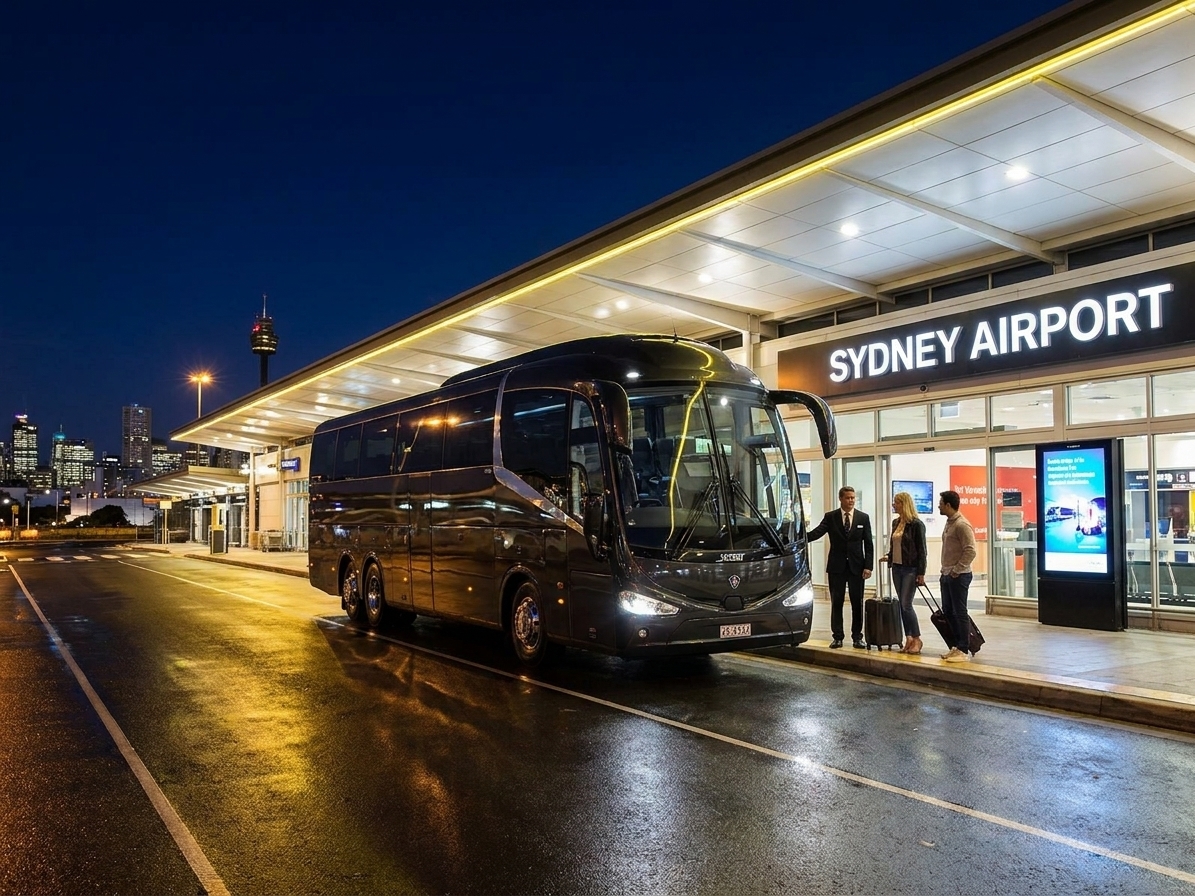
The return leg is the part of a regional wedding that has to be planned first, not last. Eighty guests at a venue 120 km from Sydney means one movement of eighty seats, a published departure time, and a driver whose working day has a legal end. You cannot solve it on the night by asking the coach to wait, and you cannot solve it with an app. It is solved weeks earlier by deciding where guests sleep and when the last vehicle leaves.
Start with the people who have no alternative
Before any vehicle discussion, count the guests for whom there is genuinely no other way home. Anyone who has been drinking. Anyone who flew in and has no car. Older guests and guests with mobility needs, who cannot walk to accommodation in the dark on a rural verge. Guests with young children, who need to leave early rather than late.
That group is your floor. Whatever else you plan, the last vehicle of the night has to be able to carry them in one movement, because there is no second chance at 11.30pm on a country road.
The outbound leg does not work this way. Guests arriving at 2pm on a sunny afternoon have options, patience and daylight. The return leg has none of those, which is why sizing the whole job to the outbound number is the most common planning error at regional venues.
Check the rideshare assumption instead of making it
Plenty of guests will assume a car can be summoned. Do not repeat that assumption and do not flatly deny it either. Check it.
Open a rideshare app with the venue address, at the hour your reception actually ends, on a comparable night of the week, several weeks out. Do the same for a local taxi company by phone, and ask directly whether they can supply cars at that hour and how many. Write down what you find and publish it to guests in those words.
That five minute exercise converts an argument into a fact you can plan around, and it is the single most useful thing a couple can do before booking transport for a regional venue.
The driver’s day has a legal end
This is the constraint that surprises people, and it is worth understanding properly because it cannot be worked around on the night.
Charter work carried out for a fare is a public passenger service in NSW. The NSW exemption that relieves some bus drivers from heavy vehicle fatigue requirements does not apply to that work, so a commercial charter coach and its driver sit inside the national fatigue regime. Under standard hours a solo driver’s work in any 24 hour period is capped and a block of continuous stationary rest is required, and a separate standard hours table applies specifically to solo bus and coach drivers.
The practical consequence for a wedding: the driver’s finishing time was fixed when the job was scheduled, and it includes the drive back to the depot after the last guest steps off. A driver who starts in the early afternoon, runs the outbound leg, waits through the reception and then drives 120 km back to Sydney has a day with an outer limit, and it is not a matter of goodwill.
So the last departure time is not something to leave open. Ask the operator at quote stage what the latest workable departure from the venue is, get it in writing, and build the run sheet backwards from it.
One related detail worth knowing: a vehicle over 4.5 tonnes is limited to 100 km/h in NSW regardless of a higher posted limit. Coach travel times are therefore longer than the car times guests quote at you, which matters when you are calculating whether a second trip is possible.
Three ways to move eighty people, and what each one costs you
| Approach | How it works | Where it works | What it costs you |
|---|---|---|---|
| One vehicle, one movement | A single full-size coach carries the whole group in one run each way | Any distance. The simplest plan for a large regional group | Everyone leaves at the same time, so there is no early option for guests with children |
| One vehicle, staggered runs | The same vehicle makes two or three return runs at published times | Only where the round trip fits the schedule. At 120 km each way that is roughly three hours of driving per cycle, so it usually does not | Cheapest on paper, but at regional distances it rarely fits inside the night |
| Two vehicles | A full-size coach plus a smaller vehicle, or two coaches | Large groups, or where you want an early return option | More cost, but it gives you a 9pm run and an 11.30pm run without a long cycle |
| Sleep near the venue, travel in the morning | A short shuttle to nearby accommodation at night, and a single coach back to Sydney the next morning | Where accommodation clusters near the venue | Guests need rooms, but the long leg moves to daylight and the night run becomes trivial |
The fourth option deserves more attention than it gets. If most guests are staying in the nearest town rather than driving back to Sydney, your late night problem shrinks to a short local shuttle, and the 120 km leg happens the next morning with rested guests and a fresh driver. Accommodation and transport are the same decision at a regional venue, and couples who plan them together spend less and worry less.
A worked example
This is an illustrative plan, not a real booking.
A Saturday wedding at a Southern Highlands venue, about 120 km from Sydney, roughly an hour and a half of driving each way. 80 guests, reception ending at midnight.
The couple ask the transport question on the RSVP and get 62 riders outbound and 74 on the return, with 6 guests never answering. Sizing to the return, counting non-responders as riders and adding a planning buffer gives about 88 seats needed on the last movement.
Options that work:
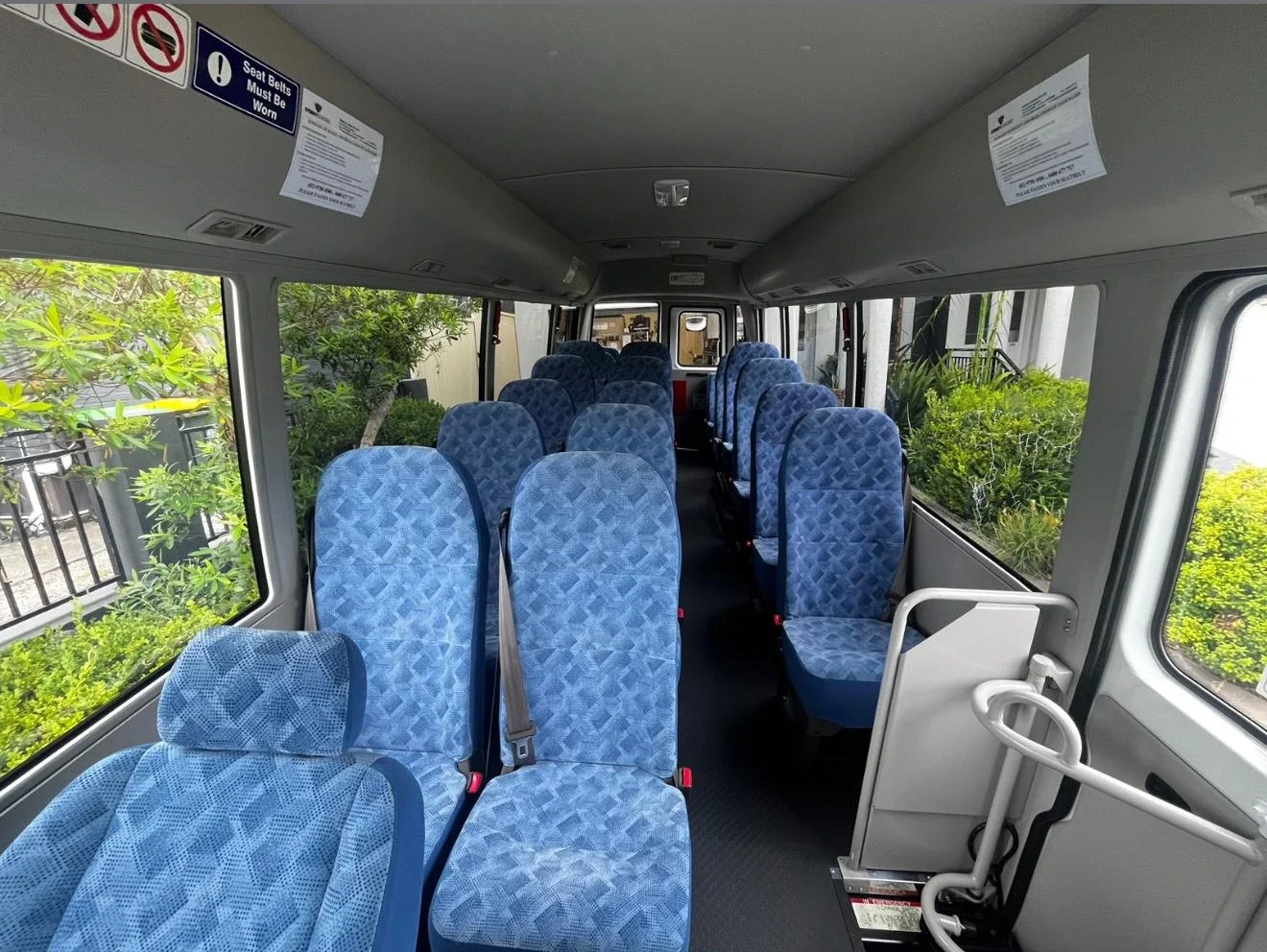
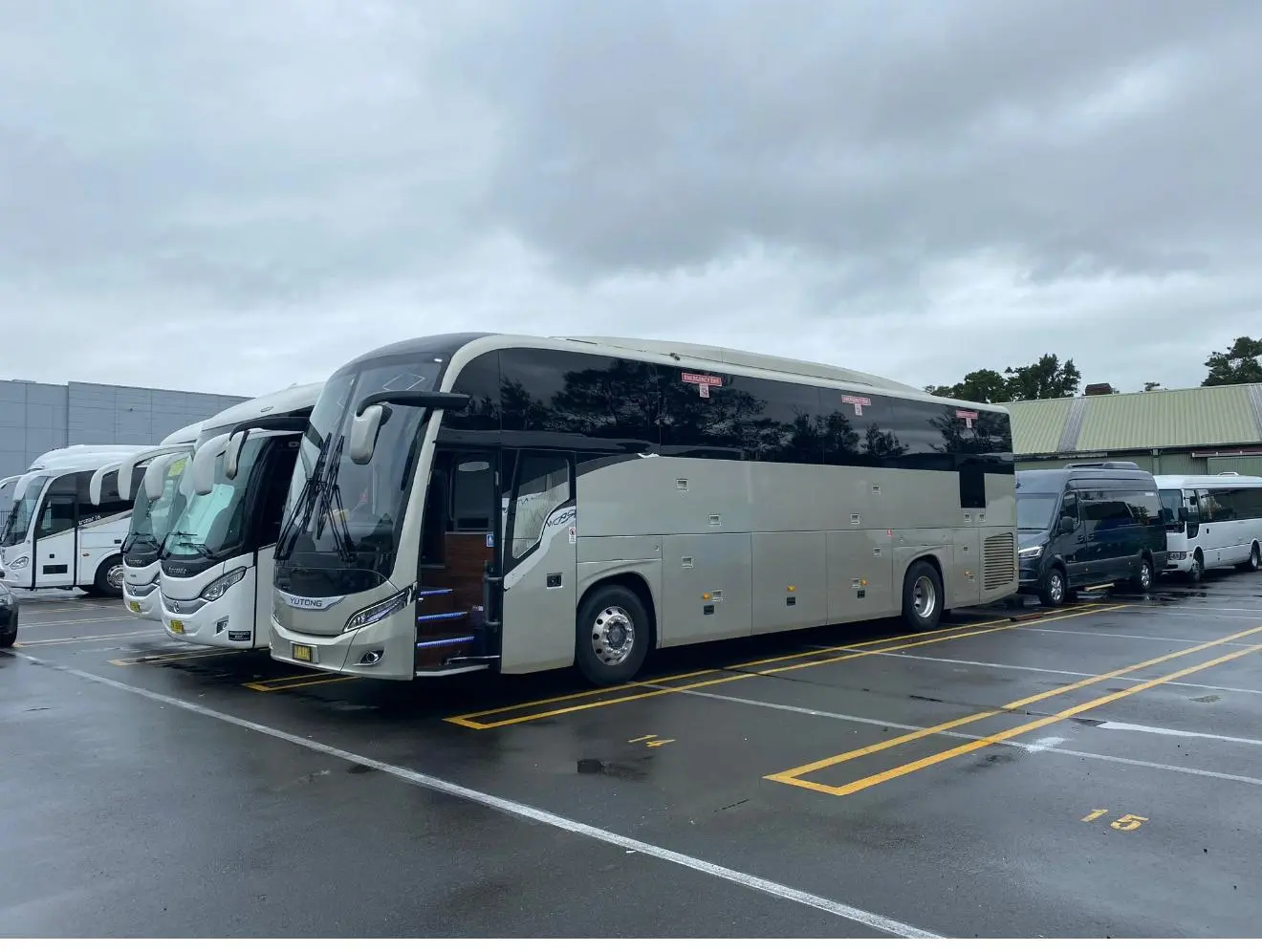
- One 53-seat coach and one 27-seat midi-coach. Both run out together in the afternoon. The midi-coach makes an early return at 9.30pm for guests with children and older guests. The coach takes the rest at 11.45pm. Combined capacity covers the group with margin.
- Accommodation-led. Guests book rooms in the nearest town. A midi-coach runs three short local loops between 10pm and midnight, and a full-size coach returns everyone to Sydney at 10am on Sunday. The long leg happens in daylight.
Options that do not work: one 53-seat coach running the return twice. At an hour and a half each way, the second run means the coach leaves the venue around 11.45pm, reaches Sydney after 1am, returns to the venue after 2.30am, and gets back to the city near 4am, which is not a schedule that fits inside a driver’s day. Two vehicles is the answer, not two trips.
The last departure is a published time, not a negotiation
Guests will ask the driver to wait. Someone will be saying goodbye. Someone will be looking for a jacket.
Publish the last departure as a fixed time in every place guests see transport information, brief a named day-of contact who is not the couple to enforce it, and put a card on the welcome table saying the last coach leaves at that time and cannot wait. The reason is not rudeness, it is that the driver’s hours are regulated and the vehicle is due back.
Give the day-of contact the driver’s name, mobile number and vehicle registration, which are sent 24 hours before travel, so the coordination at the end of the night happens between two people who are expecting each other’s call.
What to ask the venue before you book transport
- Can a full-size coach reach the set-down point, or does the driveway or gate restrict vehicle size?
- Is there a turning area, or does the vehicle need to reverse in the dark?
- Where do guests wait if it rains, and is that spot visible from where the coach stops?
- Is there lighting at the set-down point at midnight?
- Can the coach stay on site during the reception, or does it have to leave and come back?
- What time does the venue require everyone off the property?
The last one governs everything else. Your final departure has to sit before the venue’s curfew and inside the driver’s day, and those two limits are set by other people.
What to ask the operator
- What is the latest departure from the venue that works for a single driver, given the return distance?
- Is this quoted hourly or as a fixed transfer fare, and how is after-hours running handled? After-hours and public holiday loading, waiting time beyond the booked window, and tolls and parking are confirmed in advance and priced separately.
- Does the vehicle wait at the venue or return to Sydney between movements, and how does that change the price?
- What is the seat count on the exact vehicle being allocated, excluding the driver?
- Is alcohol on board agreed? It is permitted on private function bookings by prior arrangement only, so raise it at quote stage.
For the Southern Highlands specifically, it is worth starting from what coach travel between Sydney and the Southern Highlands actually involves, because the return leg is the same drive in reverse at midnight and that is the leg your plan lives or dies on.
Frequently asked questions
What happens at 11pm when there is no rideshare?
Whatever you arranged in advance. Confirm availability yourself before the day rather than assuming, and if it is thin, plan the return leg as a scheduled coach movement with a published departure time. A regional venue at midnight is not a place to improvise.
How many return runs should I plan?
At least two if you can, because an early run lets guests with children and older guests leave without a fuss and shrinks the crowd on the last movement. Over a long distance, staggering means a second vehicle rather than a second trip, because the round trip does not fit inside the night.
How late can a coach run?
Later than most weddings need, but not indefinitely, and the limit is legal rather than commercial. Charter work carried out for a fare sits inside the heavy vehicle fatigue regime, so the driver’s working day is capped and includes the drive back to the depot. Ask for the latest workable departure in writing at quote stage.
Is it cheaper to run one coach twice?
Only where the round trip genuinely fits. From a Southern Highlands venue at about an hour and a half each way, a second return run adds roughly three hours of driving after midnight, which does not work. From a venue close to guest accommodation, two or three short loops with one vehicle is often the cheapest plan available.
Where should guests stay?
As close to the venue as the local accommodation allows. Clustering guests near the venue turns the late night movement into a short shuttle and moves the long leg to the next morning, which is safer, easier to staff and usually cheaper than a midnight run to Sydney.
Next step
Send the venue address, the number of guests you expect on the return leg, the reception finish time and the venue’s curfew, and you will get a fixed written quote back within two business hours with the vehicle named and the latest workable departure confirmed rather than assumed.
Start with wedding bus hire in Sydney, or if the group is large enough to need full-size coach hire in one movement, say so in the enquiry. Call 02 9469 6600, Monday to Friday 7am to 6pm or Saturday 8am to 2pm. Regional weddings cluster in peak periods, so allow four to eight weeks over December and long weekends.
Sources
- National Heavy Vehicle Regulator, Heavy vehicle fatigue management: bus industry, https://www.nhvr.gov.au/safety-accreditation-compliance/fatigue-management/heavy-vehicle-fatigue-management-bus-industry. Accessed 7 September 2026.
- NSW Government, Heavy Vehicle National Law (NSW) 2013, sections 222A, 222B and 248A, https://legislation.nsw.gov.au/view/whole/html/inforce/current/act-2013-042. Accessed 7 September 2026.