Never book a group airport transfer to the scheduled landing time. Book it to a realistic kerbside time, and settle four things in writing before you pay a deposit: who is watching the flight, what waiting is included, what waiting costs beyond that, and what happens if the flight is cancelled or diverted. A delay is not an unusual event in airport work. It is the ordinary case, and the booking should already have an answer for it.
Why a delay is not just a waiting problem
Group organisers tend to picture a delay as a coach sitting patiently at the kerb for an extra hour. That is not what happens at Sydney Airport.
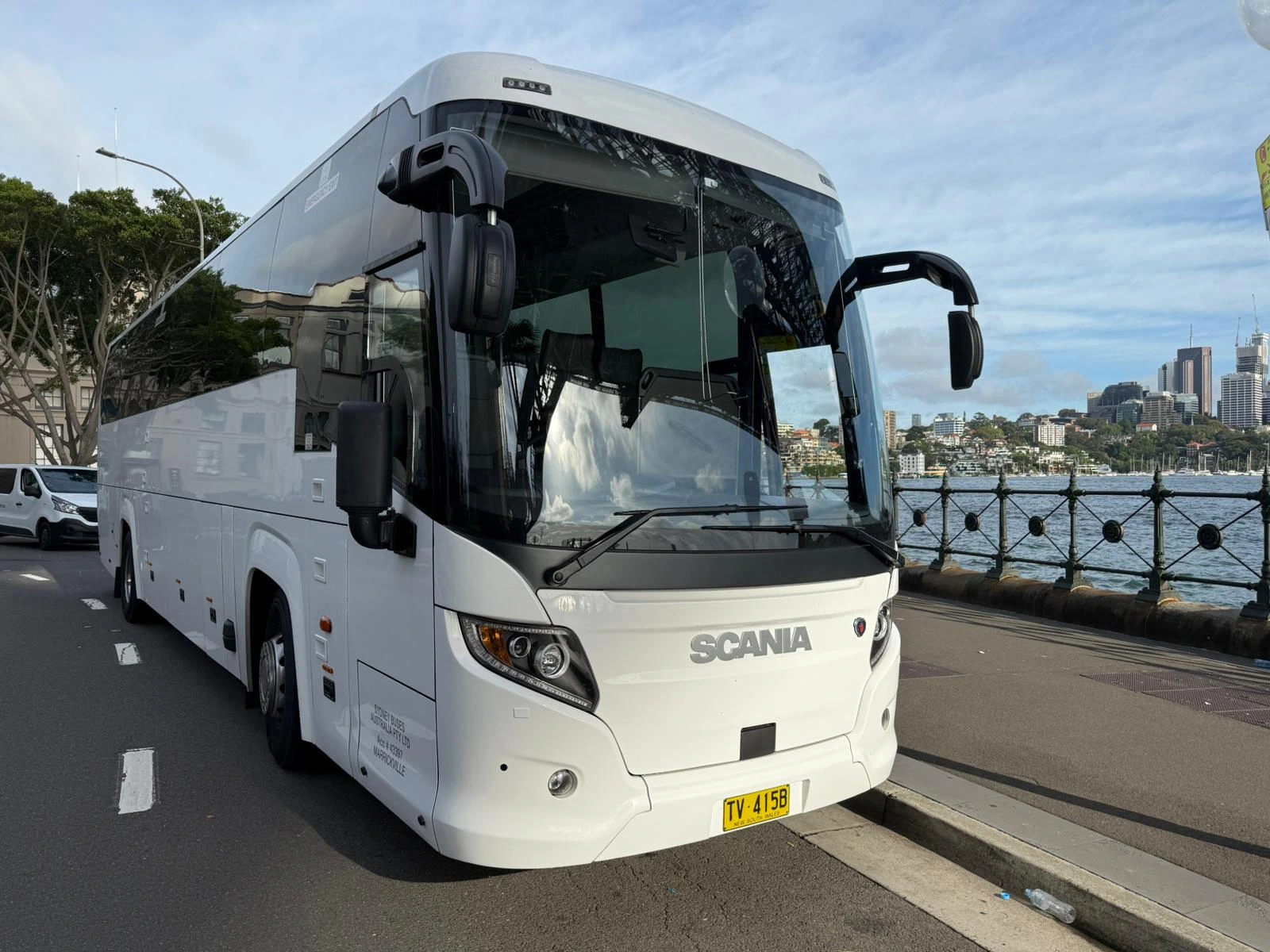
Collection at Sydney Airport is zone-only. Commercial vehicles must not be left unattended at terminal frontages at any time, and must use the vehicle holding areas when they are not collecting pre-booked passengers. A delayed arrival therefore means the vehicle is holding at the bus holding area on Ross Smith Avenue, not idling outside arrivals. That is a good arrangement, and it is exactly why a delay is manageable at all. But it also means the delay is absorbed by three things you cannot see: the operator’s waiting terms, the vehicle’s schedule for the rest of the day, and the driver’s legal work hours.
Those three are the reasons a “flexible” fare can quietly stop being flexible while your group is still airborne. That failure pattern is well documented across the industry, and it almost always traces back to terms that were never written down.
Wheels down is not kerbside
The second planning error is subtler than the first. Even a perfectly on-time flight does not deliver a group to the kerb at the landing time.
Between wheels down and a group standing complete at the meeting point, an arriving party clears the aircraft, then the terminal’s arrivals processing, then baggage. A large group is not through until its slowest member is through. For an international arrival there are more sequential steps than for a domestic one, and the tail on a group of forty is longer than the tail on a group of six.
We have not published an interval for this, because an honest one is a range rather than a number and it varies with the terminal’s load on the day. Ask your operator for their own observed figures for the specific terminal. What matters for the booking is that the pick-up time should already sit later than the landing time before any delay is announced.
The four terms that decide whether a delay costs you money
Put these four questions to the operator in writing at quote stage. The quality of the written answers tells you more about an operator than the price does.
| Question | What a weak answer looks like | What a usable answer looks like |
|---|---|---|
| Who is monitoring the flight, and how? | “We keep an eye on it.” | A named process, the flight number and operating carrier the operator will track, and who contacts whom when the arrival time moves. |
| How much waiting is included? | “We are flexible.” | A stated window, with the start point defined (landing time, or a nominated pick-up time). |
| What does waiting beyond that cost? | Silence, or “we will sort it out on the day.” | A rate or basis stated in the written quote, agreed before the deposit. |
| What happens if the flight is cancelled, diverted or rebooked to another terminal? | Nothing in writing. | A stated position on rescheduling, on cancellation, and on a terminal change, which is a genuine change of job. |
Our written quotes are fixed, name the actual vehicle, and set out cancellation terms, and waiting time beyond the booked window is confirmed in advance and priced separately. Getting those items on paper before the deposit is the whole exercise.
What flight monitoring actually requires from you
Monitoring is only as good as the identifiers it is given. Whoever is watching the flight needs four things, and a surprising number of bookings supply two.
- The flight number and the operating carrier. On a codeshare the terminal follows the operator, not the ticket. This single field prevents the most expensive kind of error.
- The arrival date in local Sydney time. An overnight international sector crosses a date boundary, and bookings have been made for the wrong day because of it.
- The terminal. State it explicitly even where it seems obvious.
- A person on the ground with a phone that works in Australia. International roaming is the most common failure point in the whole chain. Nominate someone with local connectivity, and give the driver’s mobile number to them directly. We send the driver’s name, mobile number and vehicle registration twenty-four hours before travel.
Ask the operator directly whether inbound flight monitoring is performed as standard on your booking, and get the answer in writing. Do not assume it because the word appears on a website.
The driver’s clock is part of the problem
This is the constraint almost no organiser knows about, and it explains operator behaviour that otherwise looks unhelpful.
A charter coach carrying passengers for a fare is inside the Heavy Vehicle National Law fatigue regime. The exemption that applies to some bus driving in New South Wales switches off the moment there is a fare, and a commercial charter is a public passenger service. Standard hours for a solo driver cap work in a 24-hour period and require a continuous stationary rest break, with further limits across seven and fourteen days. A bus and coach specific standard hours table also applies.
The practical effect: a three-hour delay does not just cost waiting time. It eats the driver’s remaining available hours for the day. An operator that says “we can hold until 4pm but not until 7pm” is usually telling you something about the law rather than about their willingness. If your group’s arrival is genuinely open-ended, say so at quote stage so the job is resourced accordingly, rather than discovering the limit at the airport.
Hourly or fixed: which structure survives a delay
The pricing structure you choose changes your exposure to a delay, and most groups pick the wrong one by default.
| Structure | How a delay affects you | Best suited to |
|---|---|---|
| Hourly charter against a minimum hire (3 hours for minibuses and people movers, 4 hours for midi-coaches and full-size coaches) | The clock is the basis of the charge, so a delay extends the booked window and any time beyond it is quoted separately. | Jobs where the vehicle is retained for a period anyway, such as a multi-stop day. |
| Single fixed transfer fare | A fare quoted this way is a point-to-point price and is not charged against a minimum hire block. Waiting beyond the booked window is still confirmed and priced separately. | A straight airport run, especially where the arrival time is uncertain. |
For an airport arrival, ask for the fixed transfer fare and ask what waiting sits inside it. Then ask what happens after that. Two questions, one page, no surprises. How our charter pricing is structured sets out the published rates behind both options, and airport transfers for groups in Sydney covers the service itself.
A booking note you can copy
Paste this into the booking request. It is short, it is specific, and it forces the four terms onto paper.
> Inbound group transfer, [date, Sydney local time]. > Flight [number], operated by [operating carrier], arriving [terminal]. > [Headcount] passengers, approximately [number] checked cases and [number] cabin bags. > Please quote as a fixed transfer fare. > Please confirm in writing: (1) whether the flight will be monitored and by whom; (2) what waiting time is included and from what start point; (3) how waiting beyond that is charged; (4) your position if the flight is cancelled, diverted, or rebooked to a different terminal. > Ground contact: [name], [Australian mobile number]. > Meeting point to be confirmed in the booking.
The last line matters more at some terminals than others. Sydney Airport publishes meeting points at T1 International and T2 Domestic but publishes none at T3, so a T3 arrival needs the meeting point agreed rather than assumed.
When the delay becomes a different job
Three situations stop being delays and become new bookings. Recognise them early.
A terminal change. A rebooking that moves the group from one Sydney Airport terminal to another changes the collection zone, the meeting point and possibly the vehicle. Tell the operator immediately rather than at the original pick-up time.
A date change. An overnight delay is a cancellation and a rebooking, and it is governed by the cancellation terms in the written quote, not by the waiting terms.
A split group. If half the party is rebooked onto a later flight, you are no longer managing a delay. You are managing staggered arrivals, and the decision becomes whether to hold one vehicle or run two movements.
Frequently asked questions
What happens if our flight is late?
That depends entirely on what the booking says, which is why the four terms belong in writing before the deposit. Operationally the vehicle waits at Sydney Airport’s bus holding area on Ross Smith Avenue rather than at the kerb, and is called forward when the group is assembled.
Is there free waiting time on a group airport transfer?
Do not assume there is. Our position is that waiting time beyond the booked window is confirmed in advance and priced separately, so the number should be in your written quote. Ask for it explicitly rather than relying on the word “flexible”.
Should I book the coach for the landing time?
No. The landing time is not the kerbside time. A group is only through when its slowest member is through, and an international arrival has more steps than a domestic one. Set the pick-up later than the landing time as a matter of course.
How is flight monitoring actually done?
By tracking a specific flight number and operating carrier for a specific date and terminal, and by having a nominated person on the ground who can be reached on an Australian mobile number. Ask your operator in writing whether monitoring is performed on your booking and who performs it.
Why can’t the driver simply wait as long as we need?
Two reasons. Sydney Airport does not permit commercial vehicles to be left unattended at terminal frontages, so waiting happens at the holding area. And a charter driver is inside the Heavy Vehicle National Law work and rest limits, so a long hold reduces the hours available for the rest of the day.
What if the flight is cancelled after we have paid a deposit?
That is governed by the cancellation terms set out in your written quote rather than by any waiting provision. Read those terms before paying, and ask specifically what applies to a same-day cancellation.
Next step
Send the flight number, operating carrier, date, terminal and headcount, and ask for the run to be quoted as a fixed transfer fare with the delay terms set out in writing. Quotes come back within two business hours during office hours, Monday to Friday 7am to 6pm and Saturday 8am to 2pm. Our published booking terms answer the standard questions, and anything specific to your arrival can be written into the quote.
For arrivals with genuinely open-ended timing, call 02 9469 6600 first. It is a five-minute conversation that decides how the job is resourced.
Sources
- Sydney Airport, “Resources for registered limousines, buses and coaches”, https://www.sydneyairport.com.au/corporate/partner-with-us/commercial-vehicles/resources-for-registered-limousines-buses-and-coaches. Accessed 7 September 2026.
- Sydney Airport, “Pick-up”, https://www.sydneyairport.com.au/pickup. Accessed 7 September 2026.
- National Heavy Vehicle Regulator, “Heavy vehicle fatigue management, bus industry”, https://www.nhvr.gov.au/safety-accreditation-compliance/fatigue-management/heavy-vehicle-fatigue-management-bus-industry. Accessed 7 September 2026.
- National Heavy Vehicle Regulator, “Bus and coach driver fatigue and health and wellbeing”, https://www.nhvr.gov.au/safety-accreditation-compliance/chain-of-responsibility/regulatory-advice/bus-and-coach-driver-fatigue-and-health-and-wellbeing. Accessed 7 September 2026.