A convoy is two or more coaches run as a single movement, with one schedule, one named point of contact and a defined loading order. Sydney Buses & Coaches quotes a coordinated convoy per event once a group passes 58 passengers, because the largest single vehicle in the fleet seats 57. Above that line the job stops being a vehicle booking and becomes a timing problem, and the three things that decide whether it works are load order, the gap between departures and who the drivers call.
Where the second vehicle actually comes from
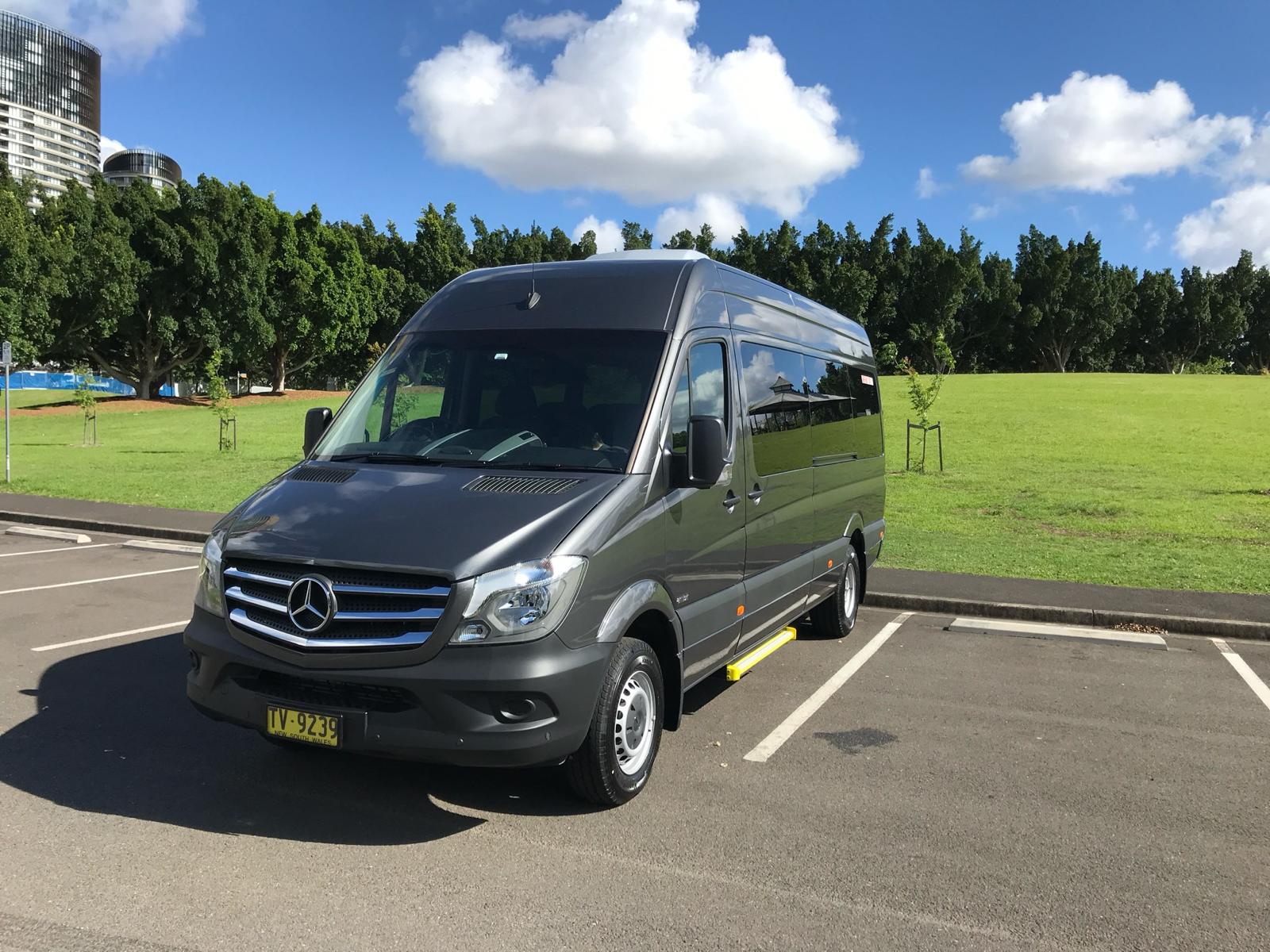
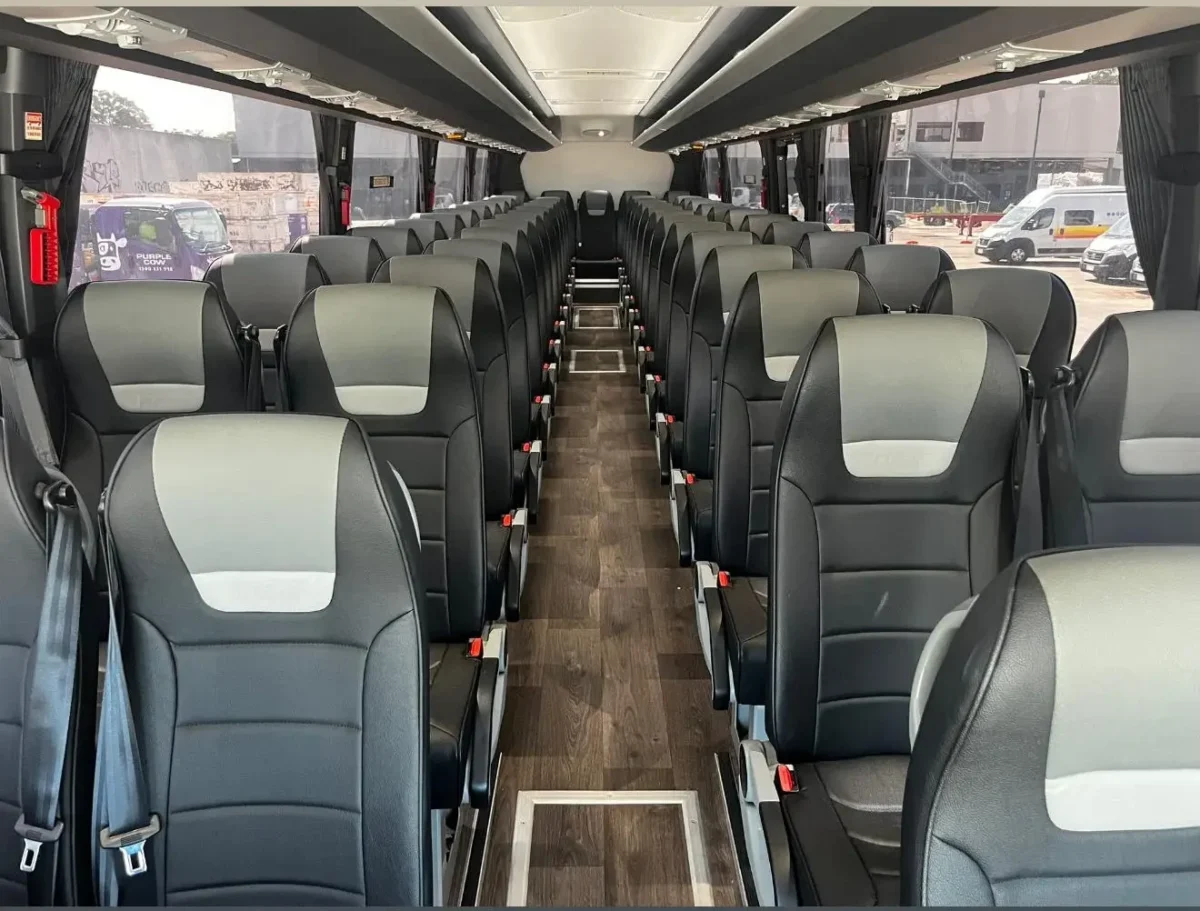
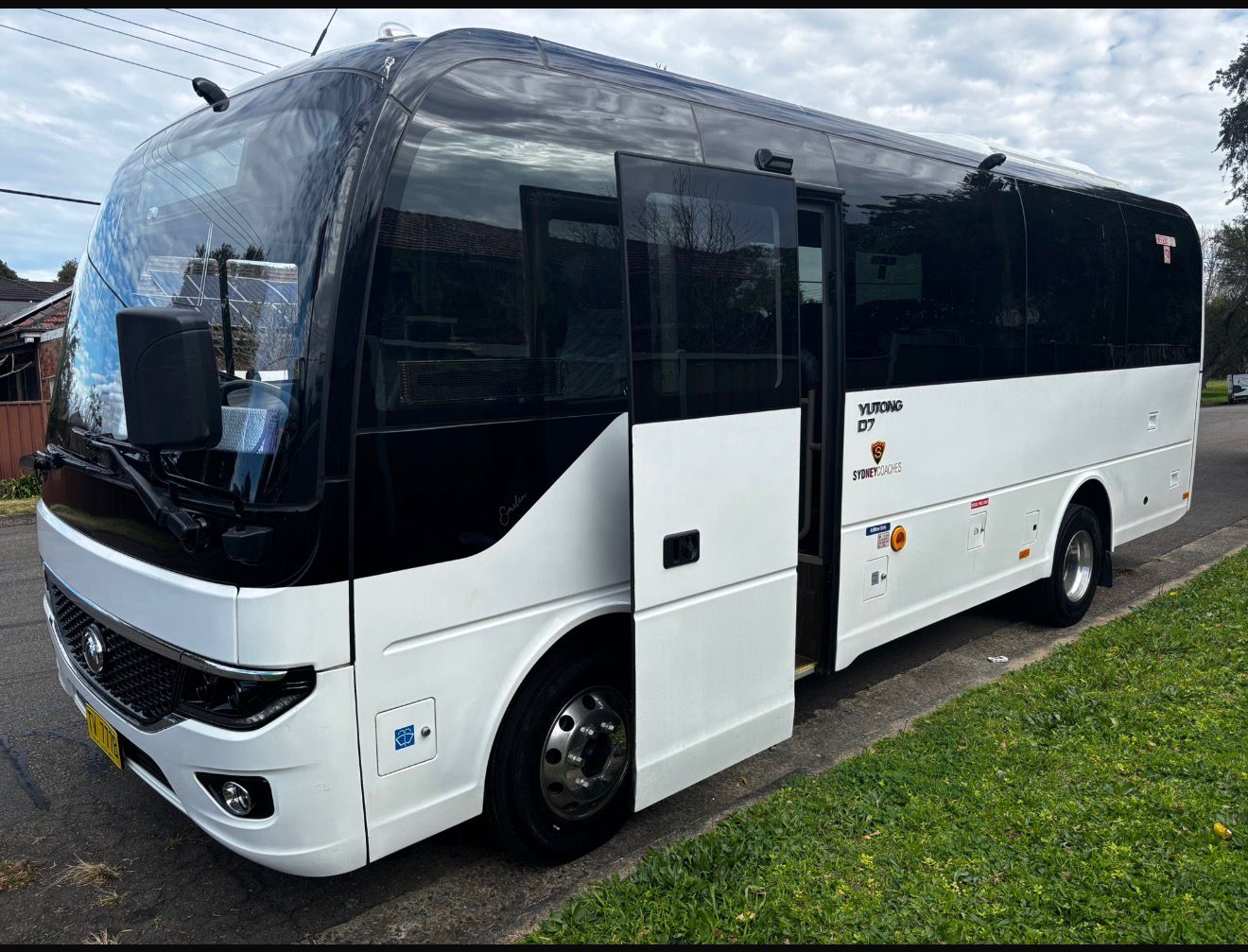
The published fleet runs from a 7-seat Mercedes V-Class up to a luxury touring coach seating 50 to 57, with an executive coach at 53 and a 48-seat luxury coach in between. Seat counts exclude the driver. Once a group is 58 or more, there is no single vehicle, so the quote becomes a coordinated convoy priced per event rather than at a published hourly rate.
The build is not automatic, and it is worth understanding before you read a quote. A convoy can be assembled several ways for the same headcount, and the right answer usually depends on the venue rather than the arithmetic.
| Group size | One way to build it | The other consideration |
|---|---|---|
| 58 to 70 | One 53-seat executive coach plus a 21 to 24 seat executive minibus | The minibus can serve a second pick-up suburb that the coach cannot reach on time |
| 71 to 100 | Two full-size coaches | Two identical vehicles are easier to sequence and easier to relabel if numbers move |
| 101 to 130 | Two full-size coaches plus a 27-seat midi-coach | The midi-coach is the flexible unit for late additions and for venues with a height or turning limit |
| 130 plus | Three or more full-size coaches | The venue’s set-down capacity, not the fleet, becomes the constraint |
Two identical vehicles are almost always easier to run than a coach plus a minibus. Everyone travels at the same speed, both vehicles hold the same number, and if one group is short you can move people between them without breaking a seat count. Mixed builds exist for a reason, usually geography, but they cost you flexibility on the day.
For anything above two vehicles, ask the operator to name each vehicle and its seat count in the written quote rather than accepting a total capacity figure. A quote that says “capacity 110” tells you nothing about how those 110 seats arrive.
One point of contact, and what that person actually does
The single most common failure on a multi-vehicle job is that three different people are giving three different instructions to three different drivers.
There should be exactly one person on the customer side who talks to the operator, and exactly one arrangement on the operator side for reaching every driver in the convoy. The customer contact is not the host, the bride, the chief executive or the person being farewelled. It is someone with no ceremonial role who is willing to hold a phone all day.
That person needs four things before the day: the name and mobile of every driver, the registration of every vehicle, the operator’s dispatch number, and a written run sheet that every driver has also been given. Sydney Buses & Coaches sends driver name, driver mobile and vehicle registration 24 hours before travel, which is the point at which you should be building your own contact sheet rather than the morning of the event.
The convoy also needs a lead vehicle. The lead sets the pace, arrives first, and is the vehicle whose driver confirms the set-down point is clear before the rest commit to the approach. Everything else follows a decision that has already been made rather than five drivers each deciding independently.
Agree the communication method in advance and write it into the run sheet. It matters less which method is used than that all the drivers are on the same one, and that your contact knows how to reach the operator’s office rather than only one driver.
Staggered loading, and why a convoy does not leave together
Coaches do not arrive together, and they should not try to. Almost no Sydney venue has room for three full-size coaches at a single set-down point at the same moment, so a convoy that arrives as a block ends up with two vehicles circling.
The sequence that works looks like this.
- Publish one departure time per vehicle, not one departure time for the group. Give each passenger a vehicle number and a time, and put both on the same message.
- Assign passengers to vehicles in advance, by suburb, by table, by department or by family group. Never let people self-select at the kerb.
- Set a fixed gap between departures. The gap is set by how long the set-down point takes to clear at the other end, not by how long boarding takes.
- Load the lead vehicle first and let it go once it is loaded, rather than holding it while the rest fill. A held vehicle is the start of a cascade.
- Give each vehicle a nominated marshal from the group, not just a driver. The marshal has the passenger list for that vehicle and counts heads.
- Confirm each departure to the single point of contact by exception. Silence means loaded and moving. A call means a problem.
- Reverse the same order for the return, and publish it before the event starts rather than at the end of the night.
Boarding a full-size coach takes longer than most organisers allow, and it takes much longer when luggage goes underneath, when the group is elderly, when it is raining, or when everyone has been at a function for four hours. Build the schedule on the slow version.
Sydney venues where the convoy sequence is decided for you
Several major Sydney venues publish coach arrangements that effectively dictate how a convoy has to be sequenced, because they publish a single point rather than a coach parking area.
At Sydney Olympic Park, serving Accor Stadium and Afterpay Arena, coaches use Coach Pod C off Edwin Flack Avenue, accessed from Uhrig Road via Carter Street. Access is pre-booked through the Sydney Olympic Park Authority, the booking is valid only for the date and location shown, and the booking window closes at 11.59pm the day before the event. On a convoy, that means a booking for every vehicle, made the day before at the latest. Sydney Olympic Park is a restricted parking area, so vehicles must sit wholly within marked bays rather than lining up along a kerb.
At Allianz Stadium in Moore Park, the published guidance during events is that private coaches should access Driver Avenue via Lang Road and not Moore Park Road. Coaches may park at the southern end of Driver Avenue if space is available. Availability-based is not the same as reserved, so a three-vehicle convoy cannot be planned on the assumption that all three will fit.
At ICC Sydney, coach drop-off is at Iron Wharf Place off Darling Drive, and coach parking is arranged through a dedicated ICC Sydney Event Manager rather than booked online.
Away from venues with their own arrangements, the underlying road rule governs. A coach may stop in a bus zone to set down or pick up passengers under NSW Road Rules 2014 rule 183, because the NSW Dictionary defines a public bus as including a coach. It may not wait there. The City of Sydney’s Central Sydney On-Street Parking Policy states that the City will not accommodate long-stay coach lay-over on-street in central Sydney, so a convoy in the CBD needs a plan for where three vehicles physically sit between drop-off and pick-up. That plan is the operator’s to make, but it is a fair question to ask before you sign.
What breaks a convoy
Six things account for most multi-vehicle failures, and every one of them is preventable at the quoting stage.
Passengers not assigned to a vehicle. People board the first coach they see, the lead vehicle leaves overloaded and the last one leaves half empty. Assign seats to vehicles by name.
A single departure time. One time for four coaches guarantees a queue at the set-down point.
No return plan published before the event. The return is where convoys fall apart, because everyone leaves at once and the vehicles are not all in the same place. Publish the return sequence in the same message as the outbound one.
The venue booking made too late. Where a venue runs a booking window, as Sydney Olympic Park does, missing it removes the arrangement for the entire convoy, not just one vehicle.
The day stretching past the driver’s hours. Coach drivers are inside the heavy vehicle fatigue regime, which sets maximum work hours and minimum continuous stationary rest across 24 hours, 7 days and 14 days, with a separate standard hours table for solo bus and coach drivers. A convoy that starts at 6am for an airport run and is asked to hold until midnight is not a scheduling irritation, it is a legal limit. Raise the full span of the day at the quote stage so it is built in.
One contact on the customer side becoming three. By the afternoon, someone senior always starts calling drivers directly. Tell your group in advance that the drivers only take instructions from one named person.
What to lock in before the day
- Every vehicle named in the written quote with its individual seat count.
- A passenger list per vehicle, with a nominated marshal for each.
- One departure time per vehicle, outbound and return, published to the group.
- Driver names, mobiles and registrations, which arrive 24 hours before travel.
- The set-down point as a street address, plus the approach route where the venue specifies one.
- Any venue coach booking, who is buying it, and its deadline.
- Where the vehicles sit between drop-off and pick-up.
- The full span of the day from first pick-up to last drop-off, confirmed against driver hours.
If the movement is a recurring corporate pattern rather than a one-off, corporate bus charter in Sydney is the right starting point, and the published fleet and seat counts will tell you how the vehicles combine. For match days and arena events, stadium and event shuttle runs covers the route side.
Frequently asked questions
At what group size do you need more than one coach?
At 58 passengers. The largest vehicle in the published fleet is a luxury touring coach seating 50 to 57, excluding the driver, so 58 or more is quoted as a coordinated convoy priced per event rather than at a published hourly rate.
Who coordinates multiple coaches on the day?
One named person on the customer side and the operator’s scheduling office on the other. Drivers should take movement instructions through that single channel. Driver names, mobiles and vehicle registrations are provided 24 hours before travel so the contact sheet can be built in advance.
Do all the coaches leave at the same time?
No. Departures are staggered, with a fixed gap set by how long the set-down point at the destination takes to clear. Arriving as a block is the fastest way to end up with vehicles circling, because most Sydney venues publish a single coach set-down point rather than a coach parking area.
How are passengers split between vehicles?
In advance, and by something people already understand: suburb, department, table number or family group. Self-selection at the kerb reliably produces one overloaded vehicle and one that is half empty.
Can several coaches wait together near a Sydney venue?
Rarely on-street. A coach may stop in a bus zone to set down or pick up under rule 183 of the NSW Road Rules but may not wait there, and the City of Sydney’s parking policy states it will not accommodate long-stay coach lay-over on-street in central Sydney. Where the vehicles wait is a question to settle in the quote, not on the night.
How far ahead should a multi-vehicle booking be made?
Published lead times are two to four weeks for most jobs and four to eight weeks for peak periods including December, race days, school excursion season and long weekends. A convoy takes more vehicles out of the same fleet on the same day, so the peak-period figure is the one to plan against.
Next step
Send the pick-up suburb or suburbs, the date, the total group size and the venue. That is enough to start, and you will get a fixed written quote back within two business hours with every vehicle named and the loading sequence set out rather than a single capacity number.
Start with corporate bus charter in Sydney or call 02 9469 6600, Monday to Friday 7am to 6pm or Saturday 8am to 2pm.
Sources
- Sydney Olympic Park Authority, Bus and coach parking, https://www.sydneyolympicpark.com.au/parking/bus-and-coach-parking. Accessed 7 September 2026.
- Allianz Stadium, Plan your visit: transport, https://www.allianzstadium.com.au/plan-your-visit/transport. Accessed 7 September 2026.
- ICC Sydney, Getting here, https://iccsydney.com.au/visitors/getting-here/. Accessed 7 September 2026.
- NSW Government, Road Rules 2014 (NSW), rule 183 and Dictionary, https://legislation.nsw.gov.au/view/html/inforce/current/sl-2014-0758. Accessed 7 September 2026.
- City of Sydney, Central Sydney On-Street Parking Policy, https://www.cityofsydney.nsw.gov.au/-/media/corporate/files/publications/policies/central-sydney-street-parking-policy/central-sydney-on-street-parking-policy_0525.pdf. Accessed 7 September 2026.
- National Heavy Vehicle Regulator, Heavy vehicle fatigue management: bus industry, https://www.nhvr.gov.au/safety-accreditation-compliance/fatigue-management/heavy-vehicle-fatigue-management-bus-industry. Accessed 7 September 2026.