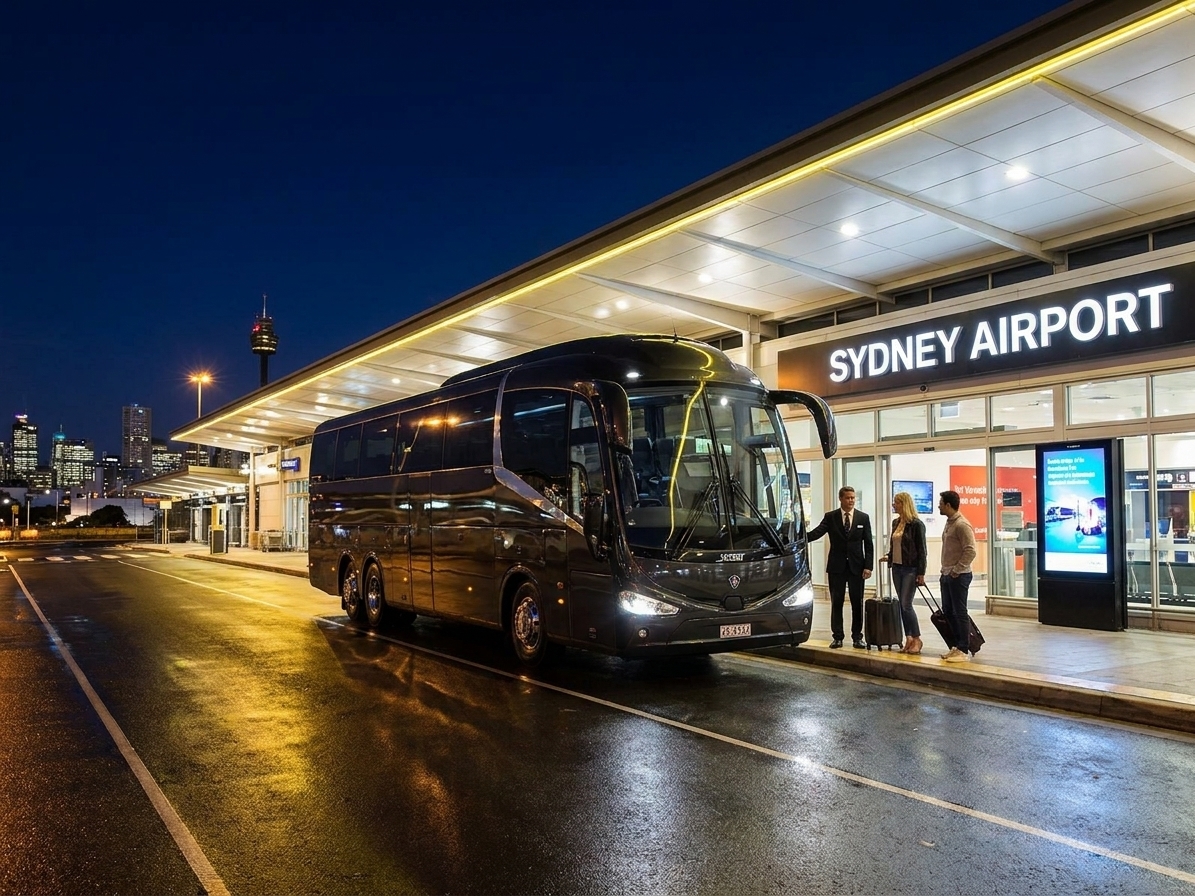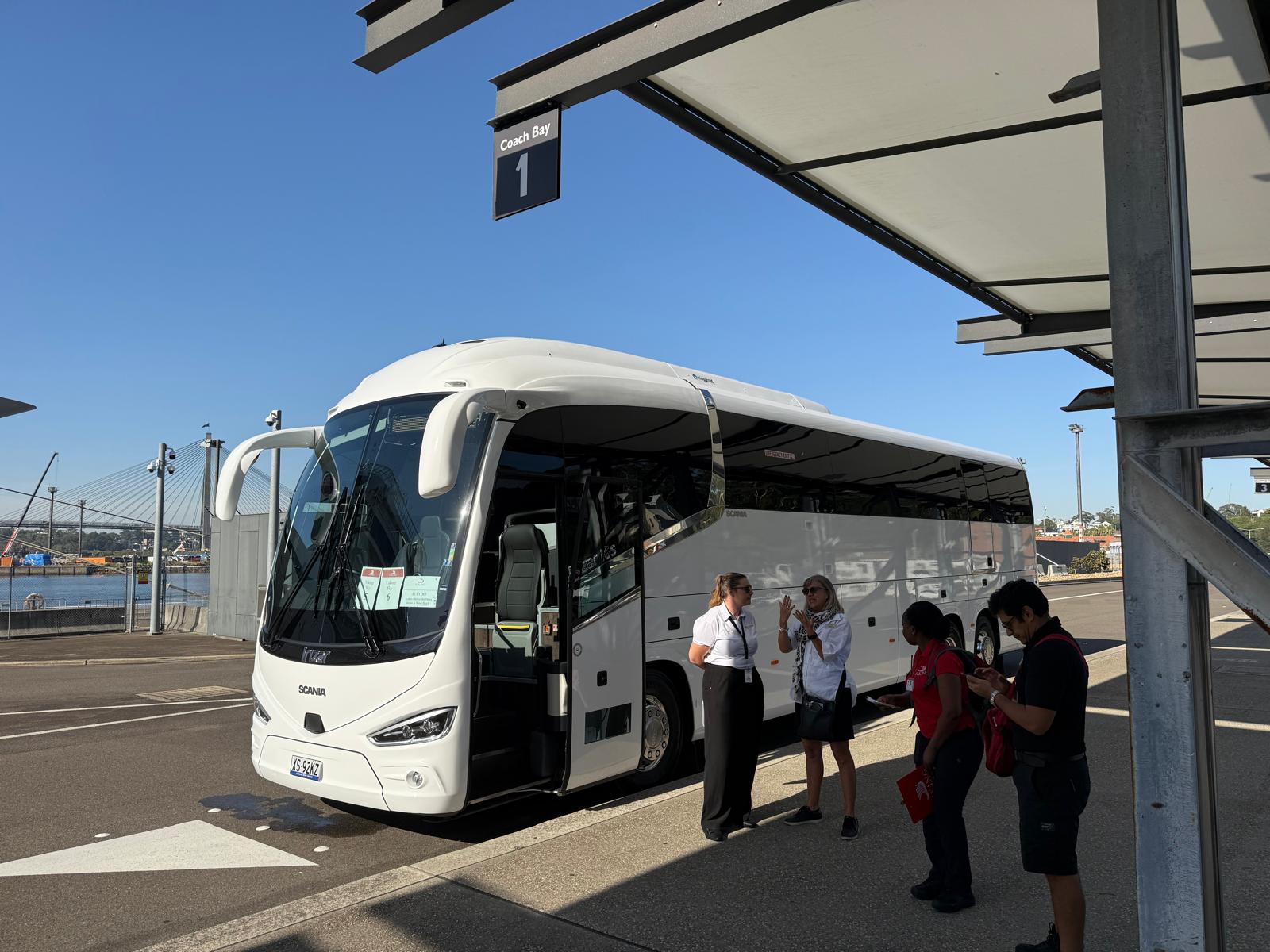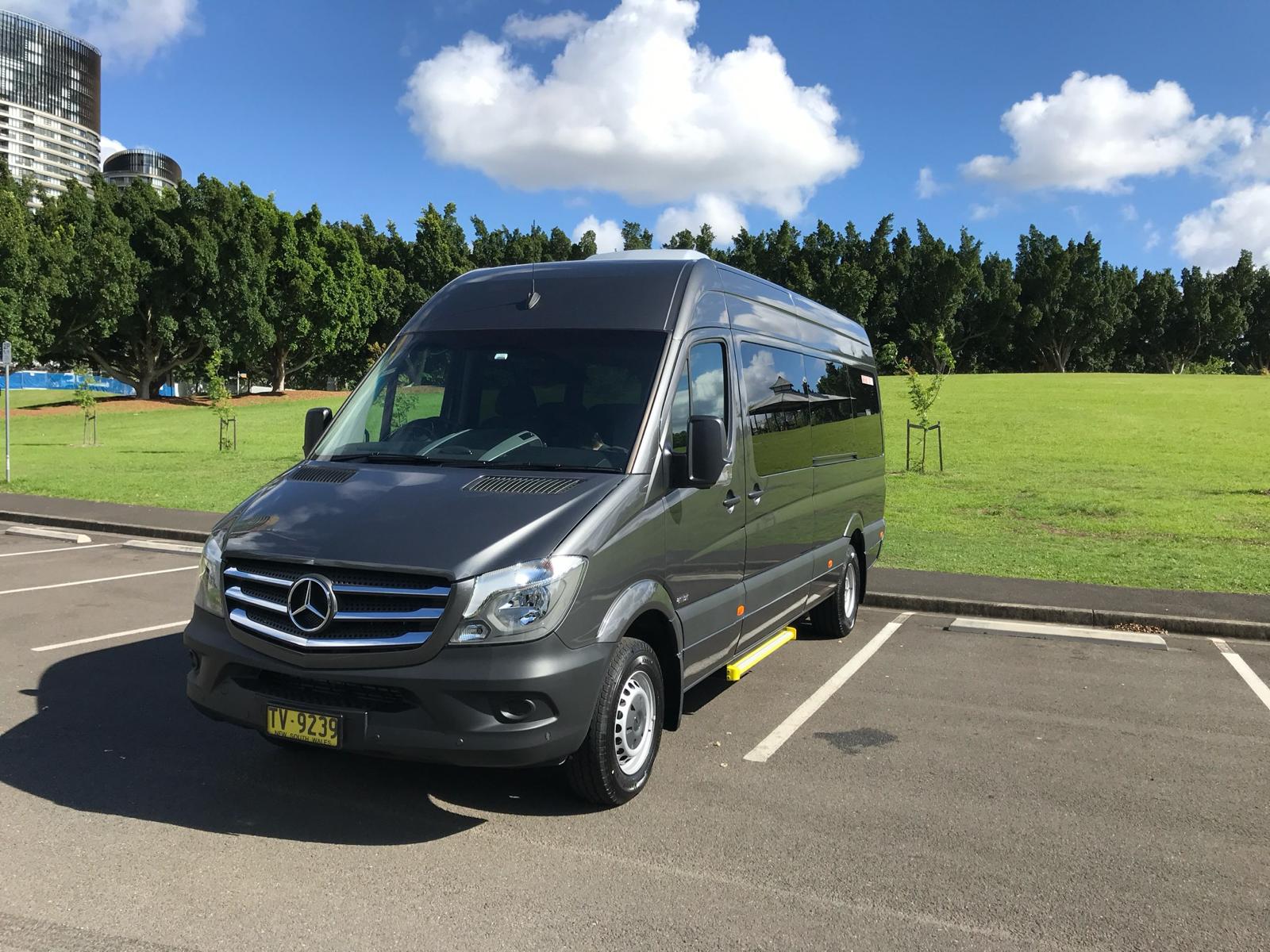
When clients are on board, the transport stops being logistics and becomes part of the hosting. What they judge is narrow and predictable: whether someone was expecting them, how far they had to walk, the condition of the interior, and whether the vehicle was there when they wanted to leave. None of those are solved by a bigger coach. They are solved by specifying the job properly and by knowing where each Sydney venue will actually let a vehicle stop.
The four things guests notice
Everything worth specifying maps to one of these.
Recognition at the pick-up point. A named person, holding a sign, who knows who is expected. This is the meet and greet, and it is the single highest-return item in the whole exercise because it happens before anyone has formed any other impression.
Walking distance at both ends. Determined by venue access rules, not by the operator’s willingness. At most Sydney venues, the vehicle’s height decides where it can stop, and a full-size coach and a mini bus get different answers at the same venue.
Interior condition. Cleanliness, air conditioning, seat condition, and whether the vehicle smells like the job before yours. Guests notice condition long before they notice specification.
Availability at departure. Guests leave when they decide to, not when the run sheet says. A vehicle that is present and waiting reads as service. A vehicle that has to be called back reads as an afterthought.
What to actually write in the brief
This is a specification you can paste into an enquiry. It exists because “we need something nice for a client visit” produces a quote against assumptions, and assumptions are where the disappointment comes from.
| Item | What to specify | Why it matters |
|---|---|---|
| Vehicle class and seat count | The class, not just the headcount. Seat counts exclude the driver. | A group of 6 in a 24 seat minibus feels like a shuttle. The same 6 in a people mover feels like a car. |
| Presentation standard | State plainly that this is a client-facing movement | It changes how the vehicle is prepared and which vehicle is allocated. Say it rather than assume it. |
| Luggage | Bags per person, plus samples, banners or display material | Underfloor bay volume, not seat count, is usually the binding constraint once suitcases appear. |
| Meet and greet | Who is meeting, where they stand, what the sign says | Decide whether this is your person or an arrangement with the operator. Do not leave it unassigned. |
| Movement type | Point-to-point, or hourly as-directed across a span | Client entertainment is almost always as-directed, because the departure time is soft. |
| Latest realistic finish | The honest one, not the polite one | The finish time is the field that determines whether the day can be resourced as booked. |
| On-site contact | One name, one mobile, reachable at the hour of the movement | The driver takes kerbside instruction from that person and no one else. |
| Accessibility | Wheelchair space, hoist, step-free boarding, assistance | Wheelchair-equipped vehicles with hoists are available and must be requested at booking. |
| Refreshments | Whether anything is carried or served on board | Food and non-alcoholic drinks are fine on all vehicles. Alcohol is by prior arrangement on private function bookings only. |
| Contingency | Wet-weather set-down point, and who decides to use it | Agree it with the venue when you agree the fine-weather one. |
Choosing the vehicle class
The instinct is to book up. Often the better answer is to book across.
| Group | Usually the right call | The failure mode to avoid |
|---|---|---|
| 2 to 6 clients | People mover, 7 seats | A 24 seat minibus for six people looks like a bus that nobody filled. |
| 7 to 13 | Small van or minibus, 11 to 14 seats | Splitting into two cars, which separates the conversation you organised the day for. |
| 14 to 24 | Executive minibus, 21 to 24 seats | Choosing a coach for the badge when a minibus reaches more venues. |
| 25 to 27 | Executive midi-coach, 27 seats | Forgetting luggage. A 27 seat vehicle with 25 suitcases is a different problem. |
| 28 to 57 | Executive or luxury coach, up to 57 seats | Height. A full-size coach cannot reach several Sydney venue set-down points that a mini bus can. |
| 58 or more | Coordinated convoy, quoted per event | Treating it as two separate bookings. A convoy needs a lead vehicle and one point of instruction. |
The Sydney-specific version of that last warning is worth stating on its own. Vehicle height, not seat count, is what excludes a vehicle from the closest set-down point at several venues. If getting guests as close as possible to the door matters more than travelling as one group, the smaller vehicle can genuinely be the better client experience.
Meet and greet, and where it can legally happen
Airport arrivals are where meet and greet matters most and where the rules are tightest.
Sydney Airport operates dedicated ground transport zones for registered commercial vehicles. Registration through the airport’s bus and limousine registration system is mandatory, and pre-booking is required. Drop-off is kerbside at the Departures level. Collection is within dedicated zones only, not at the kerb.
One provision makes a proper meet and greet possible: bus and coach drivers may leave the vehicle to meet passengers inside the terminal. That is the mechanism behind an arrival that feels hosted rather than self-service.
Meeting points are published at two terminals only. Sydney Airport currently signposts a meeting point at T1 International, Arrivals level, between exits A and B, and at T2 Domestic, Arrivals level, opposite baggage carousel 6. There is no published meeting point at T3, so a T3 arrival needs an arrangement agreed in advance rather than a landmark. Meeting points are described by movable furniture and do change, so confirm the current signage before the day.
Two constraints to design around. Kerbside at Departures is set-down only, and the driver must remain with the vehicle. And the T2/T3 Priority Pick-up zone has a 2.9 metre height restriction, which excludes full-size coaches. A bus holding area is available on Ross Smith Avenue, free for the first 60 minutes, which is where a vehicle waits rather than circling.
The practical brief for an arrival: flight number and terminal, expected pax, who is holding the sign, the agreed meeting point, and a mobile number that works the moment the phone comes off flight mode.
Where Sydney venues let the vehicle stop
Three contexts where the vehicle is judged, and the published rule for each.
Harbour venues. At the Sydney Opera House, buses and coaches cannot park onsite, and large buses must disembark passengers on Macquarie Street. That walk is part of your guest experience whether you planned it or not, so put it in the timings and decide what happens if it rains.
Racecourse marquees. The two Australian Turf Club courses use different height thresholds. At Royal Randwick the threshold is 3.1 metres, and coaches above it set down and pick up on the eastern side of Darley Road outside TAFE NSW Randwick, while mini buses under 3.1 metres use the infield car park. At Rosehill Gardens the threshold is 3.4 metres, with above-threshold coaches on the western side of Arthur Street, where private coaches may park for the duration of the race day. Do not carry one venue’s number to the other.
The central city. A coach may stop in a bus zone to set down or pick up passengers, but it may not wait or lay over there. That is a legal limit, not a courtesy. It is also why a vehicle held across a long lunch has to go somewhere, and why the span is what you are buying.
The moment that decides the impression
If you get one thing right, make it the departure.
Client entertainment has a soft finish time by design. Guests stay because they are enjoying it, which is the point. So book the vehicle as an hourly as-directed span to the venue’s close and release it early if you finish early, rather than booking a departure time and hoping.
The one thing that cannot be arranged at the kerb is an extension. Charter driving in NSW sits inside the heavy vehicle fatigue regime, and the driver’s day is measured from sign-on at the depot rather than from your first pick-up. A driver cannot agree to two extra hours at 11pm no matter how the conversation goes. Build the span at quote stage and the problem never arises.
Frequently asked questions
What vehicle standard suits client-facing work?
Match the vehicle to the group size rather than booking the largest thing available, and state in the enquiry that the movement is client-facing so it is allocated and prepared accordingly. Seat counts exclude the driver, and the fleet runs from 7 seats up to 57, with anything above 58 quoted as a coordinated convoy.
Can the driver meet guests inside the airport terminal?
At Sydney Airport, bus and coach drivers may leave the vehicle to meet passengers inside the terminal. Agree the meeting point in advance, because published meeting points exist at T1 International and T2 Domestic only and there is no published T3 meeting point.
Can a coach wait outside the venue between movements?
No. A coach may stop to set down and pick up, but it cannot wait or lay over at the kerb, and the City of Sydney will not accommodate long-stay coach layover on-street in central Sydney. The vehicle stages elsewhere and returns, which is why you buy the span rather than the trip.
Can we serve drinks on board?
Food and non-alcoholic drinks are fine on all vehicles. Alcohol is permitted on private function bookings by prior arrangement only, so raise it when you book rather than on the day.
Does a bigger vehicle get guests closer to the door?
Often the opposite. Several Sydney venues band their set-down points by vehicle height, and a mini bus under the threshold reaches a closer point than a full-size coach. Where the walk matters most, the smaller vehicle can be the better decision.
Next step
Send the guest count, the venues and the honest latest finish time, and ask for the movement to be quoted as a span rather than as fixed transfers. Our operations team will tell you which vehicle class reaches which set-down point at each venue before you commit to one. Start with coach hire in Sydney and the vehicle classes available, or look through the vehicle classes and seat counts in the fleet. Call 02 9469 6600 and a written quote comes back within two business hours.
Sources
- Sydney Airport, “Resources for registered limousines, buses and coaches”, https://www.sydneyairport.com.au/corporate/partner-with-us/commercial-vehicles/resources-for-registered-limousines-buses-and-coaches. Accessed 7 September 2026.
- Sydney Airport, “Pick-up information”, https://www.sydneyairport.com.au/pickup. Accessed 7 September 2026.
- Sydney Opera House, “Plan your excursion”, https://www.sydneyoperahouse.com/schools/plan-your-excursion. Accessed 7 September 2026.
- Australian Turf Club, “Travel and parking at Royal Randwick”, https://www.australianturfclub.com.au/travel-parking-at-royal-randwick/. Accessed 7 September 2026.