Site visit transport breaks three assumptions that office transport relies on. The destination often has no kerb, so the pick-up point is the last sealed trafficable surface rather than the address. The day starts before the office opens, because site inductions do. And the group carries things: hard hats, boots, samples, drawings. Plan around those three and the rest of the day is ordinary charter work.
The address is not the stop
On an office day, the address and the stop are the same thing. On a site day they are frequently a few hundred metres apart, and the difference is what determines whether your group walks through mud in business shoes.
Before you book, establish four things for each site.
The last sealed, trafficable surface a bus can reach. Not where the site office is. Where a laden vehicle can get to, turn, and leave without reversing blind onto a road.
Whether the vehicle can turn around there. A coach that can reach a point but cannot turn has not reached it. This is the single most common failure on site visit work.
Overhead clearance on the approach. Site hoardings, temporary gantries, low branches on an unmade access road and awnings at industrial estates. A full-size coach exceeds 2.8 metres in height, which is a routine constraint on an industrial approach even where it is fine on a road.
Whether the driver and the vehicle need site access at all. Often they do not, and the cleaner arrangement is a set-down outside the gate with a walk in. Decide that in advance rather than at the boom gate.
The practical version: send the operator a pin or a photograph of the intended stop, not a street address. On a greenfield site in the western growth corridor, the street address may not describe a place a vehicle can usefully reach.
Vehicle sizing for constrained access
The instinct to book one coach for the whole group is often wrong for site work.
| Group | Usually the right call | Why |
|---|---|---|
| Up to 13 | Van or small minibus | Reaches almost anything a work ute can reach. Turns in a normal driveway. |
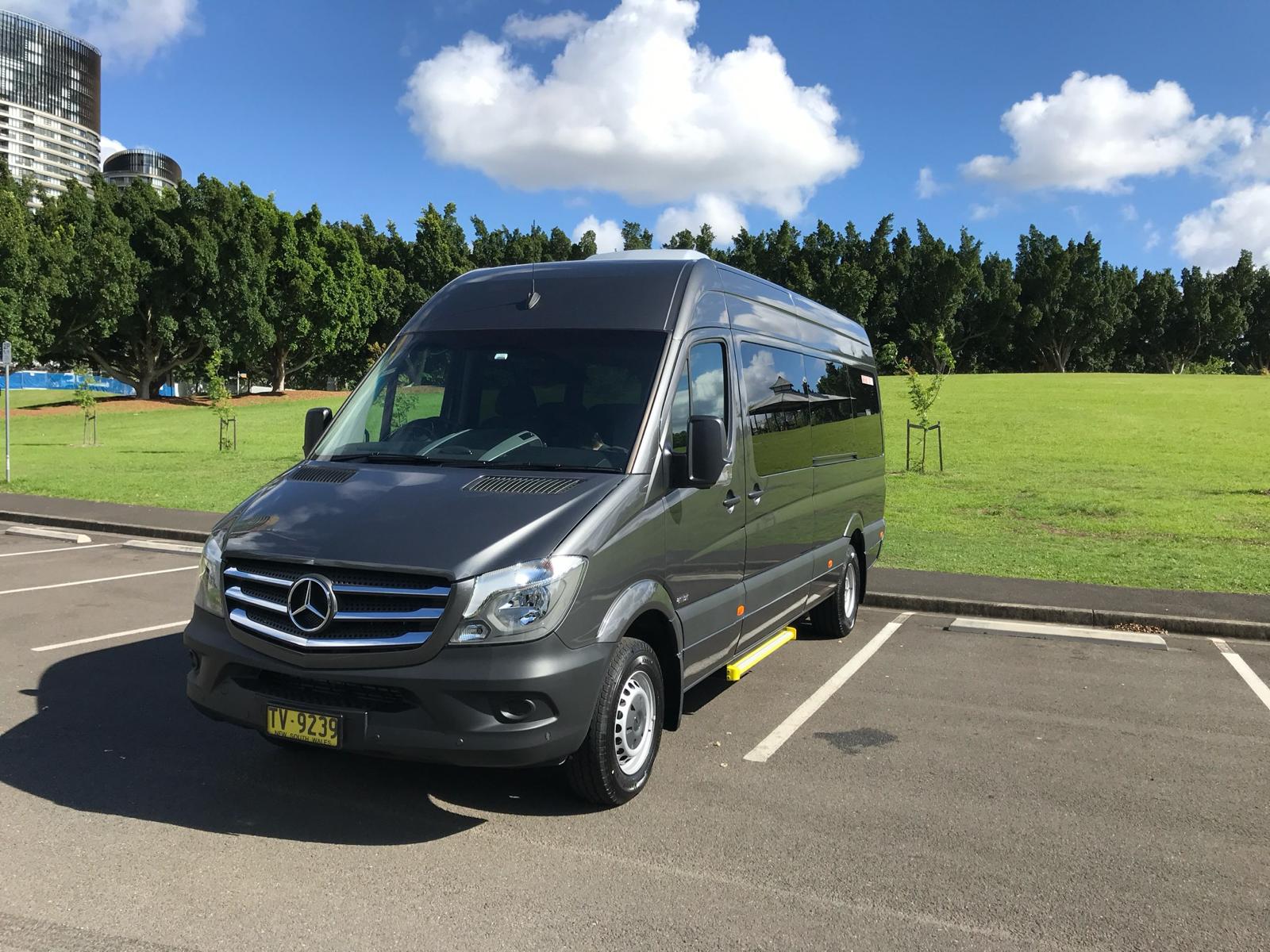
| 14 to 24 | Minibus, 21 to 24 seats | The sweet spot for site work. Enough capacity to keep the group together, small enough for constrained access and unmade approaches. |
| 25 to 27 | Midi-coach, 27 seats | Check the turning circle and the overhead clearance at every stop before committing. |
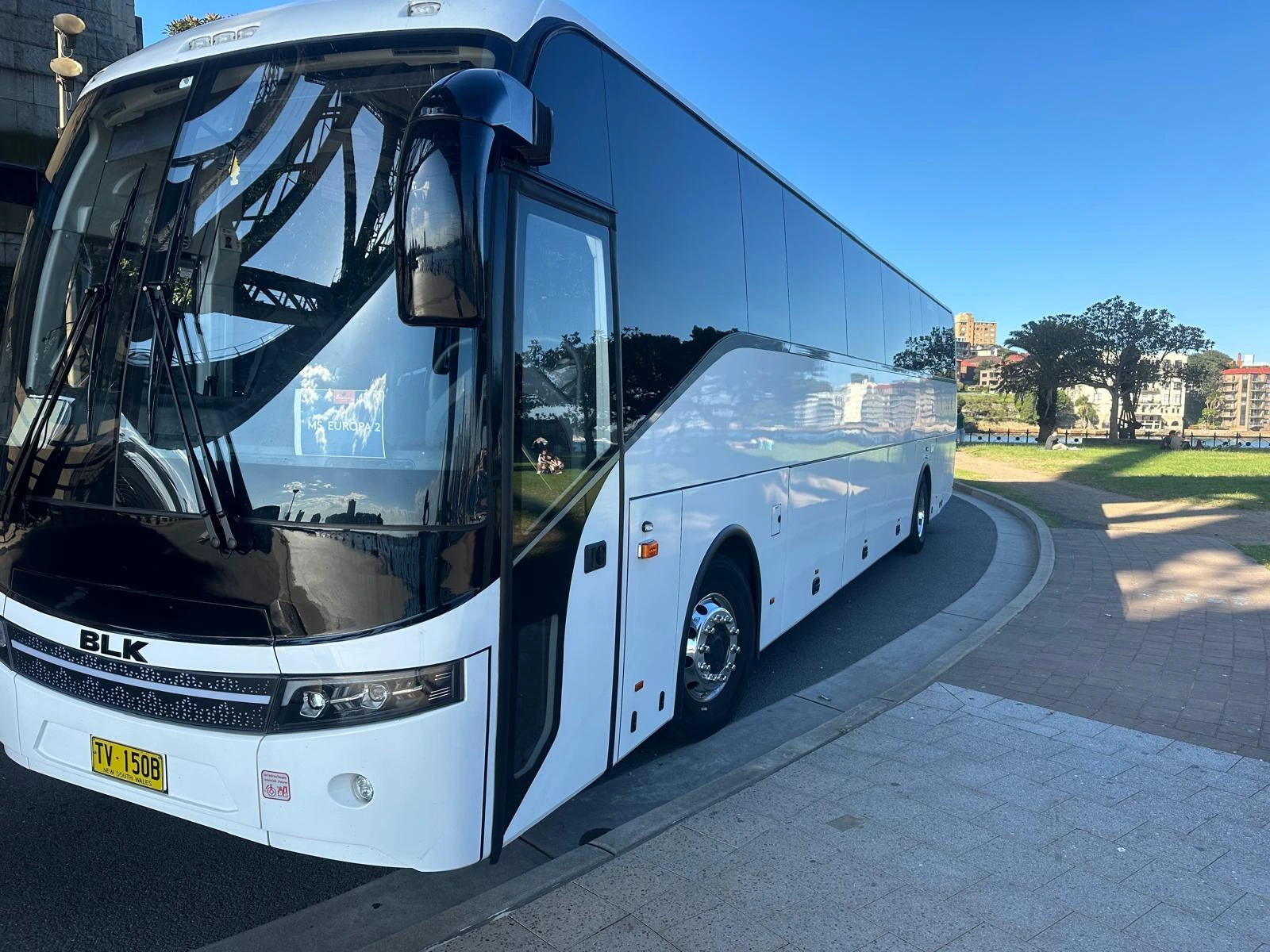
| 28 and above | Full-size coach, or two smaller vehicles | Two minibuses will often reach the site while one coach stops at the gate. Ask which outcome you want. |
The trade-off is honest: one vehicle keeps the group together and keeps the commentary shared, which matters on an inspection day where the conversation between sites is half the point. Two vehicles reach the site itself. Choose deliberately rather than by headcount alone.
Boots, PPE and what comes on board
This is where site work differs most from every other kind of corporate transport, and it is worth raising when you book rather than discovering at the door.
- Decide where PPE goes on and comes off. Boots and hi-vis at the vehicle, or at the site gate. Both work. Doing it inconsistently across a multi-site day does not.
- Assume boots will be wet or muddy on the return leg. Say so when you book so it can be planned for rather than dealt with afterwards.
- Hard hats and vests are luggage, not hand baggage. Twenty sets take real space. Count them into the vehicle sizing.
- Drawings, samples and display boards need a flat surface or a bay. A tube of drawings across three seats reduces your capacity.
- Nominate who carries the sign-in sheet and the induction paperwork. On a multi-site day this is the item most likely to be left on the vehicle.
- Confirm whether the driver needs a site induction. If the vehicle is entering the site, usually yes. If it is not, usually no. Establish it before the morning.
- Water and rubbish. Food and non-alcoholic drinks are fine on all vehicles. On a hot western Sydney site day, water on board is worth arranging.
One safety point that catches groups out, because it is not the same in every state. On a coach fitted with seatbelts, wearing them is mandatory in NSW for every passenger aged 16 or over, and it is enforceable against the passenger rather than against the driver. On a site visit day, where people stand up between stops and treat short hops casually, that is worth saying out loud in the morning briefing.
Why site visits start early
Inductions run early, trades start early, and the useful part of a site day is over before the afternoon. So most inspection days want a departure before the office is properly awake.
Two consequences.
The driver’s day starts before yours. A 6am passenger pick-up involves a sign-on at the depot meaningfully earlier, plus empty running to your suburb. Public holiday and after-hours loading is a named cost that is confirmed in advance and priced separately, so it appears in the written quote rather than as an adjustment afterwards. Ask for it as its own line.
Book it during office hours. The office runs Monday to Friday 7am to 6pm and Saturday 8am to 2pm. An early Monday departure is arranged the week before. Driver name, mobile and vehicle registration are sent 24 hours before travel, which for a pre-dawn start should be forwarded straight to whoever is standing at the pick-up point in the dark.
Sequencing more than one site in a day
Three or four sites in a day is normal for a development tour or an investor inspection, and the sequencing rules are different from a city roadshow.
Sequence by access difficulty, not by geography alone. Put the hardest access site early, when the schedule still has its buffer intact and the light is good.
Book it as one hourly as-directed hire, not as separate transfers. The vehicle stays with the group and waits at each site. Minimum hire is three hours for minibuses and people movers and four hours for midi-coaches and full-size coaches. Quoted as separate transfers, a site visit that runs long leaves you with no vehicle.
Group sites by corridor. In practice, western Sydney site days cluster around the Parramatta, Blacktown, Penrith and Liverpool corridors, and a day that bounces between two of those corridors twice has wasted an hour. There is no travel surcharge inside Greater Sydney across the six regions covered, so the cost of a bad sequence is time rather than money, which makes it easy to overlook until the day.
Watch the school zone windows on the way home. Most NSW school zones operate 8:00 to 9:30am and 2:30 to 4:00pm at 40 km/h on notified school days, and the sign always governs. A site day that departs at 6am misses the morning window entirely and then runs straight into the afternoon one on the return leg through the suburbs. Build for it rather than being surprised by it.
Tolls are a routing decision. Sydney toll classes are dimension-based on length and height rather than weight. A full-size coach exceeds 2.8 metres in height, so it is Class B on every class-based Sydney toll road regardless of length, and the Class B ratio is not uniform across the network. Tolls are confirmed in advance and priced separately, so a motorway-heavy sequence shows up on the quote.
A site visit movement plan
One row per movement. This is the version to hand the operator.
| Ref | Assemble | Depart | From | To | Pax | Notes |
|---|---|---|---|---|---|---|
| M1 | 05.45 | 06.00 | CBD office, kerbside | Site A, set-down at gate on the sealed apron | 18 | Driver induction not required, vehicle stays outside the gate. PPE donned at vehicle. |
| M2 | 08.15 | 08.30 | Site A gate | Site B, last sealed surface before the access track | 18 | Turning circle confirmed by site contact. Vehicle waits on site. |
| M3 | 10.45 | 11.00 | Site B | Site C | 18 | Boots wet. Return leg to be planned for soiled footwear. |
| M4 | 13.30 | 13.45 | Site C | CBD office | 18 | Runs into the afternoon school zone window through the suburbs. |
Three fields are doing the work. The “to” column names a surface, not an address. The notes column records the access decision for each site, which is the thing that gets lost between the site contact and the driver. And the vehicle is held all day, so there is no return-to-depot leg in the middle.
When site transport becomes a recurring run
If the same group travels to the same site more than about weekly, stop booking it as individual jobs. At that point the questions change: fixed timetable, standard pick-up points, consistent vehicle class, and a standing brief held on file so each booking is a date and a headcount. That is a route design conversation rather than a booking one, and it is worth having deliberately.
Frequently asked questions
Can a coach get onto a construction site?
Sometimes, and often it should not try. Establish the last sealed trafficable surface the vehicle can reach and turn on, plus the overhead clearance on the approach, then decide whether a gate set-down and a short walk is the better plan. Send a photograph of the intended stop rather than a street address.
Do we need PPE on the bus?
Decide where PPE goes on and comes off, and be consistent about it across the day. Count hard hats and vests into the luggage, not into hand baggage. Tell the operator at booking that boots may be muddy on the return leg.
Can we book a 6am departure for a site induction?
Yes. Arrange it during office hours with the usual lead time, and expect an after-hours loading as a confirmed line on the quote rather than a later adjustment.
How many sites can we do in a day?
Fewer than the map suggests. Sequence by access difficulty first and by corridor second, put the hardest site early, and book the day as one continuous hire so that an overrun does not cost you the vehicle.
Does the group have to wear seatbelts between sites?
On a coach fitted with seatbelts, yes. In NSW, wearing them is mandatory for every passenger aged 16 or over and it is enforceable against the passenger. Short hops between sites are exactly where it gets forgotten.
Next step
Send the site list with a photograph or a pin of the intended stop at each one, the departure time your induction requires, and the group size including PPE. Our operations team will tell you which vehicle reaches which site and where the day is likely to lose time. Start with corporate bus and coach hire in Sydney, or see our western Sydney coverage if the day runs into the growth corridor. Call 02 9469 6600 and a written quote comes back within two business hours.
Sources
- Transport for NSW, “School zones”, https://www.transport.nsw.gov.au/roadsafety/community/schools/school-zones. Accessed 7 September 2026.
- Transport for NSW, “Seatbelts”, https://www.transport.nsw.gov.au/roadsafety/topics-tips/seatbelts. Accessed 7 September 2026.
- Linkt, “Vehicle classes on Sydney toll roads”, https://www.linkt.com.au/help/travelling-toll-roads/vehicle-class/sydney. Accessed 7 September 2026.