Yes, a 4am pick-up is bookable. It costs more than a 9am one, and the reason has two parts. An after-hours loading is a named cost that is confirmed in advance and priced separately, alongside tolls, parking and waiting time. And the driver’s working day starts at sign-on at the depot, not when your group boards, which is why a late finish is a rostering question rather than a favour the driver can grant at the kerb.
The span, not the passenger hours
This is the idea that makes everything else make sense.
Your booking describes passenger movements. The operator schedules a driver’s day. Those are different lengths, and the difference sits at both ends.
| Block | What happens | Who sees it |
|---|---|---|
| Sign-on at the depot | Pre-departure vehicle check, paperwork, vehicle prepared | Nobody on your side |
| Depot to first pick-up | Empty running from Marrickville to your suburb | Nobody on your side |
| First pick-up to final set-down | Your booked movements | This is what your run sheet shows |
| Final set-down to depot | Empty running back | Nobody on your side |
| Sign-off | Vehicle secured, paperwork closed | Nobody on your side |
A 4am passenger pick-up in the eastern suburbs therefore involves a sign-on meaningfully earlier than 4am, and empty running across the city before it. That is real time on a real roster, and it is the operational reason an early start is priced differently rather than a commercial one.
The same arithmetic runs at the other end. A 10pm final set-down is not a day that finishes at 10pm.
What the after-hours loading is, and what it is not
Charter pricing separates what is always included from what is confirmed in advance and priced separately.
Included in every quote: the professional driver, fuel, vehicle insurance and GST.
Confirmed in advance and priced separately: tolls and parking, driver accommodation on multi-day trips, public holiday and after-hours loading, and waiting time beyond the booked window.
Two things follow from that structure.
It is not a surprise line. The loading is confirmed in advance, which means it belongs in the written quote you receive within two business hours of sending the trip. If it is not on the quote, ask for it to be, before you approve the booking.
It is separate from waiting time. These get conflated constantly. The after-hours loading relates to when the work happens. Waiting time relates to holding the vehicle beyond the window you booked. An evening job can attract both, and they are answering different questions.
Ask for the loading to be shown as its own line rather than absorbed into an hourly rate. It makes the quote comparable and it makes an internal approval easier to get.
Why a driver cannot just stay two hours longer
This is the part that surprises corporate bookers, and it is the genuinely useful thing to understand before you plan an evening event.
Charter driving in NSW sits inside the heavy vehicle fatigue regime. NSW does exempt drivers of fatigue-regulated buses from the Chapter 6 fatigue requirements, but that exemption does not apply where the bus is driven to provide a public passenger service, and a charter service is expressly a public passenger service under the Passenger Transport Act 1990. The moment there is a fare, the exemption switches off.
So the limits apply in full. Under general standard hours, a solo driver has a maximum of 12 hours work in any 24 hours, with 7 continuous hours of stationary rest. There is also a separate standard hours table specifically for solo bus and coach drivers, under which a 7 day period requires 6 night rest breaks. A driver works to one table or the other, not a blend of the more convenient parts of each.
Three consequences for you as the organiser.
Waiting is not rest. A driver sitting in a layover between your afternoon movement and your evening one is working, not resting. Rest under the tables is continuous and stationary and measured in hours, not in gaps.
Being local does not help. Operating within 100 kilometres of a base changes the record keeping tier, not the limits. Work and rest hours apply in full inside that radius.
The finish time is the number to negotiate, not the start time. Adding an hour to the front of a day usually changes very little. Adding an hour to the back of a long day can change how the job has to be resourced, which is a quote-stage decision rather than an on-the-night one.
One further point worth knowing if you are reading older advice: Basic Fatigue Management and Advanced Fatigue Management are closed to new applicants and have been replaced by Alternative Compliance Hours under ACA-Fatigue within the Heavy Vehicle Accreditation scheme. Anything that tells you an operator can apply for BFM to make your itinerary work predates 1 August 2026.
A decision framework for a finish time that might move
Use this at quote stage, not on the day.
| Your situation | What to ask for | Why |
|---|---|---|
| Fixed finish, confident | Point-to-point movements at named times | Cheapest structure. No flexibility, and none needed. |
| Finish likely to move by up to an hour | Hourly as-directed across a stated span with a nominated latest departure | You are buying the span. The vehicle is already resourced for the later time. |
| Finish genuinely unpredictable | Book the span to the venue’s close, then release early if you finish early | Releasing a vehicle early is easy. Extending one at 11pm may not be possible. |
| Very long day, early start and late finish | Ask directly whether the day fits inside one driver’s available hours | If it does not, the options are a shorter programme, a different structure or different resourcing, and each has a cost. |
| Overnight or split shift work | Discuss before quoting | The night rest break requirement in the bus and coach table makes consecutive late nights a rostering question. |
The sentence that saves the most money and the most friction is this one, said at enquiry stage: “the finish time might move by up to an hour, please quote it that way.”
The early flight problem
The most common after-hours job in Sydney is a group leaving on an early international or domestic departure, and it has its own constraints beyond the hour.
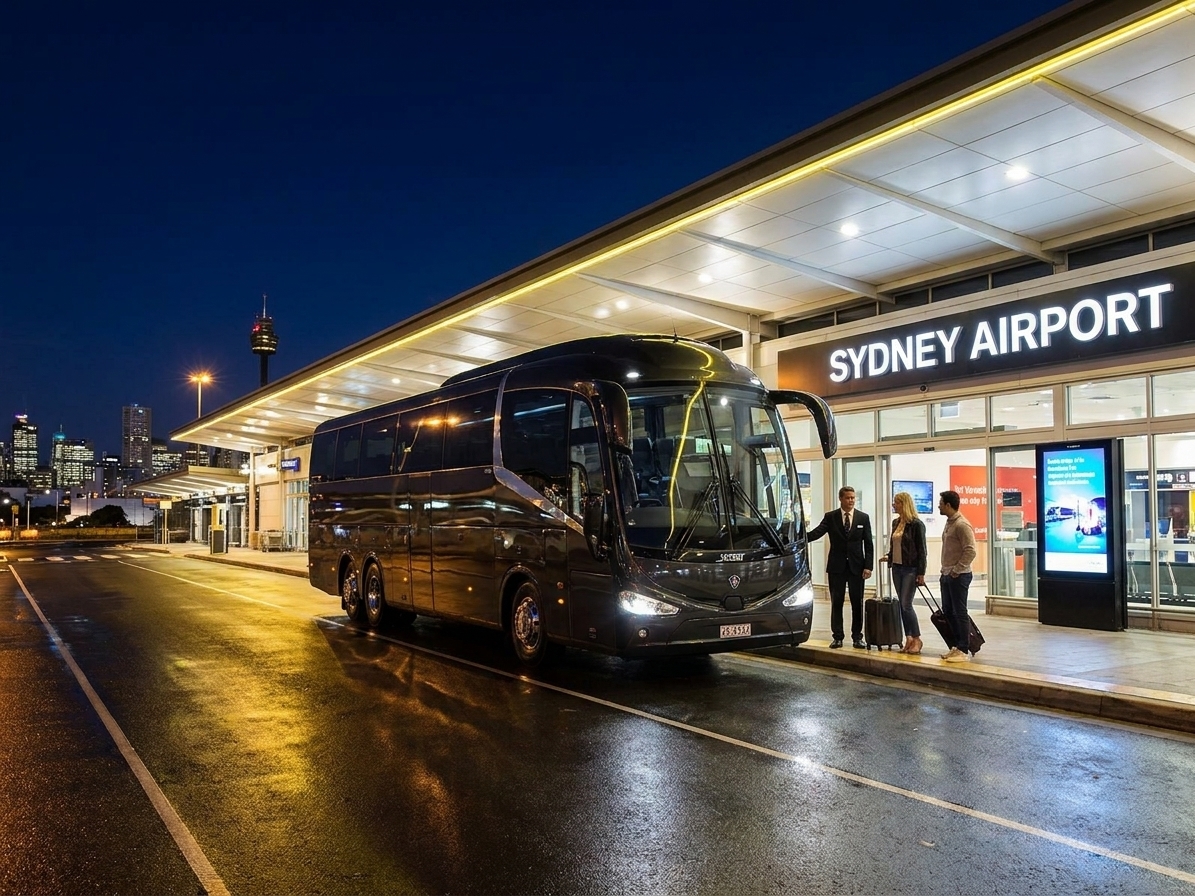
At Sydney Airport, drop-off is kerbside at the Departures level and collection is within dedicated zones only. Access requires registration through the airport’s bus and limousine registration system, and pre-booking is required. A bus holding area is available on Ross Smith Avenue, free for the first 60 minutes. Kerbside is set-down only: a commercial driver cannot leave a vehicle unattended at a terminal frontage, and cannot sit at the kerb waiting.
For your planning, that means two things. The departure set-down is quick and one-directional, which is good news for an early run. And a pre-dawn arrival collection is a zone-and-holding-area operation rather than a kerbside one, which is why the meeting arrangement needs to be agreed in advance rather than by text message at 5am.
There is one pricing detail worth knowing here. Minimum hire is three hours for minibuses and people movers and four hours for midi-coaches and full-size coaches, but an airport or point-to-point run can instead be quoted as a single fixed transfer fare, and a fare quoted that way is not charged at a minimum. For a short early transfer, ask which basis you are being quoted on.
Booking mechanics for out-of-hours work
Book during office hours, travel outside them. The office runs Monday to Friday 7am to 6pm and Saturday 8am to 2pm. A 4am Monday departure is arranged during the previous week, not at midnight.
Give the usual notice, or more. Published lead times are two to four weeks for most jobs and four to eight weeks for peak periods including December, race days, school excursion season and long weekends. An after-hours job in a peak period is the hardest thing to place at short notice, because the driver roster is the constraint rather than the vehicle.
Use the 24 hour handover. Driver name, mobile and vehicle registration are sent 24 hours before travel. For a pre-dawn start, forward those details to whoever is standing at the pick-up point in the dark, and to the passengers if it is a small group.
Name your on-site contact. One person, one mobile, reachable at the hour of the movement. An events inbox is not a contact at 4am.
Frequently asked questions
Can we book a 4am start?
Yes. Arrange it during office hours with the usual lead time, and expect an after-hours loading to appear as a confirmed line in the written quote rather than as an adjustment afterwards.
How much is the after-hours loading?
It is confirmed in advance and priced separately for the specific job, so it is quoted rather than published as a standing figure. Ask for it as its own line on the quote so you can see it.
Can the driver wait and take us back later than booked?
Only if the job has been resourced for it. Waiting time beyond the booked window is priced separately, and more importantly the driver’s total work time is capped by the fatigue rules regardless of what anyone is willing to pay.
Does the 100 kilometre radius mean local late-night work is exempt?
No. That radius affects record keeping obligations. The work and rest limits apply in full inside it.
Is a late finish cheaper than an early start?
Not reliably, and they are not symmetrical operationally. An early start adds empty running before dawn. A late finish pushes against the end of the driver’s available hours. The one that is genuinely constrained is the late finish.
Next step
Send the movement times you actually need, including the latest realistic finish rather than the optimistic one, and you will get a written quote back within two business hours with the after-hours loading shown separately. If the day looks tight, ask for a shuttle plan review and our operations team will tell you whether it fits inside one driver’s hours before you commit to it. Start with corporate bus and coach hire in Sydney, or see what is included in a charter price and what is confirmed separately. Call 02 9469 6600.
Sources
- National Heavy Vehicle Regulator, “Heavy vehicle fatigue management: bus industry”, https://www.nhvr.gov.au/safety-accreditation-compliance/fatigue-management/heavy-vehicle-fatigue-management-bus-industry. Accessed 7 September 2026.
- NSW Legislation, “Heavy Vehicle National Law (NSW)”, https://legislation.nsw.gov.au/view/whole/html/inforce/current/act-2013-042. Accessed 7 September 2026.
- NSW Legislation, “Passenger Transport Act 1990 (NSW)”, https://legislation.nsw.gov.au/view/whole/html/inforce/current/act-1990-039. Accessed 7 September 2026.
- Sydney Airport, “Resources for registered limousines, buses and coaches”, https://www.sydneyairport.com.au/corporate/partner-with-us/commercial-vehicles/resources-for-registered-limousines-buses-and-coaches. Accessed 7 September 2026.