Size a school excursion on belted seats including every supervising adult, not on student numbers. Add students, teachers, support staff and parent helpers into one figure, then check that figure against the licensed passenger capacity of the specific vehicle allocated. Seat counts published by a charter operator exclude the driver. A group of 58 or more is a coordinated convoy rather than one vehicle. Get the number wrong and someone stands.
The number that actually goes into the booking
Coordinators size on students because students are the number they have. The operator sizes on bodies, because a seat is a seat.
Your booking number is:
students + supervising teachers + support staff + parent helpers = seats required
Two things then modify it. First, published seat counts exclude the driver, so you do not need to leave a seat for the driver. Second, if belts matter to your trip, the relevant capacity is belted seats, which is a question about the specific vehicle rather than the vehicle class.
The NSW departmental excursion policy, Excursions and variations of routine (PD-2005-0290-04), asks the organiser to confirm the licensed passenger capacity of the bus. That is a per-vehicle check against a real headcount, not a tick against a quote.
The fleet ladder, and where a year group lands on it
Sydney Buses and Coaches publishes this ladder. Seat counts exclude the driver.
| Vehicle | Seats | Minimum hire |
|---|---|---|
| Mercedes V-Class | 7 | 3 hours |
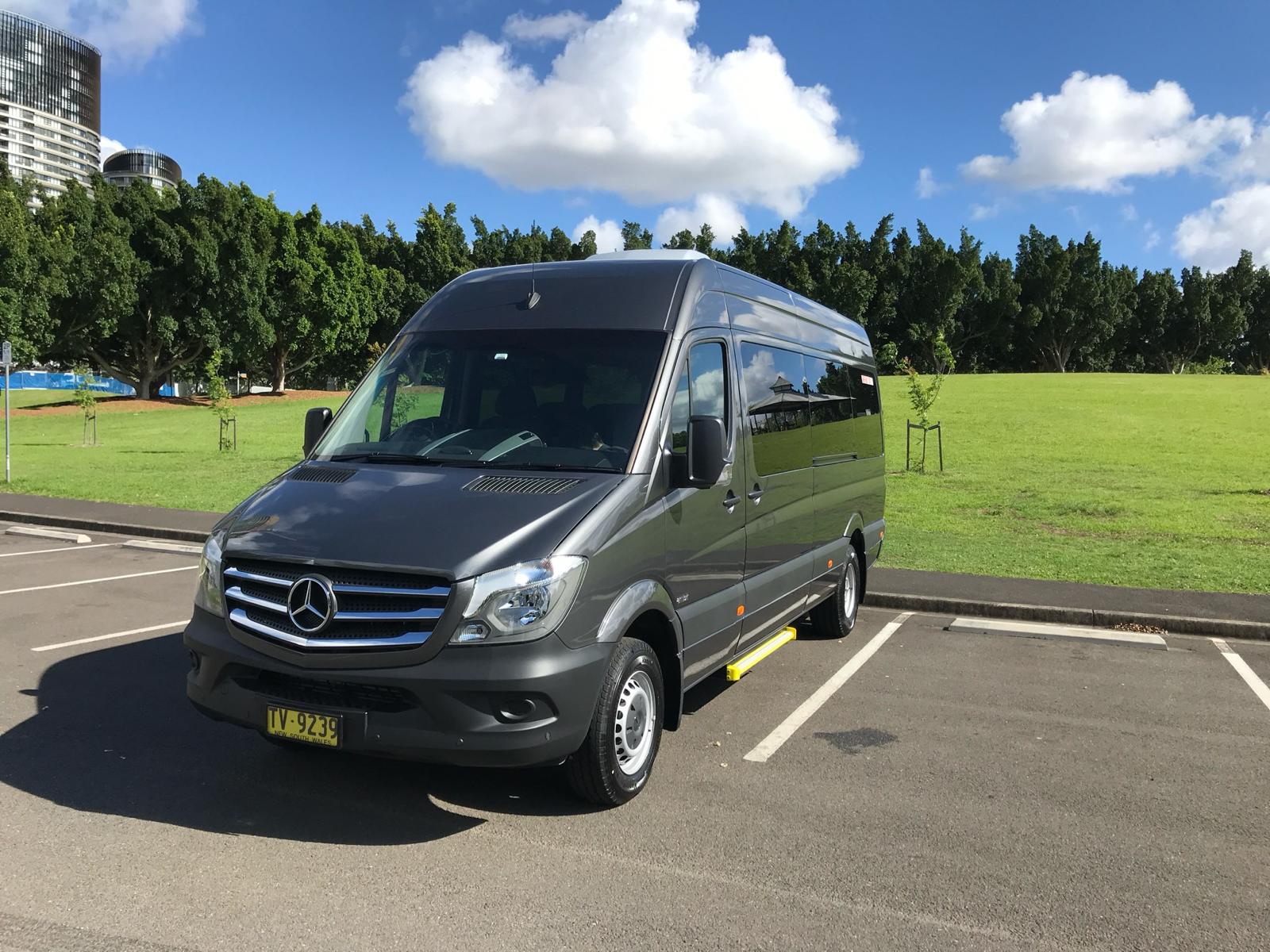
| Mercedes Sprinter | 11 to 14 | 3 hours |
| Toyota Commuter | 13 | 3 hours |
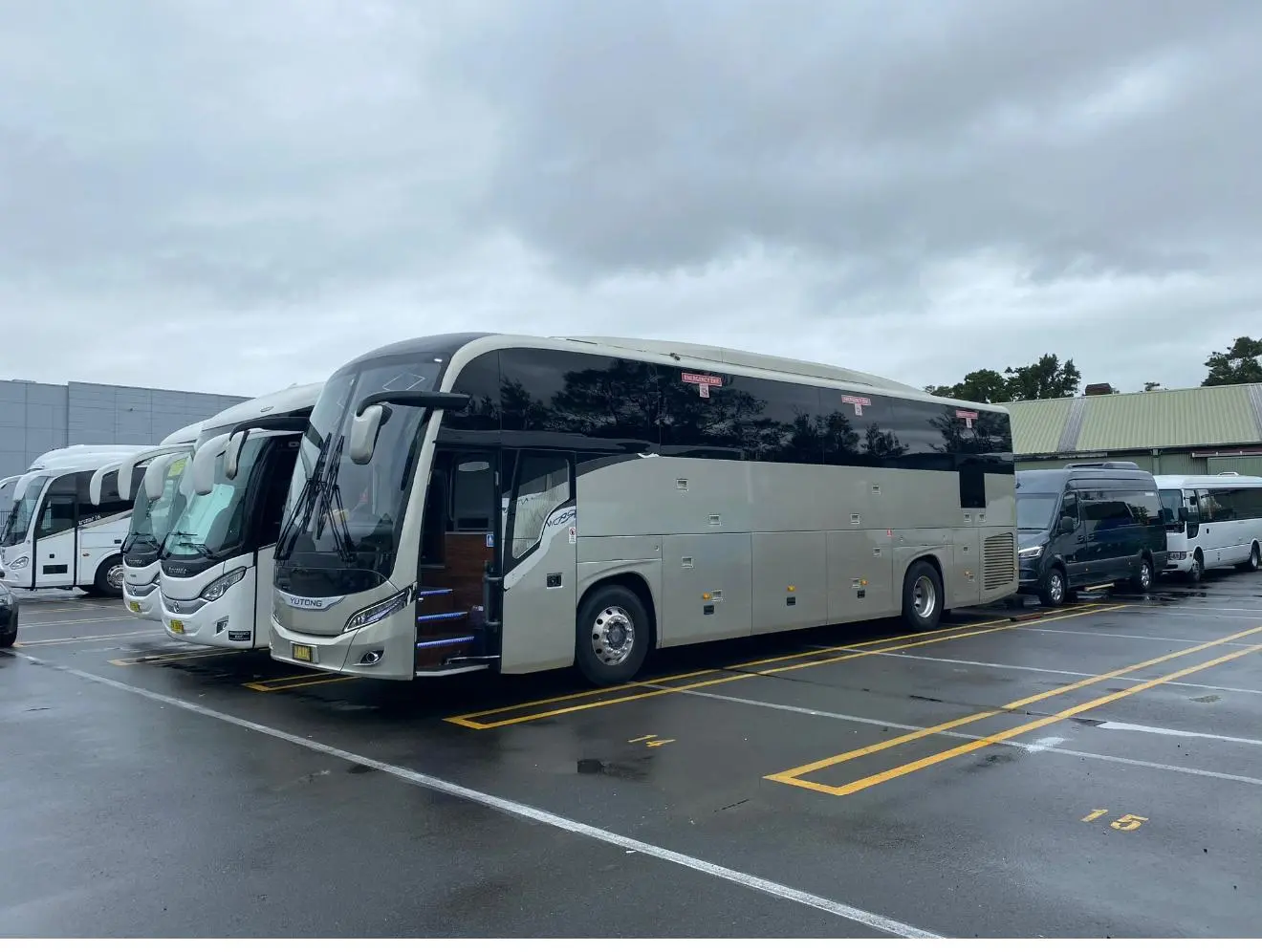
| Executive minibus | 21 to 24 | 3 hours |
| Executive midi-coach | 27 | 4 hours |
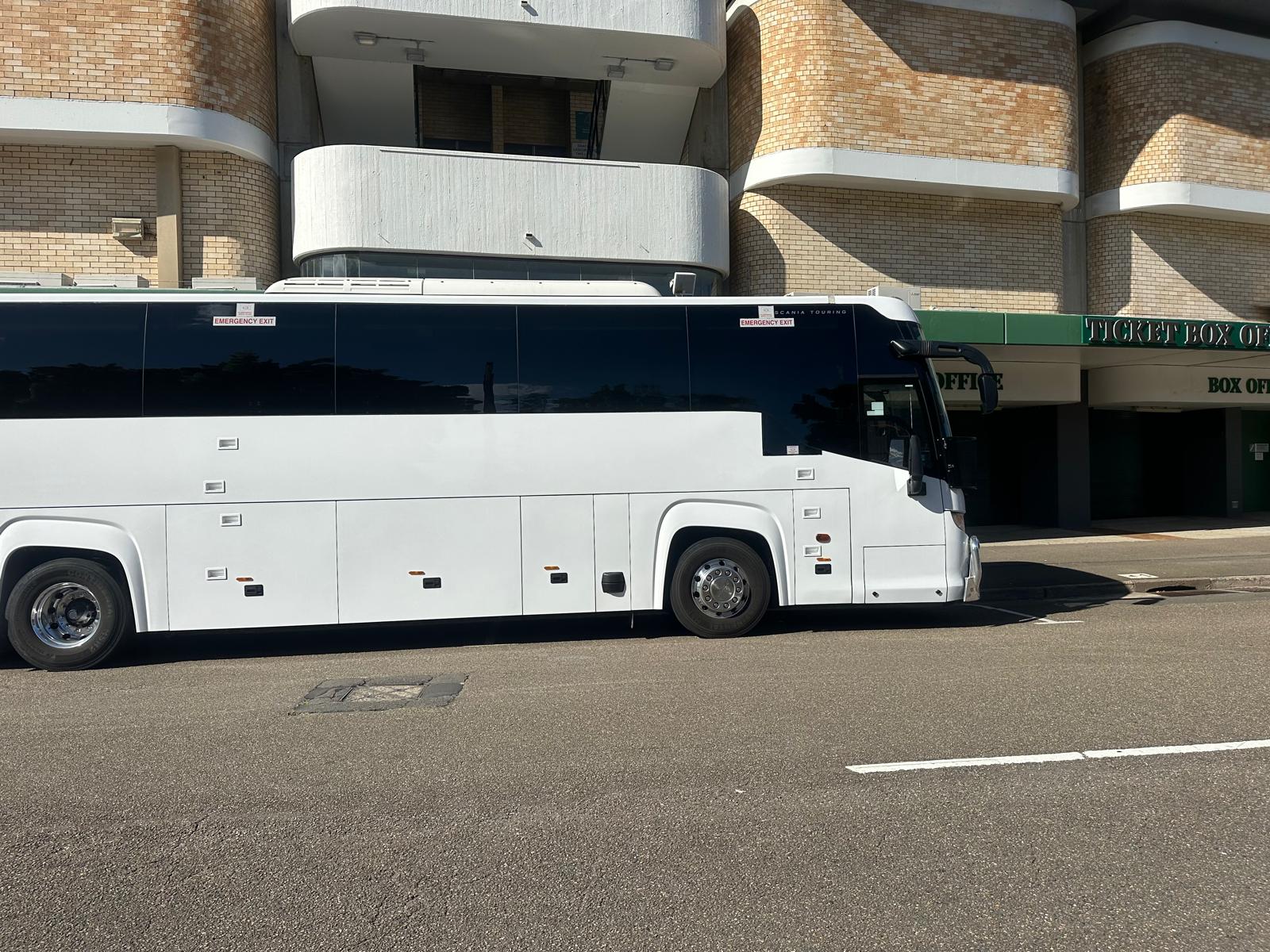
| Luxury coach | 48 | 4 hours |
| Luxury touring coach | 50 to 57 | 4 hours |
| Executive coach | 53 | 4 hours |
| Coordinated convoy | 58+ | Quoted per event |
You can check the published seat counts across the fleet before you commit, because bands move as vehicles are replaced.
Note what a band means. “50 to 57” is a class, not a promise of 57. If your maths needs 57 and the vehicle allocated seats 50, you have a problem on the morning, not at the quote. Size against the confirmed vehicle, and get the seat count in writing once the vehicle is named.
Why belted seats change the maths
This is where school sizing differs from every other kind of group booking, and it is the part most sector content skips.
Seatbelt fitment on Australian coaches is governed by the Australian Design Rules. ADR 68/00 applies to heavy omnibuses built on or after 1 July 1994. ADR 68/01, which adds seatbelt reminders, applies from 1 November 2026 for new models and 1 November 2027 for new vehicles of existing models, so it is not yet in force.
Wearing is where NSW differs from other states. NSW did not reproduce the bus-passenger carve-out that other states rely on. On a coach fitted with seatbelts, wearing them is mandatory in NSW for every passenger aged 16 or over, and that duty is enforceable against the passenger. For a Year 11 or Year 12 excursion, that is most of your group. The NSW driver-responsibility rule expressly excludes bus passengers, so the coach driver does not commit an adult passenger’s offence and will not be policing it for you.
On the departmental side, PD-2005-0290-04 expresses a preference for seatbelt-fitted vehicles “where practical”. It is a preference, not a requirement. If your own risk assessment concludes belts are needed for this trip, book accordingly and record it as your control.
The practical consequence: when you ask for capacity, ask for belted seats on the allocated vehicle, in writing. A nominal seat count and a belted seat count are not automatically the same number.
Worked examples
Three common year group sizes, sized properly. Staff numbers here are illustrative of a build, not a recommendation: staffing is determined by the principal.
Sixty students, five staff, two parent helpers. Total 67. Sixty-seven is above the largest single vehicle in the ladder, so this is two vehicles. A 53 plus a 14-seat Sprinter gets you to 67 exactly, which leaves no margin at all and is a bad plan. A 53 and a 21 to 24 seat executive minibus gives you room for a late addition and somewhere to put a student who needs to sit at the front. Two vehicles also means two loading points, two roll calls and staff split across both.
Ninety students, eight staff, four helpers. Total 102. Two full-size coaches. Two vehicles from the 48 to 57 band cover 102 with margin, and the margin is the point: a year group of ninety will move by five or six either way in the fortnight before the trip. Confirm both vehicles by class, then reconfirm the seat count once each is named.
One hundred and fifty students, twelve staff, six helpers. Total 168. Three full-size coaches, and at that point you are running a coordinated convoy rather than three separate bookings. The difference is real: a convoy needs one arrival order, one set-down sequence and one person on the ground who knows which vehicle is which. Sydney Buses and Coaches quotes 58 or more as a coordinated convoy per event rather than off the hourly ladder.
One large coach or two smaller vehicles
When the group fits either way, the trade is not really about money.
One vehicle wins on supervision simplicity, a single roll call, a single set-down at the venue, one driver contact number, and no risk of the two halves of a year group arriving twenty minutes apart.
Two vehicles win on venue access where the site cannot take a full-size coach, mixed pick-up points across suburbs, groups that need to be split for programme reasons, and returns where half the group leaves early.
There is a cost dimension too, and you can see how charter hire is priced, but note the minimum hire difference: minibuses and people movers carry a three hour minimum, midi-coaches and full-size coaches a four hour minimum. Two small vehicles is not automatically the cheaper answer.
Venue access is often the decider rather than the seat maths. Confirm what the venue can physically take before you choose the vehicle mix.
The capacity check the policy actually asks for
Run this before the excursion file goes to the approver.
- Final headcount, including every adult travelling. Not the enrolment number.
- Split the headcount by vehicle if there is more than one, and check each vehicle separately.
- Ask the operator for the licensed passenger capacity of the named vehicle, in writing.
- Ask for belted seat count on that vehicle if belts are part of your risk assessment.
- Confirm any student or staff member who needs a wheelchair space or a hoist-equipped vehicle, because that changes the vehicle, not just the seat count.
- Re-run the check if the headcount moves after you lock it. It usually does.
One accreditation point sits underneath all of this. A vehicle seating 13 or more requires Transport for NSW bus operator accreditation. Twelve seats or fewer falls to the Point to Point Transport Commission instead, which is a different regime. If you are tempted to split a small excursion across staff cars or a 12-seat van, note also that a NSW Class C licence covers up to 12 adults including the driver and up to 4.5 tonnes GVM. Both limits apply at once, and plenty of 12-seat minibuses exceed the weight limit.
Frequently asked questions
Do supervising teachers count towards the seat number?
Yes. Every adult travelling occupies a seat: teachers, support staff and parent helpers. The licensed passenger capacity check the excursion policy asks for is against your total travelling headcount, not your student headcount.
Is the driver counted in the seat number?
No. Published seat counts exclude the driver, so a 53-seat coach carries 53 passengers plus the driver.
What if our numbers are still moving?
Book on the vehicle class, then confirm the licensed passenger capacity once the vehicle is named and the headcount is locked. Ask your operator how late the final number can change before the allocation is re-quoted, and put that date in your own calendar.
How many students fit on the biggest coach?
On the Sydney Buses and Coaches ladder the largest single vehicle band is 50 to 57 seats excluding the driver. Groups of 58 or more are quoted as a coordinated convoy rather than as one vehicle.
Does the school need seatbelt-fitted coaches?
Departmental policy prefers seatbelt-fitted vehicles where practical rather than requiring them. If your risk assessment concludes belts are needed, ask for the belted seat count on the allocated vehicle and size the group against that number, including staff.
Next step
Send the operator your date, pick-up suburb and total headcount including staff, and ask for the vehicle to be named in the quote so the capacity check can be closed out early rather than in the last fortnight.
Sydney Buses and Coaches handles school and excursion transport across Greater Sydney, returns a written quote within two business hours and can supply accreditation and Working With Children Check details for your excursion file. Call 02 9469 6600.
Sources
- NSW Department of Education, Excursions and variations of routine (PD-2005-0290-04), https://education.nsw.gov.au/policy-library/policies/pd-2005-0290-04. Accessed 7 September 2026.
- Transport for NSW, Seatbelts, https://www.transport.nsw.gov.au/roadsafety/topics-tips/seatbelts. Accessed 7 September 2026.
- NSW Legislation, Road Rules 2014, Part 16, https://legislation.nsw.gov.au/view/whole/html/inforce/current/sl-2014-0758. Accessed 7 September 2026.
- Transport for NSW, Applying for bus operator accreditation, https://www.nsw.gov.au/departments-and-agencies/transport-for-nsw/bus-operators-nsw/applying-for-bus-operator-accreditation. Accessed 7 September 2026.
- NSW Government, Licence classes and conditions, https://www.nsw.gov.au/driving-boating-and-transport/driver-and-rider-licences/licence-classes-and-conditions/classes. Accessed 7 September 2026.