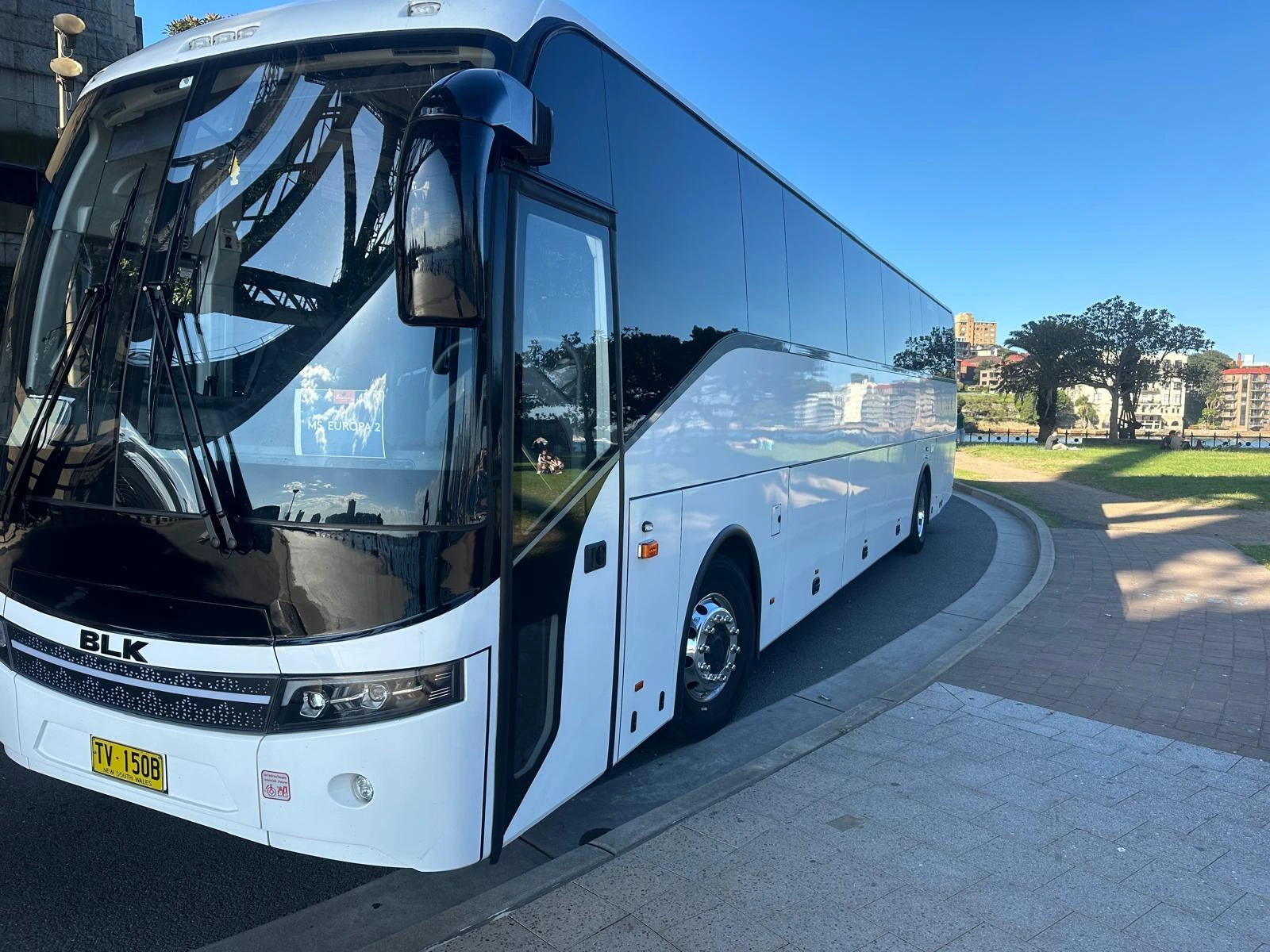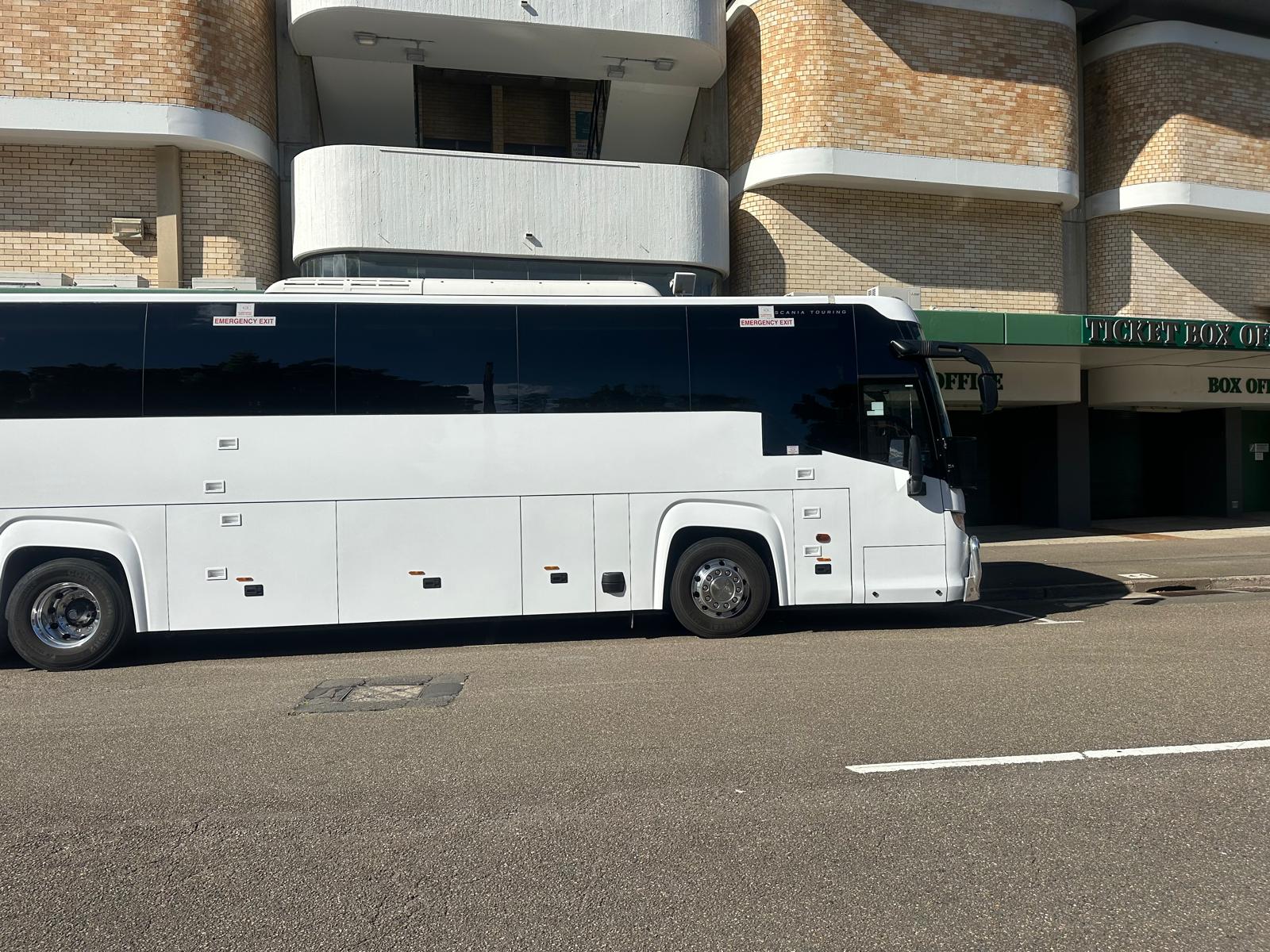
A wet weather plan for group transport is three pre-agreed decisions, not a hope. Who calls it, by when, and what specifically changes. Rain rarely cancels a Sydney charter. What it does is lengthen loading, move the set-down point, and turn a short walk into the reason your group arrives soaked and forty minutes late. Settle the three questions at booking, write the answers into the run sheet, and the day survives a shower.
What rain actually changes
Not the route. Four other things, all of which are yours to plan rather than the driver’s to absorb.
Loading gets slower. A coach loads through a single door, so boarding is serial. Add fifty people trying not to get wet, umbrellas that have to come down before anyone sits, and bags that have to be dried before they go underfloor, and the loading block stretches. It stretches at exactly the moment your group is least willing to stand outside.
The walk becomes the problem. A drop-off 120 metres from the door is nothing on a clear day. In heavy rain it is the whole experience, and it is what people remember.
The set-down point may need to move. And it can only move to somewhere lawful. A charter coach counts as a public bus under rule 183 of the Road Rules 2014, so it may stop in a bus zone to set down or pick up passengers, but it may not wait there. “Just pull up under the awning” is not a plan if the awning is over a no-stopping zone.
The waiting problem gets worse. If the vehicle was going to be released and return, a wet day is when people ask for it to stay. That is a booking change, not a favour, because the booked window is what the price is built on.
The three decisions to pre-agree
Write these into the booking, not into a conversation.
1. Who calls it. One named person. Not a committee, and not the driver. The driver will tell you what the road and the site look like; the decision is the organiser’s.
2. By when. Set a real deadline with a clock time attached, and set it early enough that the change is still possible. “We decide by 2pm” is a plan. “We’ll see how it looks” is not. The deadline has to sit before the vehicle is committed to a route, and on an out-of-town run that is much earlier than people expect. A Southern Highlands run from Sydney covers about 120 km and takes around an hour and a half each way, so a decision made when the coach is already at Mittagong is not a decision, it is an announcement.
3. What specifically changes. Name the change. Not “we’ll move it closer”, but “set-down moves from the north gate to the covered forecourt, and the group is briefed to assemble inside the foyer instead of on the lawn”.
The trigger and action matrix
Fill this in for your own event and put it on the run sheet. The point is not to predict the weather, it is to remove decisions from the day.
| Trigger | What changes for transport | Who does it | By when |
|---|---|---|---|
| Rain forecast for the loading window | Assemble point moves indoors or under cover; assemble time moves earlier to absorb slower loading | Organiser | Day before |
| Rain at the pick-up on the day | Group waits inside; contact calls the driver when the group is ready rather than the group standing out in it | Day-of contact | On the day |
| Heavy rain at the venue | Set-down point moves to the venue’s wet-weather position, if the venue has one and has confirmed it in writing | Organiser with venue | Confirmed at booking, triggered on the day |
| Outdoor element cancelled, indoor plan activated | Timings shift, which may change the booked window and the finish time | Organiser with operator | As early as possible |
| Group wants the vehicle to stay rather than be released | Booking change: the vehicle is held, and the window extends | Organiser with operator | Before the vehicle leaves |
| Road conditions deteriorate | Route or timing change, driver’s call | Driver, reported to the day-of contact | Live |
The last row is the only one that is not yours. Everything above it is.
The two Sydney venues that publish a coach position
Most venues do not publish anything about coaches, which is why the interview questions below matter. Two of the ones you are most likely to be heading for do.
ICC Sydney. Coach drop-off is at Iron Wharf Place off Darling Drive. Coach parking is not something you arrange yourself: it goes through a dedicated ICC Sydney Event Manager. If your event has a wet-weather variation, that is the person who needs to know about it, and they need to know before the day.
Sydney Opera House. Buses and coaches cannot park onsite, and large buses must disembark passengers on Macquarie Street. That position does not change because it is raining, so the wet plan for an Opera House arrival is about what happens between Macquarie Street and the door, not about moving the coach.
For everywhere else, assume nothing. Covered and undercover loading does exist at some Sydney venues, but a venue having a roof somewhere is not the same as a venue having a lawful, coach-sized, wet-weather set-down position that it will let you use.
The questions to ask any other venue
Send these in an email, because you want the answer in writing rather than in someone’s memory. Six questions, and the fifth is the one people forget.
- Where does a full-size coach set down passengers at this venue, and is that position under cover?
- Is there a different position used in wet weather, and who authorises the change?
- What is the height restriction on the approach and on any car park? A full-size coach exceeds 2.8 metres, which rules out most multi-storey and shopping-centre parking.
- How far is the set-down point from the door your group is using, and is that walk covered?
- Where does the coach wait between the drop-off and the pick-up, and does that change on a wet day when your undercover area is being used by something else?
- Who is our contact on the day if the set-down point needs to move, and what number do we call?
Keep the reply. When a venue staff member on the day says something different, a written answer from the venue is what resolves it in under a minute.
What an operator can and cannot commit to
Worth being straight about this, because it is where wet-weather plans quietly fail.
An operator can generally accommodate a change of set-down point within the same site, a change of assemble time, and a change of route where the alternative is lawful and safe. The driver will also tell you what they can see, which on a wet day is often more useful than a forecast.
What an operator cannot do is make a venue accept a coach somewhere it does not accept coaches, hold the vehicle beyond the booked window without that becoming a booking change, or extend the driver’s day without limit. Charter work sits inside the heavy vehicle fatigue regime, so a finish time is a legal constraint as well as a commercial one, and a wet day that pushes everything back by an hour can collide with it.
If a vehicle fails, a replacement is arranged and you are kept informed. That is the published policy and it applies in any weather.
The wet-weather amendment to your run sheet
Add these six lines to whatever run sheet you already have. They take two minutes and they are the difference between a plan and an intention.
> Wet plan trigger: [what condition activates it] > Decision by: [name] at [clock time] > Wet assemble point: [precise, indoor or covered] > Wet set-down point: [confirmed with the venue in writing on this date] > Assemble time in the wet: [earlier than the dry assemble time] > Communicated to the group by: [channel] at [time]
Send the amendment to the operator as well as your own team. A driver who already knows the wet plan does not need to be told it over the phone while pulling into a busy Sydney kerb.
Frequently asked questions
Does rain change the price of a charter?
Not by itself. What changes the price is a change to the booking: holding the vehicle instead of releasing it, adding a leg, or extending the finish time. Those are priced the same way any variation is, and they are confirmed in advance rather than settled afterwards.
Can the coach just drop us closer to the door if it rains?
Only if there is a lawful place to stop closer to the door. A coach may stop in a bus zone to set down passengers, but not to wait, and many venue forecourts have no coach access at all. Ask the venue in advance rather than the driver on the day.
Who decides whether the wet plan is activated?
The organiser, or one named person acting for the organiser. Give that person a clock-time deadline so the decision lands while the change is still possible.
What if the outdoor part of our event is cancelled on the day?
Tell the operator as early as you can, because the transport consequence is usually timing rather than routing. Earlier finish, later start, or an extra shuttle leg are all workable if there is notice. All three are difficult at twenty minutes’ notice.
Should we book an extra vehicle in case of rain?
Rarely worth it. Rain does not usually add passengers, it adds minutes. The better spend is an earlier assemble time and a confirmed covered assembly point.
Next step
Send the trip with the wet plan attached, even in rough form: pick-up suburb, date, group size, and one line saying what changes if it rains. A written quote with the vehicle named comes back within two business hours, and the wet variation is on the booking from the start rather than added under pressure. Start with corporate group transport in Sydney or call 02 9469 6600.
Sources
- ICC Sydney, Getting here, https://iccsydney.com.au/visitors/getting-here/. Accessed 7 September 2026.
- Sydney Opera House, Plan your excursion, https://www.sydneyoperahouse.com/schools/plan-your-excursion. Accessed 7 September 2026.
- NSW Legislation, Road Rules 2014 (rule 183 and Dictionary), https://legislation.nsw.gov.au/view/html/inforce/current/sl-2014-0758. Accessed 7 September 2026.